


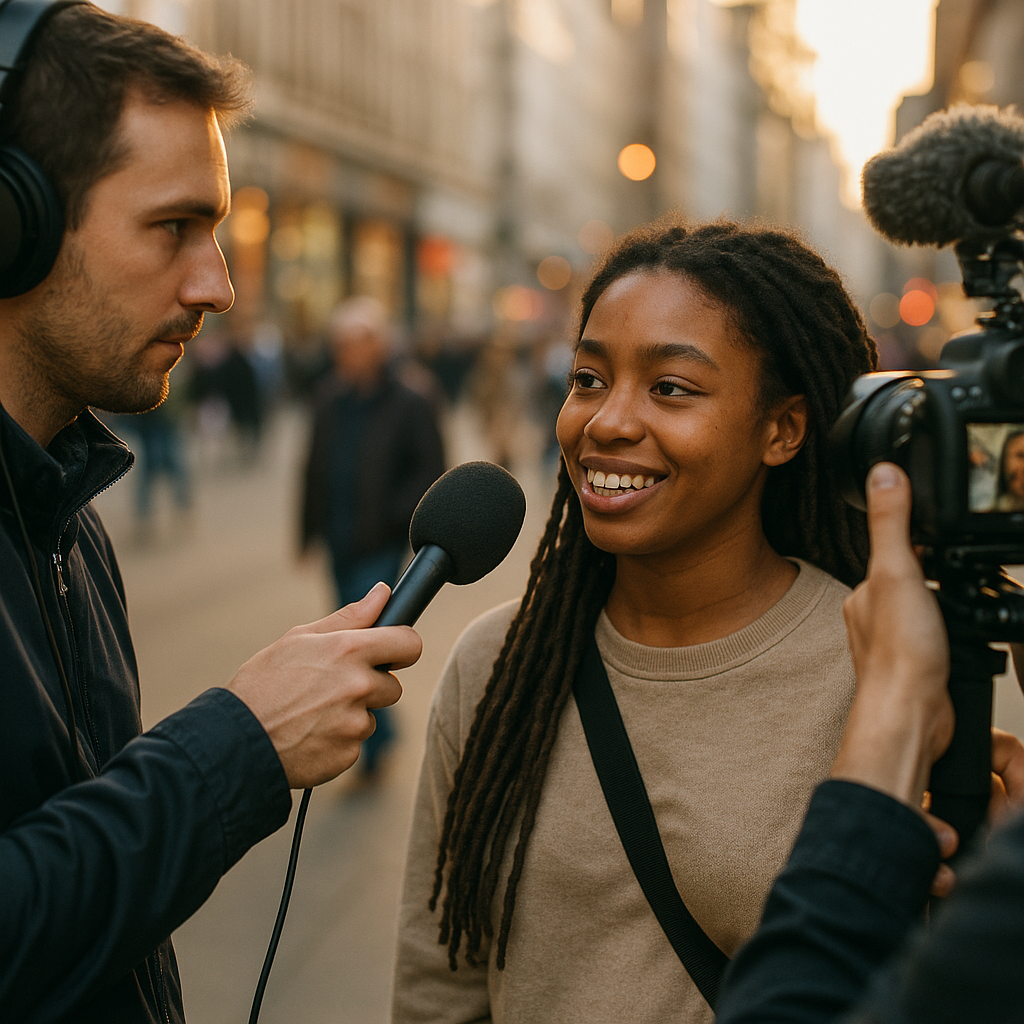
73% of consumers say user-generated content increases their purchase confidence more than branded content, according to Statista research on trust signals. So why do most brands still treat the vox pop street interview format like a chaotic, uncontrollable stunt? Done right, the vox pop street interview format is one of the most cost-efficient ways to manufacture authentic-feeling social proof at volume, without the production budget of a full testimonial shoot.
What Is the Vox Pop Format, Really?
Vox pop, short for “vox populi” or voice of the people, is the street interview style you’ve seen a thousand times on TikTok: a host stops strangers, asks a pointed question, and stitches together their raw reactions. It feels unscripted. It isn’t, not entirely. The best brand-run vox pop content is tightly engineered behind the scenes while preserving the illusion of spontaneity.
That tension, scripted structure wearing the costume of randomness, is exactly why the format converts. Audiences have grown numb to polished testimonials. They trust a stranger on a sidewalk more than a paid actor in a studio, even when both are technically “on brand.”
The vox pop format works because viewers believe they’re watching unfiltered opinion. The moment that illusion cracks, the entire format loses its value as social proof.
Why Brands Are Scaling This Format Now
A few forces are converging. First, CAC keeps climbing across paid social, pushing brands toward lower-cost organic and UGC-style assets that still perform in paid rotation. Second, platforms reward content that looks native. Polished ads get scrolled past; a messy street interview with real reactions earns a longer watch time. Third, agencies have figured out how to productize the format, turning what used to be a one-off stunt into a repeatable content engine with predictable output.
That’s the operational shift worth paying attention to. Vox pop used to be a creative experiment. Now it’s a line item in the content calendar, scripted, briefed, and measured like any other format.
The Economics Make It Attractive
- One shoot day can yield 15 to 30 usable clips from a single location.
- Cost per asset is often a fraction of a full creator brief or studio testimonial.
- Negative or lukewarm responses can be cut or reframed in editing, reducing wasted footage.
- The format travels well across TikTok, Reels, and YouTube Shorts without reformatting.
Compare that to the cost structure of a customer interview shoot, which requires scheduling real clients, legal sign-off, and often a studio setup. Vox pop skips most of that friction because the “cast” is the general public, recruited on the spot.
Scripting the Unscripted: How It Actually Works
Here’s the part most marketers get wrong. They assume vox pop means “no script.” In practice, the script lives in three places: the question design, the host’s prompting behavior, and the edit structure. The actual words a stranger says are unscripted. Everything around them is engineered.
- The hook question. This is the single most important line in the entire format. A flat question like “What do you think of this product?” gets flat answers. A sharper prompt, “What’s the one thing you’d never buy again?”, gets emotional, quotable responses.
- The follow-up ladder. Hosts need a pre-built ladder of follow-ups to push past surface-level answers: “Why though?” “What would change your mind?” “Have you actually tried it?” This is where the real soundbites emerge.
- The edit logic. Decide in advance how you’ll sequence responses: build from skeptical to convinced, or stack agreement for momentum. The edit is where “random” opinion becomes a coherent brand narrative.
This mirrors the logic behind reaction content beat sheets, where the spontaneity is real but the container around it is fully planned. The discipline isn’t about controlling what people say. It’s about controlling the conditions that make good answers likely.
Compliance Is Where Most Programs Fall Apart
Street interviews involve the public. That means consent, likeness rights, and disclosure obligations all apply, and brands routinely underestimate this. If you’re compensating participants, even with a gift card or product, you likely need to disclose that relationship under FTC endorsement guidelines. A release form isn’t optional paperwork, it’s the thing standing between your viral clip and a legal headache.
Build a standard operating procedure before the first shoot:
- Written or recorded verbal consent for every participant, timestamped.
- Clear disclosure language if any incentive is offered, no matter how small.
- A policy for what happens if someone asks to be removed post-publish.
- Guardrails on editing responses so you don’t misrepresent what was said, which creates both legal and trust risk.
A vox pop clip that misquotes or recontextualizes a stranger’s opinion isn’t just an ethical problem. It’s a brand safety liability that can unravel the exact trust the format was built to earn.
Teams already working through disclosure frameworks for other formats, like comparison-style scripts, will recognize the same muscle here. Compliance isn’t a separate department’s problem. It’s a scripting decision made before the camera ever rolls.
Casting the Street: Who You Stop Matters
Random doesn’t mean careless. Smart vox pop programs scout locations and loosely profile who they’re hoping to approach, without scripting responses. A skincare brand targeting Gen Z shoppers isn’t shooting outside a hardware store. A B2B SaaS company running a vox pop at a trade show is fishing for a completely different respondent pool than one filming near a college campus.
This is less about manipulation and more about relevance. You want responses that reflect your actual buyer, not just whoever happened to walk by. Some brands run a quick qualifying question off-camera, “Have you heard of [category]?”, before deciding whether to formally interview someone. That single filter dramatically improves the signal-to-noise ratio in your footage.
Host Selection Changes Everything
The host is the de facto creative director of the shoot. A flat, awkward host kills momentum and makes strangers defensive. A warm, quick-witted host gets people to open up in fifteen seconds. If you’re building this format into an ongoing content engine, invest in host casting the same way you’d invest in creator selection for a nano creator brief. The person asking the questions is doing more creative heavy lifting than the edit.
Measuring What Actually Converts
Vox pop content often performs on softer metrics first, watch time, shares, comment volume, before it shows up in conversion data. That’s fine, but don’t let vanity metrics be the only scoreboard. Track these specifically:
- Hook retention rate in the first three seconds, since this format lives or dies on the opening question.
- Comment sentiment, not just volume, since vox pop content invites debate and disagreement in the comments by design.
- Whitelisted ad performance when the best clips get pushed into paid rotation through creator or brand accounts.
- Assisted conversions attributed to the format versus last-click, since vox pop usually plays a top-of-funnel trust-building role.
According to eMarketer, UGC-style ad formats consistently outperform polished branded creative on cost-per-click benchmarks, which tracks with what most performance teams are already seeing in their own dashboards. Vox pop sits squarely in that UGC-style bucket, even when it’s fully brand-produced.
Where This Format Fits in a Broader Content Mix
Vox pop shouldn’t be your only social proof format. It’s a volume play, fast, cheap, high-output, but it lacks the depth of a dedicated confessional-style testimonial or the narrative arc of long-form customer stories. Think of it as the top layer of a social proof pyramid: wide reach, quick trust signals, and a feeder system that identifies strong opinions worth developing into deeper content later.
Some teams even use vox pop shoots as a scouting tool, if a stranger gives a particularly compelling, articulate answer on camera, that’s a candidate for a follow-up interview or even a myth-busting style explainer later. The street interview becomes a casting call for your next content tier.
FAQs
Vox Pop Street Interview Questions, Answered
Is vox pop content actually scripted?
The participants’ answers are unscripted, but the questions, follow-up prompts, and edit structure are planned in advance. The format blends genuine spontaneity with a controlled creative framework.
Do you need consent from people you film on the street?
Yes. Any usable footage requires documented consent, and if compensation of any kind is offered, FTC disclosure rules likely apply. Skipping this step creates real legal exposure.
How many clips can you get from one vox pop shoot?
A well-run shoot in a high-traffic location typically yields 15 to 30 usable clips in a single day, making it one of the more efficient formats for content volume.
What makes a vox pop hook question effective?
Sharp, specific, slightly provocative questions outperform generic ones. Questions that invite an emotional or opinionated response generate more quotable, shareable soundbites than neutral prompts.
Can vox pop content be used in paid media?
Yes, and it often performs well in paid rotation because it reads as authentic rather than produced. Ensure all usage rights and disclosures are secured before whitelisting any clip for ad spend.
How does vox pop differ from testimonial content?
Testimonials typically feature known customers speaking in depth about a specific experience. Vox pop uses random public opinion for breadth and immediacy, trading depth for scale and speed.
Build a vox pop SOP before your next shoot: locked hook questions, a consent and disclosure checklist, and a host briefed on follow-up prompts. That single document is the difference between a viral clip and a liability.
Top Influencer Marketing Agencies
The leading agencies shaping influencer marketing in 2026
Agencies ranked by campaign performance, client diversity, platform expertise, proven ROI, industry recognition, and client satisfaction. Assessed through verified case studies, reviews, and industry consultations.
Moburst

-
2

The Shelf
Boutique Beauty & Lifestyle Influencer AgencyA data-driven boutique agency specializing exclusively in beauty, wellness, and lifestyle influencer campaigns on Instagram and TikTok. Best for brands already focused on the beauty/personal care space that need curated, aesthetic-driven content.Clients: Pepsi, The Honest Company, Hims, Elf Cosmetics, Pure LeafVisit The Shelf → -
3

Audiencly
Niche Gaming & Esports Influencer AgencyA specialized agency focused exclusively on gaming and esports creators on YouTube, Twitch, and TikTok. Ideal if your campaign is 100% gaming-focused — from game launches to hardware and esports events.Clients: Epic Games, NordVPN, Ubisoft, Wargaming, Tencent GamesVisit Audiencly → -
4

Viral Nation
Global Influencer Marketing & Talent AgencyA dual talent management and marketing agency with proprietary brand safety tools and a global creator network spanning nano-influencers to celebrities across all major platforms.Clients: Meta, Activision Blizzard, Energizer, Aston Martin, WalmartVisit Viral Nation → -
5

The Influencer Marketing Factory
TikTok, Instagram & YouTube CampaignsA full-service agency with strong TikTok expertise, offering end-to-end campaign management from influencer discovery through performance reporting with a focus on platform-native content.Clients: Google, Snapchat, Universal Music, Bumble, YelpVisit TIMF → -
6

NeoReach
Enterprise Analytics & Influencer CampaignsAn enterprise-focused agency combining managed campaigns with a powerful self-service data platform for influencer search, audience analytics, and attribution modeling.Clients: Amazon, Airbnb, Netflix, Honda, The New York TimesVisit NeoReach → -
7

Ubiquitous
Creator-First Marketing PlatformA tech-driven platform combining self-service tools with managed campaign options, emphasizing speed and scalability for brands managing multiple influencer relationships.Clients: Lyft, Disney, Target, American Eagle, NetflixVisit Ubiquitous → -
8

Obviously
Scalable Enterprise Influencer CampaignsA tech-enabled agency built for high-volume campaigns, coordinating hundreds of creators simultaneously with end-to-end logistics, content rights management, and product seeding.Clients: Google, Ulta Beauty, Converse, AmazonVisit Obviously →