


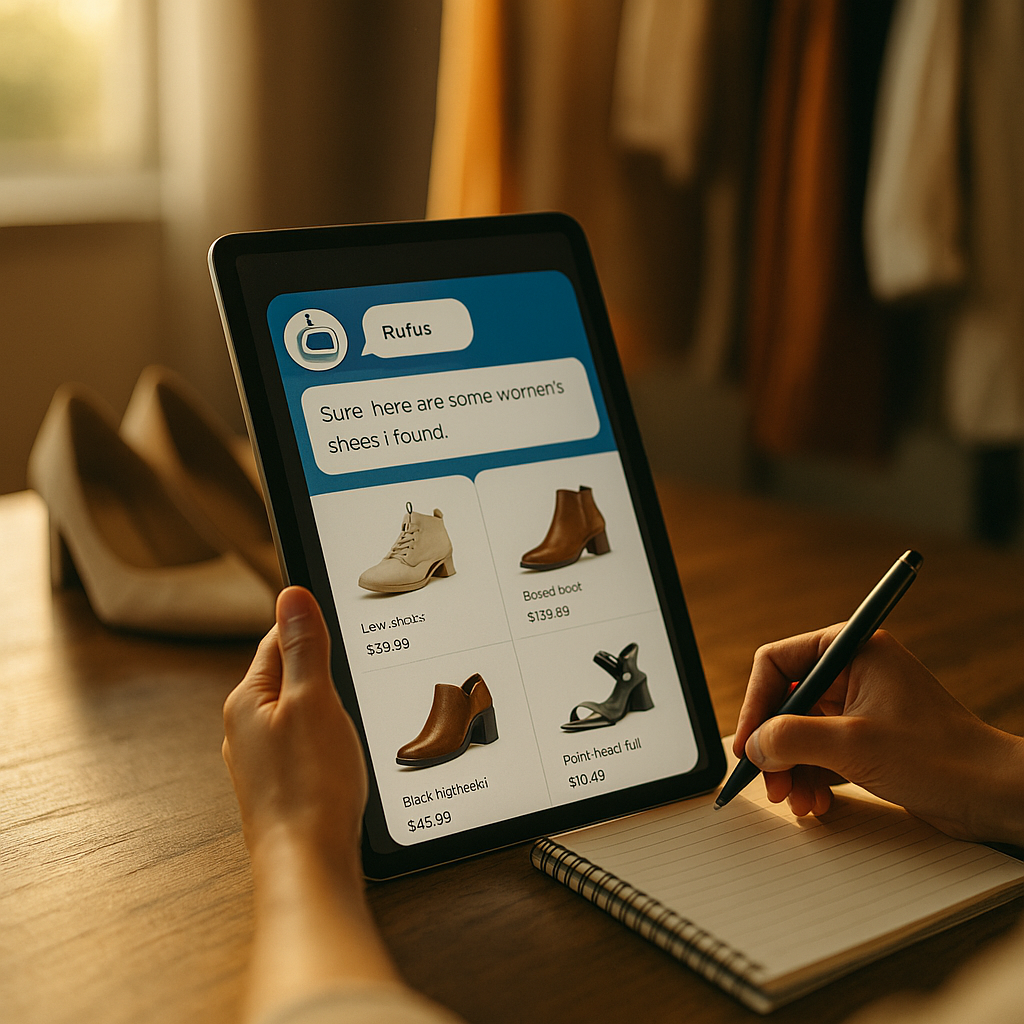
Amazon’s Rufus now answers more than 100 million product questions a week, and ChatGPT’s shopping results pull directly from creator reviews indexed across the web. If your influencer content isn’t structured for machines to parse, it’s invisible to the fastest-growing discovery channel in retail. Scripting creator content that surfaces in AI shopping assistants isn’t a nice-to-have anymore. It’s becoming the difference between a product that gets recommended and one that doesn’t exist.
The Discovery Funnel Just Got a New Gatekeeper
For a decade, brands optimized creator content for engagement: watch time, comments, shares. Those metrics still matter. But a new layer sits on top of them now, and it doesn’t care about your like count. AI shopping assistants like Amazon Rufus, Google’s AI Mode, Perplexity Shopping, and ChatGPT’s commerce features scrape, summarize, and recommend based on how clearly a piece of content answers a question.
Think about what that means operationally. A perfectly produced UGC video with vague captions and no spoken specifics might convert on TikTok but disappear entirely when an AI assistant is deciding which product to recommend for “best running shoes for flat feet.” The assistant isn’t watching the video. It’s reading the transcript, the metadata, the surrounding text, and whatever structured signals it can find.
If an AI assistant can’t extract a clear claim, a clear use case, and a clear outcome from your creator content, it will recommend a competitor’s instead, even if your product is better.
What Are These Assistants Actually Reading?
Large language model shopping tools don’t “watch” video the way a human does. Most rely on transcripts, closed captions, on-page text, product schema, and third-party review aggregation. Some, like Google’s AI Mode, draw on the Shopping Graph alongside crawled web content. Others, like Perplexity, lean heavily on indexed articles and forum discussion that reference specific products by name.
That has a direct implication for scripting: spoken clarity and written clarity now carry equal weight. A creator who says “this cream genuinely fixed my under-eye puffiness in about two weeks” gives the model a parsable claim, a timeframe, and a use case. A creator who says “I’m obsessed, you guys need this” gives it nothing to extract.
Script for Extraction, Not Just Emotion
This doesn’t mean killing the personality or the hook. It means building a script architecture that gives both humans and machines what they need, in the order they need it.
- Name the product and category explicitly in the first 15 seconds. Don’t rely on visual context. Say the brand name, the product name, and what category it solves for.
- State the specific use case out loud. “For combination skin” or “for small kitchens” gives the assistant a searchable attribute to match against user queries.
- Include a comparative or quantified claim. “Lasts twice as long as my old charger” is extractable. “It’s so good” is not.
- Close with a clear outcome statement. Spell out the result, not just the feeling. “My skin looked less red by day three” beats “I love how it made me feel.”
This is the same discipline we’ve recommended for educational micro demo scripts, where specificity drives both trust and findability. The AI shopping layer just raises the stakes.
Structure the Caption Like a Mini FAQ
Video is hard for some assistants to parse directly, but the caption, pinned comment, and accompanying product page text are low-hanging fruit. Write captions as if answering a question a shopper typed into a search bar: “Best budget blender for smoothies under $100?” Then answer it directly in the first line.
This mirrors how we’ve advised teams scripting dupe comparison videos to front-load claims that hold up under scrutiny. The same front-loaded clarity that satisfies FTC review also satisfies a language model looking for a confident, specific answer.
Entity Clarity Is Non-Negotiable
AI assistants match content to products using entities: brand names, model numbers, ingredient lists, SKU-level detail. Vague creator content that never says the exact product name, or that refers to “this little gadget” throughout, simply won’t get matched to a specific listing no matter how good the content is.
Brief creators to repeat the full product name at least twice, once early and once in the recap. It feels repetitive on camera. It’s essential for machine readability. According to eMarketer, a growing share of product discovery now starts with a conversational query rather than a traditional search, which makes exact-match naming more valuable than it’s ever been.
Treat the product name the way you’d treat a hashtag five years ago: say it exactly, say it often, and never assume context will carry it.
Don’t Forget the Negative Case
Good scripts also name who the product isn’t for. “This isn’t for people who want a super matte finish” sounds like a downside, but it’s gold for an AI assistant trying to filter recommendations by user intent. Honest limitations are extractable signals, and they build the kind of credibility that versus format scripts rely on to pass both legal review and audience skepticism.
Where This Breaks: Common Scripting Mistakes
Most brands aren’t failing because their creators are bad. They’re failing because the scripts were written for a 2022 engagement model that no longer reflects how discovery works.
- Vague superlatives instead of specifics. “Game changer” tells an algorithm nothing. “Cut my morning routine from 20 minutes to 8” tells it everything.
- No product name until the final seconds, or not at all. Relying on on-screen text or a product tag isn’t enough if transcripts are the primary data source.
- Captions written as hashtag soup instead of answerable sentences. A caption stuffed with #skincare #glowup gives the model nothing structured to extract.
- No comparison points. Shopping assistants are built to compare. Content that never positions a product against alternatives gets skipped in favor of content that does.
- Inconsistent naming across creators. If five creators call the product five slightly different things, you fragment the entity signal instead of reinforcing it.
Teams building out nano creator briefs at scale should bake a shared naming convention and claim bank into the brief itself, not leave it to individual creator interpretation.
A Quick Brief Checklist
Before you send a script to a creator, check for these five things:
- Full product name stated at least twice
- One quantified or comparative claim
- One explicit use case or audience fit statement
- One honest limitation or “not for” statement
- A caption written as a direct answer to a likely shopper question
This checklist doesn’t replace creative freedom. It’s a floor, not a ceiling. Creators can still bring voice, humor, and format innovation on top of it, the same way we’ve recommended for ASMR unboxing scripts that balance sensory appeal with clear product information.
Measuring Whether It’s Actually Working
Most brands don’t yet have a clean dashboard for “AI shopping assistant visibility.” That’s fine. There are proxy signals you can track today.
- Branded + modifier search volume. Tools like Google Search Console can show whether queries combining your product name with specific attributes (“quietest blender”) are rising after a content push.
- Referral traffic from AI platforms. Google Analytics increasingly segments traffic from AI overviews and chat interfaces as a distinct channel. Watch it the way you’d watch organic search in its early days.
- Manual spot checks. Literally ask ChatGPT, Perplexity, and Google’s AI Mode your target queries once a week and see whether your product shows up, and whose language it’s echoing back.
- Review and UGC indexation. Check whether your creator content is being cited or summarized in assistant answers, not just ranking in traditional search.
Platforms like Sprout Social and HubSpot are starting to build AI-referral tracking into their reporting suites, which is worth watching as this space matures through the year.
Compliance Still Applies Here
None of this changes disclosure requirements. If anything, AI summarization makes clean, visible disclosure more important, since assistants may strip visual cues like on-screen tags. Keep spoken and written disclosure explicit, in line with FTC endorsement guidance, so the compliance signal survives even when a platform repackages your content into a summary.
Start by rewriting one high-performing creator script with explicit naming, one quantified claim, and one honest limitation, then track whether it starts showing up in AI shopping answers within a few weeks. Small, specific edits to existing winners will teach you more than a full creative overhaul.
Frequently Asked Questions
What makes creator content visible to AI shopping assistants?
Clear, specific language that names the product, states a use case, and includes a quantified or comparative claim. Assistants extract text and transcripts, so vague emotional language without specifics is far less likely to be surfaced.
Do AI shopping assistants actually watch creator videos?
Most don’t process raw video. They rely on transcripts, captions, on-page text, and structured product data, which means spoken and written clarity matter more than visual production quality for discoverability purposes.
Does this replace traditional influencer marketing metrics?
No. Engagement, conversion, and reach still matter for campaign performance. AI shopping visibility is an additional layer to optimize for, not a replacement for existing KPIs.
How many times should a creator say the product name in a script?
At least twice, once early in the content and once in a closing recap, using the exact full product name consistently across every creator involved in a campaign.
Does FTC disclosure guidance change for AI-surfaced content?
The underlying rules don’t change, but disclosure needs to be explicit in both speech and on-screen text, since AI summarization may strip visual-only cues when repackaging content into an answer.
Top Influencer Marketing Agencies
The leading agencies shaping influencer marketing in 2026
Agencies ranked by campaign performance, client diversity, platform expertise, proven ROI, industry recognition, and client satisfaction. Assessed through verified case studies, reviews, and industry consultations.
Moburst

-
2

The Shelf
Boutique Beauty & Lifestyle Influencer AgencyA data-driven boutique agency specializing exclusively in beauty, wellness, and lifestyle influencer campaigns on Instagram and TikTok. Best for brands already focused on the beauty/personal care space that need curated, aesthetic-driven content.Clients: Pepsi, The Honest Company, Hims, Elf Cosmetics, Pure LeafVisit The Shelf → -
3

Audiencly
Niche Gaming & Esports Influencer AgencyA specialized agency focused exclusively on gaming and esports creators on YouTube, Twitch, and TikTok. Ideal if your campaign is 100% gaming-focused — from game launches to hardware and esports events.Clients: Epic Games, NordVPN, Ubisoft, Wargaming, Tencent GamesVisit Audiencly → -
4

Viral Nation
Global Influencer Marketing & Talent AgencyA dual talent management and marketing agency with proprietary brand safety tools and a global creator network spanning nano-influencers to celebrities across all major platforms.Clients: Meta, Activision Blizzard, Energizer, Aston Martin, WalmartVisit Viral Nation → -
5

The Influencer Marketing Factory
TikTok, Instagram & YouTube CampaignsA full-service agency with strong TikTok expertise, offering end-to-end campaign management from influencer discovery through performance reporting with a focus on platform-native content.Clients: Google, Snapchat, Universal Music, Bumble, YelpVisit TIMF → -
6

NeoReach
Enterprise Analytics & Influencer CampaignsAn enterprise-focused agency combining managed campaigns with a powerful self-service data platform for influencer search, audience analytics, and attribution modeling.Clients: Amazon, Airbnb, Netflix, Honda, The New York TimesVisit NeoReach → -
7

Ubiquitous
Creator-First Marketing PlatformA tech-driven platform combining self-service tools with managed campaign options, emphasizing speed and scalability for brands managing multiple influencer relationships.Clients: Lyft, Disney, Target, American Eagle, NetflixVisit Ubiquitous → -
8

Obviously
Scalable Enterprise Influencer CampaignsA tech-enabled agency built for high-volume campaigns, coordinating hundreds of creators simultaneously with end-to-end logistics, content rights management, and product seeding.Clients: Google, Ulta Beauty, Converse, AmazonVisit Obviously →