


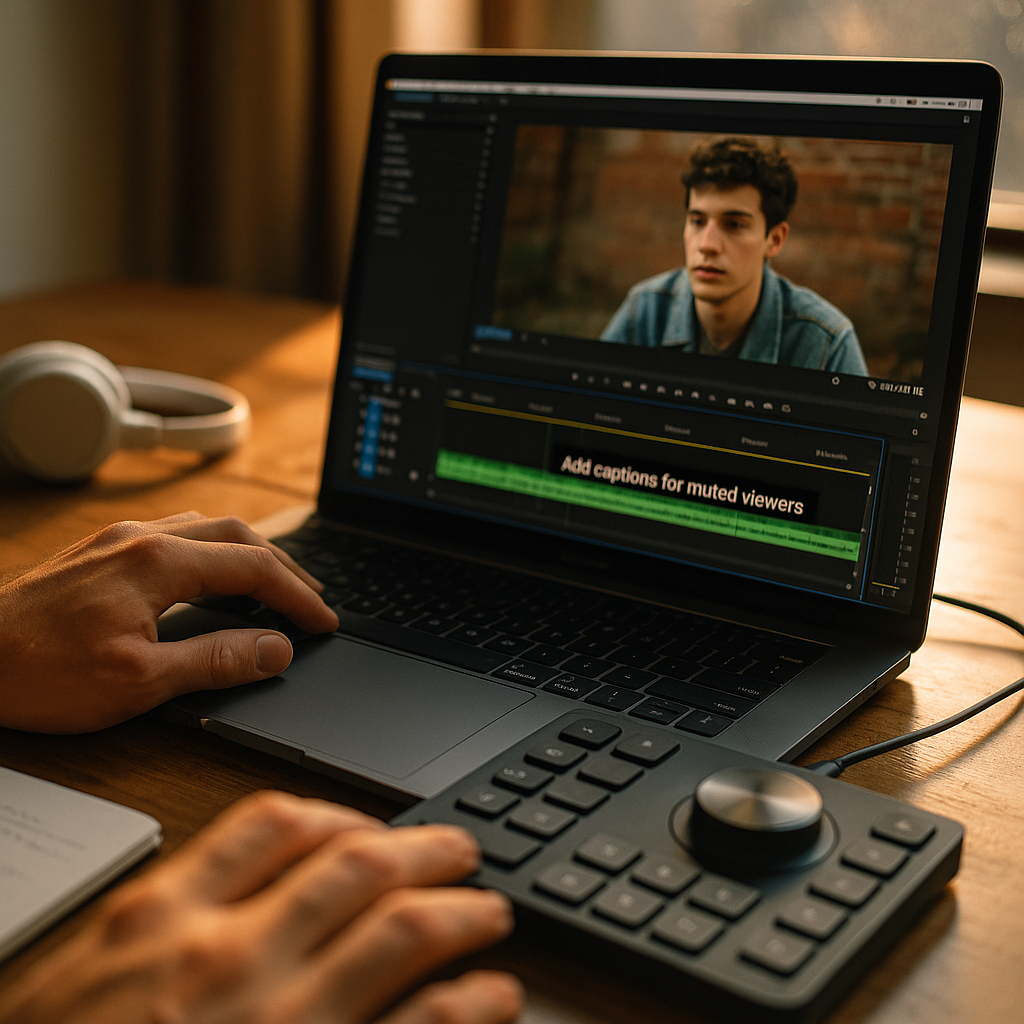
Up to 85% of video views on Facebook and a huge share of Instagram and TikTok traffic happen with the sound off. If your scripts still treat captions as an afterthought, you are losing the message before it ever lands. Silent-first video editing flips the production order: you write for the eye first, the ear second. For brands running paid social at scale, that single shift can be the difference between a scroll-past and a saved, shared, or purchased moment.
This isn’t a design trick. It’s a scripting discipline. And most brand teams are still doing it backward.
Why Sound Off Is the Default, Not the Exception
Think about where your audience actually watches. Office breaks, commutes, waiting rooms, bed at midnight next to a sleeping partner. Sound is a liability in most of those contexts, not a feature. Meta has long reported that the overwhelming majority of video impressions on its feed happen muted, and social platform behavior data consistently backs this up across TikTok and LinkedIn too.
LinkedIn video, in particular, skews heavily toward silent consumption because people watch it at work. If your B2B thought leadership clip relies on a voiceover to deliver the hook, you’ve already lost half your potential reach before the algorithm even gets a fair shot at amplifying it.
If your video’s core message only exists in the audio track, you’ve built a campaign for the minority of viewers who happen to have earbuds in.
The Scripting Mistake Most Teams Make
Here’s the pattern we see constantly in creative reviews: a script gets written as a voiceover document, handed to an editor, and then captions get bolted on afterward using auto-transcription. The result reads like a transcript, not a message. Auto-captions follow speech rhythm, not visual rhythm. They break lines mid-thought, bury the hook in a wall of text, and treat every sentence with equal visual weight.
Silent-first scripting reverses the workflow. You write the caption copy as the primary layer and treat spoken audio as a supporting enhancement, not the load-bearing wall. That means thinking in short visual bursts, not spoken paragraphs, from the first draft.
This matters even more as AI-generated and AI-assisted content scales. If you’re already structuring assets for machine readability (see our breakdown on structuring content for AI assistants), applying that same discipline to human caption scanning is a natural extension, not an extra step.
How Do You Script for a Muted Viewer?
Start with the assumption that the viewer will never hear a word. If the message survives that constraint, sound becomes a bonus layer that deepens engagement for the smaller audience that does have volume on. Here’s the practical framework we recommend to creative teams:
- Hook in text, not just visuals. Your first on-screen caption line needs to carry the thesis of the video within the first two seconds. Don’t wait for a spoken setup to justify the text.
- One idea per caption card. Resist the urge to cram a full sentence onto screen. Break thoughts into digestible fragments that match natural eye-scan speed, roughly 2-3 words per visual beat for fast cuts, slightly longer for static shots.
- Use visual punctuation. Bold key words, change text color for emphasis, or use scale shifts to mimic vocal inflection. The eye needs the equivalent of tone of voice.
- Design for the thumbnail freeze. Platforms often show a static frame before autoplay. If that frame includes a caption fragment, make sure it’s compelling on its own.
- Build pattern interrupts into the text track. Just as audio needs pacing changes to hold attention, your caption rhythm needs variation, short burst, short burst, then a slightly longer explanatory line.
Once the silent cut works on its own, layer in audio as reinforcement. Sound effects, music swells, and voiceover now add texture rather than carrying the entire narrative burden.
Captions as a Conversion Tool, Not a Compliance Checkbox
Too many brands still treat captions as an accessibility requirement handled by a plugin at the final export stage. That’s a missed opportunity. Accessibility matters, full stop, and it’s the right thing to do. But captions scripted with intention also drive measurable commercial outcomes: longer watch time, higher completion rates, and more saves.
HubSpot’s research on video marketing performance has repeatedly found that caption presence correlates with longer average view duration across paid and organic placements. When captions are scripted well rather than auto-generated, that lift tends to be even more pronounced because the pacing matches viewer attention span instead of speech cadence.
There’s also a brand safety angle worth flagging to legal and compliance teams. A silent-first script forces every claim to be visible on screen, which makes it far easier to review for accuracy before a video ships. That same discipline is exactly what teams use when preparing comparison claims for regulatory review, where every assertion needs to hold up without relying on tone or context from spoken delivery.
Where This Changes Your Production Workflow
Silent-first editing isn’t just a scripting tweak, it reshapes how creative briefs get written and how editors are briefed. A few operational shifts worth making:
- Write the caption script before the shot list. Treat the text track as the spine of the video. Everything else, b-roll, voiceover, music, gets built around it.
- Review cuts muted first. Make silent playback a mandatory step in your approval workflow, before anyone evaluates the version with sound. If the muted cut doesn’t land, no voiceover will save it.
- Standardize caption templates across creators. If you’re running nano or micro creator programs, give them a text hierarchy template rather than leaving caption placement to guesswork. This keeps brand consistency across dozens of UGC assets, similar to the structured approach used in nano creator briefing frameworks.
- Budget extra editing time for text pacing. Caption timing adjustments often take longer than people expect. Build that into production timelines rather than treating it as a quick fix at the end.
This reordering also pays off when content gets repurposed. A video scripted silent-first tends to clip more cleanly into shorter assets because each caption beat already functions as a standalone unit, an approach that overlaps with what we cover in designing clip-ready shoots.
Testing and Measuring the Silent Cut
Don’t just assume your captions work. Test the muted version against a voiceover-reliant control and track completion rate, three-second view rate, and save rate specifically. Most ad platforms, including TikTok Ads Manager, let you segment performance data enough to spot whether muted impressions are dragging down your overall metrics.
If you see a sharp drop-off in the first two seconds on placements known for muted autoplay (Facebook feed, Instagram Reels discovery), that’s a strong signal your hook isn’t surviving without sound. Run an A/B test where the only variable is caption hook strength. You’ll often find the “silent” version outperforms the control even among viewers who have sound on, because the text reinforces comprehension rather than competing with it.
FAQs
Does silent-first editing mean I should remove voiceover entirely?
No. It means the video should work without sound as a baseline, then audio layers on top to add depth for viewers who do have sound enabled. Voiceover and music still matter, they just stop being the only vehicle for your message.
How long should caption text stay on screen?
A common benchmark is roughly one second per three to four words for short phrases, slightly longer for text that requires more processing time. Test with real viewers rather than relying purely on a formula, since reading speed varies by platform context and audience.
Do auto-generated captions hurt performance compared to scripted ones?
Auto-captions follow speech timing, not visual rhythm, so they often create awkward line breaks and uneven pacing. Scripted captions written with silent viewing in mind tend to produce cleaner hooks and better retention, especially in the first few seconds.
Which platforms benefit most from silent-first scripting?
Facebook and Instagram feed placements see the heaviest muted viewing, followed closely by LinkedIn given its workplace viewing context. TikTok viewers are more likely to have sound on, but silent-first scripting still improves accessibility and comprehension there too.
How does this affect accessibility compliance?
Well-scripted captions naturally support accessibility standards because they prioritize clarity and pacing over literal transcription. It’s worth checking platform-specific accessibility guidance through resources like Google’s support documentation to confirm you’re meeting technical requirements alongside the creative ones.
FAQPage Schema
Start your next review by muting the cut before you watch it with sound. If the message doesn’t survive silence, no voiceover is going to save the budget behind it.
Top Influencer Marketing Agencies
The leading agencies shaping influencer marketing in 2026
Agencies ranked by campaign performance, client diversity, platform expertise, proven ROI, industry recognition, and client satisfaction. Assessed through verified case studies, reviews, and industry consultations.
Moburst

-
2

The Shelf
Boutique Beauty & Lifestyle Influencer AgencyA data-driven boutique agency specializing exclusively in beauty, wellness, and lifestyle influencer campaigns on Instagram and TikTok. Best for brands already focused on the beauty/personal care space that need curated, aesthetic-driven content.Clients: Pepsi, The Honest Company, Hims, Elf Cosmetics, Pure LeafVisit The Shelf → -
3

Audiencly
Niche Gaming & Esports Influencer AgencyA specialized agency focused exclusively on gaming and esports creators on YouTube, Twitch, and TikTok. Ideal if your campaign is 100% gaming-focused — from game launches to hardware and esports events.Clients: Epic Games, NordVPN, Ubisoft, Wargaming, Tencent GamesVisit Audiencly → -
4

Viral Nation
Global Influencer Marketing & Talent AgencyA dual talent management and marketing agency with proprietary brand safety tools and a global creator network spanning nano-influencers to celebrities across all major platforms.Clients: Meta, Activision Blizzard, Energizer, Aston Martin, WalmartVisit Viral Nation → -
5

The Influencer Marketing Factory
TikTok, Instagram & YouTube CampaignsA full-service agency with strong TikTok expertise, offering end-to-end campaign management from influencer discovery through performance reporting with a focus on platform-native content.Clients: Google, Snapchat, Universal Music, Bumble, YelpVisit TIMF → -
6

NeoReach
Enterprise Analytics & Influencer CampaignsAn enterprise-focused agency combining managed campaigns with a powerful self-service data platform for influencer search, audience analytics, and attribution modeling.Clients: Amazon, Airbnb, Netflix, Honda, The New York TimesVisit NeoReach → -
7

Ubiquitous
Creator-First Marketing PlatformA tech-driven platform combining self-service tools with managed campaign options, emphasizing speed and scalability for brands managing multiple influencer relationships.Clients: Lyft, Disney, Target, American Eagle, NetflixVisit Ubiquitous → -
8

Obviously
Scalable Enterprise Influencer CampaignsA tech-enabled agency built for high-volume campaigns, coordinating hundreds of creators simultaneously with end-to-end logistics, content rights management, and product seeding.Clients: Google, Ulta Beauty, Converse, AmazonVisit Obviously →