


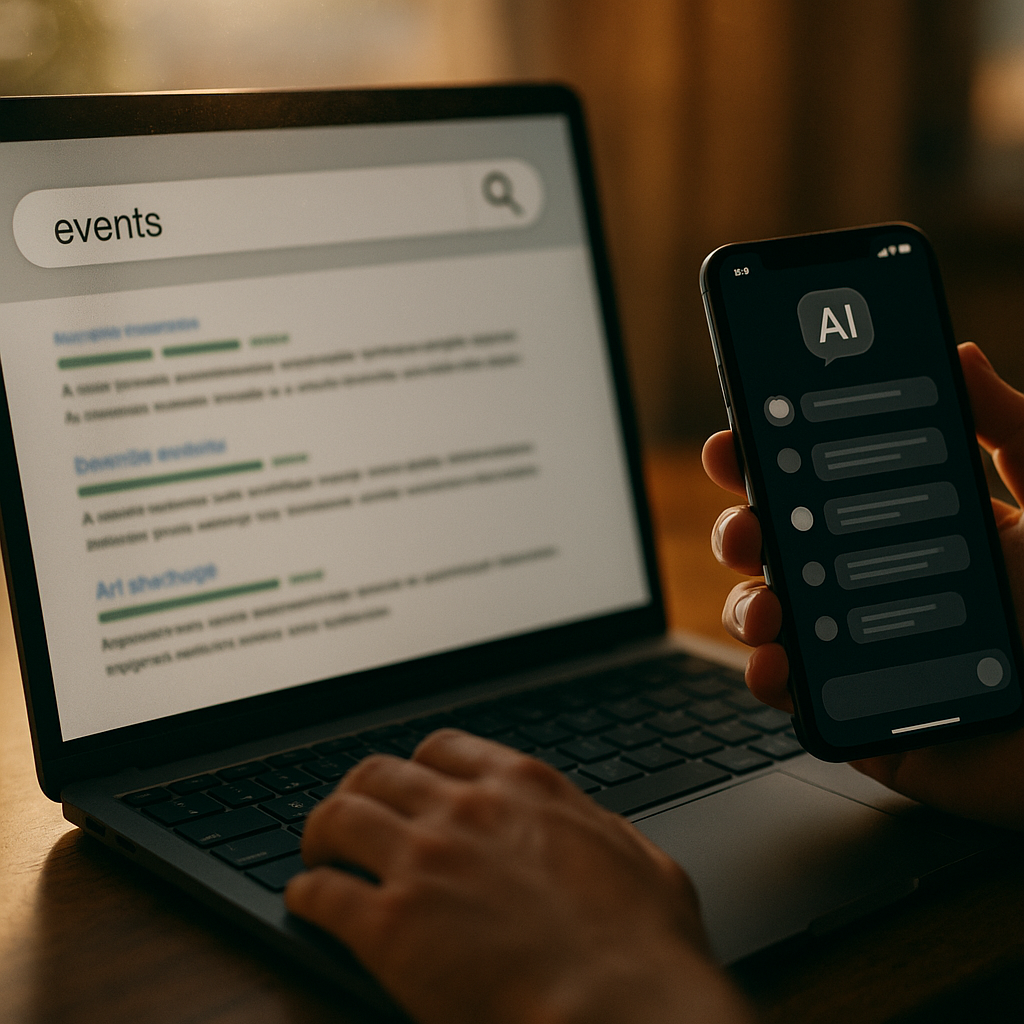
Sixty percent of Google searches now end without a single click to a website. That statistic alone explains why a conference called Zero Click London sold out its first run and why a wave of copycat events is now crowding the marketing calendar. If your SEO team still measures success in blue links and organic sessions, you are optimizing for a search experience that is quietly disappearing.
Zero Click London is not just another marketing summit with a trendy name. It is a symptom of a bigger structural shift: AI Overviews, ChatGPT, Perplexity, and Google’s own generative search features are rewriting how brands get discovered. And marketers are realizing that the playbooks they learned at Brighton SEO or MozCon do not translate cleanly to a world where the “answer” is the destination, not the website.
What Zero Click London Actually Is
Zero Click London launched as a one-day, practitioner-led event focused entirely on how brands show up (or fail to show up) inside AI-generated answers. No keynote fluff about “the future of search” in the abstract. Sessions covered structured data for large language models, how citation patterns work inside AI Overviews, and why some brands get quoted by name while competitors with stronger domain authority get ignored entirely.
The event drew SEO leads, content strategists, and increasingly, influencer and brand marketing teams who have realized that AI search tools cite creator content more often than branded copy. That crossover audience is new. Traditional search conferences rarely had a seat for influencer marketers. Now they are showing up because the data demands it.
When AI Overviews pull from Reddit threads, YouTube reviews, and creator blog posts more than brand landing pages, search marketing and influencer marketing stop being separate disciplines.
Our own coverage of this shift, AI Overviews Cite Creators, Not Brand Copy, Budgets Follow, found that brands are reallocating content budgets toward creator-produced material specifically because it performs better inside generative answers. That is the exact tension Zero Click London was built to address.
Why the Old Conference Model Stopped Working
Marketing conferences have always been slow to specialize. For years, “SEO” sessions at general marketing events amounted to a single panel squeezed between a keynote on brand purpose and a workshop on TikTok trends. That worked fine when search was a stable, well-understood channel.
It stopped working the moment Google started answering questions directly on the results page. Suddenly the skillset required to win in search looked nothing like the skillset required five years earlier. Technical SEO teams needed to understand large language model training data. Content teams needed to think about citation-worthiness, not just keyword density. And brand marketers needed to understand that a creator’s YouTube review might carry more weight in an AI answer than the brand’s own product page.
Generalist marketing conferences could not keep pace. A single track on “search” could not cover entity optimization, AI citation strategy, structured data, and creator content sourcing in a 45-minute slot. Dedicated events filled the gap, and Zero Click London became the proof of concept that practitioners would pay for depth over breadth.
This mirrors a pattern we have tracked elsewhere in the industry. As Enterprise AI Budgets Hit Two Thirds, Creator Funds Shrink noted, large organizations are pouring money into AI tooling and training faster than they are building the internal expertise to use it well. Specialized events are one way teams try to close that gap without waiting a full budget cycle for formal training programs.
What Brands Actually Need From These Events
Not every AI-search conference is worth the airfare. Before booking a ticket, marketing leaders should ask what specific operational problem the event solves. The useful ones tend to deliver on a few fronts:
- Citation mechanics: concrete frameworks for how AI tools select and attribute sources, not vague trend commentary.
- Measurement models: ways to track visibility and influence when there is no click to measure, since standard analytics platforms were not built for this.
- Cross-functional alignment: sessions that bring SEO, content, PR, and influencer teams into the same room, because AI search blurs those silos by design.
- Vendor transparency: honest demos from tools claiming to track “AI search rank,” many of which are still immature and inconsistent.
If an event cannot answer “how do we measure this” with something more specific than “share of voice,” it is probably trend-chasing rather than teaching. That distinction matters more now than ever, because budgets for these programs are not unlimited and finance teams are asking harder questions about attribution. Our piece on Signal Loss Makes Targeting Harder Than Buying Reach covers a parallel problem: marketers investing in channels where the measurement infrastructure has not caught up to the spend.
The FOMO Risk Is Real, and It Is Expensive
Here is the uncomfortable part. A lot of the AI-search event boom is being fueled by fear of missing out rather than clear ROI cases. Ticket prices for these niche summits often run higher than general marketing conferences, partly because organizers know demand currently outstrips supply, and partly because the content genuinely requires rarer expertise to produce.
Marketing leaders approving travel and training budgets should treat these events the way they would treat any other line item: with a clear expected outcome. Did the team come back with an actionable framework, a vendor shortlist, or a measurement approach they can pilot in the next quarter? Or did they come back with forty slide decks of inspiration and no plan?
This is not a reason to avoid these events. It is a reason to be disciplined about which ones earn a seat on the calendar. Given that 71 Percent of Brands Plan Creator Budget Increases Again, the pressure to justify every dollar, including training and conference spend, is only going up. Treat conference budgets with the same rigor you’d apply to a media buy.
How This Connects to Influencer and Creator Strategy
It would be a mistake to file Zero Click London under “pure SEO” and move on. The entire premise of AI-search marketing events is that search and creator content have merged into the same discipline. AI tools do not distinguish between a brand’s owned content and a creator’s independent review when deciding what to cite. If anything, they tend to favor the latter, because it reads as more authentic and less promotional.
That has direct implications for how brands brief creators. A sponsored post optimized purely for Instagram engagement is not the same asset as a long-form YouTube review structured to answer specific buyer questions, the kind of content AI search tools are more likely to surface. Teams that understand this distinction are starting to brief creators with AI citation potential in mind, not just reach and engagement.
It also changes how agencies pitch measurement. Traditional influencer reporting leans on impressions, engagement rate, and link clicks, metrics that assume a visible, trackable user journey. When the “conversion” is an AI chatbot citing a creator’s video as a source, that journey disappears from standard dashboards entirely. Brands are having to invent new visibility metrics almost from scratch, which is exactly the kind of problem dedicated AI-search events are trying to solve with shared frameworks and benchmarks.
For a broader view of how attribution gaps are reshaping budget conversations across the creator economy, see Agentic AI Pilots Stall at 11 Percent, Budgets Pay the Price, which documents how unproven AI measurement tools are stalling broader adoption despite strong executive interest.
Should Your Team Go? A Quick Gut Check
Before committing budget to Zero Click London or one of its growing number of competitors, ask three questions internally. First, does anyone on the team currently own AI search visibility as a measurable KPI? If not, a conference will not create that ownership for you. Second, has your content or influencer team already noticed shifts in referral traffic or brand mentions tied to AI tools? If the data is already moving, the event has a concrete problem to solve. Third, can the attendee realistically implement what they learn within one or two quarters, given current tooling and team capacity?
Industry research from firms like eMarketer and Statista continues to track the decline in traditional organic click-through rates, which is useful context to bring into any budget conversation with finance. Pairing that external data with internal analytics, including Google’s own guidance through Google Search Central, gives marketing leaders a stronger case for (or against) investing in specialized training.
Visible FAQ
Frequently Asked Questions
What is Zero Click London?
Zero Click London is a specialized marketing event focused on how brands gain visibility inside AI-generated search answers, covering topics like citation mechanics, structured data, and content strategy for tools such as AI Overviews, ChatGPT, and Perplexity.
Why are dedicated AI-search marketing events becoming more common?
Traditional marketing and SEO conferences struggle to cover the technical depth AI search requires. As generative search tools change how content gets surfaced and cited, practitioners are seeking focused events that address measurement, strategy, and tooling specific to this shift.
How does AI search affect influencer marketing specifically?
AI search tools frequently cite creator content, such as YouTube reviews and independent blog posts, over branded copy because it reads as more authentic. This is pushing brands to brief creators with AI citation potential in mind, not just engagement metrics.
Is it worth sending a marketing team to an AI-search focused conference?
It depends on whether the team has a concrete problem to solve, such as owning AI visibility as a KPI or responding to shifts in referral traffic. Attend if there’s a clear plan to implement learnings within a quarter or two, not simply to stay current on trends.
How should brands measure success in a zero-click search environment?
Since standard click-based analytics do not capture AI citation visibility, brands need new metrics such as brand mention frequency in AI answers, share of citations relative to competitors, and tracking which content formats get referenced most often.
FAQPage Schema
Next step: Audit whether your brand or your creators’ content currently shows up in AI Overviews or ChatGPT answers for your top ten commercial search terms. If the answer is “we don’t know,” that gap, not the next conference ticket, is where your next budget cycle should start.
Top Influencer Marketing Agencies
The leading agencies shaping influencer marketing in 2026
Agencies ranked by campaign performance, client diversity, platform expertise, proven ROI, industry recognition, and client satisfaction. Assessed through verified case studies, reviews, and industry consultations.
Moburst

-
2

The Shelf
Boutique Beauty & Lifestyle Influencer AgencyA data-driven boutique agency specializing exclusively in beauty, wellness, and lifestyle influencer campaigns on Instagram and TikTok. Best for brands already focused on the beauty/personal care space that need curated, aesthetic-driven content.Clients: Pepsi, The Honest Company, Hims, Elf Cosmetics, Pure LeafVisit The Shelf → -
3

Audiencly
Niche Gaming & Esports Influencer AgencyA specialized agency focused exclusively on gaming and esports creators on YouTube, Twitch, and TikTok. Ideal if your campaign is 100% gaming-focused — from game launches to hardware and esports events.Clients: Epic Games, NordVPN, Ubisoft, Wargaming, Tencent GamesVisit Audiencly → -
4

Viral Nation
Global Influencer Marketing & Talent AgencyA dual talent management and marketing agency with proprietary brand safety tools and a global creator network spanning nano-influencers to celebrities across all major platforms.Clients: Meta, Activision Blizzard, Energizer, Aston Martin, WalmartVisit Viral Nation → -
5

The Influencer Marketing Factory
TikTok, Instagram & YouTube CampaignsA full-service agency with strong TikTok expertise, offering end-to-end campaign management from influencer discovery through performance reporting with a focus on platform-native content.Clients: Google, Snapchat, Universal Music, Bumble, YelpVisit TIMF → -
6

NeoReach
Enterprise Analytics & Influencer CampaignsAn enterprise-focused agency combining managed campaigns with a powerful self-service data platform for influencer search, audience analytics, and attribution modeling.Clients: Amazon, Airbnb, Netflix, Honda, The New York TimesVisit NeoReach → -
7

Ubiquitous
Creator-First Marketing PlatformA tech-driven platform combining self-service tools with managed campaign options, emphasizing speed and scalability for brands managing multiple influencer relationships.Clients: Lyft, Disney, Target, American Eagle, NetflixVisit Ubiquitous → -
8

Obviously
Scalable Enterprise Influencer CampaignsA tech-enabled agency built for high-volume campaigns, coordinating hundreds of creators simultaneously with end-to-end logistics, content rights management, and product seeding.Clients: Google, Ulta Beauty, Converse, AmazonVisit Obviously →