


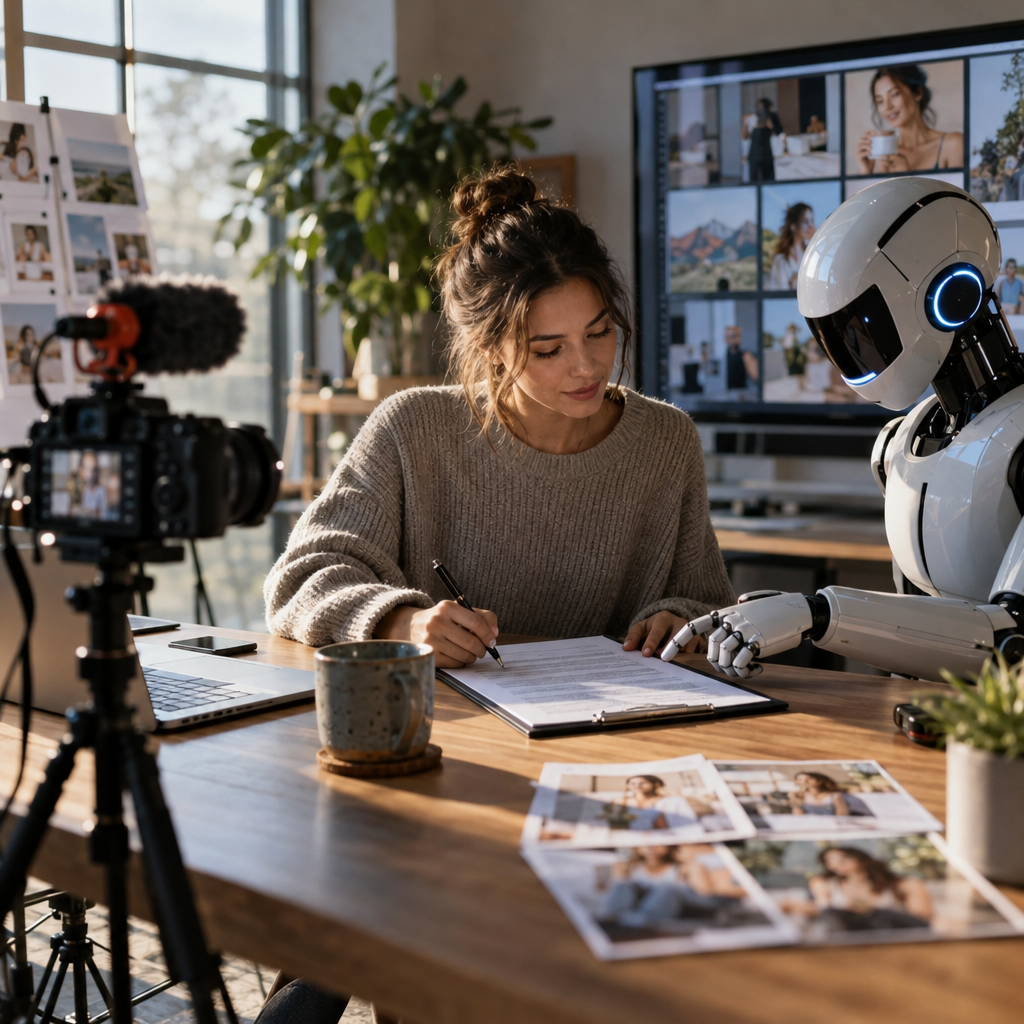
One in three brands using AI tools to generate or edit UGC has no contract language covering who owns the output. That gap isn’t theoretical anymore. As AI-assisted UGC contracts become standard practice for creator deals, legal teams are discovering that generic influencer agreements were never built for synthetic voices, machine translation, or infinite reuse loops. Get the clauses wrong and you don’t just risk a lawsuit. You risk losing the asset entirely.
Why AI Changes the Contract Math
Traditional UGC agreements assumed a simple chain: a creator films something, a brand licenses it, both sides agree on a usage window. AI breaks that chain in three places. First, tools like Synthesia, HeyGen, and Captions can alter a creator’s face, voice, or likeness after the fact, raising questions about consent scope. Second, generative editing means the “final” asset might not match what the creator actually approved. Third, AI-powered localization lets brands spin one piece of content into a dozen language variants without ever re-contacting the original talent.
Each of these shifts moves risk onto the brand if the contract doesn’t explicitly address it. A 2024 Influencer Marketing Hub survey found that brand spend on creator content continues to climb year over year, yet legal review processes for that content have barely evolved. That mismatch is exactly where disputes start.
If your contract is silent on AI modification, courts and arbitrators will typically read that silence against the party that drafted the agreement, which is usually the brand or agency.
Rights Clauses: Define the Machine’s Role Explicitly
Standard “all rights” language doesn’t cut it anymore. You need clauses that specifically name AI processes, not just outcomes. Consider separating three distinct rights buckets:
- Capture rights: permission to record the creator’s raw likeness, voice, and performance.
- Transformation rights: explicit consent for AI tools to edit, enhance, dub, or synthesize elements of that capture.
- Derivative rights: ownership of AI-generated variants (translated cuts, resized formats, voice clones) that didn’t exist in the original take.
Without that third bucket, you own the original video but may not legally own the twelve AI-translated spinoffs your team made from it. That’s a real problem when a creator’s agent later claims the Spanish-dubbed version constitutes an unauthorized derivative work.
This is closely related to the ownership confusion already surfacing in fully synthetic content deals. If you haven’t read our breakdown on who owns AI-generated affiliate content, it’s worth reviewing before you draft anything new. The same ownership ambiguity applies even when a human creator is the starting point and AI only touches the edit.
Specify the Tools, Not Just the Category
Vague phrases like “brand may use artificial intelligence to edit the content” invite disputes. Name the actual function: voice cloning, face swapping, background generation, auto-dubbing, script rewriting. Creators and their reps increasingly want to know exactly what AI can and cannot do to their likeness, and regulators are paying attention too. The FTC’s ongoing guidance on endorsement and testimonial rules already treats manipulated representations as a disclosure issue, which means your contract language and your public-facing disclosure strategy need to match.
Reuse Clauses: Where Most Brands Get Burned
Reuse is the clause that generates the most post-campaign legal tickets, full stop. Here’s why: AI makes reuse frictionless. A brand can take a single UGC clip, generate ten platform-specific cuts, run them through an AI resizing tool for Stories, Reels, and Shorts, and push paid spend behind variants the creator never saw. If your contract caps “usage” at a single platform or a single edit, you’re now in breach the moment AI starts multiplying that content.
Smart reuse clauses in 2026 define usage by three variables instead of one:
- Volume: how many AI-generated variants are permitted per original asset.
- Channel: organic social, paid media, retail media networks, email, out-of-home.
- Duration: a hard expiration date, with explicit renewal or buyout terms for extensions.
Buyout structures have already shifted in other parts of the industry, and the same logic applies here. Our piece on usage rights buyouts covers how rate spikes during peak seasons are pushing brands toward flat buyout fees instead of per-use billing. AI-assisted reuse should follow the same model: pay once for a defined bundle of AI variants, rather than negotiating creator approval for every single output.
Treat AI-generated variants as a volume, not a loophole. If your contract doesn’t cap it, your production team will eventually test the limit.
Cross-platform whitelisting adds another wrinkle. Paid amplification through a creator’s handle, especially when AI tools auto-generate ad variants for testing, needs its own line item. We’ve covered the mechanics of this in cross-platform whitelisting tools, and the same principle holds: whitelisting rights and AI-variant rights are not the same grant, even if they feel adjacent.
Translation Clauses: The Clause Everyone Forgets
Here’s a question most legal teams haven’t asked: does your creator agreement cover the right to translate dialogue into another language using AI dubbing? Probably not, because two years ago that capability barely existed at scale. Now tools like ElevenLabs and HeyGen can produce lip-synced, voice-matched translations in minutes, and global brands are using them to turn one US creator shoot into a dozen localized ad sets.
Translation isn’t neutral. A joke that lands in English might not land in German. A tone that reads as confident in one market might read as aggressive in another. The creator’s original performance carries nuance that AI translation can flatten or distort, and if the creator’s reputation gets tied to a version of themselves speaking words they never approved in a language they don’t speak, that’s a real liability.
Translation clauses should cover:
- Which languages are pre-approved versus requiring separate sign-off.
- Whether the creator gets review rights over the translated script before dubbing.
- Whether voice cloning for dubbing requires a separate, explicit consent beyond the general AI transformation clause.
- Compensation structure for each additional language market activated.
This matters even more in regulated categories. If you’re running health, finance, or gambling content across markets, translation errors compound existing compliance exposure. Our coverage of iGaming creator deals shows how double regulation across jurisdictions already strains standard contracts; add AI translation into markets with different advertising rules, and the exposure multiplies fast.
Indemnification and the Liability Question Nobody Wants to Answer
Who’s liable if an AI translation tool mistranslates a drug claim, a financial disclosure, or an age-restricted product warning? Right now, in most contracts: nobody, explicitly. That’s a drafting failure waiting to become a courtroom problem.
Indemnification clauses need updating to specify that AI-tool errors (mistranslation, voice drift, unintended likeness distortion) fall under the brand’s liability if the brand selected and operated the tool, not the creator’s. Creators didn’t choose the AI translation vendor; they shouldn’t carry legal exposure for its failures. This mirrors the broader shift happening in retail media and agency contracts, where indemnification language is being rewritten to reflect who actually controls the technology. See our analysis of retail media creator contracts for a parallel example of indemnification catching up to new tech stacks.
Agencies sit in a particularly exposed position here too. If an agency selects the AI tool, manages the translation vendor, and the output causes harm, vicarious liability questions follow. Our piece on agency vicarious liability is directly relevant if you’re structuring AI-assisted UGC work through a managed talent roster rather than direct creator contracts.
Practical Drafting Checklist
Before your next campaign brief goes out, run your template against this list:
- Does it name specific AI functions (dubbing, face editing, voice cloning) rather than using “AI” as a blanket term?
- Does it separate capture rights, transformation rights, and derivative rights?
- Does it cap the number of AI-generated variants per asset?
- Does it define translation approval workflows and compensation per language?
- Does it assign liability for AI-tool errors to whichever party selected and operated the tool?
- Does it include a sunset date with clear renewal or buyout terms?
If you can’t check all six, your current template is operating on outdated assumptions. For data privacy adjacent concerns (training AI models on creator content, storing biometric voice data), pair this checklist with the vetting process outlined in creator data privacy audits, since many AI translation and dubbing vendors process biometric data that triggers separate consent obligations under state and international privacy law.
One more operational note worth raising with your procurement team: tool selection isn’t just a creative decision anymore, it’s a contractual one. Platforms like Meta Business and TikTok Ads Manager are both building native AI editing and translation features directly into their ad tools, which means the “who owns the output” question is shifting from third-party vendors to the platforms themselves. Your contracts need to anticipate that shift rather than react to it after a campaign is already live.
Draft your next AI-assisted UGC agreement with rights, reuse caps, and translation sign-off as three separate, named clauses, not one vague “AI usage” paragraph, and route it through legal before the shoot, not after the edit.
FAQs
What is an AI-assisted UGC contract?
It’s a creator agreement that explicitly addresses how artificial intelligence tools may capture, edit, translate, or generate variants of a creator’s content and likeness, going beyond standard usage and licensing terms to cover AI-specific transformations.
Do I need separate consent for AI voice cloning in creator deals?
Yes. Voice cloning and dubbing typically require explicit, named consent separate from general content usage rights, since many states and countries treat voice as a protected element of likeness under right of publicity law.
How many AI-generated variants should a UGC contract allow?
There’s no universal number, but contracts should cap variants by volume, channel, and duration rather than leaving reuse open-ended. A defined bundle with a buyout fee is more predictable than per-use negotiation for every AI output.
Who is liable if an AI translation misrepresents a brand claim?
Liability should sit with whichever party selected and operated the AI tool, typically the brand or its agency, not the creator, since the creator has no control over the translation vendor’s accuracy.
Does AI-assisted UGC content need the same FTC disclosure as standard influencer posts?
Yes. If the content features endorsement, disclosure rules still apply regardless of whether AI edited, translated, or generated parts of it. Manipulated representations can trigger additional disclosure obligations under current FTC guidance.
Top Influencer Marketing Agencies
The leading agencies shaping influencer marketing in 2026
Agencies ranked by campaign performance, client diversity, platform expertise, proven ROI, industry recognition, and client satisfaction. Assessed through verified case studies, reviews, and industry consultations.
Moburst

-
2

The Shelf
Boutique Beauty & Lifestyle Influencer AgencyA data-driven boutique agency specializing exclusively in beauty, wellness, and lifestyle influencer campaigns on Instagram and TikTok. Best for brands already focused on the beauty/personal care space that need curated, aesthetic-driven content.Clients: Pepsi, The Honest Company, Hims, Elf Cosmetics, Pure LeafVisit The Shelf → -
3

Audiencly
Niche Gaming & Esports Influencer AgencyA specialized agency focused exclusively on gaming and esports creators on YouTube, Twitch, and TikTok. Ideal if your campaign is 100% gaming-focused — from game launches to hardware and esports events.Clients: Epic Games, NordVPN, Ubisoft, Wargaming, Tencent GamesVisit Audiencly → -
4

Viral Nation
Global Influencer Marketing & Talent AgencyA dual talent management and marketing agency with proprietary brand safety tools and a global creator network spanning nano-influencers to celebrities across all major platforms.Clients: Meta, Activision Blizzard, Energizer, Aston Martin, WalmartVisit Viral Nation → -
5

The Influencer Marketing Factory
TikTok, Instagram & YouTube CampaignsA full-service agency with strong TikTok expertise, offering end-to-end campaign management from influencer discovery through performance reporting with a focus on platform-native content.Clients: Google, Snapchat, Universal Music, Bumble, YelpVisit TIMF → -
6

NeoReach
Enterprise Analytics & Influencer CampaignsAn enterprise-focused agency combining managed campaigns with a powerful self-service data platform for influencer search, audience analytics, and attribution modeling.Clients: Amazon, Airbnb, Netflix, Honda, The New York TimesVisit NeoReach → -
7

Ubiquitous
Creator-First Marketing PlatformA tech-driven platform combining self-service tools with managed campaign options, emphasizing speed and scalability for brands managing multiple influencer relationships.Clients: Lyft, Disney, Target, American Eagle, NetflixVisit Ubiquitous → -
8

Obviously
Scalable Enterprise Influencer CampaignsA tech-enabled agency built for high-volume campaigns, coordinating hundreds of creators simultaneously with end-to-end logistics, content rights management, and product seeding.Clients: Google, Ulta Beauty, Converse, AmazonVisit Obviously →