


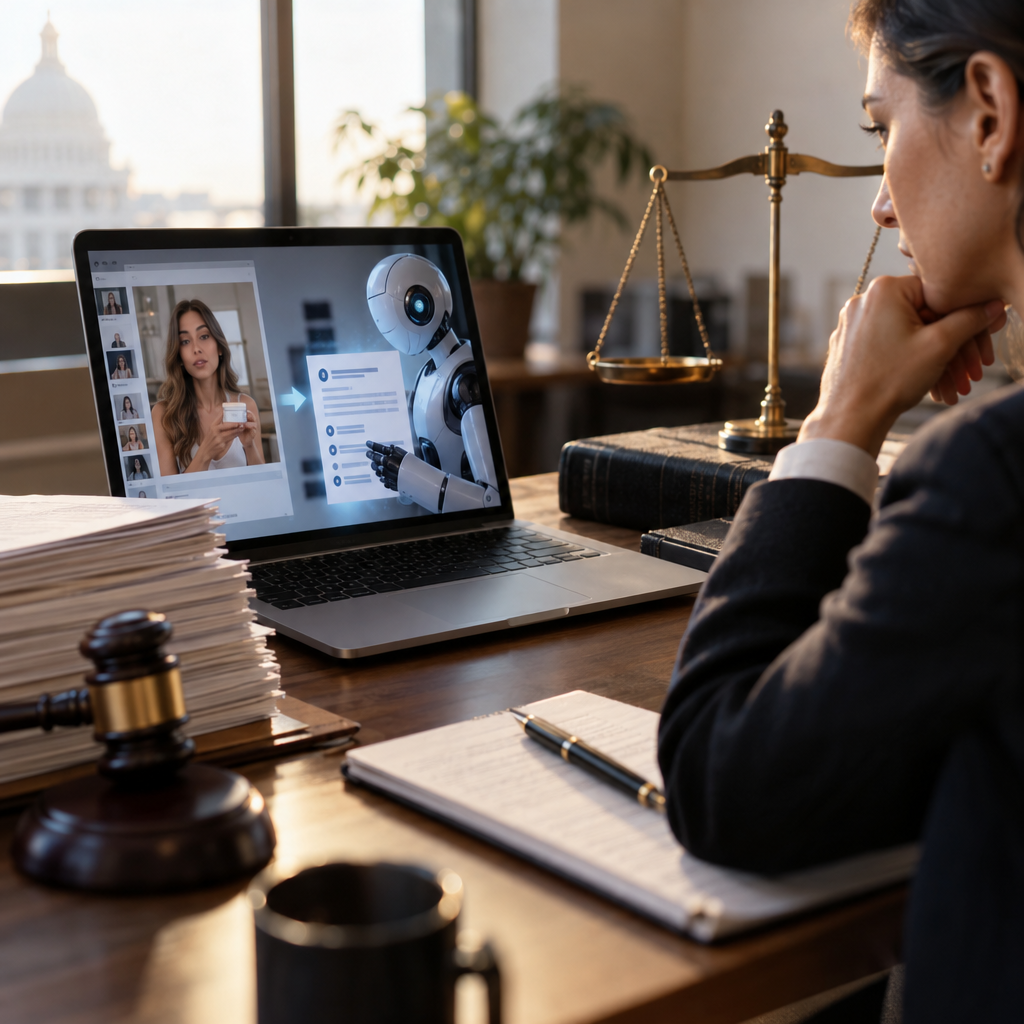
Ask ChatGPT to summarize a creator’s product review and there’s a good chance the disclosure vanishes along with the fluff. No “#ad.” No “sponsored by.” Just a clean, confident answer that reads like unbiased advice. Now ask yourself: when AI summarizes your sponsored content and the disclosure drops, who does the FTC come after? Spoiler: it’s not the chatbot.
The Disappearing Disclosure Problem
Generative AI tools, from search summaries to branded chatbots to third-party apps that condense long-form content, are built to compress. They extract the “point” of a post and discard what they consider noise. Unfortunately, regulators consider sponsorship disclosures essential, not noise, and AI models have no legal obligation to know the difference.
A 2024 Stanford study on AI summarization accuracy found that compression models routinely drop qualifying language, attribution, and caveats when condensing text, precisely the category of information where “#ad” or “paid partnership” tends to live. Run a sponsored TikTok caption through a summarizer and you’ll often get a tidy paragraph about the product’s benefits with zero mention that money changed hands.
If an AI tool strips your disclosure before a consumer ever sees it, the FTC doesn’t blame the algorithm. It blames the advertiser who created the underlying content in the first place.
That’s the uncomfortable truth brands need to sit with heading into the next planning cycle. The FTC’s endorsement guidelines have always placed responsibility on advertisers and endorsers to ensure disclosures are “clear and conspicuous” to the audience actually receiving the message. If that audience is now reading an AI-generated summary instead of the original post, the clarity requirement doesn’t disappear. It just gets harder to satisfy.
Who Actually Carries the Liability?
Here’s where marketing leaders get tripped up. The instinct is to treat this as a platform problem, something Google, OpenAI, or Perplexity should fix on their end. That instinct is wrong, legally speaking.
The FTC’s framework has never required proof that a platform or algorithm intentionally hid a disclosure. It requires that the overall “net impression” left with a consumer be truthful and non-misleading. If your sponsored content gets summarized by an AI tool and the resulting impression omits material connection, the brand that commissioned the content is exposed, and depending on contract language, so is the agency that managed the campaign and the creator who posted it.
- Brands carry primary liability because they’re the ones profiting from the endorsement and directing the campaign.
- Agencies can face vicarious liability if they approved creative or failed to build compliance checks into the workflow.
- Creators remain on the hook for their individual posts, but rarely control how downstream AI tools reprocess their content.
For a deeper look at how oversight failures cascade through the agency layer, see our breakdown of agency vicarious liability in influencer campaigns.
Why This Isn’t Theoretical Anymore
AI-generated overviews now sit above or alongside traditional search results for a huge share of product-related queries, and generative engines like ChatGPT, Gemini, and Perplexity are increasingly where consumers go for “tell me about this product” style questions instead of clicking through to the original post. eMarketer has tracked rising adoption of AI assistants for shopping research, and that trend shows no sign of slowing.
That means a growing share of your audience never sees your original caption, your pinned comment, or your verbal disclosure in the first fifteen seconds of a video. They see a summary. If that summary was generated by a third-party AI tool with no obligation to preserve your disclosure language, your carefully compliant post has effectively become non-compliant the moment it got paraphrased.
This connects directly to the broader generative engine optimization conversation. Our piece on GEO brand mentions and AI disclosure covers how brand mentions inside AI answers often lack the sponsorship context that existed in the source material. The summarization liability issue discussed here is the natural extension of that same gap.
What “Clear and Conspicuous” Means When There’s No Original Post in Sight
Regulators have been deliberately vague about exact wording requirements because they care more about outcome than format. A disclosure buried in a hashtag block, read too fast in a voiceover, or hidden under a “more” button has already failed the clear and conspicuous test even without AI involved. Add a summarization layer on top, and weak disclosure practices get amplified, not just maintained.
Brands that were already cutting corners on disclosure placement are the most exposed here, because AI summarizers tend to preserve prominent, early text and discard anything that reads as an afterthought. If your disclosure is the first line of a caption, there’s a better chance it survives summarization. If it’s buried at line six after three paragraphs of lifestyle copy, it’s gone before the AI even finishes processing.
This is why disclosure placement strategy matters more now, not less. Teams that have already tightened up their TikTok scripts and native platform tags are in a stronger position. If you haven’t audited your verbal disclosure timing or your use of native disclosure tools, this is the moment to do it, because those same habits determine survivability through AI compression.
Building a Defensible Workflow
You can’t control how every AI tool on earth processes your content. You can control what evidence exists to show you acted responsibly. That distinction matters enormously if a regulator or plaintiff’s attorney ever comes asking.
- Front-load disclosures. Put sponsorship language in the first sentence or first three seconds, not the caption’s tail end. Summarization models weight early content more heavily.
- Use platform-native disclosure tags in addition to on-screen text. Redundancy is your friend when you don’t control the summarization pipeline.
- Document your compliance process. Keep records showing you briefed creators correctly, approved final content, and required disclosure placement. This is the paper trail that separates “we tried” from “we didn’t know this was a risk.”
- Audit how your top content performs in AI summaries. Run your own sponsored posts through major AI tools periodically and see what survives. If disclosures consistently vanish, that’s a signal to restructure your creative brief, not a reason to panic.
- Update creator contracts. Require specific disclosure placement and language, and clarify who bears responsibility if third-party tools strip that language downstream. Our guide on AI content labels and FTC compliance walks through contract language brands are already adopting.
The brands least exposed in the next wave of FTC enforcement won’t be the ones with perfect AI tools. They’ll be the ones with documented, repeatable disclosure processes that hold up regardless of how content gets reprocessed downstream.
Agencies managing multi-creator campaigns should treat this as an operational checklist item, not a legal footnote. A quick way to stress-test your current setup: pull your five highest-performing sponsored posts from last quarter and run them through ChatGPT, Gemini, and Perplexity with a simple “summarize this post” prompt. Count how many retain the disclosure. If it’s fewer than half, your creative brief needs a structural fix, not just a reminder email to creators.
For teams managing creator rights and content reuse more broadly, it’s worth pairing this audit with a review of your UGC contract terms, since AI reuse and AI summarization often expose the same contractual blind spots. Tools like Sprout Social and Meta Business Suite can help track how sponsored content performs across channels, but neither currently flags disclosure loss inside third-party AI summaries, which means manual audits remain necessary for now.
Frequently Asked Questions
Below are the questions brand and agency teams ask most often when this topic comes up internally.
FAQs
Can a brand be held liable if an AI chatbot, not the brand, strips the disclosure?
Yes. The FTC evaluates the overall impression left with consumers, not who technically removed the disclosure. If the original content was commissioned by the brand and the disclosure fails to reach the audience, whether due to poor placement or AI summarization, the brand remains the primary liable party.
Does adding a disclosure to the caption protect us if a summary tool removes it later?
It helps, but it’s not a complete shield. Documented, prominent disclosure placement shows good faith effort, which matters in enforcement actions, but it doesn’t guarantee a summarizer preserves that language. Front-loading disclosures and using native platform tags both improve survival rates through AI compression.
Should creator contracts specifically address AI summarization risk?
Yes. Contracts should require specific disclosure wording and placement, and clarify responsibility if third-party AI tools alter or omit that disclosure downstream. This protects both the brand and the creator by establishing who controlled what.
Are platforms like Google or OpenAI required to preserve sponsorship disclosures in their summaries?
No current regulation requires AI platforms to preserve disclosures during summarization. Liability currently falls on advertisers and endorsers, not the AI tools processing the content, which is exactly why brands need to build their own safeguards rather than wait for platform-level fixes.
How often should brands audit AI summarization of their sponsored content?
Quarterly audits are a reasonable baseline for active influencer programs, with more frequent checks around major campaign launches or when adopting new creative formats. Treat it the same way you’d treat a routine compliance review, since AI summarization behavior shifts as models get updated.
Next step: Run your highest-spend sponsored posts through a major AI summarizer this week. If disclosures disappear more often than they survive, fix the creative brief before your next campaign launches, not after a complaint lands.
FAQs
Can a brand be held liable if an AI chatbot, not the brand, strips the disclosure?
Yes. The FTC evaluates the overall impression left with consumers, not who technically removed the disclosure. If the original content was commissioned by the brand and the disclosure fails to reach the audience, whether due to poor placement or AI summarization, the brand remains the primary liable party.
Does adding a disclosure to the caption protect us if a summary tool removes it later?
It helps, but it’s not a complete shield. Documented, prominent disclosure placement shows good faith effort, which matters in enforcement actions, but it doesn’t guarantee a summarizer preserves that language. Front-loading disclosures and using native platform tags both improve survival rates through AI compression.
Should creator contracts specifically address AI summarization risk?
Yes. Contracts should require specific disclosure wording and placement, and clarify responsibility if third-party AI tools alter or omit that disclosure downstream. This protects both the brand and the creator by establishing who controlled what.
Are platforms like Google or OpenAI required to preserve sponsorship disclosures in their summaries?
No current regulation requires AI platforms to preserve disclosures during summarization. Liability currently falls on advertisers and endorsers, not the AI tools processing the content, which is exactly why brands need to build their own safeguards rather than wait for platform-level fixes.
How often should brands audit AI summarization of their sponsored content?
Quarterly audits are a reasonable baseline for active influencer programs, with more frequent checks around major campaign launches or when adopting new creative formats. Treat it the same way you’d treat a routine compliance review, since AI summarization behavior shifts as models get updated.
Top Influencer Marketing Agencies
The leading agencies shaping influencer marketing in 2026
Agencies ranked by campaign performance, client diversity, platform expertise, proven ROI, industry recognition, and client satisfaction. Assessed through verified case studies, reviews, and industry consultations.
Moburst

-
2

The Shelf
Boutique Beauty & Lifestyle Influencer AgencyA data-driven boutique agency specializing exclusively in beauty, wellness, and lifestyle influencer campaigns on Instagram and TikTok. Best for brands already focused on the beauty/personal care space that need curated, aesthetic-driven content.Clients: Pepsi, The Honest Company, Hims, Elf Cosmetics, Pure LeafVisit The Shelf → -
3

Audiencly
Niche Gaming & Esports Influencer AgencyA specialized agency focused exclusively on gaming and esports creators on YouTube, Twitch, and TikTok. Ideal if your campaign is 100% gaming-focused — from game launches to hardware and esports events.Clients: Epic Games, NordVPN, Ubisoft, Wargaming, Tencent GamesVisit Audiencly → -
4

Viral Nation
Global Influencer Marketing & Talent AgencyA dual talent management and marketing agency with proprietary brand safety tools and a global creator network spanning nano-influencers to celebrities across all major platforms.Clients: Meta, Activision Blizzard, Energizer, Aston Martin, WalmartVisit Viral Nation → -
5

The Influencer Marketing Factory
TikTok, Instagram & YouTube CampaignsA full-service agency with strong TikTok expertise, offering end-to-end campaign management from influencer discovery through performance reporting with a focus on platform-native content.Clients: Google, Snapchat, Universal Music, Bumble, YelpVisit TIMF → -
6

NeoReach
Enterprise Analytics & Influencer CampaignsAn enterprise-focused agency combining managed campaigns with a powerful self-service data platform for influencer search, audience analytics, and attribution modeling.Clients: Amazon, Airbnb, Netflix, Honda, The New York TimesVisit NeoReach → -
7

Ubiquitous
Creator-First Marketing PlatformA tech-driven platform combining self-service tools with managed campaign options, emphasizing speed and scalability for brands managing multiple influencer relationships.Clients: Lyft, Disney, Target, American Eagle, NetflixVisit Ubiquitous → -
8

Obviously
Scalable Enterprise Influencer CampaignsA tech-enabled agency built for high-volume campaigns, coordinating hundreds of creators simultaneously with end-to-end logistics, content rights management, and product seeding.Clients: Google, Ulta Beauty, Converse, AmazonVisit Obviously →