


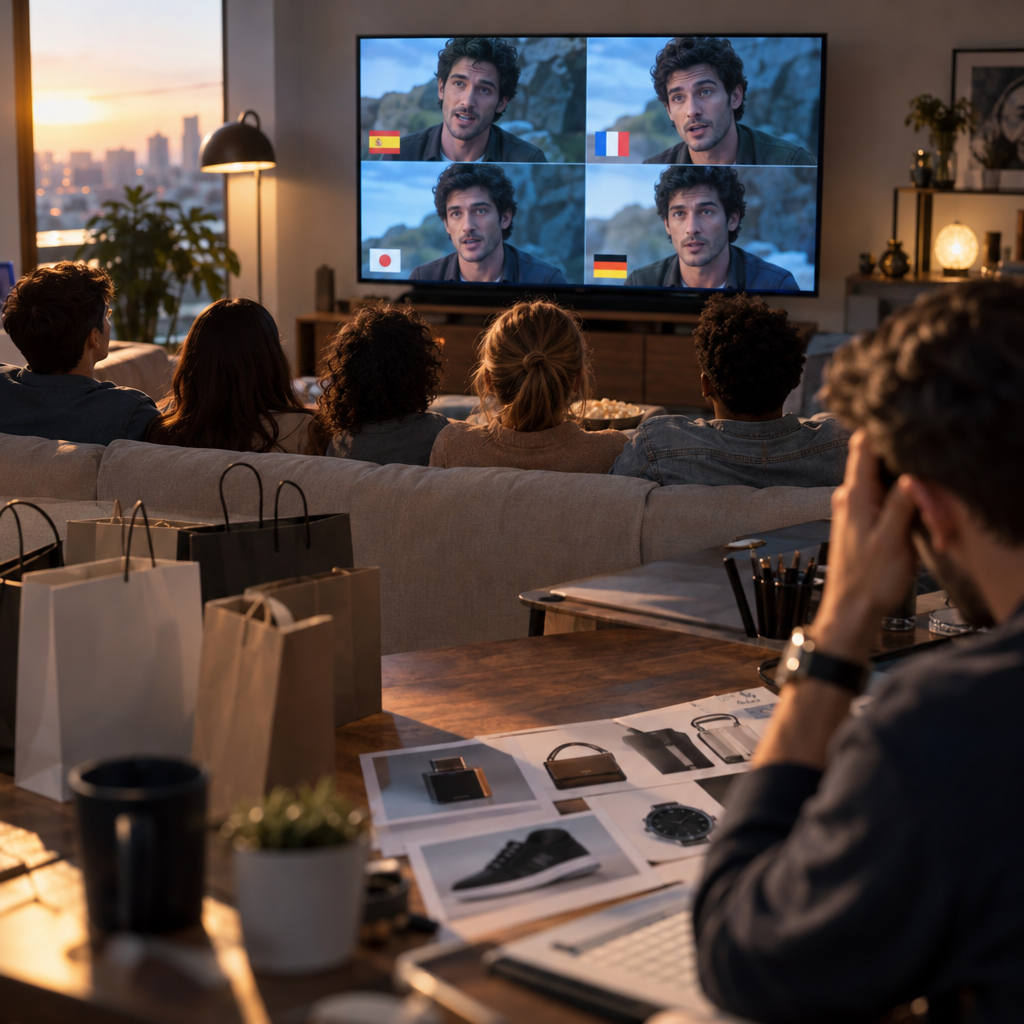
Six million people watch auto-dubbed creator content every single day, and most brand marketers couldn’t tell you which languages their top-performing videos are even playing in. That’s not a niche curiosity anymore. That’s a distribution channel sitting unmonetized in plain sight, while budgets get fought over for incremental gains in markets creators are already reaching for free.
Auto-dubbing, the AI-powered translation and voice-matching layer now built into YouTube, TikTok, and a growing list of creator tools, has quietly become one of the fastest-scaling content formats nobody’s budgeting for. Brands are still negotiating single-market, single-language deals while the content they’ve already paid for gets algorithmically served to audiences on three other continents. Nobody’s tracking it, nobody’s optimizing for it, and almost nobody’s paying creators differently because of it.
What’s Actually Driving the 6 Million Number
YouTube rolled out automatic dubbing across its Partner Program creators, and the feature has moved from gimmick to genuine viewing habit faster than most platform updates do. The 6 million daily viewer figure reflects people actively choosing dubbed audio tracks over subtitles or the original language, which tells you something important: this isn’t a fallback option people tolerate. It’s a preference.
TikTok and Meta have pushed similar capabilities into their creator tools, and third-party platforms like ElevenLabs and HeyGen have made near-instant multilingual repurposing accessible to creators who’d never touch a localization vendor. A mid-tier creator posting a product review in English can now have that same video live in Spanish, Portuguese, Hindi, and German within hours, with voice cloning convincing enough that most viewers don’t register it as synthetic.
The content brands already paid for is being consumed in markets they never budgeted media spend against, and almost nobody is tracking which languages are driving the engagement.
That’s the uncomfortable part for anyone running a global creator program. You negotiated usage rights for a campaign in one market. The content is now performing in five, and your contract probably never anticipated that.
Why Brands Are Structurally Blind to This
Most influencer programs are still built around market-by-market thinking: a US team briefs US creators, a UK team runs a parallel process, and a LatAm team does its own thing with its own budget line. That structure made sense when distribution was manual and content didn’t travel. It makes much less sense now that a single video can auto-translate itself into a dozen markets without anyone touching a localization budget.
The result is a reporting gap. Brand dashboards track views, engagement, and conversion by campaign, but very few track performance by audio language. If you’re not segmenting analytics that way, you literally cannot see where auto-dubbed reach is happening. It’s there, in the data, but nobody built the report to surface it.
This mirrors a pattern Influencers Time has covered before: brands pairing attention metrics with purchase data to prove ROI, only to discover the attention was happening in channels they weren’t measuring at all. The attention and purchase data gap isn’t just about which platform a view came from anymore. It’s about which language a viewer actually heard.
The Contract Problem Nobody’s Solved
Here’s where it gets genuinely messy for legal and partnerships teams. Usage rights clauses were written for a world where “the content” meant one video, one language, one geography. Auto-dubbing breaks that assumption completely. If a creator’s video auto-translates into eight languages and starts pulling meaningful view counts in a market you never negotiated exclusivity or usage terms for, who owns that value? Does the original fee cover it? Does the creator get additional compensation for markets they never actively targeted?
Most standard influencer contracts don’t address this at all, because the feature didn’t exist widely when the templates were drafted. Brands that have renegotiated usage rights structures around production fees, as covered in our piece on production fee deals cutting usage costs, are closer to being ready for this shift than those still running flat one-time payouts. But very few agencies have explicitly built auto-dub distribution into their rights language yet.
The Opportunity Side: Reach You’re Already Paying For
Flip the risk framing around for a second, because there’s a genuine upside here that’s easy to miss when you’re focused on contract exposure. If your creator content is already getting auto-dubbed and surfacing in new markets, you’re getting international reach you didn’t pay media dollars for. That’s an efficiency story, not just a risk story.
Consider a mid-size DTC brand running a creator program concentrated in North America. If even a fraction of that content is auto-dubbing into Spanish and reaching audiences in Mexico and Spain organically, that’s incremental top-of-funnel awareness at zero incremental media cost. The question is whether the brand is positioned to capitalize on it, with localized landing pages, region-appropriate offers, and customer service that can actually handle the inbound interest, or whether that reach just evaporates because nobody built the follow-through.
This is where the smartest brands are starting to treat auto-dub performance as a signal for where to expand creator partnerships deliberately, rather than accidentally. If a creator’s dubbed content is consistently overperforming in a specific market, that’s a data-backed argument for commissioning localized content there on purpose, with a creator who actually speaks the language and understands the cultural context, instead of relying on AI dubbing as a permanent substitute.
Auto-dubbed reach isn’t a replacement for localized creator strategy. It’s a signal that tells you exactly where to invest in one.
That distinction matters enormously. Brands that have split creator strategy from local execution, a model detailed in our coverage of global strategy and local execution, are structurally better equipped to act on auto-dub signals because they already have regional teams ready to pick up a market the moment the data points there.
Compliance and Trust: The Part Everyone Forgets
AI-dubbed content introduces a disclosure problem that regulators haven’t fully caught up to yet, but will. If a creator’s voice is cloned and translated, does the audience in that new market know they’re hearing a synthetic voice track rather than the creator actually speaking their language? Transparency expectations around sponsored content are already tightening, and the FTC’s endorsement guidelines increasingly expect disclosures to be clear and unambiguous wherever the content appears, not just in its original form.
The UK’s Information Commissioner’s Office has also signaled growing scrutiny of AI-generated content and synthetic media, which should put brands on notice that auto-dubbed disclosure practices will get examined eventually, probably sooner than most legal teams expect.
This connects directly to the broader UGC moderation and risk conversation. Brands that have already built out vendor relationships for content moderation, as outlined in our analysis of UGC moderation vendors becoming core infrastructure, are better positioned to extend that oversight into multilingual dubbed variants. If you’re not reviewing what your sponsored content sounds like in Portuguese or Hindi, you don’t actually know what claims are being made on your brand’s behalf in that market.
What Trust Research Tells Us About Synthetic Voice
Gen Z audiences in particular have grown skeptical of anything that smells manufactured, and auto-dubbed content sits uncomfortably close to that line if it’s not handled transparently. The trust collapse documented in our piece on Gen Z trust and creator vetting suggests that younger audiences notice when something feels off, even if they can’t immediately articulate why. A synthetic voice that’s 95% convincing can still trigger that instinct, and brands that ignore it risk the exact authenticity backlash the creator economy was supposed to solve.
Building an Actual Program Around This
So what does a competent response look like, practically speaking? A few moves worth making now:
- Segment analytics by audio language, not just by platform or market, so you can actually see where auto-dubbed reach is happening and size the opportunity.
- Rewrite usage rights clauses to explicitly address auto-dubbed and AI-translated derivatives, including whether additional compensation applies once a video crosses a performance threshold in a new market.
- Treat high-performing dubbed markets as expansion signals, commissioning native-language creator content there instead of relying indefinitely on synthetic dubbing.
- Audit disclosure practices across every language variant your content appears in, not just the original.
- Loop in moderation vendors to review dubbed content for claims accuracy and compliance, since a mistranslation can create liability exposure identical to a false claim made in English.
None of this requires a massive platform investment. It requires someone on the team actually owning the question, which right now almost nobody does. Marketing organizations that have already professionalized creator operations, the kind reflected in the program maturity data from recent job postings, are the ones most likely to have the bandwidth to pick this up before competitors do.
Platform-side tools are evolving fast too. YouTube’s creator-facing documentation on dubbing settings, available through Google’s support resources, gives a sense of how granular control is getting for creators managing multiple language tracks. Brands negotiating usage rights should be asking creators directly whether they have dubbing enabled and in which languages, because that answer should shape the deal terms.
Frequently Asked Questions
What is auto-dubbed content exactly?
Auto-dubbed content is video where an AI system generates a translated audio track in a different language, often cloning the original creator’s voice characteristics, so viewers in another market can watch with native-sounding audio instead of relying on subtitles.
Which platforms support auto-dubbing for creators?
YouTube has the most mature auto-dubbing rollout across its Partner Program, and TikTok and Meta platforms have introduced similar translation tools. Third-party tools like ElevenLabs and HeyGen also let creators generate dubbed versions independently of the platform’s native features.
Do brand usage rights automatically cover auto-dubbed versions of sponsored content?
In most cases, no. Standard usage rights clauses were written before auto-dubbing existed at scale, so they often don’t explicitly address translated derivatives. Brands should review and update contract language to specify whether dubbed versions are covered and whether additional compensation applies.
Does auto-dubbed content need a separate disclosure for sponsored content?
Regulators expect disclosure to be clear wherever sponsored content appears, which likely extends to dubbed versions in other languages. Brands should treat each language variant as needing its own compliant disclosure rather than assuming the original disclosure carries over.
How can a brand measure how much auto-dubbed reach it’s actually getting?
Most standard campaign dashboards don’t segment by audio language by default. Brands need to request language-level breakdowns from creators or platforms directly, or work with analytics partners who can pull that data, to see the true scope of dubbed-content performance.
The takeaway: stop treating auto-dubbed reach as a platform curiosity and start treating it as unclaimed distribution data. Pull the language breakdown on your next campaign report, update your usage rights language before the next contract cycle, and let the dubbed-market performance tell you where to invest in real, native-language creator partnerships.
Frequently Asked Questions
What is auto-dubbed content exactly?
Auto-dubbed content is video where an AI system generates a translated audio track in a different language, often cloning the original creator’s voice characteristics, so viewers in another market can watch with native-sounding audio instead of relying on subtitles.
Which platforms support auto-dubbing for creators?
YouTube has the most mature auto-dubbing rollout across its Partner Program, and TikTok and Meta platforms have introduced similar translation tools. Third-party tools like ElevenLabs and HeyGen also let creators generate dubbed versions independently of the platform’s native features.
Do brand usage rights automatically cover auto-dubbed versions of sponsored content?
In most cases, no. Standard usage rights clauses were written before auto-dubbing existed at scale, so they often don’t explicitly address translated derivatives. Brands should review and update contract language to specify whether dubbed versions are covered and whether additional compensation applies.
Does auto-dubbed content need a separate disclosure for sponsored content?
Regulators expect disclosure to be clear wherever sponsored content appears, which likely extends to dubbed versions in other languages. Brands should treat each language variant as needing its own compliant disclosure rather than assuming the original disclosure carries over.
How can a brand measure how much auto-dubbed reach it’s actually getting?
Most standard campaign dashboards don’t segment by audio language by default. Brands need to request language-level breakdowns from creators or platforms directly, or work with analytics partners who can pull that data, to see the true scope of dubbed-content performance.
Top Influencer Marketing Agencies
The leading agencies shaping influencer marketing in 2026
Agencies ranked by campaign performance, client diversity, platform expertise, proven ROI, industry recognition, and client satisfaction. Assessed through verified case studies, reviews, and industry consultations.
Moburst

-
2

The Shelf
Boutique Beauty & Lifestyle Influencer AgencyA data-driven boutique agency specializing exclusively in beauty, wellness, and lifestyle influencer campaigns on Instagram and TikTok. Best for brands already focused on the beauty/personal care space that need curated, aesthetic-driven content.Clients: Pepsi, The Honest Company, Hims, Elf Cosmetics, Pure LeafVisit The Shelf → -
3

Audiencly
Niche Gaming & Esports Influencer AgencyA specialized agency focused exclusively on gaming and esports creators on YouTube, Twitch, and TikTok. Ideal if your campaign is 100% gaming-focused — from game launches to hardware and esports events.Clients: Epic Games, NordVPN, Ubisoft, Wargaming, Tencent GamesVisit Audiencly → -
4

Viral Nation
Global Influencer Marketing & Talent AgencyA dual talent management and marketing agency with proprietary brand safety tools and a global creator network spanning nano-influencers to celebrities across all major platforms.Clients: Meta, Activision Blizzard, Energizer, Aston Martin, WalmartVisit Viral Nation → -
5

The Influencer Marketing Factory
TikTok, Instagram & YouTube CampaignsA full-service agency with strong TikTok expertise, offering end-to-end campaign management from influencer discovery through performance reporting with a focus on platform-native content.Clients: Google, Snapchat, Universal Music, Bumble, YelpVisit TIMF → -
6

NeoReach
Enterprise Analytics & Influencer CampaignsAn enterprise-focused agency combining managed campaigns with a powerful self-service data platform for influencer search, audience analytics, and attribution modeling.Clients: Amazon, Airbnb, Netflix, Honda, The New York TimesVisit NeoReach → -
7

Ubiquitous
Creator-First Marketing PlatformA tech-driven platform combining self-service tools with managed campaign options, emphasizing speed and scalability for brands managing multiple influencer relationships.Clients: Lyft, Disney, Target, American Eagle, NetflixVisit Ubiquitous → -
8

Obviously
Scalable Enterprise Influencer CampaignsA tech-enabled agency built for high-volume campaigns, coordinating hundreds of creators simultaneously with end-to-end logistics, content rights management, and product seeding.Clients: Google, Ulta Beauty, Converse, AmazonVisit Obviously →