


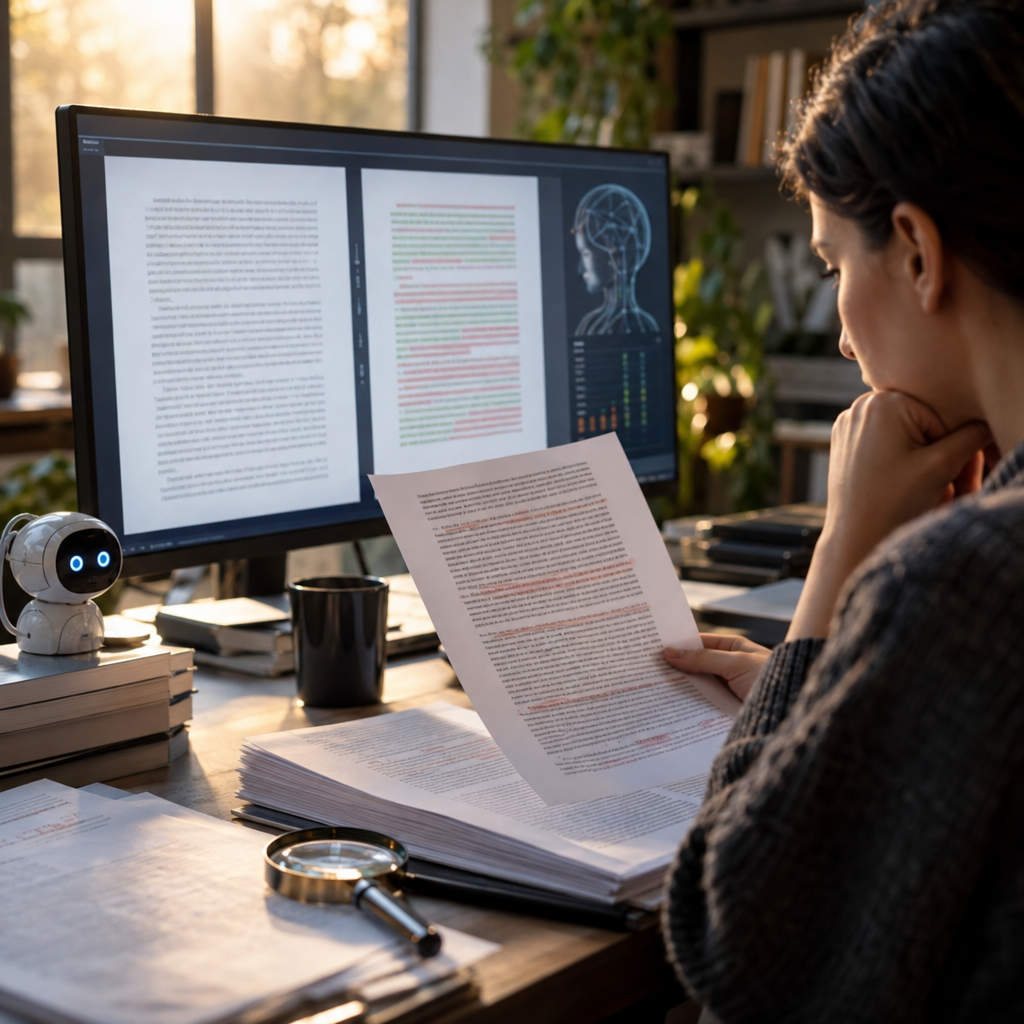
A Cornell study found that nearly 60% of marketers now use generative AI somewhere in their content pipeline, yet most brands still have no formal process for checking whether that output is original, legally clean, or quietly lifted from a training set. That gap is where AI content originality checkers earn their budget line. The tools exist. The question is whether anyone vetted them before they became the last line of defense.
The Originality Problem Nobody Budgeted For
Generative copy tools don’t plagiarize in the traditional sense. They remix. But remixing at scale across thousands of blog posts, product descriptions, and creator briefs creates a statistical problem: similar prompts produce similar phrasing, and similar phrasing starts to look a lot like duplication once it’s indexed next to a competitor’s page.
For brands running high volume content programs, that’s not a copyright footnote. It’s a search visibility risk, a brand voice risk, and increasingly, a legal exposure risk if a creator’s “original” sponsored post turns out to echo someone else’s unlicensed work. Licensing risk doesn’t stay contained to the creator who posted it. It follows the brand that paid for the placement.
An originality score isn’t a pass or fail grade. It’s a risk signal that tells you where to spend human review time before copy goes live.
What These Tools Actually Measure (and What They Don’t)
Most originality checkers on the market, think Originality.ai, Copyleaks, Winston AI, and GPTZero, run two separate analyses that get conflated constantly: plagiarism detection against indexed web content, and AI likelihood scoring based on perplexity and burstiness patterns in the text.
These are not the same thing. A piece of copy can score 100% human written and still be a near-duplicate of a competitor’s landing page because the model trained on similar source material. Conversely, text can trigger a high AI probability score and still be entirely original, factually accurate, and brand safe. Treating the two scores interchangeably is the single most common mistake marketing teams make when they first adopt these tools.
- Plagiarism detection compares text against indexed sources, useful for catching lifted product copy or scraped review language.
- AI detection scoring flags statistical patterns common in machine generated text, useful for disclosure compliance, not for proving authorship.
- Similarity clustering (less common, but growing) flags when multiple pieces of your own content start resembling each other, a sign your prompts are too narrow or your team is leaning on the same three templates.
None of these tools catch bias baked into training data or tone mismatches with your brand voice. That’s a separate audit layer, and one bias audit workflow we’ve covered addresses directly.
Why “Accuracy Rate” on the Vendor Page Means Almost Nothing
Every originality checker vendor advertises an accuracy percentage. Ignore it, at least as a standalone number. Accuracy claims are almost always measured against the vendor’s own test set, built from the exact model outputs they tuned their detector against. Run the same tool against copy generated by a newer model version, or against heavily edited AI output (which is most of what agencies actually publish), and accuracy drops fast.
A more useful question: how does the tool perform on hybrid content, text that started as an AI draft and was rewritten by a human editor? That’s the real-world scenario for roughly every content team running a generative workflow in 2026. If a vendor can’t show you benchmark data on hybrid content specifically, treat their accuracy claim as marketing copy, not a spec sheet.
A Vetting Checklist Before the Tool Touches Your Content Calendar
Procurement teams buy originality checkers the same way they buy most SaaS: demo, trial, sign. That approach misses the operational questions that actually determine whether the tool earns its keep.
- Does it integrate with your CMS or content workflow? A checker that requires manual copy-paste for every asset will get skipped under deadline pressure, which defeats the purpose entirely.
- What’s the false positive rate on heavily edited text? Ask for this specifically. Vendors rarely volunteer it.
- Does it flag at the sentence level or only the document level? Sentence level flagging lets editors fix specific passages instead of rewriting entire pieces from scratch.
- How does it handle multilingual content? If your program spans dubbed or translated creator content, most detectors trained primarily on English text lose reliability fast outside it.
- Is there an audit trail? For regulated categories (finance, health, pharma), you need a timestamped record showing content was checked before publication, not just a score you glanced at once.
Run this checklist against at least two vendors before signing anything. The tools look similar in a demo. They diverge hard once you’re processing 200 assets a week instead of five.
Where Originality Checkers Quietly Fail
No detector catches everything, and pretending otherwise sets your team up for a bad quarter. Three gaps show up repeatedly in practice.
Paraphrased lifts. If a model (or a creator using a model) rewrites someone else’s argument structure while swapping vocabulary, plagiarism checkers often miss it because the word-level match is low even though the idea, structure, and claims are copied wholesale.
Model version drift. Detectors trained to spot GPT-era output patterns can lose accuracy against newer models or against open source fine-tunes that produce less statistically “AI sounding” text. This isn’t a one-time setup. It’s an ongoing calibration problem, similar to the cross-model monitoring work brands are now doing for AI search visibility.
False confidence on short-form copy. Social captions, product titles, and ad headlines are too short for most statistical detectors to score reliably. If your program leans heavily on short-form generative copy, an originality checker built for long-form blog content is the wrong tool for the job.
A detection tool that’s accurate on 1,500-word articles and unreliable on 15-word ad headlines isn’t broken. It’s just being asked to do a job it was never built for.
Building the Pre-Publish Workflow That Actually Holds
The brands getting this right aren’t relying on a single tool as a gate. They’re running a layered check, similar in structure to the guardrail frameworks now standard for AI decisioning in media buying.
A workable sequence looks like this: generate draft, run originality and plagiarism scan, route flagged sections to a human editor, run a brand voice check, then publish with a logged timestamp of each step. It sounds heavier than it is. Most teams compress this into under ten minutes per asset once the workflow is templated into the CMS.
The part teams skip is the escalation path. What happens when a piece fails the originality check twice? Who makes the call to kill the asset versus push it through with edits? Without a defined owner, flagged content either sits in limbo or gets published anyway because nobody wants to be the bottleneck. According to HubSpot’s marketing benchmarks, content teams already cite approval bottlenecks as a top production slowdown, and an unowned originality check just adds another stall point.
What Regulators and Platforms Actually Care About
This isn’t purely a quality control issue. The FTC’s disclosure guidance for endorsements increasingly intersects with AI generated content, particularly when creators use generative tools to draft sponsored posts without disclosing AI involvement to brands or audiences. Originality checks don’t replace disclosure compliance, but they create a paper trail that matters if a claim ever gets challenged.
Platform policies are moving in parallel. Search engines have been explicit that the issue isn’t AI generated content itself, it’s low-value, unoriginal content at scale. Google’s help documentation on content quality reinforces that helpfulness and originality matter more than how the content was produced. An originality checker that only hunts for “AI fingerprints” without evaluating actual uniqueness of value is solving the wrong problem.
Vendor Selection: What to Actually Ask in the Sales Call
Skip the feature list. Ask these instead:
- Can you show benchmark data against content edited by a human after AI drafting?
- How often is the detection model retrained against new generative models?
- What’s your false positive rate, and do you have a published methodology?
- Does pricing scale by seat, by word count, or by API call, and what happens at volume?
- Can flagged content be routed automatically to a reviewer, or does someone have to check a dashboard manually?
Vendors confident in their accuracy will answer the first two questions without hedging. The ones that pivot to generic marketing language are telling you something, even if they don’t realize it.
Next Step
Don’t buy an originality checker based on a vendor’s accuracy claim alone. Run a 30-day pilot against your actual hybrid content, human-edited AI drafts, short-form copy, translated assets, and measure the false positive rate yourself before it becomes the gatekeeper for everything your brand publishes.
Frequently Asked Questions
What is an AI content originality checker?
It’s a software tool that scans text for two separate signals: similarity to existing indexed content (plagiarism detection) and statistical patterns associated with AI generated text (AI likelihood scoring). Brands use these tools to flag risky copy before it publishes.
Can AI originality checkers reliably detect AI generated text?
Not with full reliability, especially once content has been human edited or generated by newer models the detector wasn’t trained on. Treat scores as a risk indicator for review, not a definitive verdict.
Do originality checkers replace human editorial review?
No. They flag content that needs a closer look. A trained editor still needs to assess accuracy, brand voice, and whether flagged similarity is coincidental or a genuine duplication issue.
How do originality checkers handle short-form content like ad copy or captions?
Poorly, in most cases. Statistical detection methods need enough text to establish a reliable pattern, and short-form copy often falls below that threshold, producing unreliable scores.
Are AI originality checkers required for legal compliance?
They aren’t legally mandated, but they help create an audit trail that supports disclosure compliance and reduces risk if content originality is ever challenged, particularly in regulated industries.
How often should brands recalibrate or switch originality detection tools?
Review vendor performance at least twice a year, since generative models update frequently and detection accuracy can drift as new models produce less detectable output patterns.
Top Influencer Marketing Agencies
The leading agencies shaping influencer marketing in 2026
Agencies ranked by campaign performance, client diversity, platform expertise, proven ROI, industry recognition, and client satisfaction. Assessed through verified case studies, reviews, and industry consultations.
Moburst

-
2

The Shelf
Boutique Beauty & Lifestyle Influencer AgencyA data-driven boutique agency specializing exclusively in beauty, wellness, and lifestyle influencer campaigns on Instagram and TikTok. Best for brands already focused on the beauty/personal care space that need curated, aesthetic-driven content.Clients: Pepsi, The Honest Company, Hims, Elf Cosmetics, Pure LeafVisit The Shelf → -
3

Audiencly
Niche Gaming & Esports Influencer AgencyA specialized agency focused exclusively on gaming and esports creators on YouTube, Twitch, and TikTok. Ideal if your campaign is 100% gaming-focused — from game launches to hardware and esports events.Clients: Epic Games, NordVPN, Ubisoft, Wargaming, Tencent GamesVisit Audiencly → -
4

Viral Nation
Global Influencer Marketing & Talent AgencyA dual talent management and marketing agency with proprietary brand safety tools and a global creator network spanning nano-influencers to celebrities across all major platforms.Clients: Meta, Activision Blizzard, Energizer, Aston Martin, WalmartVisit Viral Nation → -
5

The Influencer Marketing Factory
TikTok, Instagram & YouTube CampaignsA full-service agency with strong TikTok expertise, offering end-to-end campaign management from influencer discovery through performance reporting with a focus on platform-native content.Clients: Google, Snapchat, Universal Music, Bumble, YelpVisit TIMF → -
6

NeoReach
Enterprise Analytics & Influencer CampaignsAn enterprise-focused agency combining managed campaigns with a powerful self-service data platform for influencer search, audience analytics, and attribution modeling.Clients: Amazon, Airbnb, Netflix, Honda, The New York TimesVisit NeoReach → -
7

Ubiquitous
Creator-First Marketing PlatformA tech-driven platform combining self-service tools with managed campaign options, emphasizing speed and scalability for brands managing multiple influencer relationships.Clients: Lyft, Disney, Target, American Eagle, NetflixVisit Ubiquitous → -
8

Obviously
Scalable Enterprise Influencer CampaignsA tech-enabled agency built for high-volume campaigns, coordinating hundreds of creators simultaneously with end-to-end logistics, content rights management, and product seeding.Clients: Google, Ulta Beauty, Converse, AmazonVisit Obviously →