


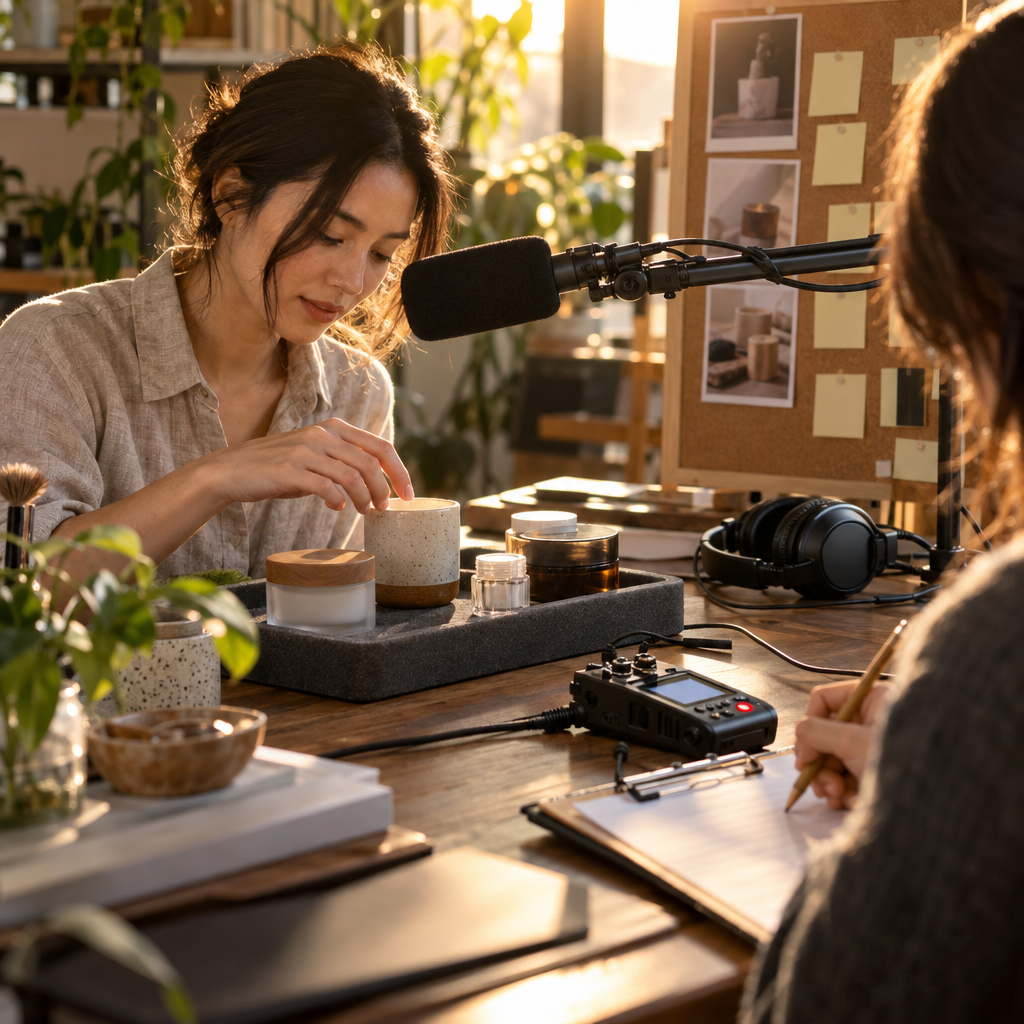
Your product has a sound, and most brands never brief it. ASMR product sound content turns that sound into the hook, the proof and the reason to watch with headphones on. For food, beauty, home and personal care, it may be the cheapest sensory demonstration you can buy. It also fails in specific, predictable ways.
Why sound sells where visuals stall
Visual product content has a ceiling. A lipstick swatch looks like every other lipstick swatch. A crisp wrapper, a pump dispenser or a satisfying lid click gives the viewer something a photo can’t: evidence of quality they can almost feel.
That is the logic behind the format. Sound compresses the “what will this be like in my hands?” question into a few seconds. It works best in categories where texture, weight and material carry the purchase decision.
Where does it work? Think skincare textures, snacks and beverages, haircare tools, stationery, kitchenware, packaging-led gifting, and anything with a tactile ritual. Where does it flop? Categories with no meaningful sound or touch, such as insurance or most software, and products whose sound is unpleasant.
Brief the sound before you brief the script. If the product has no distinctive audio signature, ASMR is a costume, not a format, and audiences notice.
The product audio audit
Before you spend on a creator, run a ten-minute audit. Record your top five SKUs on a phone, in a quiet room, with earbuds on. Then listen back and score each one.
- Distinctiveness: could a listener identify the product with their eyes closed?
- Comfort: is any sound harsh, shrill or unpleasant on headphones?
- Repeatability: can the sound be produced cleanly several times in one take?
- Brand fit: does the sound match the promise on the pack (premium, fresh, gentle)?
The winners become hero SKUs. The losers get a different format. A cap that rattles cheaply will undercut a premium positioning no matter how soft the creator whispers.
Triggers that earn their place
ASMR creators work with a familiar toolkit: tapping, scratching, crinkling, pouring, clicking, brushing and soft speech. Your job is to map those triggers to real product behavior, not invent new ones.
A practical mapping looks like this:
- Opening triggers: seals, lids, tissue paper, magnetic closures. These double as packaging proof.
- Use triggers: the pour, the spray, the spread, the crunch. This is the product doing its job.
- Close triggers: the satisfying click shut, the final sip, the neatly stacked set.
Keep the talking minimal. A few whispered lines naming the product and one real benefit are enough. If you want a deeper look at script structure for the whispered layer, our guide on ASMR unboxing briefs covers it in detail.
What goes in the creator brief?
Most ASMR briefs fail because they read like standard UGC briefs with the word “ASMR” added. Sound-led content needs production specifics, or you get uneven audio and unusable footage.
Audio requirements
Specify microphone expectations. Binaural or close-mic setups are common in the genre, but you don’t need to dictate gear. Ask for a sample clip first, recorded with the actual product, so you can judge noise floor, room echo and proximity before the full shoot.
Pacing and length
Slow is the point. Ask for deliberate movements, pauses between triggers and no rapid cuts that break the calm. Short-form cuts can run well under a minute, while long-form on YouTube can run much longer for audiences who use the content to wind down.
Do and don’t list
- Do: require a clean first three seconds with a clear trigger, so the hook works on autoplay with sound on.
- Do: request raw audio files alongside the final edit so your team can recut.
- Don’t: allow loud background music. It masks the product sound you are paying to feature.
- Don’t: let creators exaggerate sound with heavy effects that misrepresent the product.
That last point matters. If the sound is edited into something the product can’t deliver, you have a misleading-demonstration problem, not just a creative one. The same discipline applies to visual claims, as we explain in before and after content.
Silent viewers, and the platform reality
Here is the awkward truth: a large share of social video is watched with sound off. A format built on audio therefore needs a plan for the muted scroll.
Handle it in the edit. Burn in captions that describe the sound (“soft crunch,” “gentle click”), add strong visual motion at the trigger moment, and put a clear on-screen product name in the opening frames. Think of it as a dual-track design: one layer for headphones, one layer for the feed.
For the reverse problem, selling when audio is off entirely, see our brief on silent selling videos. The two formats pair well in one shoot.
Platform behavior differs too. YouTube tends to reward longer, relaxation-led sessions. TikTok and Instagram Reels reward the tight trigger-and-payoff clip. Test each separately. Our channel-specific testing scorecards give you a framework for judging them on their own terms.
Music rights and the sound layer
ASMR sounds clean until someone lays a trending track underneath. Then you have a licensing question. Commercial use of music in branded content is not the same as personal use, and many popular sounds are not cleared for ads or whitelisted posts.
Default to product-only audio with no music bed. It protects the format and removes the risk. If you do want a musical element, use a track explicitly licensed for commercial use and put that in the contract. Our piece on licensed audio for trend content walks through the practical checks.
Disclosure: whisper does not mean hidden
There is a quirk in this format. A soft, intimate tone feels personal, which makes the commercial relationship easier to overlook. That makes disclosure more important, not less.
The FTC states plainly that receiving a free product and posting about it triggers endorsement rules, and notes that viewers of social and video reviews may not realize the reviewer has a relationship with the brand. So the disclosure has to be visible and understandable.
Build it into the brief:
- Place a clear on-screen label early, not buried in a caption or hashtag pile.
- Add a brief spoken disclosure in the first lines, since many viewers will have captions off but audio on.
- Repeat it in the caption and use the platform’s paid partnership tool where available.
For wording that holds up without killing the mood, see UGC intent disclosures.
Measuring what the sound actually did
Views are a weak signal for a relaxation format. People may watch to the end and never buy. Track the metrics that map to purchase intent.
- Average watch time and completion rate: the core health check for slow-paced content.
- Saves and replays: sensory content gets rewatched, and replays signal affinity.
- Comment themes: look for “I need that sound” or product-name questions, which indicate demand.
- Branded search and product page visits: compare against a baseline period before launch.
- Conversion by hook: test different opening triggers against each other.
That last one is where the real learning lives. Shoot several opening triggers in one session and let the data pick. The method is covered in one creator shoot, ten hooks.
Treat each trigger as a testable variable. The sound that wins watch time is not always the one that wins add-to-cart.
FAQs
What is ASMR product sound content?
It is branded video built around the audible and tactile qualities of a product, such as tapping, pouring, opening or using it, usually delivered at a calm pace with minimal speech. The goal is to demonstrate quality and texture through sound.
Which product categories suit ASMR best?
Categories where texture, material or ritual drive purchase: skincare, food and beverage, haircare, stationery, kitchenware and premium packaging. Products with no distinctive sound are poor candidates.
Do ASMR creators need to disclose brand partnerships?
Yes. Free products and payment both create a relationship that should be disclosed clearly. Use an on-screen label, a brief spoken line and the platform’s partnership tool, and don’t rely on hashtags alone.
Can I use trending music under ASMR content?
Only if it is licensed for commercial use. Safer still is product-only audio, which protects the format and avoids rights disputes in paid or whitelisted placements.
How should I brief creators on audio quality?
Request a test clip with the real product, specify no music bed, ask for raw audio files and require a clear trigger in the first three seconds. Reject effects that exaggerate what the product sounds like.
How do I measure ASMR campaign performance?
Prioritize completion rate, saves, replays, comment themes, branded search and conversion by hook variant. Raw view counts say little about purchase intent in a relaxation-led format.
Next step: record your top five SKUs this week, score them on distinctiveness and comfort, and brief a creator on the single product with the best sound.
Top Influencer Marketing Agencies
The leading agencies shaping influencer marketing in 2026
Agencies ranked by campaign performance, client diversity, platform expertise, proven ROI, industry recognition, and client satisfaction. Assessed through verified case studies, reviews, and industry consultations.
Moburst

-
2

The Shelf
Boutique Beauty & Lifestyle Influencer AgencyA data-driven boutique agency specializing exclusively in beauty, wellness, and lifestyle influencer campaigns on Instagram and TikTok. Best for brands already focused on the beauty/personal care space that need curated, aesthetic-driven content.Clients: Pepsi, The Honest Company, Hims, Elf Cosmetics, Pure LeafVisit The Shelf → -
3

Audiencly
Niche Gaming & Esports Influencer AgencyA specialized agency focused exclusively on gaming and esports creators on YouTube, Twitch, and TikTok. Ideal if your campaign is 100% gaming-focused — from game launches to hardware and esports events.Clients: Epic Games, NordVPN, Ubisoft, Wargaming, Tencent GamesVisit Audiencly → -
4

Viral Nation
Global Influencer Marketing & Talent AgencyA dual talent management and marketing agency with proprietary brand safety tools and a global creator network spanning nano-influencers to celebrities across all major platforms.Clients: Meta, Activision Blizzard, Energizer, Aston Martin, WalmartVisit Viral Nation → -
5

The Influencer Marketing Factory
TikTok, Instagram & YouTube CampaignsA full-service agency with strong TikTok expertise, offering end-to-end campaign management from influencer discovery through performance reporting with a focus on platform-native content.Clients: Google, Snapchat, Universal Music, Bumble, YelpVisit TIMF → -
6

NeoReach
Enterprise Analytics & Influencer CampaignsAn enterprise-focused agency combining managed campaigns with a powerful self-service data platform for influencer search, audience analytics, and attribution modeling.Clients: Amazon, Airbnb, Netflix, Honda, The New York TimesVisit NeoReach → -
7

Ubiquitous
Creator-First Marketing PlatformA tech-driven platform combining self-service tools with managed campaign options, emphasizing speed and scalability for brands managing multiple influencer relationships.Clients: Lyft, Disney, Target, American Eagle, NetflixVisit Ubiquitous → -
8

Obviously
Scalable Enterprise Influencer CampaignsA tech-enabled agency built for high-volume campaigns, coordinating hundreds of creators simultaneously with end-to-end logistics, content rights management, and product seeding.Clients: Google, Ulta Beauty, Converse, AmazonVisit Obviously →