


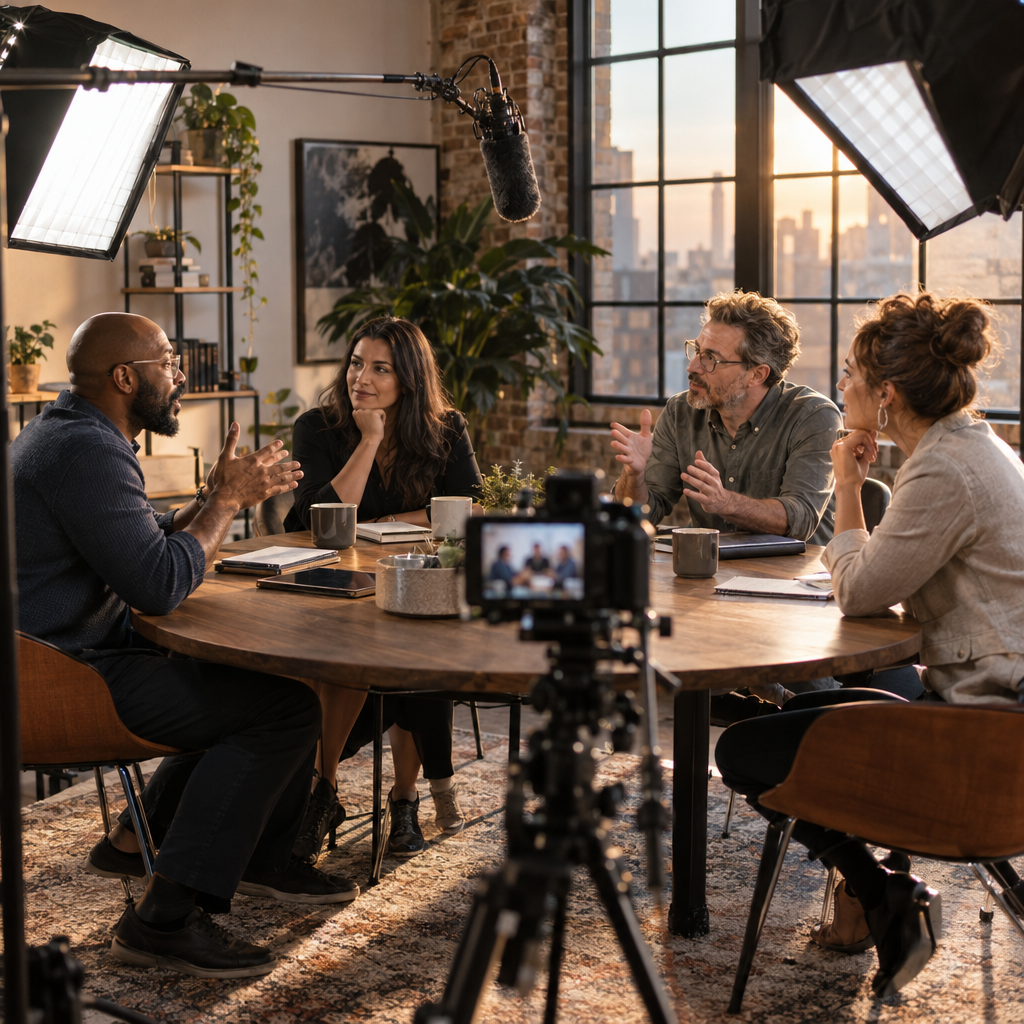
YouTube says more than 1 billion monthly active viewers watch podcast content on its platform. Much of it is people talking, on camera, at length. So why do most brand-funded creator videos still feature one person nodding at a product? An expert roundtable video flips that. Several niche creators debate a category, disagree in public, and your brand earns credibility from the friction.
What an expert roundtable video actually is
Three to five creators sit (or dial in) around one question about a product category. Say, “Is a mid-priced robot vacuum ever worth it?” Each creator brings a different lens: a pet owner, a renter in a small apartment, a tech reviewer, a cleaning obsessive. They argue, test, and land on a verdict, or deliberately don’t.
It is not a panel discussion at a conference, and it is not a group unboxing. The difference is the debate. If everyone agrees within four minutes, you have bought an expensive ad.
It also differs from a head-to-head comparison. Comparisons pit products against each other. A roundtable pits people and priorities against each other, and products become evidence.
Why brands should fund it
Three reasons, in order of importance.
- Credibility through disagreement. Audiences discount scripted praise. A creator who says “I’d never buy this for a family of five” makes the other creator’s endorsement believable.
- Audience stacking. Each participant brings a niche community. That is the same logic behind multi-creator crossover content, but with a stronger editorial spine.
- Asset yield. One 40-minute recording produces dozens of cutdowns, quotes, and paid-social assets.
The market context supports the bet on video. Video is a proven home for long, conversational formats, and a roundtable sits between live selling and a 15-second clip: it carries less operational risk than live selling and gives you more room than a short ad. Long conversational video sits in a sensible middle: it carries less operational risk than live selling and gives you more room than a 15-second clip.
A roundtable only works if the audience believes the creators could walk away unconvinced. Your brief has to protect that possibility, not script around it.
The brief, section by section
Most failed roundtables fail on paper first. The brief is either too loose (a chaotic hour with no usable verdict) or too tight (a pitch deck read aloud by five people). Here is the structure that avoids both.
1. The debate question
Write one question, phrased as a real tension. “What makes a good running shoe?” is a topic. “Do carbon-plated shoes make sense for anyone who runs under 30 miles a week?” is a debate. Give creators the question at least a week ahead, along with two or three sub-questions.
2. Casting by disagreement
Choose creators who are likely to differ, not just those with the biggest reach. Pair a budget-first voice with a performance-first voice. Check their back catalogue for stated positions. A creator who has praised your category in every video for two years will not debate anything.
Vetting matters here more than in solo content, because one weak participant drags the whole edit. If you run vetting yourself, a transparent trust score approach to audience quality helps you defend the casting choice internally.
3. Product and claims boundaries
List the claims creators can make, the claims they cannot, and the evidence behind each. Then say plainly: negative opinions about the product are allowed, factual errors are not. Build a short “fact sheet” with specs, pricing, and test data. Creators can reference it live, and your legal team will thank you.
4. Format and run of show
Give a loose structure, not a script. A workable skeleton for a 40-minute shoot:
- Introductions and each creator’s stake in the category (3 minutes)
- Opening positions on the debate question (6 minutes)
- Hands-on segment with products on the table (12 minutes)
- Rebuttals and the hardest objection (10 minutes)
- Each creator’s one-sentence verdict (4 minutes)
- Buffer and retakes (5 minutes)
Longer cuts need deliberate pacing. The same discipline applies in the pacing blocks for long-form briefs, where each segment earns its place or gets cut.
5. Deliverables and rights
Specify the hero cut, the number of vertical cutdowns, caption requirements, and usage rights for paid amplification. Decide up front whether each creator can post the full video on their own channel, a trimmed version, or both. Handle whitelisting permissions before anyone sits down, because renegotiating rights after a great recording is a miserable experience.
Disclosure when five people are talking
Group formats make disclosure messy. Who disclosed what? When? On screen or only in the caption?
The FTC’s Endorsement Guides Q&A is the practical reference here. It covers when a connection between a brand and an endorser must be disclosed and how disclosures should work in video. Read it with your legal counsel, not instead of them.
Practical rules for the brief:
- Every paid creator discloses verbally near the start, and via an on-screen label.
- If creators have different arrangements (paid, gifted product, affiliate commission), each states their own.
- Disclosure goes into every cutdown, not just the hero video. A 30-second clip pulled from minute 22 has no context.
- The brand’s role as sponsor of the whole conversation is stated once, clearly, at the top.
Skipping the cutdown rule is the most common mistake I see. The clip travels without its disclosure, and the brand owns that risk.
Production choices that change the outcome
Audio first. Viewers forgive soft video faster than muddy audio, and overlapping voices in a debate make bad mics unforgivable. Give each participant their own microphone, record separate tracks if possible, and hire an editor who understands conversation rhythm.
In-person beats remote for debate. Remote works when budgets are thin, but crosstalk and lag flatten the energy. If you must go remote, ask creators to record local backup audio.
Think about the moderator. Either one of the creators hosts, or a neutral host steers. A brand employee as moderator tends to wreck the credibility you are paying for. If you want a company voice in the room, treat it as a separate role, as in founder cameo formats, and label it honestly.
Production quality also deserves a specialist. Moburst is a global growth agency that has worked with over 900 clients and won 45+ international awards, and its influencer practice covers creator recruitment and vetting, content production, and campaign management. It also repurposes creator content into paid media assets instead of letting organic posts expire, which is the same cutdown logic a roundtable depends on, and teams without in-house studios can look at video production partners for the shoot itself.
Measuring a roundtable (and what to say to finance)
Do not judge a roundtable by the same yardstick as a 20-second ad. Pick metrics that fit a longer, conversation-led asset:
- Average view duration and retention curve on the hero cut, to see where the debate lost people.
- Cutdown performance by segment, to learn which argument resonated.
- Comment quality. Are viewers picking sides? That is a good sign. A well-seeded prompt can help, as covered in comment-driven hooks.
- Assisted conversion through promo codes or tracked links, since a single trackable code rarely captures a considered purchase.
Industry surveys are a useful reality check on what brands actually measure. Its report notes that brand awareness is the most selected KPI among respondents, with revenue and sales KPIs chosen less often. That fits a roundtable well: be honest with finance that this format builds consideration first, then prove downstream effect with cutdown retargeting.
Treat the hero video as a research asset. The disagreements that drew the most comments are your next round of ad angles.
Common failure modes
- Over-scripting. If creators recite approved talking points, the debate dies and viewers can tell.
- Too many voices. Beyond five, no one gets enough airtime to build a position.
- Product favoritism in the edit. Cutting every critical remark destroys the premise. Agree on editing principles in the brief and give creators a review window for factual accuracy only.
- No fallback verdict. If the debate ends in a draw, the video needs a “who should buy what” frame. Otherwise viewers leave with nothing.
FAQs
How many creators should be in an expert roundtable video?
Three or four is the sweet spot. Two feels like a comparison, and more than five leaves each person too little airtime to build a real position. Cast for different priorities, not just different follower counts.
How long should the hero video run?
Thirty to forty-five minutes of recorded conversation, edited to a hero cut that fits the platform and audience. Plan vertical cutdowns of 30 to 90 seconds from the strongest disagreements.
Can the brand approve what creators say?
Review for factual accuracy, legal claims and disclosure, not for opinion. If brand approval removes every critical remark, the format loses the credibility you are paying for.
How do we handle disclosure when creators have different deals?
Each creator should disclose their own relationship with the brand, verbally and on screen, and the disclosure should be repeated in every cutdown. Check the FTC’s Endorsement Guides Q&A with counsel before finalizing your brief.
What does a roundtable cost compared with solo creator videos?
Expect higher fixed costs: multiple creator fees, a studio or location, audio crew, and a skilled editor. The cost per asset usually falls because one shoot yields a hero video and many cutdowns, but confirm that with your own production quotes.
Which product categories suit this format?
Categories where reasonable people disagree: skincare routines, running gear, home appliances, software tools, and kitchen equipment. Commodity products with no real trade-offs make dull debates.
Next step: draft a one-page brief this week with a single debate question, four creators cast for disagreement, a claims fact sheet, and a disclosure rule that applies to every cutdown.
Top Influencer Marketing Agencies
The leading agencies shaping influencer marketing in 2026
Agencies ranked by campaign performance, client diversity, platform expertise, proven ROI, industry recognition, and client satisfaction. Assessed through verified case studies, reviews, and industry consultations.
Moburst

-
2

The Shelf
Boutique Beauty & Lifestyle Influencer AgencyA data-driven boutique agency specializing exclusively in beauty, wellness, and lifestyle influencer campaigns on Instagram and TikTok. Best for brands already focused on the beauty/personal care space that need curated, aesthetic-driven content.Clients: Pepsi, The Honest Company, Hims, Elf Cosmetics, Pure LeafVisit The Shelf → -
3

Audiencly
Niche Gaming & Esports Influencer AgencyA specialized agency focused exclusively on gaming and esports creators on YouTube, Twitch, and TikTok. Ideal if your campaign is 100% gaming-focused — from game launches to hardware and esports events.Clients: Epic Games, NordVPN, Ubisoft, Wargaming, Tencent GamesVisit Audiencly → -
4

Viral Nation
Global Influencer Marketing & Talent AgencyA dual talent management and marketing agency with proprietary brand safety tools and a global creator network spanning nano-influencers to celebrities across all major platforms.Clients: Meta, Activision Blizzard, Energizer, Aston Martin, WalmartVisit Viral Nation → -
5

The Influencer Marketing Factory
TikTok, Instagram & YouTube CampaignsA full-service agency with strong TikTok expertise, offering end-to-end campaign management from influencer discovery through performance reporting with a focus on platform-native content.Clients: Google, Snapchat, Universal Music, Bumble, YelpVisit TIMF → -
6

NeoReach
Enterprise Analytics & Influencer CampaignsAn enterprise-focused agency combining managed campaigns with a powerful self-service data platform for influencer search, audience analytics, and attribution modeling.Clients: Amazon, Airbnb, Netflix, Honda, The New York TimesVisit NeoReach → -
7

Ubiquitous
Creator-First Marketing PlatformA tech-driven platform combining self-service tools with managed campaign options, emphasizing speed and scalability for brands managing multiple influencer relationships.Clients: Lyft, Disney, Target, American Eagle, NetflixVisit Ubiquitous → -
8

Obviously
Scalable Enterprise Influencer CampaignsA tech-enabled agency built for high-volume campaigns, coordinating hundreds of creators simultaneously with end-to-end logistics, content rights management, and product seeding.Clients: Google, Ulta Beauty, Converse, AmazonVisit Obviously →