


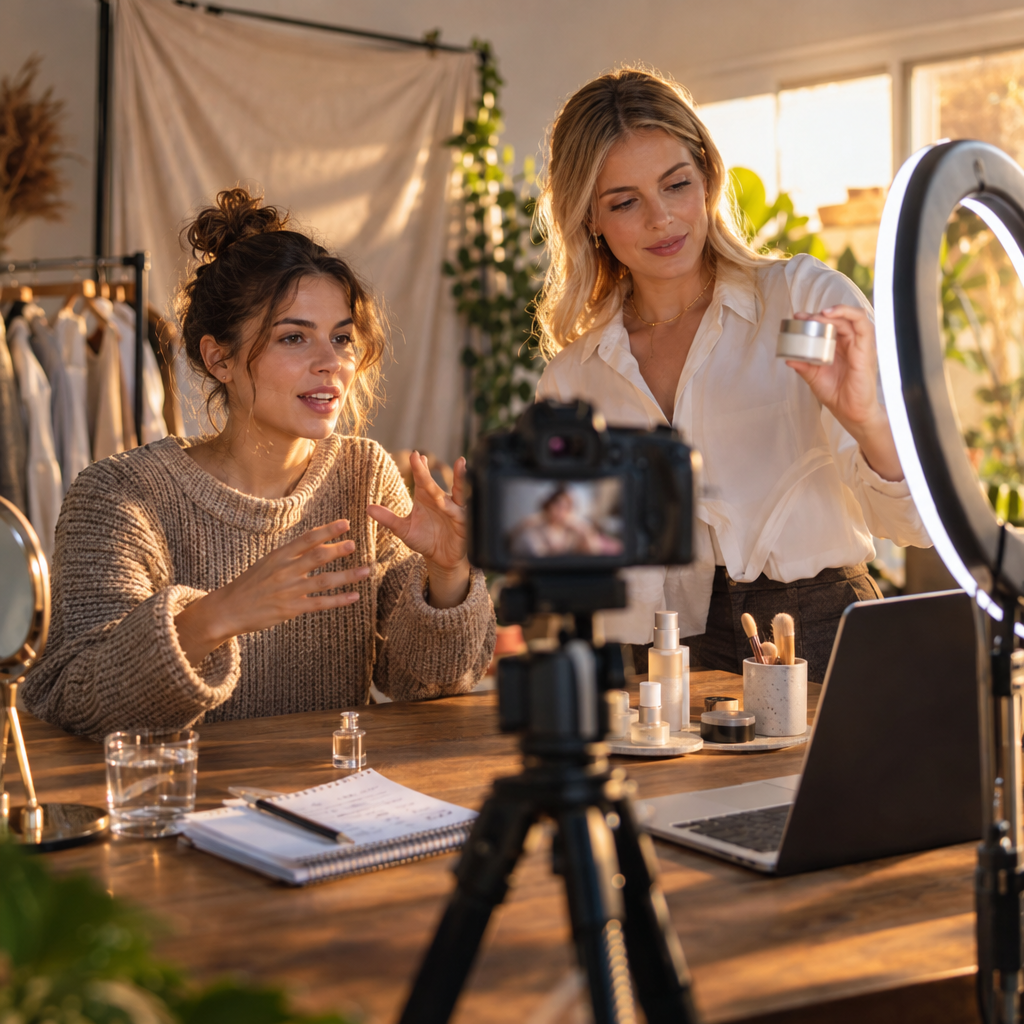
Who do viewers trust more in a livestream: the creator who says a product is great, or the brand employee who built it? Neither alone. The strongest co-hosted livestream shopping shows pair both on camera. The creator brings credibility and audience rapport. The brand representative brings product depth and the authority to make offers on the spot.
Why the two-host format works
A solo creator can sell on charisma, but gets stuck on a pointed question about ingredients, compatibility or warranty terms. A solo brand rep knows every answer, but viewers read them as a salesperson. Put them side by side and each covers the other’s weak spot.
The creator asks the questions the audience is already typing. The brand rep answers with specifics. That exchange is the show. It also lowers your risk, because claims come from someone accountable to the company, not improvised by a freelancer.
TikTok’s own seller education says to pick a host who matches your brand image, can present and engage confidently, and knows how to sell through real-time interaction. Our recommendation, not TikTok’s: apply the same three tests to the brand representative’s seat, and read the TikTok Shop host selection guidance for the platform’s full host steps.
The creator earns attention. The brand rep earns the purchase. Cast the show so each person has a job the other cannot do.
Casting: who sits in each chair
Most failed co-hosted shows fail at casting, not production. A few rules from programs I have seen work:
- Brand rep: a product manager, formulator, merchandiser or founder. Avoid pure marketing titles. Viewers can smell a script. Our guide to founder cameo roles covers how to keep that presence credible.
- Creator: someone whose audience already buys in your category, not simply the biggest reach. Audience fit beats follower count in live, because the chat is the conversion engine.
- Chemistry check: run a 20-minute unscripted rehearsal on camera. If they talk over each other or go stiff, recast before you spend on promotion.
Should the brand rep be an employee or an agency actor? Employee, every time. Disclosure is simpler and answers are real.
The run of show
Improvisation sells. Structure makes improvisation safe. A 60-minute show can follow this shape:
- Minutes 0-5, the hook: state today’s offer and the reason to stay. Tease the best deal for later to hold viewers.
- Minutes 5-20, hero product: the creator demos in real use while the rep explains what is inside, how it differs and who it is not for. Admitting limits is a credibility asset.
- Minutes 20-40, rotation: two or three secondary products, each with a short demo, one customer question answered live and a pinned link.
- Minutes 40-55, offer window: the limited-time bundle or code, with a visible countdown. Here the rep’s authority to approve deals pays off.
- Minutes 55-60, close: recap, restate the offer deadline, and tell viewers where the replay and clips will live.
Pacing matters beyond the live moment. If you are planning longer formats, the logic in pacing blocks for long video transfers well: define segments, assign a purpose to each, and brief the talent on transitions.
Role split that keeps it conversational
Give the creator the questions and the brand rep the answers, then swap once or twice so it does not feel like an interview. Hand a small segment to the rep to demo something technical, and let the creator close with a personal verdict.
Brief both on three things: the claims you can make, the claims you cannot, and what happens when a viewer asks something off script. The answer to that last one should be simple: “Let me check and follow up in the pinned comment.” Never guess live.
Disclosure and compliance, live
Live is where disclosure slips, because nobody can edit it. The FTC’s Disclosures 101 for social media influencers says that when an endorsement is made in a live stream, the disclosure should be repeated periodically so viewers who only catch part of the stream still get it.
Build that into the run of show:
- Put a persistent on-screen paid partnership label in place before going live.
- Have the creator say the relationship aloud at the open and again at each offer window.
- Have the brand rep state their employer plainly. It is a material connection too.
- Assign a producer to watch the chat and flag any claim that drifts beyond approved language.
If you plan to amplify the replay as an ad, settle usage rights first. Whitelisting permissions belong in the contract, not in a panicked email after the stream.
Measuring what matters
Orders during the broadcast are only part of the picture. Track a layered set of metrics:
- Conversion rate by segment: which product rotation and which host moment drove purchases.
- Average watch time and peak concurrent viewers: a leading indicator of format fit.
- Chat questions by category: a free research feed for FAQs, product pages and future briefs.
- Replay and clip sales: live content keeps earning if you cut it up. See how cross-platform cuts extend the life of a single production.
- Cost per incremental order: include talent fees, discounting, production and the rep’s time.
Run the same format three to five times before judging it. The first show tests the setup. The third tests the idea.
Common mistakes to avoid
- Over-scripting. If every line is approved word for word, the credibility you paid for disappears.
- Discounting as the only hook. Offers get the click. Product proof keeps the viewer.
- No moderator. Two hosts cannot sell and read chat. Add a third person for comments and links.
- Ignoring the platform. TikTok Shop LIVE, Amazon Live and Instagram each have different tools for pinning products and running offers. Brief to the platform you chose.
FAQs
What is a co-hosted livestream shopping show?
It is a live selling broadcast with two on-camera hosts: a creator who represents the audience and a brand representative who represents the product. Viewers can buy through pinned or tagged products while the show runs.
Who should be the brand representative?
Choose someone with real product knowledge and comfort on camera, such as a founder, product lead or category manager. They should be an actual employee so disclosure is straightforward and their answers are accurate.
How long should a co-hosted live shopping show run?
Thirty to sixty minutes suits most first-time shows. Long enough to demo a hero product and run an offer window, short enough to keep energy high. Extend only after retention data supports it.
Do both hosts need to disclose their relationship?
Yes. The creator discloses the paid or gifted relationship, and the brand rep states they work for the brand. Per FTC guidance, repeat disclosures periodically during a live stream so late joiners see them.
How do I brief hosts without making the show feel scripted?
Brief on outcomes, not lines: the run of show, approved claims, prohibited claims, and the offer details. Rehearse transitions, then let the conversation happen naturally.
How do I prove ROI to leadership?
Report cost per incremental order, conversion by segment, and replay sales alongside live sales. Compare against a paid social benchmark for the same product and period.
Next step: schedule one 45-minute pilot with a single hero product, cast the brand rep from your product team, and write the disclosure moments into the run of show before anything else.
Top Influencer Marketing Agencies
The leading agencies shaping influencer marketing in 2026
Agencies ranked by campaign performance, client diversity, platform expertise, proven ROI, industry recognition, and client satisfaction. Assessed through verified case studies, reviews, and industry consultations.
Moburst

-
2

The Shelf
Boutique Beauty & Lifestyle Influencer AgencyA data-driven boutique agency specializing exclusively in beauty, wellness, and lifestyle influencer campaigns on Instagram and TikTok. Best for brands already focused on the beauty/personal care space that need curated, aesthetic-driven content.Clients: Pepsi, The Honest Company, Hims, Elf Cosmetics, Pure LeafVisit The Shelf → -
3

Audiencly
Niche Gaming & Esports Influencer AgencyA specialized agency focused exclusively on gaming and esports creators on YouTube, Twitch, and TikTok. Ideal if your campaign is 100% gaming-focused — from game launches to hardware and esports events.Clients: Epic Games, NordVPN, Ubisoft, Wargaming, Tencent GamesVisit Audiencly → -
4

Viral Nation
Global Influencer Marketing & Talent AgencyA dual talent management and marketing agency with proprietary brand safety tools and a global creator network spanning nano-influencers to celebrities across all major platforms.Clients: Meta, Activision Blizzard, Energizer, Aston Martin, WalmartVisit Viral Nation → -
5

The Influencer Marketing Factory
TikTok, Instagram & YouTube CampaignsA full-service agency with strong TikTok expertise, offering end-to-end campaign management from influencer discovery through performance reporting with a focus on platform-native content.Clients: Google, Snapchat, Universal Music, Bumble, YelpVisit TIMF → -
6

NeoReach
Enterprise Analytics & Influencer CampaignsAn enterprise-focused agency combining managed campaigns with a powerful self-service data platform for influencer search, audience analytics, and attribution modeling.Clients: Amazon, Airbnb, Netflix, Honda, The New York TimesVisit NeoReach → -
7

Ubiquitous
Creator-First Marketing PlatformA tech-driven platform combining self-service tools with managed campaign options, emphasizing speed and scalability for brands managing multiple influencer relationships.Clients: Lyft, Disney, Target, American Eagle, NetflixVisit Ubiquitous → -
8

Obviously
Scalable Enterprise Influencer CampaignsA tech-enabled agency built for high-volume campaigns, coordinating hundreds of creators simultaneously with end-to-end logistics, content rights management, and product seeding.Clients: Google, Ulta Beauty, Converse, AmazonVisit Obviously →