



Your vendor says its model delivers a big jump in watch time. Compared with what? Measured by whom? AI generated watch time metrics now headline creator platform pitch decks, and many of them are predictions dressed up as measurements. Before you sign, you need to know which numbers came from a platform and which came from a model. This guide shows how to tell them apart and what to put in the contract.
Measured, modeled, or guessed?
Start with a distinction most pitch decks blur. Watch time on YouTube is a platform-reported figure. The YouTube Help Center defines it simply as the amount of time viewers have watched your video. It also separates out watch time that originated from thumbnail impressions, which is a narrower slice of the same pie.
That is a measurement. Now consider what a vendor typically sells:
- Measured: numbers pulled directly from a creator’s native analytics or an authorized API connection.
- Modeled: estimates for creators or campaigns where the vendor has no direct access, built from public signals like view counts and posting cadence.
- Predicted: forecasts of future watch time for a creator you have not yet hired.
All three can appear in the same dashboard, in the same font, with the same decimal precision. That is the problem. A predicted figure looks just as authoritative as a reported one.
If a vendor cannot label every watch time figure as measured, modeled, or predicted, treat the whole dashboard as modeled.
Definitions are where claims go to hide
“Watch time” is not one metric. Google’s own developer documentation lists it as a core metric in the YouTube Analytics and Reporting API, where it appears as the number of minutes users watched videos for a given channel, video, or playlist. The same documentation describes engaged views as views past the first frame, or where the user clicks or taps to play. Those are not the same thing as a completed view or a qualified view.
So ask the vendor to write down its definition for each of these:
- What counts as a view? Autoplay, muted play, and loops can inflate counts depending on the platform.
- What counts as watch time? Total minutes, average view duration, or percentage of video watched?
- What is the denominator? Per impression, per view, per dollar, per creator?
- What is the window? First 24 hours, 7 days, 30 days, lifetime?
- How are Shorts, long form, and live treated? Blending them can mask a weak format.
A vendor that answers in a vague paragraph has just told you something. One that answers in a data dictionary has told you something better.
Ask for the lineage, not the logo
Pretty dashboards prove nothing. Data lineage does. For every watch time number in the pilot report, you should be able to trace three things: the source system, the transformation applied, and the date it was last refreshed.
Try this request in the first call. Pick one creator you already work with and know well. Ask the vendor to show its watch time figures for that creator’s last ten videos. Then compare them against the creator’s own YouTube Studio screenshots. Do it before the creator knows which vendor is being tested, if you can, so you get an honest read on modeled versus authorized data.
Expect gaps. A gap of a few points is normal. A gap you cannot explain is a finding. Document it and put it in writing, because it becomes your baseline for any later dispute.
The questions that separate real tooling from a wrapper
- Which numbers come from creator-authorized API connections, and which come from scraping or inference?
- What share of creators in the database have authorized connections?
- How does the model handle creators with no authorization? Is that flagged on screen?
- Has anyone outside the vendor tested accuracy? Can you see the test design?
This overlaps with a broader issue we covered in our piece on probabilistic matching, where vendor outputs look deterministic but are not. Watch time modeling carries the same risk.
Why accuracy claims deserve a legal lens
Marketers sometimes treat vendor claims as the vendor’s problem. They are not entirely. If you repeat a vendor’s performance claim to a client, a CFO, or the public, you own part of that claim.
The FTC has been explicit about AI marketing.
That is a detection tool, not a watch time forecaster. But the lesson transfers cleanly. A headline accuracy figure with no test behind it is exactly what regulators look for. If your vendor claims its model predicts watch time with a headline accuracy figure, ask for the test set, the sample size, and the error metric. Accuracy against what?
An accuracy claim without a documented test is a liability you are importing into your own reporting.
We have also written about how AI ROI dashboards inflate results and how performance guarantees create FTC exposure. Both are worth a read before your legal team reviews the paper.
Run a pilot that can actually fail
Most pilots are designed to succeed. The vendor picks the creators, the window, and the benchmark. Take that control back.
Set the rules before the pilot starts:
- You choose the holdout. Select a set of creators the vendor’s model did not recommend and track them the same way.
- You set the success threshold in advance. Write the number down and have both parties initial it.
- You use native analytics as ground truth. Collect screenshots or API exports from creators at the end of the window.
- You compare predicted to actual. Calculate the error per creator, not just the average, since averages hide the creators who blew up the forecast.
Beware of one trap in particular: attribution creep. Watch time lifts are easy to claim and hard to isolate. If the vendor says its picks drove branded demand, test that too. Our breakdown of branded search lift claims covers how to pressure-test those stories.
Contract language that protects you
Once the pilot data is in, push the findings into the paper. Procurement teams often skip this step and rely on the sales deck. Do not.
- Metric definitions as an exhibit. Attach the data dictionary, and require written notice of any definition change.
- Source labeling. Require the platform to tag measured, modeled, and predicted values in exports as well as the interface.
- Audit rights. Reserve the right to have a third party test accuracy, at least annually, with reasonable access to methodology.
- Accuracy remedies. Tie fee credits or termination rights to documented error beyond an agreed tolerance.
- Model change notice. Retraining or swapping the underlying model can shift every number overnight. Require notice and a re-baseline.
- Data rights and exit. Confirm you can export historical data in a usable format when you leave.
- Claim substantiation. Require the vendor to supply documentation for any performance claim you are permitted to repeat externally.
Pay attention to who the vendor says authorizes creator data. If creators have not given permission, you inherit a licensing and privacy question on top of the accuracy one. See our guide to creator platform vendor licensing for the terms to look for.
Red flags worth walking away over
Some signals do not need a second meeting.
- Precision with no error bars. A forecast stated to the last digit is not more credible than a rounded one. It is less. It is less.
- Refusal to share a sample export.
- Case studies with no baseline, no time window, or no named metric definition.
- “Proprietary” as the answer to every methodology question.
- Pressure to sign before a pilot reads out.
One bad answer is a conversation. Three is a pattern.
FAQs
What are AI generated watch time metrics?
They are watch time figures that a vendor estimates or forecasts with a model, instead of pulling them directly from a platform’s analytics. They can be useful for screening creators, but they are not the same as platform-reported numbers and should be labeled differently.
How do I verify a vendor’s watch time numbers?
Compare the vendor’s figures for a handful of creators you already work with against the creators’ own native analytics, such as YouTube Studio exports. Use the same date range and metric definition, and record any gaps in writing.
Is watch time the same across platforms?
No. Definitions of a view, a play, and time watched differ by platform and even by format. Check the platform’s own documentation, such as the YouTube Help Center and YouTube Analytics API reference, and require the vendor to map its metric to each source.
Can a brand be liable for repeating a vendor’s inflated claims?
Potentially, yes. The FTC has signaled that AI-related claims must be substantiated, and that applies to anyone making the claim in marketing. Ask your counsel to review any vendor figure before it appears in client decks, case studies, or public materials.
What should an audit clause include?
It should give you or a neutral third party the right to test accuracy against native platform data, access to methodology documentation, a defined error tolerance, and remedies such as fee credits or termination if the vendor misses it.
How long should a vendor pilot run?
Long enough to cover a full measurement window for the metric you care about, and long enough to include several content cycles per creator. A pilot shorter than your normal campaign reporting window rarely tells you whether the model holds up.
Next step: before the next vendor call, pick one creator you know well and ask for their last ten videos’ watch time with each figure labeled measured, modeled, or predicted. Compare it to their Studio data, and let the gap decide whether the contract moves forward.
Top Influencer Marketing Agencies
The leading agencies shaping influencer marketing in 2026
Agencies ranked by campaign performance, client diversity, platform expertise, proven ROI, industry recognition, and client satisfaction. Assessed through verified case studies, reviews, and industry consultations.
Moburst

-
2

The Shelf
Boutique Beauty & Lifestyle Influencer AgencyA data-driven boutique agency specializing exclusively in beauty, wellness, and lifestyle influencer campaigns on Instagram and TikTok. Best for brands already focused on the beauty/personal care space that need curated, aesthetic-driven content.Clients: Pepsi, The Honest Company, Hims, Elf Cosmetics, Pure LeafVisit The Shelf → -
3
Audiencly
Niche Gaming & Esports Influencer AgencyA specialized agency focused exclusively on gaming and esports creators on YouTube, Twitch, and TikTok. Ideal if your campaign is 100% gaming-focused — from game launches to hardware and esports events.Clients: Epic Games, NordVPN, Ubisoft, Wargaming, Tencent GamesVisit Audiencly → -
4
Viral Nation
Global Influencer Marketing & Talent AgencyA dual talent management and marketing agency with proprietary brand safety tools and a global creator network spanning nano-influencers to celebrities across all major platforms.Clients: Meta, Activision Blizzard, Energizer, Aston Martin, WalmartVisit Viral Nation → -
5
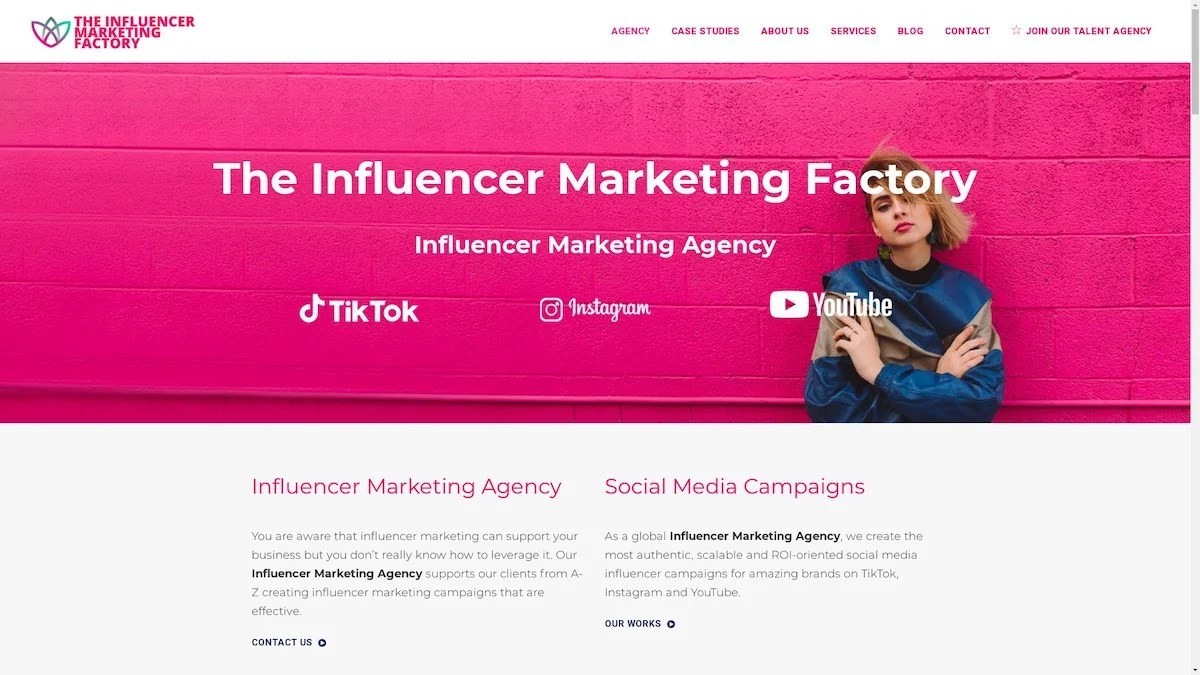
The Influencer Marketing Factory
TikTok, Instagram & YouTube CampaignsA full-service agency with strong TikTok expertise, offering end-to-end campaign management from influencer discovery through performance reporting with a focus on platform-native content.Clients: Google, Snapchat, Universal Music, Bumble, YelpVisit TIMF → -
6
NeoReach
Enterprise Analytics & Influencer CampaignsAn enterprise-focused agency combining managed campaigns with a powerful self-service data platform for influencer search, audience analytics, and attribution modeling.Clients: Amazon, Airbnb, Netflix, Honda, The New York TimesVisit NeoReach → -
7
Ubiquitous
Creator-First Marketing PlatformA tech-driven platform combining self-service tools with managed campaign options, emphasizing speed and scalability for brands managing multiple influencer relationships.Clients: Lyft, Disney, Target, American Eagle, NetflixVisit Ubiquitous → -
8

Obviously
Scalable Enterprise Influencer CampaignsA tech-enabled agency built for high-volume campaigns, coordinating hundreds of creators simultaneously with end-to-end logistics, content rights management, and product seeding.Clients: Google, Ulta Beauty, Converse, AmazonVisit Obviously →