


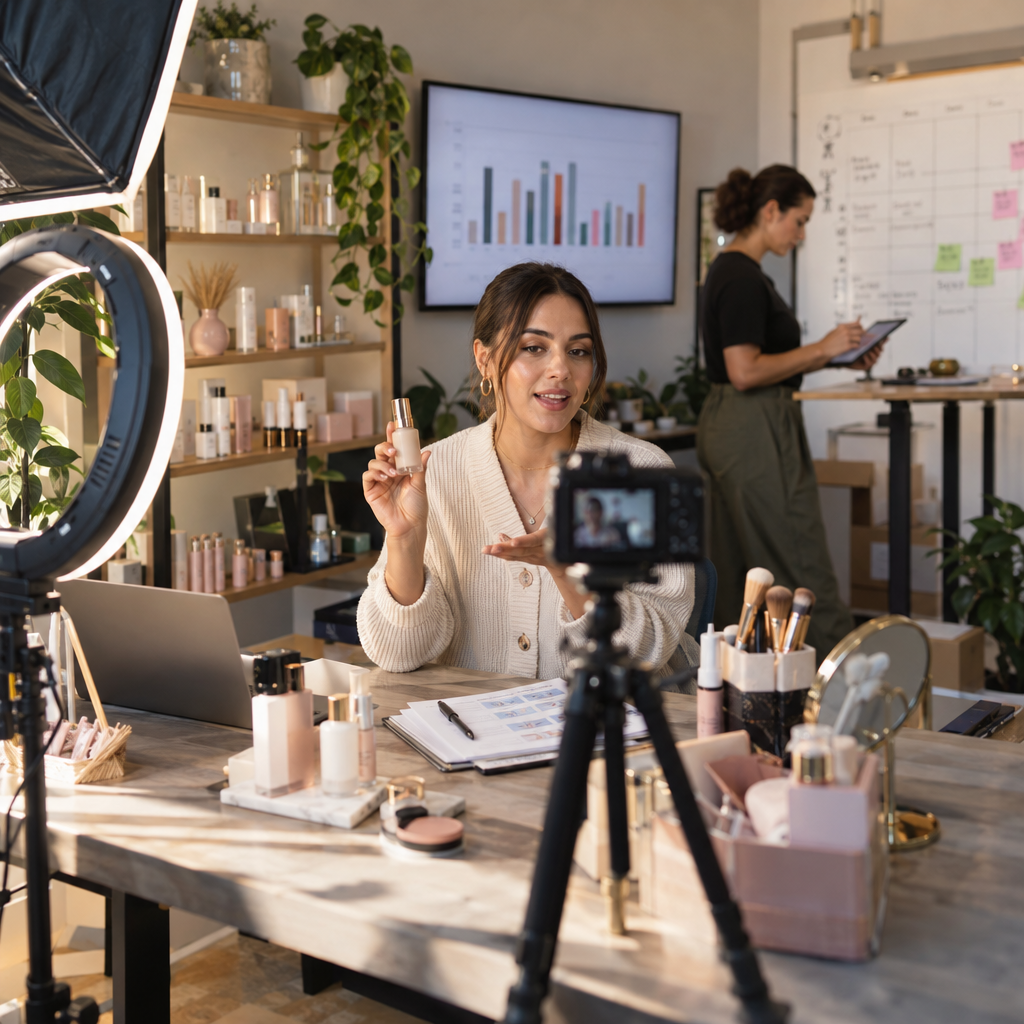
E.l.f. Beauty’s haircare line became its biggest day-one category launch in history, and a single four-hour TikTok Shop Live helped drive it. That is the clearest signal yet that e.l.f. Cosmetics’ TikTok Shop Live strategy is a repeatable GMV system, not a lucky stunt. Here is what it shows, and what it doesn’t.
The launch that set the benchmark
When e.l.f. debuted its haircare line, it did something counterintuitive. Fast Company reported that the line hit TikTok Shop a week before it reached Target, e.l.f.’s official retail partner, via a four-hour livestream cohosted by beauty influencer Yonna Jay and cosmetic chemist Erica Douglas.
Read that sequencing again. The brand gave a social channel a head start over its biggest brick-and-mortar partner.
That is a bet on where demand gets created. Retail shelves capture demand. A long, entertaining Live manufactures it, and then the shelf harvests it. If you plan launches around a retail calendar only, you are leaving the demand-creation window to chance.
Why the market is moving under this strategy
E.l.f. is not swimming against the current. Per Emarketer, citing a Momentum Works report, TikTok Shop GMV rose 103% year over year to $11.8 billion in the first half of 2026. Consumer Edge card data puts TikTok Shop at roughly 2% of total U.S. online retail spend, up from effectively zero three years ago.
Live is the format pulling that volume toward brands willing to commit. Fast Company’s reporting on the e.l.f. playbook cites Social/Tale putting Live conversion near 10%, against 2% to 3% for e-commerce sites. Treat that as a directional benchmark, not a promise. Your category, price point, and host quality will move it.
The lesson is not “go live.” It is “go live on a schedule, for hours at a time, with a host who can teach.”
Cadence beats campaigns
According to Fast Company, e.l.f. broadcasts roughly 15 livestreams each month, running from two to six hours. It also joined TikTok in 2019 and started selling there early, so this is years of compounding, not a quarter’s experiment.
Why does cadence matter for GMV? Three reasons.
- Audience habit. Followers learn when to show up. Repeat viewers convert better than cold ones.
- Algorithmic signal. Consistent Lives give TikTok more data on who buys from you, which helps it route future streams to similar shoppers.
- Cheaper learning. Fifteen streams a month means fifteen chances to test offers, hosts, and product order. One-off events teach you almost nothing.
Compare this with brands that treat Live as a launch-day firework. A handful of strong streams cannot build a baseline. If you want a second example of volume as strategy, see Scrub Daddy’s Live volume approach.
Edutainment as the conversion engine
Fast Company frames e.l.f.’s approach as “edutainment,” and the haircare stream shows why. Pairing an influencer with a cosmetic chemist gives viewers two things: someone they like and someone they can trust on ingredients.
That pairing answers the objection that kills most impulse purchases. “Will this actually work for my hair?” gets resolved live, in the chat, by a credentialed person. For a brand, this is also quiet risk mitigation. Claims made by a scientist on camera are easier to keep accurate than claims improvised by a host reading a script.
A practical template for your own streams:
- Pair a high-affinity creator with a subject-matter expert.
- Build the run of show around questions shoppers actually ask, not product features.
- Time offers and demos at points where viewership typically dips, so you re-engage rather than lose people.
- Keep a compliance reviewer on call for claims and disclosure.
Beauty peers are circling the same ideas. For another angle on how Live performance gets scored, read Fenty’s TikTok Shop LIVE lessons.
What the public data does not tell you
Here is where a skeptical buyer should slow down. The Fast Company piece reports “hundreds of thousands of views” and a record day-one launch for the category. It does not publish e.l.f.’s Live GMV, average order value, return rates, or the cost of hosts and affiliate commissions.
So we can say the strategy works for e.l.f. We cannot say what margin it earns on each stream.
Before you copy the model, pressure-test it:
- Unit economics. Subtract platform fees, creator commission, discounts, and sample costs from Live revenue.
- Incrementality. Did the stream create new buyers, or discount existing ones? Compare against a holdout period.
- Attribution. Live sales often blend with affiliate and ad-boosted traffic. This attribution breakdown shows how to separate them.
How to adapt it without e.l.f.’s scale
Start smaller, but keep the structure. Run four to six Lives a month for a quarter, not one big event. Use hosts who already sell in your category. Feed the streams with affiliate content, since e.l.f.’s wider affiliate and boost engine is what gives Lives a warm audience to land on.
Track a short scorecard per stream: GMV per hour, new-customer share, average viewer duration, and net margin after commissions. Cut formats that miss after three tries. Double down on the host-expert pairings that beat your median.
FAQs
What does e.l.f.’s TikTok Shop Live strategy reveal about scaling GMV?
It shows that GMV scales through frequency, long runtimes, and trusted hosts rather than one-off events. E.l.f. runs roughly 15 Lives a month of two to six hours each, and uses creator and expert pairings to educate shoppers while they buy.
Do TikTok Shop Lives really convert better than a website?
Fast Company’s e.l.f. coverage cites Social/Tale at roughly 10% Live conversion, versus 2% to 3% for e-commerce sites. Treat it as a benchmark from a single consultancy. Your own category and offer will decide your result.
How often should a brand go live?
There is no universal number, but e.l.f.’s cadence suggests frequency matters. A realistic starting point for a smaller brand is one stream a week, then scale as you identify which hosts and formats earn positive margin.
Should I launch on TikTok Shop before retail?
It can work if your product suits demonstration and your fulfillment is ready. E.l.f. launched its haircare line on TikTok Shop a week ahead of Target and saw its biggest day-one category launch. Make sure inventory and retailer agreements allow the sequencing.
What should I measure beyond GMV?
Net margin per stream, new-customer share, return rate, and incrementality against a holdout. GMV alone hides the cost of discounts and commissions.
Next step: schedule a four-stream test this month, pair each host with a product expert, and judge the results on net margin per hour, not headline GMV.
Top Influencer Marketing Agencies
The leading agencies shaping influencer marketing in 2026
Agencies ranked by campaign performance, client diversity, platform expertise, proven ROI, industry recognition, and client satisfaction. Assessed through verified case studies, reviews, and industry consultations.
Moburst

-
2

The Shelf
Boutique Beauty & Lifestyle Influencer AgencyA data-driven boutique agency specializing exclusively in beauty, wellness, and lifestyle influencer campaigns on Instagram and TikTok. Best for brands already focused on the beauty/personal care space that need curated, aesthetic-driven content.Clients: Pepsi, The Honest Company, Hims, Elf Cosmetics, Pure LeafVisit The Shelf → -
3

Audiencly
Niche Gaming & Esports Influencer AgencyA specialized agency focused exclusively on gaming and esports creators on YouTube, Twitch, and TikTok. Ideal if your campaign is 100% gaming-focused — from game launches to hardware and esports events.Clients: Epic Games, NordVPN, Ubisoft, Wargaming, Tencent GamesVisit Audiencly → -
4

Viral Nation
Global Influencer Marketing & Talent AgencyA dual talent management and marketing agency with proprietary brand safety tools and a global creator network spanning nano-influencers to celebrities across all major platforms.Clients: Meta, Activision Blizzard, Energizer, Aston Martin, WalmartVisit Viral Nation → -
5

The Influencer Marketing Factory
TikTok, Instagram & YouTube CampaignsA full-service agency with strong TikTok expertise, offering end-to-end campaign management from influencer discovery through performance reporting with a focus on platform-native content.Clients: Google, Snapchat, Universal Music, Bumble, YelpVisit TIMF → -
6

NeoReach
Enterprise Analytics & Influencer CampaignsAn enterprise-focused agency combining managed campaigns with a powerful self-service data platform for influencer search, audience analytics, and attribution modeling.Clients: Amazon, Airbnb, Netflix, Honda, The New York TimesVisit NeoReach → -
7

Ubiquitous
Creator-First Marketing PlatformA tech-driven platform combining self-service tools with managed campaign options, emphasizing speed and scalability for brands managing multiple influencer relationships.Clients: Lyft, Disney, Target, American Eagle, NetflixVisit Ubiquitous → -
8

Obviously
Scalable Enterprise Influencer CampaignsA tech-enabled agency built for high-volume campaigns, coordinating hundreds of creators simultaneously with end-to-end logistics, content rights management, and product seeding.Clients: Google, Ulta Beauty, Converse, AmazonVisit Obviously →