


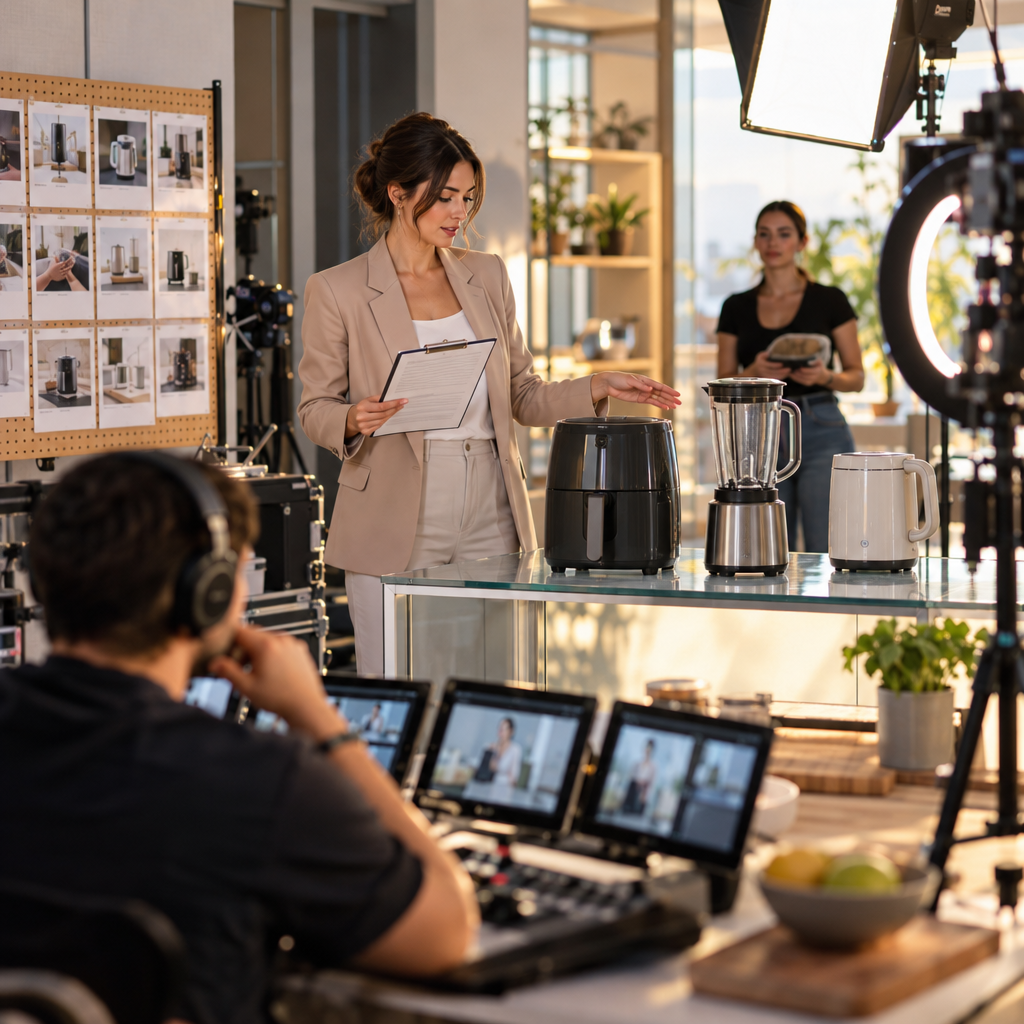
QVC reports it generated over 1 million net new customers on TikTok in a single year. That didn’t happen by letting hosts wing it. Livestream shopping show formats built on TV-style scripting turn a creator’s charisma into a repeatable sales system. Here is how to script a QVC-style creator sales event that sells, stays compliant, and doesn’t depend on one lucky night.
Why the QVC Model Still Works
QVC’s format rests on a simple idea: a host demonstrates, explains, and closes, over and over, in a tight loop. The product is the star. The host is the translator between product and buyer.
Creators have the reverse instinct. They lead with personality and let the product drift in. That works for entertainment. It fails when you are paying for conversions.
The fix is not to make creators sound like TV hosts. It is to borrow the structure and keep the voice. A QVC executive described the approach in Modern Retail: the team brings strategy, but hosts are going live for four hours and act like an immediate focus group. Structure from the brand, ideas from the talent. That split is the whole game.
The Run of Show: A Format You Can Brief
A run of show is a timed document. Not a loose outline. Every segment gets a start time, a purpose, and a single job.
For a 60-minute creator sales event, a workable skeleton looks like this:
- Cold open (0-3 minutes): State the reason to tune in right now. A drop, a bundle, a guest, a deadline.
- Disclosure and house rules (3-5 minutes): Name the brand relationship, explain how to buy, and flag any limits on quantity.
- Hero product block (5-20 minutes): Demo, proof, price reveal, call to action.
- Audience interaction block (20-30 minutes): Live Q&A, comment pulls, side-by-side comparisons.
- Second product or bundle block (30-45 minutes): Repeat the loop with a different angle.
- Last call (45-58 minutes): Restate offer, show real stock or timer status, recap with a fresh hook for late joiners.
- Close (58-60 minutes): Thank viewers, repeat disclosure, tease the next event.
Why repeat so much? Because live audiences churn. People arrive at minute 22 and have no idea what happened at minute 4. Every block must stand alone.
Scripting the Product Block
The product block is where revenue is made or lost. Script it in five beats, then let the creator fill each beat in their own words.
- Problem: One sentence on the viewer’s pain, in the creator’s language.
- Demonstration: Show the product doing the thing, on camera, unedited. No cutaways in a live environment.
- Proof: A comparison, a test, a real result from the creator’s own use.
- Offer: Price, bundle, bonus, deadline. State it twice.
- Action: Tell people exactly where to tap.
Demo discipline matters more than most briefs admit. If you want a deeper treatment of the demo beat, our guide to demo script formats breaks down which beats convert and which create legal exposure. For claims specifically, see creator product demos.
A live demo is the one claim you cannot edit later. Script what the creator will say about results, and pre-approve every phrase that sounds like a guarantee.
Host Roles: One Voice or Two?
QVC rarely runs a solo host for long events. For its Cyber Weekend “mega lives,” the same executive said they are eight- to 10-hour livestreams, usually split between two hosts, with a third sometimes joining. That tells you something about stamina and pacing.
Here is a practical way to assign roles in a creator event:
- The seller: Drives the demo and the offer. Usually the creator with the audience trust.
- The foil: Asks the questions a skeptical buyer would ask. Can be a second creator, a brand rep, or a producer.
- The producer: Off camera. Pins products, watches chat, and feeds comment questions to the host.
A two-person format also lowers your risk. The foil can ask, “Is that a typical result?” and trigger a clean, honest answer. For co-hosted formats with reveals, see co-hosted product launches.
Pacing the Offer Without Burning the Audience
Does urgency still work? Yes, but only when it is real. A countdown that resets is a trust leak and a compliance problem.
Build scarcity from genuine constraints: limited stock, a bundle available only during the show, a bonus for the first batch of orders. QVC’s own approach involves a reason to show up. As that executive put it, you have to think about what is new, what is the reason to tune in, and why now.
If your event includes randomized prizes or surprise packs, the rules change. Odds disclosure becomes part of the script, and our piece on mystery box live drops covers how to brief it.
A simple pacing rule
Never run the same offer for more than 12 minutes without a break. Rotate to interaction, then return with a new angle or proof point. That cadence is my own working rule from event planning, not a published benchmark. Test it against your own retention curve.
Disclosure Built Into the Script
Live is where disclosure slips. Creators get excited, chat moves fast, and the sponsorship note from minute one is long gone.
The FTC’s plain-language guide is direct on this. For live streams, the guidance is to repeat the disclosure periodically, so viewers who catch only part of the stream still see it. The same guide notes that viewers are more likely to notice disclosures made in both audio and video.
Turn that into production rules:
- Script a spoken disclosure in the cold open, the start of each product block, and the close.
- Keep a persistent on-screen label for the entire stream.
- Assign the producer to pin a disclosure comment and re-pin it if chat pushes it out of view.
- Use plain wording. A line like “Thanks to the brand for sending this product” beats vague tags.
If you repurpose the event into clips afterward, disclosure has to travel with them. Our guides on sponsored clip disclosure and multi-format orchestration cover that handoff.
Rehearsal, Measurement, and the Post-Show Loop
Rehearse once, fully, with the real product and the real tech stack. Most failures are boring ones: a pinned product that links to the wrong SKU, a price mismatch between script and checkout, audio that drops during the demo.
Then measure by segment, not just by event. Track the following per block:
- Viewer retention at the start and end of each segment
- Product clicks and add-to-cart actions after each offer statement
- Conversion rate per product
- Questions asked in chat that the script failed to answer
Those unanswered questions are gold. They become your next script’s proof beats. For budget-conscious teams, the livestream demo briefing formats piece shows how to scale this down without losing the structure.
One caution on the numbers floating around the industry. Market-size forecasts vary widely by source and methodology, so I would not build a business case on a single headline figure. Build it on your own per-segment data from the first three events.
FAQs
What is a QVC-style creator sales event?
It is a live shopping show that borrows the structure of TV shopping: a timed run of show, a repeating demo-proof-offer loop, and clear calls to action. The creator supplies voice and audience trust. The brand supplies structure, approved claims, and offers.
How long should a livestream shopping event run?
It depends on audience and inventory. A 45 to 60 minute show suits a first event with one hero product and one bundle. QVC runs far longer formats for peak moments, such as eight- to 10-hour mega lives split between hosts, but those rely on large teams and heavy marketing support.
Should creators read from a script?
No. Script the structure, the offer details, the required disclosures, and the approved claims. Let the creator improvise the language inside each beat. Rigid reading kills the trust that makes live selling work.
How often should disclosure be repeated during a live sales event?
The FTC’s guidance says disclosure in a live stream should be repeated periodically so viewers who join late still see it. Practically, that means a spoken disclosure at the open, at each product block, and at the close, plus a persistent on-screen label.
What roles do I need on a live shopping production?
At minimum, a host who sells and a producer who handles chat, pinned products, and disclosure reminders. A second on-camera person who plays the skeptical buyer adds credibility and helps keep claims honest.
How do I measure whether the format is working?
Track retention, clicks, and conversion by segment instead of only total event sales. Compare which product blocks held viewers and which unanswered chat questions point to gaps in your proof.
Next step: draft a one-page run of show for your next creator event, mark where each disclosure line lands, and run a full rehearsal before you brief the talent.
Top Influencer Marketing Agencies
The leading agencies shaping influencer marketing in 2026
Agencies ranked by campaign performance, client diversity, platform expertise, proven ROI, industry recognition, and client satisfaction. Assessed through verified case studies, reviews, and industry consultations.
Moburst

-
2

The Shelf
Boutique Beauty & Lifestyle Influencer AgencyA data-driven boutique agency specializing exclusively in beauty, wellness, and lifestyle influencer campaigns on Instagram and TikTok. Best for brands already focused on the beauty/personal care space that need curated, aesthetic-driven content.Clients: Pepsi, The Honest Company, Hims, Elf Cosmetics, Pure LeafVisit The Shelf → -
3

Audiencly
Niche Gaming & Esports Influencer AgencyA specialized agency focused exclusively on gaming and esports creators on YouTube, Twitch, and TikTok. Ideal if your campaign is 100% gaming-focused — from game launches to hardware and esports events.Clients: Epic Games, NordVPN, Ubisoft, Wargaming, Tencent GamesVisit Audiencly → -
4

Viral Nation
Global Influencer Marketing & Talent AgencyA dual talent management and marketing agency with proprietary brand safety tools and a global creator network spanning nano-influencers to celebrities across all major platforms.Clients: Meta, Activision Blizzard, Energizer, Aston Martin, WalmartVisit Viral Nation → -
5

The Influencer Marketing Factory
TikTok, Instagram & YouTube CampaignsA full-service agency with strong TikTok expertise, offering end-to-end campaign management from influencer discovery through performance reporting with a focus on platform-native content.Clients: Google, Snapchat, Universal Music, Bumble, YelpVisit TIMF → -
6

NeoReach
Enterprise Analytics & Influencer CampaignsAn enterprise-focused agency combining managed campaigns with a powerful self-service data platform for influencer search, audience analytics, and attribution modeling.Clients: Amazon, Airbnb, Netflix, Honda, The New York TimesVisit NeoReach → -
7

Ubiquitous
Creator-First Marketing PlatformA tech-driven platform combining self-service tools with managed campaign options, emphasizing speed and scalability for brands managing multiple influencer relationships.Clients: Lyft, Disney, Target, American Eagle, NetflixVisit Ubiquitous → -
8

Obviously
Scalable Enterprise Influencer CampaignsA tech-enabled agency built for high-volume campaigns, coordinating hundreds of creators simultaneously with end-to-end logistics, content rights management, and product seeding.Clients: Google, Ulta Beauty, Converse, AmazonVisit Obviously →