


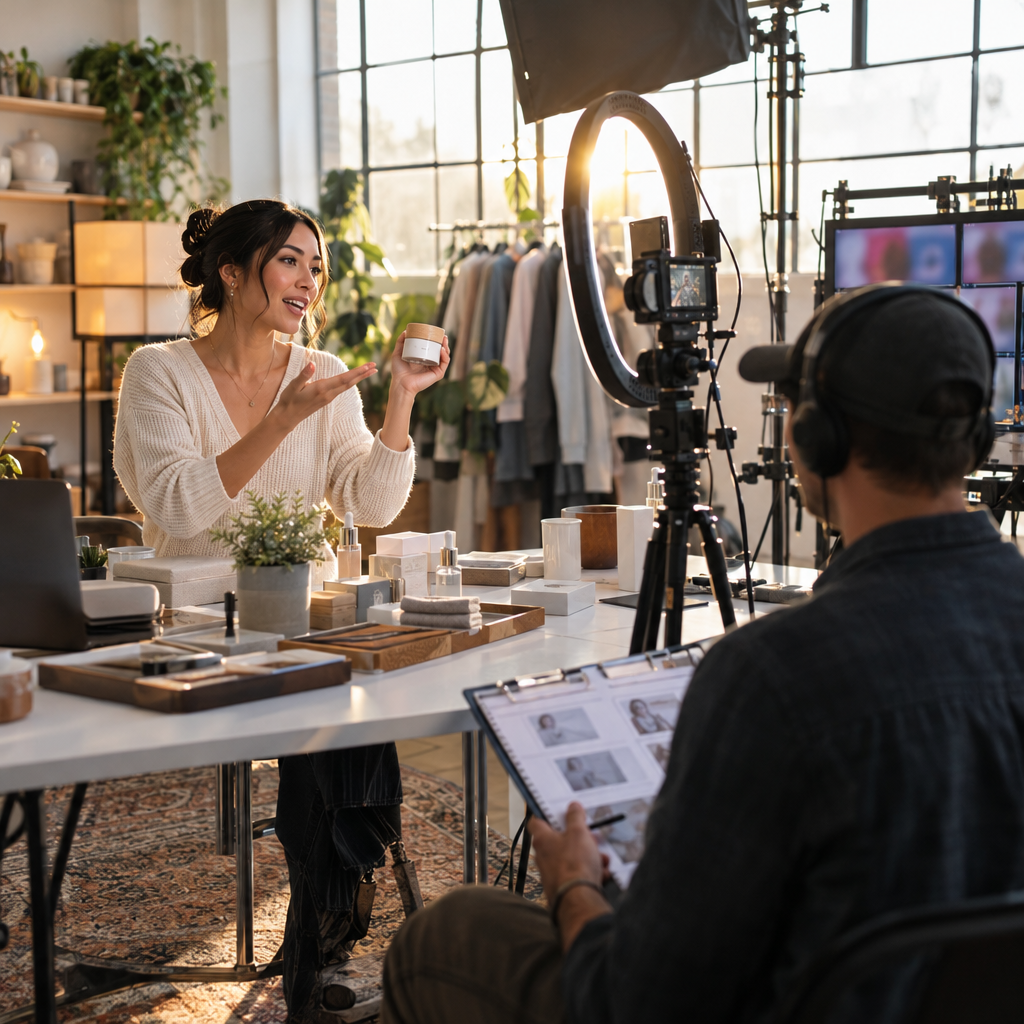
Brands often make a mistake with creator-led product demos. Live demos fail or convert based on format, not charisma. This breakdown covers the five demo formats worth running in livestream shopping campaigns, when each one earns its budget, and what to lock down before going live.
Why format choice matters more than the host
The market is not niche anymore. EMARKETER forecasts US livestream retail ecommerce sales of $19.8 billion this year, up 35% year over year, with more than 58 million US consumers expected to buy through a livestream.
Category fit varies, though. Adobe data in the EMARKETER report shows 28% of livestream shoppers have bought beauty or skincare products, which makes it one of the format’s leading categories. A demo-friendly product is a visible, tactile, explainable one.
So the real planning question is not “which creator?” first. It is “which demo format fits this product, this platform and this risk profile?” Pick the creator second.
The five demo formats, compared
1. The single-hero deep dive
One product. Thirty to sixty minutes. The creator shows setup, use, results and objections in real time.
Best for high-consideration items: appliances, skincare devices, tools. It builds the most trust per product, but it caps your reach in the cart. Viewers who don’t care about the hero leave. Use it when average order value is high and the product needs proof, not browsing.
2. The rotating lineup
Here the creator cycles through a range, giving each item a short slot. TikTok’s own seller guidance leans this way. TikTok Shop’s LIVE selling guide says streams with 10+ items see 2x higher shopping bag clicks, and that over 50% of sales come from viewers scrolling the cart rather than the item being actively demoed.
Read that second number twice. Your demo is a traffic driver, not the only conversion event. Cart hygiene (titles, pricing, stock) matters as much as the on-camera pitch.
3. The side-by-side showdown
The creator tests your product against a competitor or an older version, live. It is persuasive and it is risky. Every comparative claim becomes something legal has to defend. If you run this format, borrow the discipline from versus video briefing and agree on the test conditions before the stream, not during it.
4. The Q&A consultation
Less pitch, more advice. The creator takes questions and demonstrates answers on the product. This suits beauty, wellness and hobby categories where shoppers arrive with specific problems.
Adobe data in the EMARKETER report backs the logic: brands cite live chat interaction (46%) as one of the most effective engagement tactics for driving live shopping purchases. For the trust mechanics, see how AMA livestreams are briefed.
5. The co-hosted reveal
Two hosts, or a creator plus a brand rep, unveil a launch with a demo built in. It carries the highest production load and the highest event energy. Use it for launches only, and script the reveal moments tightly. The co-hosted launch playbook covers what to lock in advance.
A demo does not have to close the sale on camera. According to TikTok Shop’s LIVE selling guide, over 50% of sales come from viewers scrolling the cart, so treat the pitch as the spark and the cart as the checkout.
A run-of-show that holds up
Whatever format you choose, the structure underneath is similar. Here is a pacing skeleton I’d hand to any creator:
- Open with the hook (first 3 minutes): a problem, a result or a deal teaser. Not a long intro.
- Demo in real conditions: real use, real timing, no off-camera edits. Live audiences smell staging.
- Handle one objection out loud: price, sizing, durability. Pre-pick it from your support tickets.
- Call to action with a pinned product: tell viewers exactly where to tap.
- Repeat the loop: late arrivals need the hook, the demo and the CTA again.
On pinning, TikTok’s guidance suggests starting with hero products and giving at least 10 to 15 minutes in a 2 hour LIVE before switching pins. Frantic pin-swapping kills the viewer’s ability to buy.
Need a reusable script structure? The demo script formats guide breaks down the beats.
Compliance is part of the format
Live is the hardest place to disclose well, because viewers drop in and out. The FTC is direct on this. Its Disclosures 101 guidance says that when an endorsement is made in a live stream, the disclosure should be repeated periodically so viewers who only see part of the stream still get it.
Practical implications for your brief:
- Require an on-screen disclosure overlay for the full stream, plus a spoken one at set intervals.
- Give creators an approved claims sheet. Ad-libbed performance claims are the biggest live risk.
- Name who monitors chat and can message the creator mid-stream if a claim drifts.
- Decide in advance what happens to the replay. If you plan to cut it into clips, secure those rights in the contract.
For the claims side, demo claim briefing is the companion read. It pairs well with your legal review step.
What happens after the stream ends?
Brands often treat the end of the stream as the end of the campaign. The data says otherwise. Adobe figures in the EMARKETER report show that 24% of purchases happen after a livestream ends.
That has two consequences. First, keep codes and links live for a defined window after the stream. Second, plan the replay and clips as sales assets. A single shoot can feed several outputs, which is the idea behind multi-format orchestration.
Choosing a format: a quick decision filter
- High price, needs proof: single-hero deep dive.
- Broad catalog, impulse-friendly: rotating lineup.
- Crowded category, strong product edge: side-by-side, with legal sign-off.
- Advice-led category: Q&A consultation.
- New launch with a news hook: co-hosted reveal.
Measure each by more than sales during the stream. Track peak concurrent viewers, cart clicks per viewer, post-stream conversions via code or link, and compliance incidents. That last metric gets ignored until it costs something.
Your next step: pick one upcoming launch, assign it a single format from the filter above, and write the disclosure interval and post-stream code window into the brief before you contact a creator.
FAQs
What is a creator-led product demo in livestream shopping?
It is a live broadcast where a creator uses, tests or explains a product on camera while viewers can buy it through pinned links or a shopping cart on the platform, such as TikTok Shop LIVE or Whatnot.
Which demo format converts best?
Which format works best depends on the product. Single-hero deep dives suit expensive products that need proof. Test formats against your own cart click and post-stream conversion data.
How often should creators disclose a partnership during a livestream?
The FTC says the disclosure should be repeated periodically so viewers who join mid-stream still see it. Many brands add a persistent on-screen label and a spoken reminder at fixed intervals. Put the interval in the brief.
How long should a livestream shopping demo run?
Plan for the format. Deep dives can work in 30 to 60 minutes. Lineup-style streams often run longer, and TikTok’s guidance references 2 hour LIVE sessions when discussing pin timing. Longer streams need a repeated hook so late joiners understand the offer.
Should brands measure sales after the stream ends?
Yes. Adobe data in the EMARKETER report indicates 24% of purchases happen after the stream ends. Keep promo codes and product links active for a defined window and attribute those sales to the stream.
Can we reuse the livestream replay as ad content?
Only if the contract grants those rights and the claims in the replay are approved. Clips also need the disclosure to stay visible, so check each cut before it runs as paid media.
Top Influencer Marketing Agencies
The leading agencies shaping influencer marketing in 2026
Agencies ranked by campaign performance, client diversity, platform expertise, proven ROI, industry recognition, and client satisfaction. Assessed through verified case studies, reviews, and industry consultations.
Moburst

-
2

The Shelf
Boutique Beauty & Lifestyle Influencer AgencyA data-driven boutique agency specializing exclusively in beauty, wellness, and lifestyle influencer campaigns on Instagram and TikTok. Best for brands already focused on the beauty/personal care space that need curated, aesthetic-driven content.Clients: Pepsi, The Honest Company, Hims, Elf Cosmetics, Pure LeafVisit The Shelf → -
3

Audiencly
Niche Gaming & Esports Influencer AgencyA specialized agency focused exclusively on gaming and esports creators on YouTube, Twitch, and TikTok. Ideal if your campaign is 100% gaming-focused — from game launches to hardware and esports events.Clients: Epic Games, NordVPN, Ubisoft, Wargaming, Tencent GamesVisit Audiencly → -
4

Viral Nation
Global Influencer Marketing & Talent AgencyA dual talent management and marketing agency with proprietary brand safety tools and a global creator network spanning nano-influencers to celebrities across all major platforms.Clients: Meta, Activision Blizzard, Energizer, Aston Martin, WalmartVisit Viral Nation → -
5

The Influencer Marketing Factory
TikTok, Instagram & YouTube CampaignsA full-service agency with strong TikTok expertise, offering end-to-end campaign management from influencer discovery through performance reporting with a focus on platform-native content.Clients: Google, Snapchat, Universal Music, Bumble, YelpVisit TIMF → -
6

NeoReach
Enterprise Analytics & Influencer CampaignsAn enterprise-focused agency combining managed campaigns with a powerful self-service data platform for influencer search, audience analytics, and attribution modeling.Clients: Amazon, Airbnb, Netflix, Honda, The New York TimesVisit NeoReach → -
7

Ubiquitous
Creator-First Marketing PlatformA tech-driven platform combining self-service tools with managed campaign options, emphasizing speed and scalability for brands managing multiple influencer relationships.Clients: Lyft, Disney, Target, American Eagle, NetflixVisit Ubiquitous → -
8

Obviously
Scalable Enterprise Influencer CampaignsA tech-enabled agency built for high-volume campaigns, coordinating hundreds of creators simultaneously with end-to-end logistics, content rights management, and product seeding.Clients: Google, Ulta Beauty, Converse, AmazonVisit Obviously →