


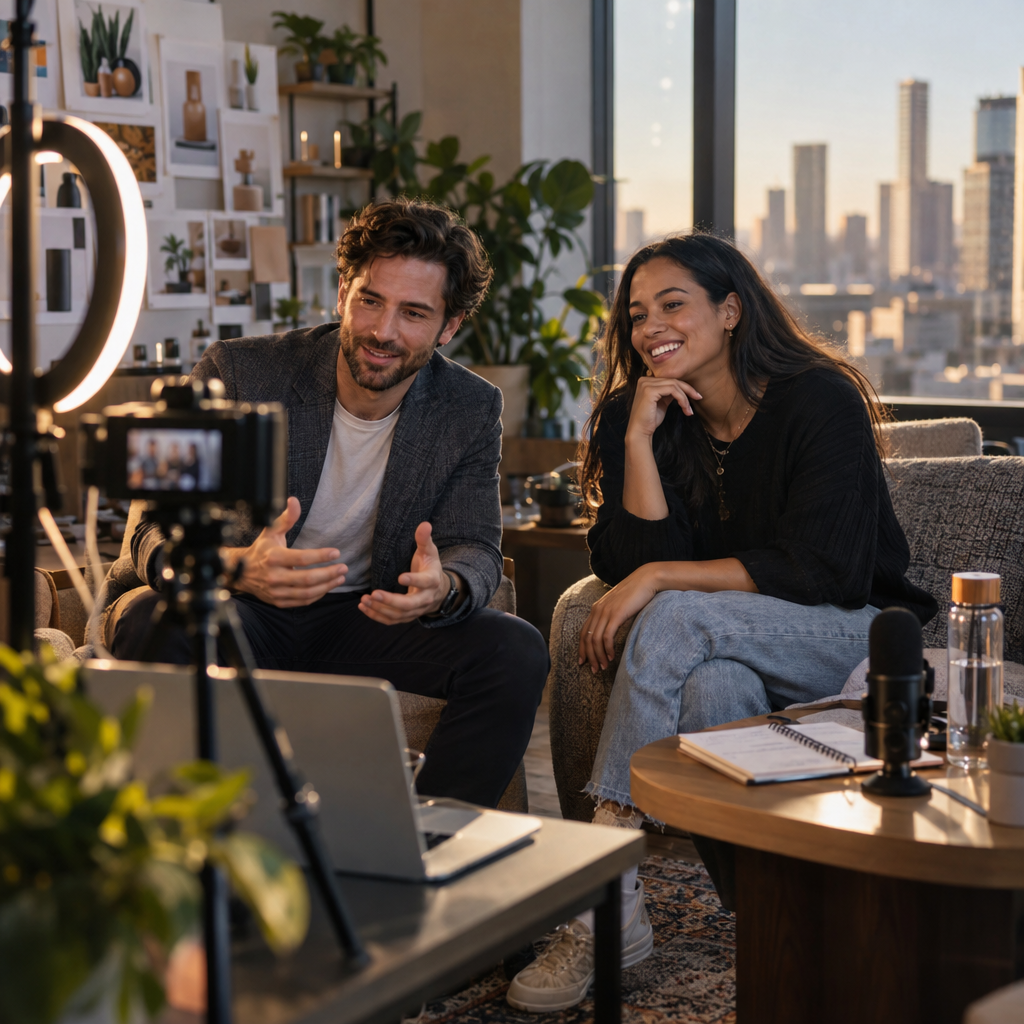
Your studio livestream cost five figures and the chat is dead. A creator’s kitchen-counter stream, with a ring light and a dog barking offstage, is selling out. Unscripted livestream formats keep beating polished production because viewers read polish as advertising. This piece explains why, how to brief raw without losing control, and what to measure.
Why does polish backfire on live?
Live video has one job that edited video cannot do: prove nothing was staged. A viewer can ask a question and watch the answer happen. A studio set with teleprompter delivery quietly cancels that advantage.
Think about what the audience is actually evaluating. They are not grading your lighting. They are asking whether this person really uses the product and whether they will say something inconvenient about it. Rough edges are evidence. A creator who fumbles a cap, laughs at a mistake, or says “huh, I didn’t expect that” is giving the viewer proof you cannot buy with a bigger crew.
TikTok’s own guidance for brands on LIVE leans the same way. TikTok’s LIVE best-practice guide frames the format around real-time interaction, reading comments, answering questions, and involving viewers. It recommends a clear narrative such as a demo, tutorial, or Q&A, plus a quiet, well-lit space with clear audio. Notice what is absent: nothing about a studio build-out. The bar is audible and visible, not cinematic.
Technical quality is a floor, not a ceiling. Clear audio, stable framing, and a steady connection are non-negotiable. Everything above that floor is where studio budgets stop paying back.
The cost side nobody puts in the deck
Studio production does not just cost more per hour. It changes what you can do.
- Fewer sessions. A rented set and crew means you stream monthly. A creator at home can go live weekly or daily, and frequency builds the habit that makes an audience show up.
- Slower response. Live commerce rewards reacting to a stock drop, a viral comment, or a competitor’s misstep. A booked studio cannot pivot.
- Stiffer talent. Creators perform differently under lights and a script. Their best selling language, the offhand and slightly funny kind, tends to disappear.
- Harder testing. You can run four cheap formats for a month and keep the winner. You cannot do that with one expensive one.
The budget logic flips. Instead of one big production, fund many small attempts and put the savings into creator fees, product sampling, and moderation. That is where live results actually come from.
What “unscripted” should and should not mean
Here is where agencies get nervous, and fairly so. Unscripted is not unbriefed.
The difference is between scripting words and scripting guardrails. A good brief for a live format tells the creator what must be true and what must never happen, then gets out of the way. If you have read our piece on briefing raw video, the same principle applies here, only with higher stakes because there is no edit button.
A workable live brief has five parts:
- Run of show, not a script. Three to five beats (open, demo, audience questions, offer, close) with rough timing. The creator chooses the language.
- Claim boundaries. A short list of approved statements and a longer list of banned ones (health, income, comparative claims). Hand it over as a one-pager the creator can glance at mid-stream.
- Disclosure plan. Who says what, when, and how often. More on this below.
- Escalation path. A named person in a private channel who can reach the creator fast if something goes wrong.
- Off-limits topics. Competitors, pricing promises you have not cleared, anything legal is watching.
This is the same discipline we describe in scripting what to reveal: decide in advance what stays private, then let everything else be real.
Disclosure on a stream that never stops
Live is where compliance quietly breaks. A creator mentions the sponsorship in the first minute. Forty minutes later, a new viewer arrives who never heard it.
The FTC addresses this directly. In its Disclosures 101 for Social Media Influencers, the agency says that when an endorsement happens in a live stream, the disclosure should be repeated periodically so viewers who only see part of the stream still get it. A one-time opener does not cover you.
Build that into the run of show, not into the creator’s memory. Practical options:
- Put a persistent on-screen label or pinned comment in place from the start.
- Schedule a spoken reminder at each beat transition.
- Assign a moderator to repost the disclosure in chat whenever the stream gets a surge of new viewers.
- Capture the full recording and chat log for your compliance file.
The rawness you want and the disclosure you need are not in conflict. A creator saying “this is a paid partnership, and I’ll tell you if I hate it” is more credible than a clean legal slide. For related thinking on keeping disclosure natural, see our guide to native-style disclosure.
Formats that hold up without a script
Not every format tolerates improvisation equally. These do well because the structure is carried by the interaction itself.
Live Q&A with the product in hand. The audience supplies the script. The creator answers honestly, including “I don’t know, let me check.” That admission is worth more than a rehearsed answer.
Unboxing and first-use. Genuine first reactions cannot be faked well. Send the product late so the surprise is real, and brief the claims boundaries before it ships.
Working sessions. A creator cooks, styles, packs orders, or builds something while talking. Attention rests on the task, so the chat can wander and nobody minds. It overlaps with the logic of a production diary series, only live.
Live comparison or challenge. Two products, one creator, open verdict. Risky for brands, which is why it needs the strongest claims brief, and why it persuades so well.
When to keep some structure
Regulated categories (supplements, finance, children’s products) and big product launches justify tighter control. Use a lightly produced setup with a hard claims checklist and a moderator. Keep the host human, just not improvised on the claims.
Measuring whether rough is working
Do not judge a live format by the same view counts as a produced video. Track what signals intent:
- Average watch time per viewer, not peak concurrents.
- Comment rate and question volume, which show whether the audience feels safe to ask.
- Conversion from live to checkout, attributed with a creator-specific code or link.
- Replay performance, since good unscripted moments clip well into short-form.
- Cost per session against output, which is where the studio comparison usually settles it.
Those replays matter more than most teams realize. A live stream is a quarry for clips, and creator moments that already earned trust are easier to put spend behind. Our briefing notes on ad-ready creator video cover the rights and disclosure checks to settle before you boost any of it.
One honest caveat: I would not claim rough always wins. A poorly lit stream with muffled audio loses viewers in seconds, and a creator with no rapport will flounder without a script. The advantage goes to teams that pick the right creator, hold the technical floor, and brief boundaries instead of lines.
FAQs
What are unscripted livestream formats?
They are live broadcasts built on a run of show rather than a word-for-word script. The creator chooses the language and responds to the chat in real time, while the brand sets claim boundaries, disclosure timing, and escalation rules.
Do unscripted livestreams really outperform studio production?
Often, but it depends on the creator and the category. Viewers use live video to check authenticity, and a heavily produced set can undercut that. The cost savings also allow more sessions, which makes testing and audience habit-building easier. Measure watch time, questions, and checkout conversion for your own audience rather than assuming.
How often should a creator repeat the sponsorship disclosure on a live stream?
Periodically throughout the stream. The FTC’s guidance for influencers says disclosures in live streams should be repeated so that viewers who join partway through still see them. Build repeats into each segment change and use a pinned comment or on-screen label as a backup.
How do I keep an unscripted stream brand-safe?
Brief guardrails, not lines. Give the creator an approved and banned claims list, off-limits topics, and a named contact who can reach them live. Assign a moderator, record the full stream, and keep the chat log for compliance review.
What equipment does a creator actually need?
Enough for a stable, clear experience. TikTok’s guidance points to a well-lit, quiet space, clear audio, a stable camera setup, and a trial stream to confirm connection quality. Spend on a decent microphone and lighting before anything else.
Which products suit unscripted live formats best?
Products that can be demonstrated and questioned in real time, such as beauty, food, apparel, and home goods. Highly regulated categories can still use live, but with a tighter claims checklist and a moderator.
Next step: pick one creator, one product, and a five-beat run of show, then test a weekly home-setup stream for a month against your last studio session’s cost per checkout.
Top Influencer Marketing Agencies
The leading agencies shaping influencer marketing in 2026
Agencies ranked by campaign performance, client diversity, platform expertise, proven ROI, industry recognition, and client satisfaction. Assessed through verified case studies, reviews, and industry consultations.
Moburst

-
2

The Shelf
Boutique Beauty & Lifestyle Influencer AgencyA data-driven boutique agency specializing exclusively in beauty, wellness, and lifestyle influencer campaigns on Instagram and TikTok. Best for brands already focused on the beauty/personal care space that need curated, aesthetic-driven content.Clients: Pepsi, The Honest Company, Hims, Elf Cosmetics, Pure LeafVisit The Shelf → -
3

Audiencly
Niche Gaming & Esports Influencer AgencyA specialized agency focused exclusively on gaming and esports creators on YouTube, Twitch, and TikTok. Ideal if your campaign is 100% gaming-focused — from game launches to hardware and esports events.Clients: Epic Games, NordVPN, Ubisoft, Wargaming, Tencent GamesVisit Audiencly → -
4

Viral Nation
Global Influencer Marketing & Talent AgencyA dual talent management and marketing agency with proprietary brand safety tools and a global creator network spanning nano-influencers to celebrities across all major platforms.Clients: Meta, Activision Blizzard, Energizer, Aston Martin, WalmartVisit Viral Nation → -
5

The Influencer Marketing Factory
TikTok, Instagram & YouTube CampaignsA full-service agency with strong TikTok expertise, offering end-to-end campaign management from influencer discovery through performance reporting with a focus on platform-native content.Clients: Google, Snapchat, Universal Music, Bumble, YelpVisit TIMF → -
6

NeoReach
Enterprise Analytics & Influencer CampaignsAn enterprise-focused agency combining managed campaigns with a powerful self-service data platform for influencer search, audience analytics, and attribution modeling.Clients: Amazon, Airbnb, Netflix, Honda, The New York TimesVisit NeoReach → -
7

Ubiquitous
Creator-First Marketing PlatformA tech-driven platform combining self-service tools with managed campaign options, emphasizing speed and scalability for brands managing multiple influencer relationships.Clients: Lyft, Disney, Target, American Eagle, NetflixVisit Ubiquitous → -
8

Obviously
Scalable Enterprise Influencer CampaignsA tech-enabled agency built for high-volume campaigns, coordinating hundreds of creators simultaneously with end-to-end logistics, content rights management, and product seeding.Clients: Google, Ulta Beauty, Converse, AmazonVisit Obviously →