


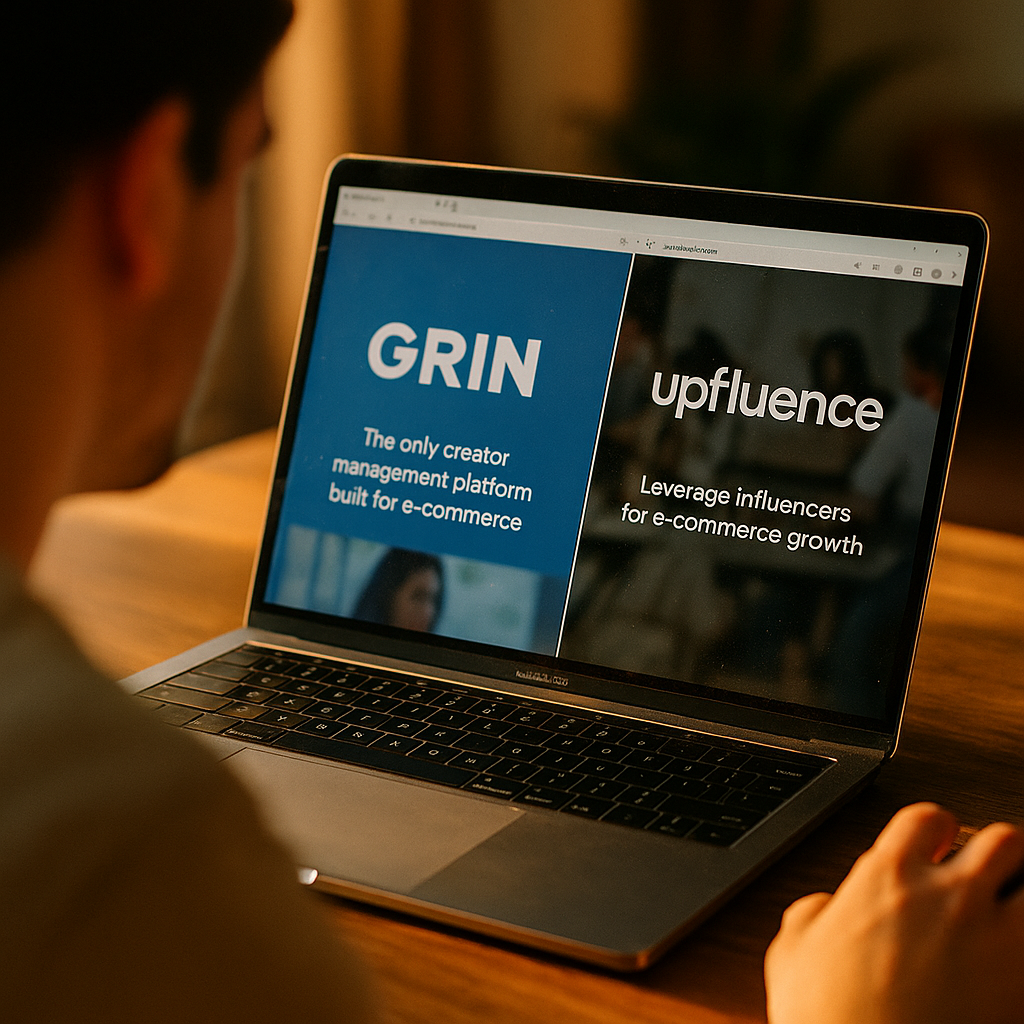
Finding the right influencer marketing platform can define the growth trajectory of D2C brands competing in 2025. This comparative review of GRIN vs. Upfluence for D2C brands explores both platforms in depth, guiding you toward a data-driven decision. Discover which solution best aligns with your direct-to-consumer marketing needs and what sets them apart in today’s dynamic landscape.
GRIN Features for D2C Brand Success
GRIN has emerged as a go-to influencer marketing platform, tailored for eCommerce and D2C brands. Its core features are built to streamline every stage of influencer collaboration, from discovery to campaign execution. With a robust CRM, GRIN integrates seamlessly with major e-commerce platforms like Shopify, WooCommerce, and Magento, reflecting its deep understanding of direct-to-consumer business models.
- Influencer Discovery: Access to a vast global database with AI-powered search filters lets brands find creators by niche, engagement rate, audience demographics, and more.
- Relationship Management: The built-in CRM not only helps organize workflows but also tracks outreach, negotiations, and terms, minimizing friction.
- Content Management: GRIN centralizes campaign deliverables, contracts, and creative assets to ensure every piece of branded content is on-brand and timely.
- Sales Attribution: Advanced analytics connect influencer efforts directly to sales and ROI using customized affiliate links and discount codes.
For D2C brands focused on scaling influencer efforts without losing personal touch, GRIN’s focus on automation and integration makes it a strong contender.
Upfluence Platform Pros and Cons
Upfluence is often spotlighted for its sophisticated influencer search capabilities—a pivotal feature for D2C brands aiming for precise customer targeting. The platform claims over 4 million influencer profiles, allowing for highly filtered searches by demographics, location, engagement history, and authenticity metrics.
- All-in-One Suite: Upfluence unifies influencer search, outreach, campaign management, and payment tracking within a cohesive dashboard.
- E-commerce Integrations: Notably compatible with Shopify, WooCommerce, and similar platforms, Upfluence imports existing customer and ambassador data for richer targeting.
- Real-Time Analytics: The platform offers in-depth reporting tools analyzing campaign reach, audience resonance, and resulting conversions.
- Cons: Some users in 2025 cite a steeper onboarding curve and higher upfront costs compared to GRIN, especially for small- to mid-sized D2C companies.
Upfluence is designed for scale and discovery. However, brands will want to weigh its powerful features against potential challenges with user experience and budget fit.
Comparing Influencer Discovery and Recruitment
Influencer sourcing is at the heart of any successful D2C marketing campaign. Comparing GRIN vs. Upfluence for D2C brands, both platforms deliver intelligent search capabilities, but their approaches have subtle differences.
- GRIN: Focuses on quality and relationship building, integrating influencer vetting into the workflow. D2C brands can shortlist and track outreach progress easily, reducing the chance of duplicate or cold contacts.
- Upfluence: Prioritizes depth and breadth, delivering real-time updates on influencer availability and recent activity. Unique filters help identify micro-influencers with viral potential or established ambassadors within a brand’s existing database.
For D2C brands looking for granular insights and hands-on talent curation, GRIN’s recruitment tools excel. Brands seeking fast-scaling campaigns with access to vast networks often lean towards Upfluence for its database depth.
Campaign Management and Performance Analytics
Measuring the real impact of influencer collaborations is vital in 2025, as D2C brands demand clear ROI. Both GRIN and Upfluence employ comprehensive campaign management and analytics dashboards but differ in nuance.
- GRIN: Known for its user-friendly interface, GRIN’s dashboard ties individual influencer content performance directly to your e-commerce sales metrics. The reporting suite highlights not just impressions, but revenue and cost-per-acquisition—critical for D2C accountability.
- Upfluence: Offers robust social listening and trend tracking, allowing brands to pivot campaigns based on real-time sentiment and performance spikes. It supports advanced UTM tracking and multi-platform analytics, making it ideal for global D2C campaigns.
If actionable insights and sales data are your top priorities, GRIN’s direct integrations give D2C marketers the edge. For those testing multiple influencer segments or focusing on cross-channel diversification, Upfluence’s analytics sophistication is highly beneficial.
Ease of Use, Support, and Pricing for D2C Brands
Adoption and ongoing platform support can make or break technology investments for fast-growing D2C brands. When considering GRIN vs. Upfluence for D2C brands, ease of onboarding, support resources, and transparent pricing are crucial decision factors.
- GRIN: Praised for its intuitive design and personalized onboarding process, GRIN provides dedicated account managers, extensive tutorials, and prompt support. Its cost, while premium, is justified for brands with clear ROI objectives.
- Upfluence: Although feature-rich, its layered functionalities may feel overwhelming at first. However, the company has invested in expanded knowledge bases, training resources, and multi-language support in 2025. Pricing is customizable, but entry costs may be higher for smaller D2C brands.
GRIN is often favored by D2C startups and intermediate brands needing fast ramp-up and hands-on guidance. Larger D2C enterprises with complex influencer programs may benefit from Upfluence’s comprehensive training and internationalization.
Which Platform Fits Your D2C Brand Best?
The ultimate decision between GRIN vs. Upfluence for D2C brands depends on your campaign goals, team size, and growth stage. Brands prioritizing relationship-driven influencer marketing, transparency in reporting, and smooth integration with their existing tech stack may find GRIN a better match.
Upfluence, with its broad database and powerful segmentation tools, is ideal for brands scaling rapidly across markets, seeking vast discovery options, and managing multi-national campaigns. Assess your strategic priorities—automation, discovery, analytics, and support—when choosing between these two powerhouse platforms.
FAQs on GRIN vs. Upfluence for D2C Brands
- Which is better for small D2C startups: GRIN or Upfluence?
GRIN is generally more user-friendly for startups, offering easier onboarding and focused support, while Upfluence is better suited for brands ready to invest in large-scale influencer discovery.
- Do both platforms integrate with leading e-commerce solutions?
Yes, both GRIN and Upfluence offer seamless integration with platforms like Shopify, WooCommerce, and Magento, aligning with the needs of D2C brands.
- How do the analytics features compare?
GRIN excels at connecting influencer efforts to direct sales, while Upfluence provides deeper social trend tracking and multi-channel analytics, ideal for larger campaigns.
- What about influencer payment processing?
Both platforms provide built-in payment solutions, but Upfluence adds multi-currency support, which can be crucial for global D2C brands.
- Can I migrate from one to the other easily?
Migration is possible, but preparation is needed. GRIN offers white-glove onboarding for new clients, while Upfluence provides data import tools and guided transitions.
Both GRIN and Upfluence drive results for D2C brands, but your brand’s size, goals, and strategy will determine the best fit. Focus on platform alignment with your influencer management needs to ensure efficient growth and maximum ROI in 2025.
Top Influencer Marketing Agencies
The leading agencies shaping influencer marketing in 2026
Agencies ranked by campaign performance, client diversity, platform expertise, proven ROI, industry recognition, and client satisfaction. Assessed through verified case studies, reviews, and industry consultations.
Moburst

-
2

The Shelf
Boutique Beauty & Lifestyle Influencer AgencyA data-driven boutique agency specializing exclusively in beauty, wellness, and lifestyle influencer campaigns on Instagram and TikTok. Best for brands already focused on the beauty/personal care space that need curated, aesthetic-driven content.Clients: Pepsi, The Honest Company, Hims, Elf Cosmetics, Pure LeafVisit The Shelf → -
3

Audiencly
Niche Gaming & Esports Influencer AgencyA specialized agency focused exclusively on gaming and esports creators on YouTube, Twitch, and TikTok. Ideal if your campaign is 100% gaming-focused — from game launches to hardware and esports events.Clients: Epic Games, NordVPN, Ubisoft, Wargaming, Tencent GamesVisit Audiencly → -
4

Viral Nation
Global Influencer Marketing & Talent AgencyA dual talent management and marketing agency with proprietary brand safety tools and a global creator network spanning nano-influencers to celebrities across all major platforms.Clients: Meta, Activision Blizzard, Energizer, Aston Martin, WalmartVisit Viral Nation → -
5

The Influencer Marketing Factory
TikTok, Instagram & YouTube CampaignsA full-service agency with strong TikTok expertise, offering end-to-end campaign management from influencer discovery through performance reporting with a focus on platform-native content.Clients: Google, Snapchat, Universal Music, Bumble, YelpVisit TIMF → -
6

NeoReach
Enterprise Analytics & Influencer CampaignsAn enterprise-focused agency combining managed campaigns with a powerful self-service data platform for influencer search, audience analytics, and attribution modeling.Clients: Amazon, Airbnb, Netflix, Honda, The New York TimesVisit NeoReach → -
7

Ubiquitous
Creator-First Marketing PlatformA tech-driven platform combining self-service tools with managed campaign options, emphasizing speed and scalability for brands managing multiple influencer relationships.Clients: Lyft, Disney, Target, American Eagle, NetflixVisit Ubiquitous → -
8

Obviously
Scalable Enterprise Influencer CampaignsA tech-enabled agency built for high-volume campaigns, coordinating hundreds of creators simultaneously with end-to-end logistics, content rights management, and product seeding.Clients: Google, Ulta Beauty, Converse, AmazonVisit Obviously →