


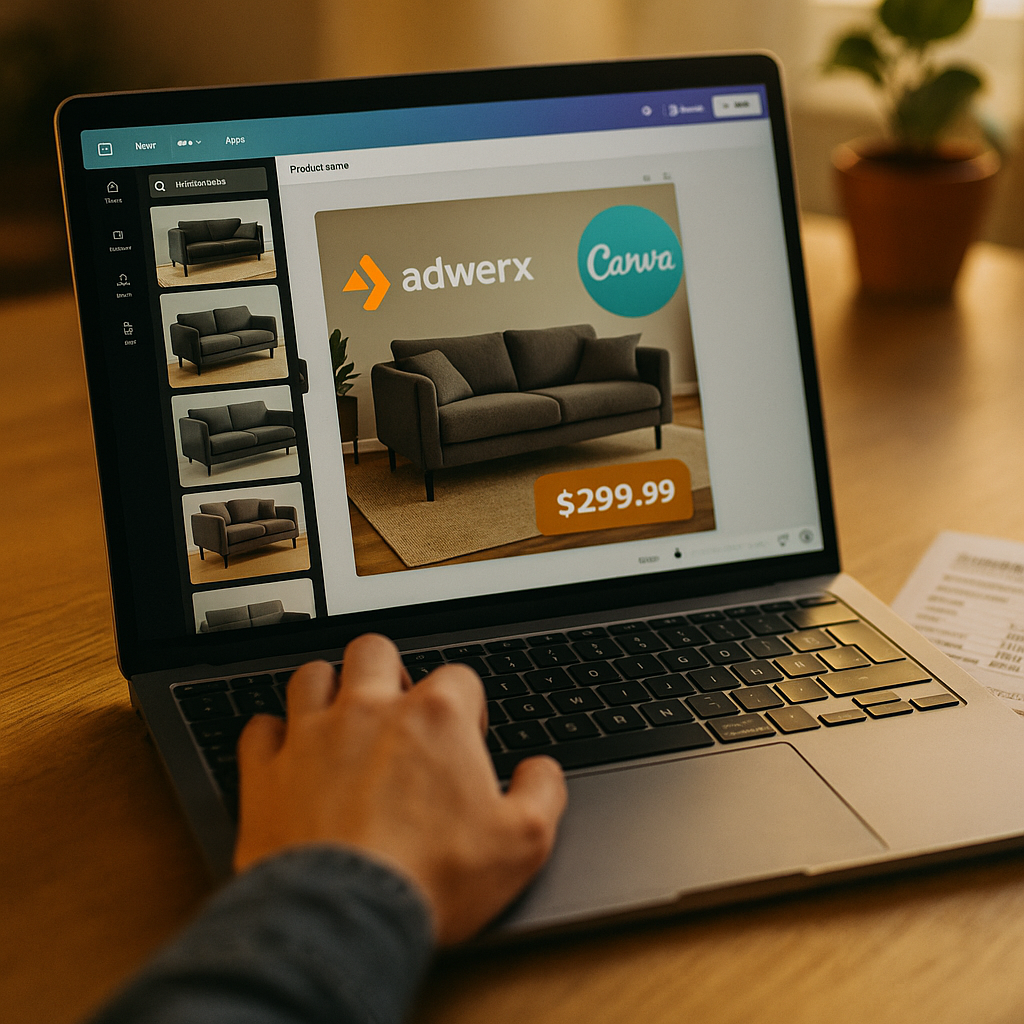
Small-business advertisers waste an average of six hours a week just producing ad creative, according to internal estimates from several self-serve ad platforms. That’s six hours not spent on strategy, budget optimization, or client calls. The Adwerx Canva integration is betting that number can shrink to almost zero, by turning raw product data into finished, brand-compliant ad creative without a designer ever opening a file.
For agencies and brand teams managing dozens (or hundreds) of small-business accounts, this isn’t a nice-to-have feature. It’s a structural shift in how ad production gets scaled.
Why product-data-to-creative automation matters now
Here’s the uncomfortable truth about small-business advertising: most local and SMB campaigns fail not because of bad targeting, but because of bad or nonexistent creative. A real estate agent doesn’t have a design team. A regional HVAC company doesn’t have a brand studio. Yet they’re expected to compete for attention against national brands with unlimited creative budgets.
Adwerx built its reputation serving exactly this segment, real estate, automotive, and local service businesses, by automating ad buying. The Canva integration extends that automation upstream, into the creative production layer itself. Instead of uploading a static banner and hoping it performs, advertisers can now feed in product or listing data (price, photos, address, specs) and have Canva templates auto-populate finished ad units.
The real innovation isn’t that Canva makes design easier. It’s that the data pipeline eliminates the manual handoff between “here’s our inventory” and “here’s an ad that sells it.”
How the walkthrough actually works
Let’s get concrete. The integration follows a fairly simple operational flow, but each step removes a point of friction that used to require a person.
- Data ingestion: Product or listing feeds (MLS data for real estate, inventory feeds for auto dealers, service menus for local businesses) connect directly into Adwerx’s ad engine.
- Template mapping: Pre-built Canva templates are mapped to specific data fields, price goes here, hero image goes there, call-to-action stays fixed per brand guidelines.
- Auto-generation: The system generates ad variants at scale, one per listing, per product, or per service line, without a designer touching each one.
- Brand governance layer: Franchise or agency admins lock down fonts, colors, and logo placement so individual users can’t go off-brand, even while customizing copy or imagery.
- Direct publish: Finished creative pushes straight into Adwerx’s programmatic and social buying flow, no export-import cycle required.
That last point matters more than it sounds. Anyone who’s managed multi-location campaigns knows the export-import cycle is where creative goes to die. Files get resized wrong, versions get lost, someone uploads last month’s pricing. Removing that handoff isn’t just convenience, it’s risk reduction.
What this means for agencies managing multiple SMB clients
If you’re an agency running paid media for twenty small-business clients, creative production is probably your biggest cost center that isn’t headcount-efficient. Every client wants “custom” creative, but few can pay for a dedicated designer’s time.
Automation like this changes the unit economics. When creative generation is driven by data feeds rather than manual design requests, an account manager can spin up compliant, on-brand ads for a new client in minutes rather than days. That’s not a marginal efficiency gain, it’s a different cost structure entirely.
It also changes how agencies pitch retainers. Instead of billing for design hours, agencies can position themselves around strategy, media buying, and optimization, while creative production becomes a near-fixed cost. That’s a healthier margin story for anyone managing SMB accounts at volume.
The compliance angle nobody talks about enough
Real estate and auto advertising carry regulatory weight that generic e-commerce ads don’t. Fair housing language, equal opportunity disclosures, MLS compliance rules, these aren’t optional extras. A designer manually building creative can forget a disclosure. A template-driven system, when built correctly, cannot.
This is where product-data-to-creative automation earns its keep from a risk-management perspective. If the data field for “required disclosure” is mandatory and locked into every template, human error drops dramatically. For brand and legal teams overseeing distributed franchise or agent networks, that’s a meaningful reduction in exposure.
Marketing compliance functions similarly to how FTC guidance treats disclosure requirements in influencer content: the obligation doesn’t go away because volume goes up. If anything, scale increases the odds of a slip-up somewhere in the funnel. Automated, locked templates are one of the few scalable answers to that problem.
Where the real ROI shows up
Marketing leaders evaluating this kind of tool should look past the “it’s easier to design” pitch and focus on three measurable outcomes:
- Time-to-launch. How long from “new listing added” to “ad live”? Manual workflows often take 24-48 hours. Automated pipelines can compress that to under an hour.
- Creative refresh rate. Ad fatigue is real, and social platform benchmarks consistently show performance decay after repeated exposure to the same creative. Automation makes it economically feasible to refresh creative weekly instead of quarterly.
- Cost per creative asset. This is the number CFOs actually care about. If a template system drops the marginal cost of a new ad variant from $40 (designer time) to effectively $0, that reshapes budget allocation across an entire portfolio of local accounts.
None of this replaces strategic creative thinking. Nobody’s claiming automated templates will out-design a top-tier agency’s hero campaign. But for the long tail of small-business advertising, where the alternative is often no professional creative at all, automation isn’t competing with great design. It’s competing with nothing.
What brand teams should watch for before adopting
Not every integration lives up to its demo. Before rolling this out across a client base or franchise network, marketing leads should press on a few operational questions:
- Does the data feed sync in real time, or is there lag between inventory updates and creative refresh?
- Can brand guardrails be enforced at the account level without requiring manual review of every asset?
- What happens when a data field is missing or malformed, does the system fail gracefully or generate broken creative?
- Is there a way to A/B test template variants, or does automation lock you into a single creative approach?
These aren’t hypothetical concerns. Automated pipelines built on messy or inconsistent product data tend to produce automated garbage at scale, just faster than a human would. The value of the Adwerx-Canva pairing depends entirely on data hygiene upstream. Garbage in, garbage out still applies, even when the output looks polished.
This mirrors a pattern showing up across martech more broadly: automation tools are only as reliable as the data infrastructure feeding them. The same logic that governs bulk listing generation accuracy applies here, speed without data integrity just moves the error further downstream.
How this fits the broader AI-in-creative trend
Adwerx isn’t operating in isolation. Google’s Performance Max has leaned hard into AI-driven video resizing to cut production costs, and marketers evaluating AI Max Suite against Google’s native tools are wrestling with similar tradeoffs between control and automation speed. The pattern is consistent across the industry: platforms are racing to remove the human bottleneck between data and finished creative.
What’s notable about the Adwerx approach is its narrow focus. Rather than trying to be a general-purpose AI creative tool, it’s purpose-built for verticals with structured, repeatable data, listings, inventory, service menus. That specificity is probably why it works. General-purpose AI ad generators still struggle with compliance-heavy verticals; a tool built around MLS and dealer feeds doesn’t have that problem because the guardrails are baked into the template architecture from day one.
For marketing teams tracking where their budget should go next, this also connects to a bigger measurement question. Once creative production scales this fast, attribution and reporting need to keep pace too. Teams already wrestling with revenue attribution setups should expect similar complexity when hundreds of auto-generated ad variants enter the funnel simultaneously. More creative volume means more data points to reconcile, not fewer.
Industry data from eMarketer has repeatedly flagged creative production cost as a top barrier for SMB digital ad adoption, right alongside budget constraints. Tools that attack that specific barrier, rather than just optimizing media buying, are addressing the actual chokepoint in SMB marketing growth.
The takeaway for brand and agency leads
If you manage SMB or franchise ad accounts at any real scale, the question isn’t whether to automate creative production, it’s how fast you can do it without sacrificing brand control or compliance. Pilot the Adwerx-Canva workflow on one client vertical, audit the output against your compliance checklist, and measure time-to-launch before rolling it out network-wide.
FAQs
What is the Adwerx Canva integration?
It’s a workflow that connects product or listing data feeds directly to Canva ad templates, automatically generating finished, brand-compliant ad creative without manual design work for each individual asset.
Which industries benefit most from this kind of automation?
Real estate, automotive dealerships, and local service businesses see the biggest gains, since these verticals rely on structured, frequently updated data (listings, inventory, service menus) that maps cleanly to ad templates.
Does automated ad creative hurt performance compared to custom design?
Not necessarily. For long-tail SMB advertisers, the realistic alternative to automated creative is often no professional creative at all, so consistent, on-brand automated ads typically outperform generic or absent creative.
How does this reduce compliance risk?
Locked template fields can enforce mandatory disclosures, such as fair housing language or equal opportunity statements, reducing the chance of human error that comes with manual, ad-by-ad creative production.
What should agencies check before adopting this workflow?
Verify real-time data sync, brand guardrail enforcement, graceful handling of missing data fields, and whether the system supports A/B testing across creative variants before rolling it out at scale.
FAQs
Top Influencer Marketing Agencies
The leading agencies shaping influencer marketing in 2026
Agencies ranked by campaign performance, client diversity, platform expertise, proven ROI, industry recognition, and client satisfaction. Assessed through verified case studies, reviews, and industry consultations.
Moburst

-
2

The Shelf
Boutique Beauty & Lifestyle Influencer AgencyA data-driven boutique agency specializing exclusively in beauty, wellness, and lifestyle influencer campaigns on Instagram and TikTok. Best for brands already focused on the beauty/personal care space that need curated, aesthetic-driven content.Clients: Pepsi, The Honest Company, Hims, Elf Cosmetics, Pure LeafVisit The Shelf → -
3

Audiencly
Niche Gaming & Esports Influencer AgencyA specialized agency focused exclusively on gaming and esports creators on YouTube, Twitch, and TikTok. Ideal if your campaign is 100% gaming-focused — from game launches to hardware and esports events.Clients: Epic Games, NordVPN, Ubisoft, Wargaming, Tencent GamesVisit Audiencly → -
4

Viral Nation
Global Influencer Marketing & Talent AgencyA dual talent management and marketing agency with proprietary brand safety tools and a global creator network spanning nano-influencers to celebrities across all major platforms.Clients: Meta, Activision Blizzard, Energizer, Aston Martin, WalmartVisit Viral Nation → -
5

The Influencer Marketing Factory
TikTok, Instagram & YouTube CampaignsA full-service agency with strong TikTok expertise, offering end-to-end campaign management from influencer discovery through performance reporting with a focus on platform-native content.Clients: Google, Snapchat, Universal Music, Bumble, YelpVisit TIMF → -
6

NeoReach
Enterprise Analytics & Influencer CampaignsAn enterprise-focused agency combining managed campaigns with a powerful self-service data platform for influencer search, audience analytics, and attribution modeling.Clients: Amazon, Airbnb, Netflix, Honda, The New York TimesVisit NeoReach → -
7

Ubiquitous
Creator-First Marketing PlatformA tech-driven platform combining self-service tools with managed campaign options, emphasizing speed and scalability for brands managing multiple influencer relationships.Clients: Lyft, Disney, Target, American Eagle, NetflixVisit Ubiquitous → -
8

Obviously
Scalable Enterprise Influencer CampaignsA tech-enabled agency built for high-volume campaigns, coordinating hundreds of creators simultaneously with end-to-end logistics, content rights management, and product seeding.Clients: Google, Ulta Beauty, Converse, AmazonVisit Obviously →