


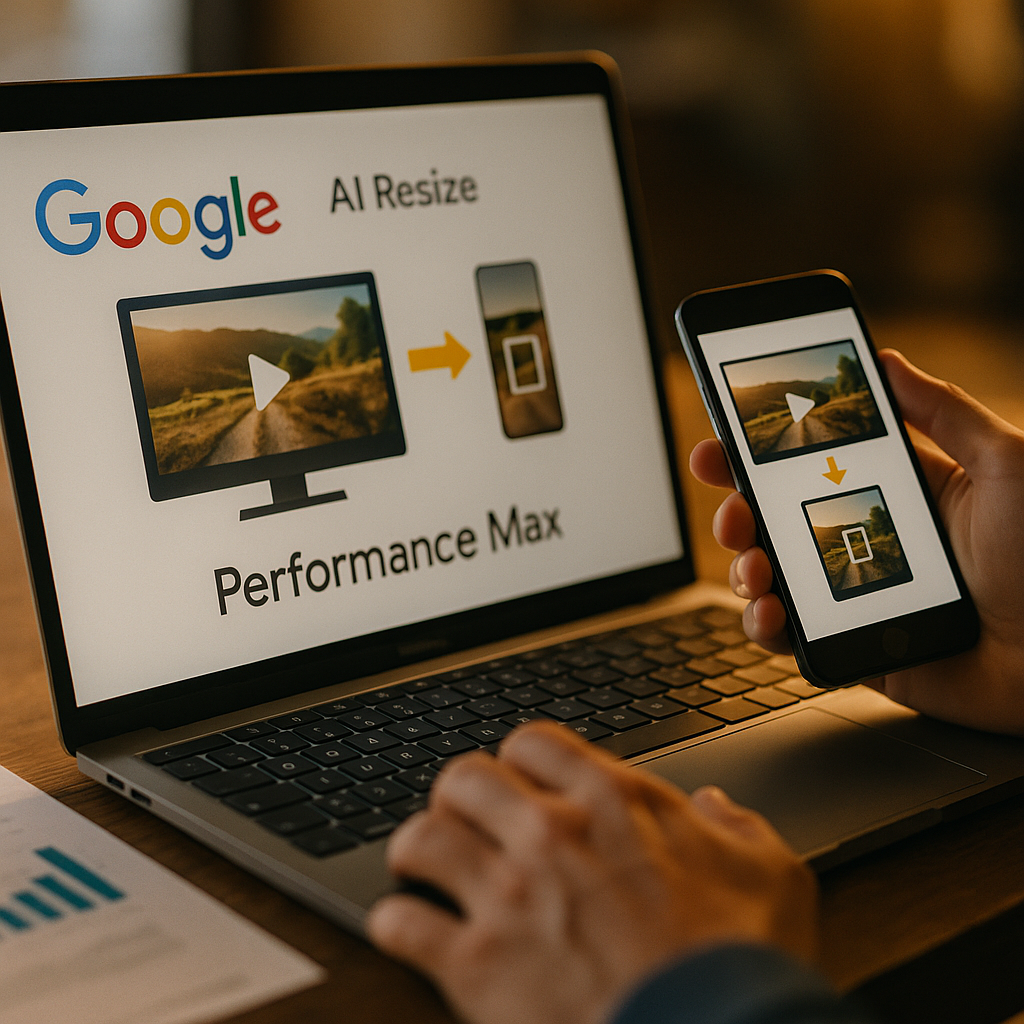
Google now claims its Performance Max algorithms can take one horizontal video and spit out a dozen aspect ratios in minutes. If that’s true, why are creative teams still budgeting six figures a year for reformatting? AI video resizing is forcing a hard conversation inside marketing departments: is this actually a budget-killer, or just a new line item wearing a cheaper suit?
The honest answer sits somewhere in between. Automatic aspect-ratio generation genuinely removes friction from a process that used to eat agency hours and freelancer invoices. But it doesn’t eliminate the need for craft, oversight, or a real production strategy. It just moves where the money goes.
What Google Actually Shipped
Performance Max has quietly expanded its asset generation tools so that a single uploaded video, typically 16:9, gets automatically reformatted into 9:16 and 1:1 crops for placement across YouTube Shorts, Discover, and the Display Network. Google’s own Ads support documentation frames this as reducing “creative gaps” that previously caused PMax campaigns to underdeliver on video inventory simply because advertisers hadn’t supplied the right shape of asset.
This isn’t new technology in the abstract. Smart cropping, subject-tracking reframes, and AI-assisted padding have existed in tools like Adobe Premiere and various third-party resizers for a few years now. What’s different is the default-on integration inside the ad platform itself. You upload once. Google’s models decide where the important visual information lives, track it across frames, and generate variants without a human touching a timeline.
For brands running lean paid media teams, that’s a meaningful shift. It also raises a question every performance marketer should be asking right now: if the platform can resize for free, what exactly are we still paying production vendors to do?
The Budget Line That’s About to Move, Not Disappear
Reformatting has long been one of the more absurd line items in influencer and brand video production. Agencies routinely charge $500 to $2,000 per additional aspect ratio delivery, on top of the original shoot cost, because it required a human editor to manually reframe, re-time cuts, and adjust text overlays so nothing got clipped. Multiply that across a campaign running on YouTube, Meta, TikTok, and Display, and you’re easily adding 20-40% to a video budget just for shape conversion.
If AI resizing genuinely handles 70-80% of reformatting work at platform-native quality, brands should expect reformatting line items to shrink by roughly the same margin within the next one to two budget cycles — but only for campaigns that plan for it from the shoot itself.
Here’s the catch nobody wants to say out loud: automatic resizing works best when the source video was shot with resizing in mind. Wide static shots, generous headroom, minimal on-screen text baked into the footage — that’s what makes AI cropping look intentional instead of amateurish. Feed the algorithm a tightly framed talking-head video with lower-third graphics burned in, and you’ll get awkward crops that clip faces or cut off captions mid-sentence.
So the budget doesn’t vanish. It shifts upstream. Production teams now need to brief shoots differently, which means more pre-production planning, more discipline around graphic placement, and potentially more time on set to capture “safe zone” coverage. You’re trading a line item on the back end (manual reformatting) for a smaller, less visible cost on the front end (production discipline). Net savings are real, but they’re not the 100% cost elimination some procurement teams are hoping for.
Where the Real Savings Show Up
- Freelance editor hours: Fewer billable hours spent on manual crop-and-reframe work for straightforward assets.
- Turnaround time: Campaigns can go live across formats same-day instead of waiting on a reformatting queue.
- Asset volume: Teams can test more creative variants because the marginal cost of a new aspect ratio drops close to zero.
- Agency retainer renegotiation: Reformatting-heavy retainers become harder to justify at previous rates, giving brands leverage in renewal conversations.
Where Costs Quietly Reappear
- Quality assurance staffing: Someone still has to review every auto-generated crop before it goes live. AI mis-crops a face or clips a CTA more often than vendors admit.
- Reshoots for AI-readiness: Older footage libraries often aren’t compatible with clean auto-resizing, forcing partial reshoots.
- Brand safety review: Legal and compliance teams need a process for reviewing machine-generated variants, not just the master file.
Is This Actually Good for Creative Quality?
Depends who you ask. Performance marketers obsessed with volume and velocity will tell you it’s a gift. More variants, more testing, more inventory eligibility, less waiting on creative teams. Brand-side creative directors tend to be more skeptical, and honestly, they have a point.
AI resizing optimizes for “nothing important got cut off.” It does not optimize for “this still feels like a deliberate piece of vertical storytelling.” There’s a real difference between a video that was shot for 9:16 and one that was algorithmically squeezed into it. Audiences, especially on platforms like TikTok and Instagram Reels where native-feeling content outperforms obviously repurposed content, can often tell.
Data from Sprout Social’s ongoing social media benchmarking work has consistently shown that platform-native creative outperforms cross-posted or reformatted content on engagement metrics. AI resizing doesn’t change that dynamic. It just makes the reformatted version cheaper to produce, which isn’t the same as making it more effective.
So the smart move isn’t “let AI resize everything.” It’s segmenting your creative pipeline: hero campaigns and top-funnel brand videos still deserve platform-native, human-directed versions. Lower-tier performance assets, retargeting creative, and rapid A/B test variants are exactly where AI resizing earns its keep.
Attribution Gets Murkier Before It Gets Clearer
There’s a secondary budget conversation happening here that most trade coverage is missing: measurement. When Google auto-generates and serves creative variants across formats without explicit advertiser sign-off on each one, tracking which specific crop drove which conversion becomes harder. PMax has always been something of a black box for creative-level reporting, and automatic asset generation deepens that opacity.
Marketing teams that already struggle to reconcile platform-reported performance with their own attribution models are going to feel this more acutely. If you’re relying on MTA and MMM blended attribution to understand true creative contribution, expect a lag before vendors update their models to account for AI-generated aspect-ratio variants as distinct creative units rather than lumping them under a single parent asset.
This matters for budget allocation too. If you can’t tell whether the 9:16 auto-crop or the 1:1 auto-crop is actually driving performance, you can’t make an informed decision about whether to invest in a custom-shot version next quarter. Brands serious about creative ROI should be pushing their measurement stack, whether that’s GA4, a dedicated attribution platform, or server-side tagging, to capture creative-level granularity now, before auto-generated variants become the majority of served impressions. Teams that have already invested in server-side tagging infrastructure will have an easier time isolating this signal than those still relying purely on platform dashboards.
Compliance and Brand Safety Don’t Get a Pass
One thing that doesn’t change with automation: legal exposure. If an AI-generated crop clips a required disclaimer, mangles a regulatory disclosure, or crops out a compliance watermark on a financial or health-adjacent ad, that’s still the advertiser’s liability, not Google’s. The FTC’s endorsement and advertising guidance doesn’t care whether a human or an algorithm made the crop. Brands running influencer-sourced video through PMax’s auto-resize pipeline need a QA checkpoint specifically for compliance elements before any variant goes live, every time.
This is a genuinely underrated risk. Marketing teams that have automated their way out of manual reformatting sometimes assume they’ve also automated away the review step. They haven’t. If anything, review needs to be more rigorous because you’re now approving a batch of variants you didn’t manually create.
How to Actually Rebuild Your Production Budget Around This
Start by auditing where your current reformatting spend actually goes. Most brands don’t have this broken out cleanly, it’s usually buried inside agency retainers or freelancer invoices as a blended line item. Get specific numbers before you promise finance a savings figure you can’t back up.
Then, restructure production briefs to be resize-aware from the start. That means shooting with safe zones, minimizing burned-in text, and capturing extra headroom and side space specifically so the AI has clean material to work with. This is a production process change, not a tooling change, and it costs nothing beyond a briefing template update.
The brands that win here won’t be the ones who adopt AI resizing fastest. They’ll be the ones who redesign their shoot briefs so the AI has something good to work with in the first place.
Reallocate the savings deliberately rather than letting finance simply absorb them as margin. The smartest teams are redirecting freed-up reformatting budget into two places: more original hero content for top-funnel campaigns, and better measurement infrastructure to actually prove what the AI-generated variants are contributing. If you’re not sure where your current martech stack stands on this, a structured vendor renewal scorecard approach helps separate genuine efficiency gains from vendor feature bloat.
Finally, renegotiate agency and freelancer scopes. If reformatting used to be 30% of a project’s line-item cost and AI now handles most of it, that scope needs to shrink accordingly, or get replaced with QA and strategic oversight work instead. Don’t let legacy pricing structures survive a workflow that no longer justifies them.
The Takeaway
Automatic aspect-ratio generation in Performance Max is a genuine efficiency gain, not marketing hype, but it redistributes cost rather than erasing it. Audit your current reformatting spend this quarter, rebuild shoot briefs for AI-readiness, and reinvest the savings into original hero content and creative-level measurement before your competitors figure out the same math.
Frequently Asked Questions
Does Google’s automatic aspect-ratio generation cost extra inside Performance Max?
No, the feature is built into standard Performance Max campaigns and doesn’t carry a separate line-item fee. Your cost impact comes from changes to production workflow and quality assurance staffing, not a new platform charge.
Will AI-resized video hurt engagement compared to platform-native creative?
It can, particularly for top-funnel brand content where platform-native framing and pacing matter most. For lower-funnel performance assets and rapid testing, the engagement gap is typically small enough that the cost savings outweigh it.
How much can brands realistically save on creative production budgets?
Early adopters report reformatting-specific costs dropping 20-40%, though total production budget savings are usually smaller once you account for added QA time and shoot planning changes needed to make source footage AI-resize friendly.
Can we opt out of automatic resizing in Performance Max?
Google allows advertisers to supply their own pre-formatted assets for specific placements, which the system will prioritize over auto-generated crops. Full opt-out of the underlying asset generation feature varies by account setup, so check current settings in Google Ads support documentation.
Who is liable if an auto-generated crop clips a required disclosure or compliance element?
The advertiser remains liable regardless of who or what created the crop. Brands should build a compliance-specific review step into their QA process for every AI-generated variant before it goes live.
Frequently Asked Questions
Does Google’s automatic aspect-ratio generation cost extra inside Performance Max?
No, the feature is built into standard Performance Max campaigns and doesn’t carry a separate line-item fee. Your cost impact comes from changes to production workflow and quality assurance staffing, not a new platform charge.
Will AI-resized video hurt engagement compared to platform-native creative?
It can, particularly for top-funnel brand content where platform-native framing and pacing matter most. For lower-funnel performance assets and rapid testing, the engagement gap is typically small enough that the cost savings outweigh it.
How much can brands realistically save on creative production budgets?
Early adopters report reformatting-specific costs dropping 20-40%, though total production budget savings are usually smaller once you account for added QA time and shoot planning changes needed to make source footage AI-resize friendly.
Can we opt out of automatic resizing in Performance Max?
Google allows advertisers to supply their own pre-formatted assets for specific placements, which the system will prioritize over auto-generated crops. Full opt-out of the underlying asset generation feature varies by account setup, so check current settings in Google Ads support documentation.
Who is liable if an auto-generated crop clips a required disclosure or compliance element?
The advertiser remains liable regardless of who or what created the crop. Brands should build a compliance-specific review step into their QA process for every AI-generated variant before it goes live.
Top Influencer Marketing Agencies
The leading agencies shaping influencer marketing in 2026
Agencies ranked by campaign performance, client diversity, platform expertise, proven ROI, industry recognition, and client satisfaction. Assessed through verified case studies, reviews, and industry consultations.
Moburst

-
2

The Shelf
Boutique Beauty & Lifestyle Influencer AgencyA data-driven boutique agency specializing exclusively in beauty, wellness, and lifestyle influencer campaigns on Instagram and TikTok. Best for brands already focused on the beauty/personal care space that need curated, aesthetic-driven content.Clients: Pepsi, The Honest Company, Hims, Elf Cosmetics, Pure LeafVisit The Shelf → -
3

Audiencly
Niche Gaming & Esports Influencer AgencyA specialized agency focused exclusively on gaming and esports creators on YouTube, Twitch, and TikTok. Ideal if your campaign is 100% gaming-focused — from game launches to hardware and esports events.Clients: Epic Games, NordVPN, Ubisoft, Wargaming, Tencent GamesVisit Audiencly → -
4

Viral Nation
Global Influencer Marketing & Talent AgencyA dual talent management and marketing agency with proprietary brand safety tools and a global creator network spanning nano-influencers to celebrities across all major platforms.Clients: Meta, Activision Blizzard, Energizer, Aston Martin, WalmartVisit Viral Nation → -
5

The Influencer Marketing Factory
TikTok, Instagram & YouTube CampaignsA full-service agency with strong TikTok expertise, offering end-to-end campaign management from influencer discovery through performance reporting with a focus on platform-native content.Clients: Google, Snapchat, Universal Music, Bumble, YelpVisit TIMF → -
6

NeoReach
Enterprise Analytics & Influencer CampaignsAn enterprise-focused agency combining managed campaigns with a powerful self-service data platform for influencer search, audience analytics, and attribution modeling.Clients: Amazon, Airbnb, Netflix, Honda, The New York TimesVisit NeoReach → -
7

Ubiquitous
Creator-First Marketing PlatformA tech-driven platform combining self-service tools with managed campaign options, emphasizing speed and scalability for brands managing multiple influencer relationships.Clients: Lyft, Disney, Target, American Eagle, NetflixVisit Ubiquitous → -
8

Obviously
Scalable Enterprise Influencer CampaignsA tech-enabled agency built for high-volume campaigns, coordinating hundreds of creators simultaneously with end-to-end logistics, content rights management, and product seeding.Clients: Google, Ulta Beauty, Converse, AmazonVisit Obviously →