


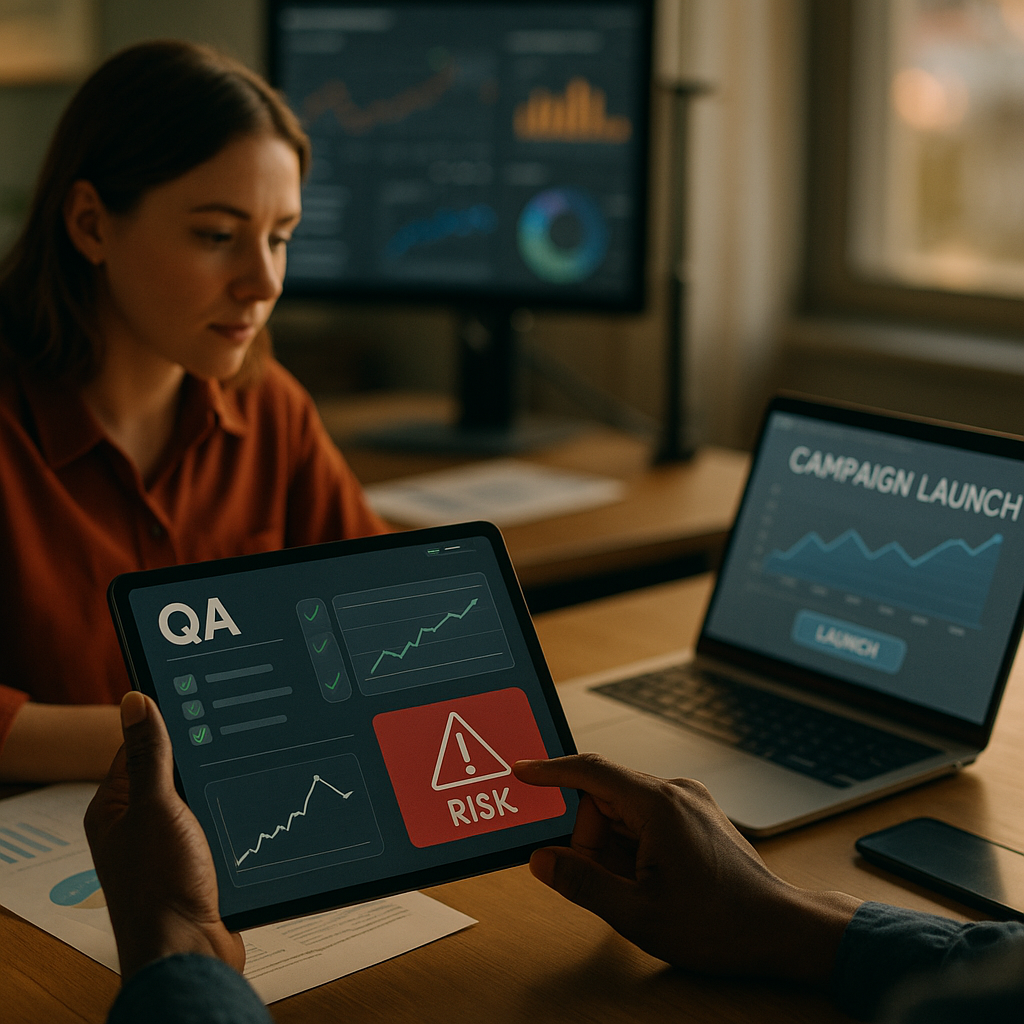
Marketing ops teams burn an average of six to eight hours per campaign on manual QA checks, link validation, UTM audits, brand voice review, compliance scans, and nobody gets a bonus for catching a broken tracking pixel. Agentic workflows in martech are quietly eliminating that grind, and the brands still relying on a human reviewer clicking through every email variant before send are about to look slow, expensive, and exposed.
The QA Bottleneck Nobody Budgets For
Here’s the uncomfortable truth about campaign QA: it’s the single most underfunded function in the modern marketing stack. Teams invest heavily in creative, media buying, and attribution tooling, then hand final review to whoever has twenty free minutes before a launch window closes. That’s not a process. That’s a hope.
Manual QA fails in predictable ways. A reviewer checks the hero email but misses the SMS variant. A UTM parameter gets typo’d and three weeks of attribution data becomes garbage. A creator disclosure tag goes missing on a paid partnership post, and suddenly legal is on the phone. None of this is a people problem. It’s a scale problem. Campaign volume has outpaced human review capacity, especially for brands running always-on influencer programs across five or six platforms simultaneously.
Agentic QA doesn’t just catch errors faster, it catches a different class of error entirely: the ones that only surface when a system checks every variant, every time, with no fatigue curve.
What Agentic Workflows Actually Do Differently
An agentic workflow isn’t a smarter checklist. It’s a system of AI agents that plan, execute, and self-correct a task with minimal human prompting at each step. Instead of a marketer feeding a tool one instruction at a time, the agent owns a goal (say, “verify this campaign is launch-ready”) and breaks it into sub-tasks on its own: checking link destinations, flagging missing FTC disclosure language, confirming brand voice consistency, cross-referencing UTM taxonomy against the campaign plan.
This matters because traditional automation was always rule-based. If X, then Y. It couldn’t handle ambiguity, and campaign QA is full of ambiguity. Is this tone “on brand” or just close enough? Does this creator caption meet disclosure standards in letter and spirit? Rule-based systems choke on judgment calls. Agentic systems, built on large language models with retrieval and tool-calling capabilities, can actually reason through them, flag confidence levels, and escalate only the genuinely uncertain cases to a human.
That escalation model is the real unlock. Instead of a human reviewing 100% of assets, they review the 8 to 12% an agent flags as uncertain. That’s not a marginal efficiency gain. That’s a structural change in headcount allocation, and it’s why martech platforms like HubSpot and Salesforce are racing to embed agent layers directly into their marketing clouds. Our coverage of Salesforce Agentforce pushing into marketing cloud creator ops breaks down how fast this shift is happening at the platform level.
Where the Technical Backbone Comes From
None of this works without agents being able to reach into other systems: your CMS, your DAM, your social scheduler, your CRM. This is where protocols like Model Context Protocol come in, giving disparate AI agents a shared language to pull context and execute actions across tools without custom integration work for every pairing. We covered this in detail in Model Context Protocol gives AI agents a universal plug, and it’s worth understanding because the QA agent is only as good as the data it can actually see. An agent that can’t query your creator contract database won’t catch a disclosure mismatch, no matter how good its reasoning is.
Marketo’s recent move to expose over 100 operations through an MCP server is a direct response to this need. Agencies and brand teams can now let QA agents touch nearly every corner of a campaign workflow, though as we noted in Marketo MCP server exposes 100 ops, demands access rules, that level of access means governance has to catch up fast or you’ve just handed a bot the keys to your entire martech stack.
Replacing Manual QA: What’s Actually Automatable Today
Let’s get specific, because “AI will handle QA” is a vague promise until you break it into tasks. Here’s what agentic suites are reliably automating right now:
- Link and UTM validation: Agents crawl every link in a campaign, confirm destination accuracy, and verify UTM parameters match the campaign taxonomy before anything goes live.
- Disclosure and compliance checks: Agents scan creator content and paid posts for FTC-required disclosure language, flagging gaps before a post publishes rather than after a regulator notices.
- Brand voice drift detection: Tools compare copy against a trained brand voice model and flag tonal deviations, a function we explored in Janice AI flags brand voice drift before blogs publish.
- Cross-channel consistency: Agents confirm that pricing, offer terms, and dates match across email, social, and landing pages, a notoriously error-prone manual task.
- Budget pacing anomalies: Agentic systems increasingly catch budget leakage in real time rather than at month-end reconciliation, as detailed in Maestro engine beats rule based automation on budget leakage.
What’s not yet fully automatable: nuanced creative judgment calls, cultural sensitivity reads that require lived context, and anything involving genuine legal interpretation rather than pattern matching against known disclosure templates. Keep a human in that loop. Anyone selling you “100% autonomous QA” with zero human checkpoint is selling you risk.
Is This Actually Replacing Jobs, or Just Tasks?
Fair question, and the honest answer is: it’s replacing tasks, which reshapes jobs. The marketing ops coordinator who used to spend half their week clicking through QA checklists is now spending that time on exception handling, agent output review, and workflow design. That’s a better use of a skilled human, frankly. Nobody got into marketing ops to be a professional link-checker.
The risk isn’t job loss, it’s governance gaps. When HubSpot’s Breeze agents started auto-routing creator data across workflows, the compliance question wasn’t “will this save time,” it was “who’s accountable when the agent routes something incorrectly.” That exact tension is covered in HubSpot Breeze agent routing puts creator data risk on CMOs, and it applies directly to QA agents too. An agent that approves a campaign as “launch ready” needs an audit trail showing exactly what it checked and what it didn’t.
The brands winning with agentic QA aren’t the ones with the most automation. They’re the ones with the clearest escalation rules for when automation should stop and a human should look.
Governance Still Lags the Tech
This is the part vendors don’t put in the demo video. Agentic workflows replacing if-then rules has outpaced the governance frameworks needed to manage them safely, a gap we flagged in AI agents replace if then rules, governance lags behind. Most marketing teams deploying QA agents today don’t have a documented policy for what happens when an agent’s confidence score is borderline. They don’t have a clear owner for agent error review. And most haven’t built in the kind of audit logging that regulators or internal legal teams will eventually ask for.
If you’re evaluating or scaling an agentic QA suite, build the governance layer before you scale the automation layer, not after. That means defining escalation thresholds, assigning a named human owner for agent oversight (not “the team,” an actual person), and logging every agent decision with enough detail to reconstruct it in an audit six months later. The FTC’s guidance on endorsement and disclosure hasn’t changed just because an AI is doing the checking, and regulators will hold the brand accountable regardless of what tool flagged (or missed) the issue. Review the FTC’s endorsement guidance resources if your creator program touches sponsored content at any scale.
Picking a Platform: What to Actually Compare
Vendor comparisons in this space move fast, and most buyers are choosing based on brand name rather than actual QA capability. If you’re comparing options, the head-to-head breakdown in Marketo AI agents vs HubSpot Breeze tested for creator ROI is a useful reference point, since both platforms take meaningfully different approaches to agent autonomy versus human checkpoints. Also worth reading if you’re specifically running creator or influencer campaigns: Marketo AI agents automate campaigns, audits stay manual, which is a useful reality check that not every “AI-powered” platform has actually closed the QA gap yet, even if the campaign execution side is fully agentic.
For benchmarking adoption rates and ROI claims against industry data, Gartner and Forrester both publish regular martech maturity surveys, and eMarketer’s research hub tracks AI adoption trends in marketing ops specifically. Cross-reference any vendor’s efficiency claims against third-party benchmarks before signing a multi-year contract; vendor-reported time savings tend to run optimistic.
Building the Business Case Internally
If you’re pitching this to finance or leadership, don’t lead with “AI efficiency.” Lead with risk reduction and hours reclaimed, because that’s the language budget owners actually respond to. Quantify current QA hours per campaign, multiply by loaded hourly cost, and compare against the subscription cost of an agentic QA layer. Then add the harder-to-quantify but very real cost of compliance exposure: one missed disclosure on a paid creator post can trigger regulatory scrutiny that costs far more than a year of software licensing.
Start with a pilot on your highest-volume, lowest-risk campaign type (recurring newsletters, evergreen paid social) before rolling agentic QA into anything touching creator contracts or regulated claims. Measure error catch rate against your current manual process for 60 days. If the agent is catching things your team misses, and it usually will, expand the scope. If it’s generating false flags that burn reviewer time, fix the training data before you scale.
Agentic QA isn’t a future-state nice-to-have anymore, it’s becoming table stakes for any team running campaign volume at scale. Pick one high-frequency campaign type, pilot an agentic QA layer against your current manual process for a full quarter, and let the error catch rate make the budget case for you.
Frequently Asked Questions
What is an agentic workflow in martech?
An agentic workflow is a system where AI agents independently plan, execute, and adjust a multi-step task, such as campaign QA, with minimal step-by-step human instruction, escalating only genuinely uncertain decisions to a human reviewer.
How is agentic QA different from traditional marketing automation?
Traditional automation follows fixed if-then rules and can’t handle ambiguity. Agentic QA uses AI reasoning to make judgment calls, such as flagging tonal drift or borderline disclosure language, and adapts its checks based on context rather than a static rulebook.
Does agentic QA eliminate the need for human reviewers?
No. It shifts human attention from reviewing every asset to reviewing only the small percentage flagged as uncertain, which changes the role from manual checker to oversight and exception handler rather than eliminating the role entirely.
What are the biggest risks of adopting agentic QA tools?
The main risks are governance gaps: unclear ownership when an agent makes an error, insufficient audit logging for compliance review, and over-reliance on automation for nuanced judgment calls like legal interpretation or cultural sensitivity.
How should a brand measure ROI on an agentic QA platform?
Compare current manual QA hours per campaign (multiplied by loaded labor cost) against the platform’s subscription cost, then track the agent’s error catch rate against your existing manual process over a defined pilot period, typically 60 to 90 days.
Top Influencer Marketing Agencies
The leading agencies shaping influencer marketing in 2026
Agencies ranked by campaign performance, client diversity, platform expertise, proven ROI, industry recognition, and client satisfaction. Assessed through verified case studies, reviews, and industry consultations.
Moburst

-
2

The Shelf
Boutique Beauty & Lifestyle Influencer AgencyA data-driven boutique agency specializing exclusively in beauty, wellness, and lifestyle influencer campaigns on Instagram and TikTok. Best for brands already focused on the beauty/personal care space that need curated, aesthetic-driven content.Clients: Pepsi, The Honest Company, Hims, Elf Cosmetics, Pure LeafVisit The Shelf → -
3

Audiencly
Niche Gaming & Esports Influencer AgencyA specialized agency focused exclusively on gaming and esports creators on YouTube, Twitch, and TikTok. Ideal if your campaign is 100% gaming-focused — from game launches to hardware and esports events.Clients: Epic Games, NordVPN, Ubisoft, Wargaming, Tencent GamesVisit Audiencly → -
4

Viral Nation
Global Influencer Marketing & Talent AgencyA dual talent management and marketing agency with proprietary brand safety tools and a global creator network spanning nano-influencers to celebrities across all major platforms.Clients: Meta, Activision Blizzard, Energizer, Aston Martin, WalmartVisit Viral Nation → -
5

The Influencer Marketing Factory
TikTok, Instagram & YouTube CampaignsA full-service agency with strong TikTok expertise, offering end-to-end campaign management from influencer discovery through performance reporting with a focus on platform-native content.Clients: Google, Snapchat, Universal Music, Bumble, YelpVisit TIMF → -
6

NeoReach
Enterprise Analytics & Influencer CampaignsAn enterprise-focused agency combining managed campaigns with a powerful self-service data platform for influencer search, audience analytics, and attribution modeling.Clients: Amazon, Airbnb, Netflix, Honda, The New York TimesVisit NeoReach → -
7

Ubiquitous
Creator-First Marketing PlatformA tech-driven platform combining self-service tools with managed campaign options, emphasizing speed and scalability for brands managing multiple influencer relationships.Clients: Lyft, Disney, Target, American Eagle, NetflixVisit Ubiquitous → -
8

Obviously
Scalable Enterprise Influencer CampaignsA tech-enabled agency built for high-volume campaigns, coordinating hundreds of creators simultaneously with end-to-end logistics, content rights management, and product seeding.Clients: Google, Ulta Beauty, Converse, AmazonVisit Obviously →