


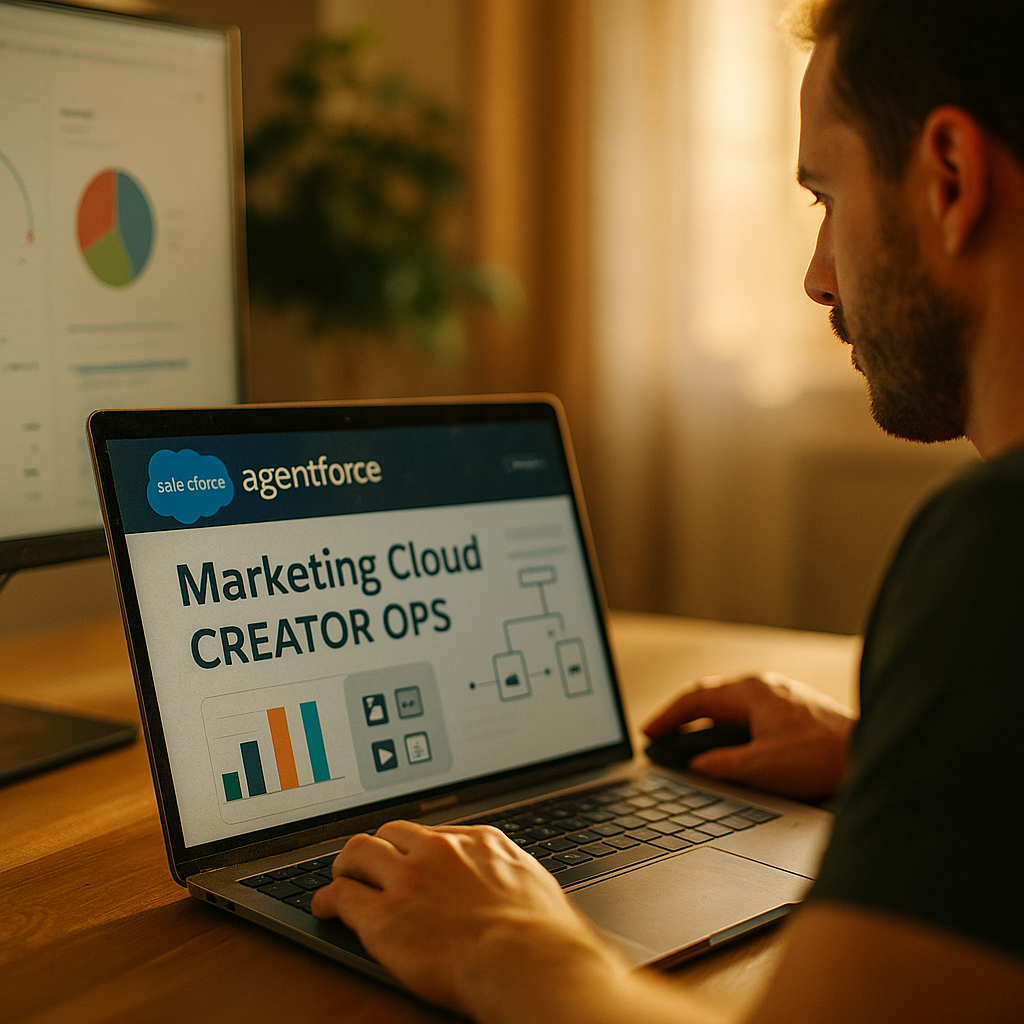
Salesforce says its Agentforce platform now touches more than 12,000 customer deployments, and Marketing Cloud is the next battleground. If your creator ops team still routes briefs through spreadsheets and Slack threads, Salesforce’s AI agent push into marketing clouds just made that workflow look prehistoric. The question isn’t whether agentic AI reaches influencer programs. It’s who controls the data once it does.
What Salesforce Actually Shipped
Salesforce rolled Agentforce capabilities directly into Marketing Cloud Growth and Marketing Cloud Advanced, giving marketers autonomous agents that can draft campaign briefs, segment audiences, trigger journeys, and now, reportedly, surface creator recommendations pulled from engagement and purchase data already sitting in the CRM. This isn’t a chatbot bolted onto a dashboard. It’s an agent that can act: pausing a paid boost, reallocating budget, or flagging a creator whose audience overlap with a target segment just spiked.
For marketing ops leaders, that’s a genuine shift. Salesforce has spent two decades owning the customer record. Now it wants to own the decision layer sitting on top of that record, including decisions about which creators get briefed, paid, and measured.
The real story isn’t the AI agent itself. It’s that Salesforce now has a plausible claim to sit between your CRM and your creator attribution stack, a position no influencer platform currently holds.
Why Creator Ops Teams Should Pay Attention Now
Most influencer programs run on a patchwork: a discovery tool, a relationship CRM, a payment processor, maybe a dedicated attribution layer. Salesforce’s pitch is consolidation. If Agentforce can pull first-party purchase data, match it against creator-driven traffic, and auto-generate a performance report, that’s a direct challenge to the standalone influencer platforms creator ops teams have built workflows around for years.
This matters for three operational reasons. First, budget conversations change when finance can see creator ROI inside the same dashboard used for email and paid search. Second, briefing speed increases, because an agent that already knows your audience segments can draft a creator brief in minutes instead of a strategist spending half a day on it. Third, and this is the uncomfortable one, vendor consolidation tends to favor whoever owns the data pipes. Right now, that’s Salesforce, not your influencer marketing platform.
We’ve already covered how AI agents are battling over real-time intent inside marketing automation platforms. Salesforce entering that fight with Marketing Cloud’s scale is a different order of magnitude.
The Attribution Gap Nobody’s Fixed Yet
Here’s the catch. Agentforce can tell you a lot about what happened after a creator post drove traffic into your owned channels. It cannot, on its own, resolve the identity mess that happens before that: which TikTok handle maps to which affiliate link maps to which customer record. That’s still a job for dedicated identity resolution layers.
Brands that have already invested in AI identity resolution for creator attribution are better positioned to feed Salesforce’s agents clean data. Everyone else risks garbage in, garbage out, except now the garbage gets automated at scale and presented with false confidence in a slick CRM dashboard.
This is the part marketing ops leaders keep underestimating. An AI agent that acts on bad attribution data doesn’t just produce a wrong report. It reallocates real budget based on that wrong report, automatically, often before a human reviews the change log. According to eMarketer’s tracking of influencer marketing spend, attribution accuracy remains one of the top three concerns cited by brand-side marketers evaluating platform investment, and that concern doesn’t disappear just because an agent is doing the math faster.
Daily Workflow: What Actually Changes
Strip away the product marketing and here’s what shifts for a creator ops team running campaigns inside Salesforce’s ecosystem:
- Brief generation speeds up. Agents can draft creative briefs pulling from past campaign performance stored in Marketing Cloud, cutting a task that used to take a strategist a few hours down to a first-draft review.
- Scheduling and sequencing get automated. Journey Builder already handles email and SMS cadence. Extending that logic to creator content calendars means posts could theoretically trigger based on real-time segment behavior, not a fixed editorial calendar. We’ve seen similar patterns emerge with AI scheduling agents posting at peak windows, and the guardrail problem is the same here: speed without human review invites brand safety misses.
- Creative testing moves faster, with more risk. If agents start A/B testing creator hooks against CRM segments automatically, the same tension shows up that we flagged when covering agentic AI creative testing and brand safety: faster iteration cycles need faster approval cycles, or the agent becomes the bottleneck’s replacement with a new kind of risk.
- Payment and negotiation logic may get pulled in. Salesforce hasn’t confirmed autonomous rate negotiation yet, but the infrastructure pattern mirrors what’s already happening elsewhere, a trend we examined in depth around AI negotiation agents haggling creator rates.
None of this is science fiction. It’s a logical extension of capabilities Salesforce already has in production for email and paid media. Creator ops is simply the next workflow in line.
The Compliance Question Nobody’s Asking Loudly Enough
When an AI agent selects a creator, approves a brief, or reallocates spend without a documented human checkpoint, who’s accountable if that creator violates FTC disclosure rules or a brand safety clause? Salesforce’s terms of service won’t answer that for you. Your internal governance framework needs to.
This is where mid-size and enterprise brands are getting caught flat. Legal and compliance teams have spent years building disclosure review processes for human-approved creator content, modeled loosely on guidance from the Federal Trade Commission. Few of those processes account for an AI agent making the initial selection or sequencing decision. If Agentforce recommends a creator whose content later triggers a disclosure complaint, “the algorithm did it” is not a defense regulators or your board will accept.
Practical fix: require a human sign-off gate between any AI-generated creator recommendation and campaign launch, logged and timestamped. It’s a small operational tax that saves you from a much bigger headache later.
Building the Playbook: Three Moves for Creator Ops Teams
You don’t need to wait for Salesforce to finish rolling out every feature to start preparing. Three moves matter now.
- Audit your data pipes before the agent gets access. If your CRM, affiliate platform, and creator payment system aren’t already talking to each other cleanly, an AI agent sitting on top of that mess just automates the confusion. Fix the plumbing first.
- Define a human-in-the-loop checkpoint and document it. This protects you legally and operationally. It also gives your team a feedback loop to catch the inevitable early mistakes agentic recommendations will make.
- Keep your attribution layer vendor-agnostic. Whatever Salesforce builds, you don’t want creator attribution locked exclusively inside one CRM’s walled garden. Platforms built around retrieval augmented generation grounded in brand truth are a useful model here: the AI layer should sit on top of your data, not own it outright.
Industry benchmarking firms like Sprout Social and HubSpot have both published guidance on integrating AI agents into existing martech stacks without losing data portability. It’s worth reviewing that guidance before signing any expanded Salesforce contract that bundles creator workflow tools into the agreement.
Frequently Asked Questions
FAQs
What is Salesforce’s Agentforce and how does it relate to influencer marketing?
Agentforce is Salesforce’s autonomous AI agent platform, now integrated into Marketing Cloud. It can draft briefs, manage audience segments, and trigger campaign actions, and its newer capabilities extend into creator recommendation and performance reporting, putting it in direct competition with standalone influencer marketing platforms.
Will Salesforce replace dedicated influencer marketing platforms?
Not immediately. Salesforce’s strength is CRM data and journey orchestration, not creator discovery depth or relationship management. Most brands will likely run Agentforce alongside existing influencer platforms rather than replace them outright, at least in the near term.
What risks should creator ops teams watch for with AI agent adoption?
The biggest risks are attribution errors scaling automatically, lack of human review before budget reallocation, and compliance gaps around FTC disclosure rules when an agent selects creators without documented oversight.
How should brands prepare their data before adopting AI agents in Marketing Cloud?
Clean up identity resolution across CRM, affiliate links, and payment systems first. An AI agent built on fragmented or duplicate data will produce confident but inaccurate recommendations at scale.
Does Salesforce’s AI agent push affect how brands measure creator ROI?
Yes. Consolidating performance data inside Marketing Cloud makes it easier to compare creator-driven revenue against other channels in one dashboard, but only if the underlying attribution data feeding the agent is accurate and vendor-agnostic.
The practical next step: run one pilot campaign through Agentforce with a documented human checkpoint before full launch, and compare its creator recommendations against your current attribution data for a single quarter before expanding further.
Top Influencer Marketing Agencies
The leading agencies shaping influencer marketing in 2026
Agencies ranked by campaign performance, client diversity, platform expertise, proven ROI, industry recognition, and client satisfaction. Assessed through verified case studies, reviews, and industry consultations.
Moburst

-
2

The Shelf
Boutique Beauty & Lifestyle Influencer AgencyA data-driven boutique agency specializing exclusively in beauty, wellness, and lifestyle influencer campaigns on Instagram and TikTok. Best for brands already focused on the beauty/personal care space that need curated, aesthetic-driven content.Clients: Pepsi, The Honest Company, Hims, Elf Cosmetics, Pure LeafVisit The Shelf → -
3

Audiencly
Niche Gaming & Esports Influencer AgencyA specialized agency focused exclusively on gaming and esports creators on YouTube, Twitch, and TikTok. Ideal if your campaign is 100% gaming-focused — from game launches to hardware and esports events.Clients: Epic Games, NordVPN, Ubisoft, Wargaming, Tencent GamesVisit Audiencly → -
4

Viral Nation
Global Influencer Marketing & Talent AgencyA dual talent management and marketing agency with proprietary brand safety tools and a global creator network spanning nano-influencers to celebrities across all major platforms.Clients: Meta, Activision Blizzard, Energizer, Aston Martin, WalmartVisit Viral Nation → -
5

The Influencer Marketing Factory
TikTok, Instagram & YouTube CampaignsA full-service agency with strong TikTok expertise, offering end-to-end campaign management from influencer discovery through performance reporting with a focus on platform-native content.Clients: Google, Snapchat, Universal Music, Bumble, YelpVisit TIMF → -
6

NeoReach
Enterprise Analytics & Influencer CampaignsAn enterprise-focused agency combining managed campaigns with a powerful self-service data platform for influencer search, audience analytics, and attribution modeling.Clients: Amazon, Airbnb, Netflix, Honda, The New York TimesVisit NeoReach → -
7

Ubiquitous
Creator-First Marketing PlatformA tech-driven platform combining self-service tools with managed campaign options, emphasizing speed and scalability for brands managing multiple influencer relationships.Clients: Lyft, Disney, Target, American Eagle, NetflixVisit Ubiquitous → -
8

Obviously
Scalable Enterprise Influencer CampaignsA tech-enabled agency built for high-volume campaigns, coordinating hundreds of creators simultaneously with end-to-end logistics, content rights management, and product seeding.Clients: Google, Ulta Beauty, Converse, AmazonVisit Obviously →