


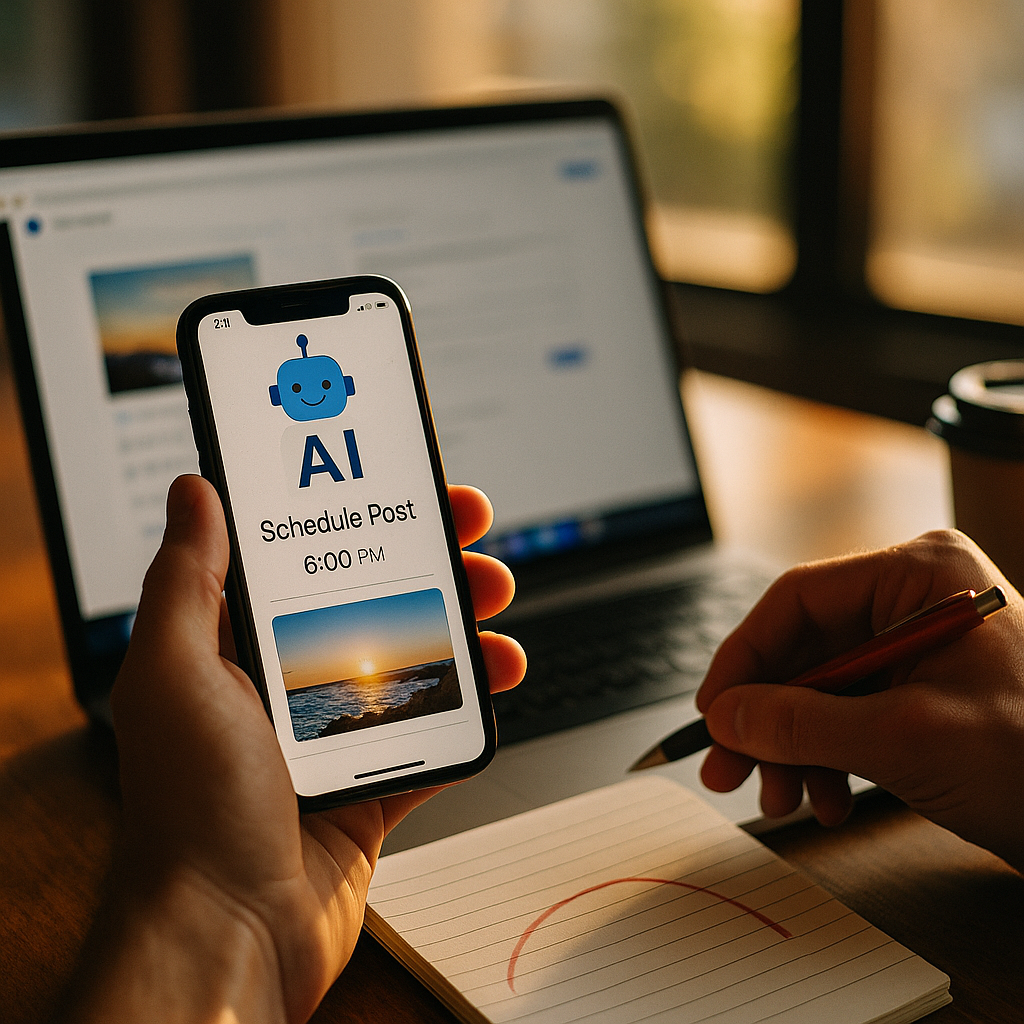
Posting at 9am and 5pm because a blog told you to in 2019? That habit is now costing brands real reach. An AI content scheduling agent analyzes when your specific audience segments are actually paying attention, then publishes automatically, no human touching the “post now” button. The brands using them are seeing engagement lifts that manual calendars simply can’t match anymore.
Why “Best Time to Post” Charts Are Already Obsolete
Every social platform’s algorithm has shifted toward recency and session-based ranking, which means the generic “best time to post on Instagram” listicle you bookmarked is stale the moment audience behavior changes, and it changes constantly. TikTok’s feed rewards content that lands right as a specific viewer opens the app, not content that lands at some universal 7pm slot. Peak attention is now a moving target, personalized down to the individual follower cluster.
That’s the gap AI scheduling agents were built to close. Instead of guessing a single “peak window” for an entire audience, these tools ingest historical engagement data, platform-level signals, and sometimes third-party behavioral data to predict micro-windows where a specific segment is most likely to stop scrolling. Then they queue and publish content automatically, often staggering the same asset across time zones or platforms without a marketer lifting a finger.
What These Agents Actually Do (Beyond Just Scheduling)
Calling these tools “schedulers” undersells them. A modern content scheduling agent typically handles four jobs at once:
- Attention window prediction: Machine learning models trained on your account’s own historical performance, refreshed continuously rather than set once a quarter.
- Cross-platform sequencing: Deciding whether the same asset should hit LinkedIn two hours before TikTok, or simultaneously, based on where each platform’s algorithm currently rewards freshness.
- Autonomous publishing: No approval queue required for lower-risk content types, the agent posts the moment its model flags a window.
- Performance feedback loops: Post-publish data flows back into the model, so next week’s predictions are sharper than this week’s.
This is the same agentic shift showing up across the marketing stack. If you’ve followed how AI trend scraping tools compress the trend-to-post timeline down to 48 hours, scheduling agents are the natural next link in that chain: scrape the trend, generate the hook, then let an agent decide the exact minute it goes live.
Brands report engagement gains of 20 to 40 percent when switching from fixed posting slots to AI-predicted windows, but the real win is time saved: social teams reclaim hours previously spent manually staggering posts across time zones.
The Tools Actually in Market Right Now
Sprinklr, Vista Social, and newer entrants like Ocoya have all rolled out predictive send-time features that go beyond static recommendations. Meta’s own Business Suite has quietly expanded its “suggested posting time” logic to factor in follower online-activity patterns rather than industry averages, a change worth checking directly through Meta Business Suite if you haven’t audited your settings lately. TikTok’s Business Center offers similar signals for brands running organic and paid content in tandem, documented through TikTok Ads Manager.
The bigger shift is happening in mid-market marketing platforms that bundle scheduling agents with broader automation. HubSpot’s ecosystem, for instance, increasingly ties content timing decisions to CRM signals rather than social metrics alone, an extension of the logic behind the HubSpot deep research connector pulling CRM data into ad decisions. If your buyer’s engagement history says they open email at 6am but browse Instagram at 9pm, why wouldn’t your scheduling logic account for both?
Where the ROI Case Gets Real
Marketing leaders don’t approve new tools on vibes, they want a number. The clearest ROI argument for scheduling agents isn’t engagement rate alone, it’s labor cost. A social team manually staggering 15 posts across four platforms and three time zones can easily burn six to eight hours a week on scheduling logistics. An agent collapses that to minutes of review time, freeing the team for the creative work that actually needs a human.
There’s a secondary ROI lever too: paid media efficiency. When organic posts land during genuine peak attention, the resulting engagement often lowers the cost of any paid amplification layered on top, because the platform’s algorithm already sees early signal. Sprout Social’s own research on posting cadence has repeatedly linked timing precision to lower cost-per-engagement in boosted content, which is exactly the kind of compounding efficiency finance teams like to see in a QBR.
The Risk Nobody’s Pricing In: Autonomous Timing Without Context
Here’s the uncomfortable part. An agent that posts automatically based on “peak attention” doesn’t know it’s about to publish a promotional carousel four minutes after a competitor’s product recall makes headlines, or right as a sensitive news cycle breaks in a specific region. Attention windows and brand safety windows are not the same thing, and most scheduling agents were built to optimize the former without any awareness of the latter.
This is the same governance blind spot we’ve flagged with other autonomous marketing tools. When agentic AI picks creators without sign off, brands eat the reputational cost later. Scheduling agents carry a quieter version of the same risk: speed and autonomy without a human checkpoint for context that a model simply can’t see. A brand safety review process, even a lightweight one, should sit between “agent recommends this window” and “agent publishes automatically” for anything above your lowest-risk content tier.
The failure mode isn’t bad content, it’s good content published at a technically optimal but contextually terrible moment. That distinction is exactly what most current scheduling agents can’t detect on their own.
How to Actually Roll This Out Without Losing Control
Rolling out a scheduling agent isn’t a set-it-and-forget-it decision, even though the vendors will pitch it that way. Treat it like any other automation deployment, with tiers of autonomy rather than an all-or-nothing switch. This mirrors the approach we’ve covered with other creator and content automation tools, where tiered automation limits keep the model’s reach proportional to the risk of the content it’s touching.
A practical rollout sequence looks like this:
- Start with low-risk, evergreen content: Product tips, brand awareness posts, and repurposed UGC are safe categories for full autonomous publishing.
- Keep a human checkpoint on anything time-sensitive: Promotions, announcements, and reactive content should route through a quick approval step even if the timing recommendation is automated.
- Audit the model’s window predictions monthly: Attention patterns shift with seasonality and platform algorithm updates, so a prediction that was accurate in Q1 may drift by Q3.
- Build a kill switch into the workflow: If a breaking news event or brand crisis hits, someone needs the ability to pause all autonomous publishing instantly, not just for the flagged post but across the entire queue.
Governance frameworks built for other agentic marketing tools translate directly here. The same principles behind attribution agents needing governance first apply to timing agents: autonomy is fine once you’ve mapped where it can fail and built a control for that specific failure, not before.
Measuring Whether It’s Actually Working
Engagement rate alone is a weak signal here, because an agent can technically hit a “peak window” and still get mediocre results if the content itself is flat. Track window-adjusted engagement against your pre-agent baseline for at least a full month, ideally through a full platform algorithm cycle, before declaring victory. Pair that with the labor-hours-saved metric mentioned earlier, since that’s often the number that actually justifies the tool’s cost to finance. If you’re also running paid amplification, check whether cost-per-result on boosted posts published during agent-selected windows outperforms your manually scheduled control group, that comparison tends to be the most convincing data point in a renewal conversation.
For teams already tracking creator content performance through predictive frameworks, this fits neatly alongside existing dashboards. If you’re using something like the logic behind predictive conversion engines to forecast creator ROI, adding timing-window data as another input sharpens the forecast rather than complicating it. HubSpot’s own reporting tools and eMarketer’s benchmark data are both useful reference points for validating whether your lift is real or just noise.
Bottom line: pilot a scheduling agent on one low-risk content category this quarter, set a 30-day review checkpoint, and don’t expand its autonomy until you’ve built the human override into the workflow.
Frequently Asked Questions
What is an AI content scheduling agent?
It’s software that predicts when a specific audience segment is most likely to engage, then automatically publishes content during that window without requiring a marketer to manually select the time.
How is this different from a regular social media scheduling tool?
Traditional schedulers rely on fixed time slots you set manually, often based on generic industry benchmarks. Scheduling agents use machine learning models trained on your account’s actual engagement history and adjust predictions continuously.
Do these agents work across all social platforms?
Most major platforms including Instagram, TikTok, and LinkedIn support some form of predictive timing through native tools or third-party integrations, though prediction accuracy varies based on how much historical data the platform or tool has access to.
What’s the biggest risk with fully autonomous posting?
The main risk is contextual blindness: an agent can identify a technically optimal attention window while missing external context like breaking news or brand crises that make that moment inappropriate to post.
How long before a brand sees measurable results?
Most teams need at least one full platform algorithm cycle, typically four to six weeks, before engagement data is reliable enough to compare against a pre-agent baseline.
Should smaller brands invest in scheduling agents too?
Yes, though the ROI case leans more on time savings than raw engagement lift for smaller accounts with lower posting volume, since the labor cost of manual scheduling is proportionally higher for lean teams.
Top Influencer Marketing Agencies
The leading agencies shaping influencer marketing in 2026
Agencies ranked by campaign performance, client diversity, platform expertise, proven ROI, industry recognition, and client satisfaction. Assessed through verified case studies, reviews, and industry consultations.
Moburst

-
2

The Shelf
Boutique Beauty & Lifestyle Influencer AgencyA data-driven boutique agency specializing exclusively in beauty, wellness, and lifestyle influencer campaigns on Instagram and TikTok. Best for brands already focused on the beauty/personal care space that need curated, aesthetic-driven content.Clients: Pepsi, The Honest Company, Hims, Elf Cosmetics, Pure LeafVisit The Shelf → -
3

Audiencly
Niche Gaming & Esports Influencer AgencyA specialized agency focused exclusively on gaming and esports creators on YouTube, Twitch, and TikTok. Ideal if your campaign is 100% gaming-focused — from game launches to hardware and esports events.Clients: Epic Games, NordVPN, Ubisoft, Wargaming, Tencent GamesVisit Audiencly → -
4

Viral Nation
Global Influencer Marketing & Talent AgencyA dual talent management and marketing agency with proprietary brand safety tools and a global creator network spanning nano-influencers to celebrities across all major platforms.Clients: Meta, Activision Blizzard, Energizer, Aston Martin, WalmartVisit Viral Nation → -
5

The Influencer Marketing Factory
TikTok, Instagram & YouTube CampaignsA full-service agency with strong TikTok expertise, offering end-to-end campaign management from influencer discovery through performance reporting with a focus on platform-native content.Clients: Google, Snapchat, Universal Music, Bumble, YelpVisit TIMF → -
6

NeoReach
Enterprise Analytics & Influencer CampaignsAn enterprise-focused agency combining managed campaigns with a powerful self-service data platform for influencer search, audience analytics, and attribution modeling.Clients: Amazon, Airbnb, Netflix, Honda, The New York TimesVisit NeoReach → -
7

Ubiquitous
Creator-First Marketing PlatformA tech-driven platform combining self-service tools with managed campaign options, emphasizing speed and scalability for brands managing multiple influencer relationships.Clients: Lyft, Disney, Target, American Eagle, NetflixVisit Ubiquitous → -
8

Obviously
Scalable Enterprise Influencer CampaignsA tech-enabled agency built for high-volume campaigns, coordinating hundreds of creators simultaneously with end-to-end logistics, content rights management, and product seeding.Clients: Google, Ulta Beauty, Converse, AmazonVisit Obviously →