


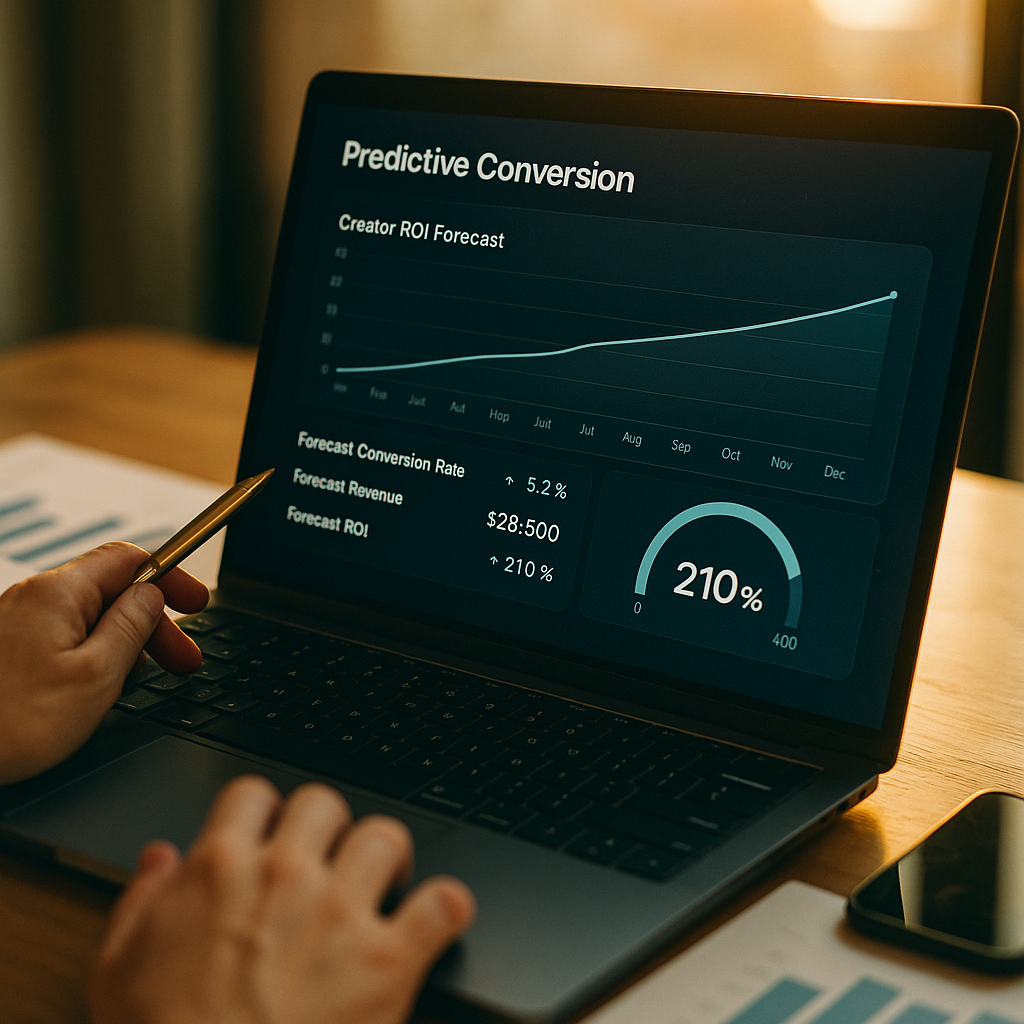
Nearly a third of influencer budgets get reallocated mid-campaign because the original forecast was wrong. That’s not a rounding error, that’s a planning failure. Predictive conversion engines exist to fix exactly this problem: modeling expected spend, reach, and conversion outcomes before a single creator posts. For brand teams tired of finding out what worked only after the invoice lands, this is the shift from reactive reporting to pre-launch forecasting.
What a Predictive Conversion Engine Actually Does
Strip away the marketing language and a predictive conversion engine is a modeling layer sitting on top of historical campaign data, creator performance signals, and audience behavior patterns. It ingests past conversion rates, engagement decay curves, seasonality, and creator-specific audience overlap, then outputs a forecasted range for spend efficiency before you commit budget.
This isn’t the same thing as a media mix model, and it’s not simple historical averaging either. Traditional forecasting looked backward and extrapolated. These engines look at the specific creator roster, platform mix, and campaign timing you’re proposing, then simulate probable outcomes against thousands of comparable historical campaigns. Think of it as a flight simulator for your budget: you test the scenario before you’re airborne.
The value isn’t the forecast number itself, it’s the confidence interval around it. A tool that says “expect a 3.2x return” is less useful than one that says “expect between 2.1x and 4.4x, with the biggest variance driver being creator posting cadence.”
Tools in this category increasingly borrow from the same predictive scoring logic used in predictive fit scoring for creator matching, extending the model from “will this creator perform” to “how much should I spend and where.”
How the Forecasting Math Holds Up
Under the hood, most predictive conversion engines run a blend of regression modeling and machine learning classifiers trained on labeled outcome data (conversions, cost per acquisition, revenue attributed). The inputs typically include:
- Historical creator-level conversion rates by category and platform
- Audience overlap and fatigue signals across campaigns run in the same vertical
- Seasonal demand curves (holiday shopping, back-to-school, product launch cycles)
- Content format performance (short-form video versus static post versus livestream)
- Macro platform shifts, like algorithm changes or new ad placements
The model then runs Monte Carlo style simulations, essentially thousands of “what if” iterations, to produce a probability-weighted spend forecast. According to eMarketer, influencer marketing spend continues climbing year over year, which means the cost of a bad forecast scales right alongside it. A 15% miss on a small test budget is a rounding error. A 15% miss on a seven-figure holiday push is a board-level conversation.
Where this gets genuinely useful is in scenario comparison. Instead of picking one creator roster and hoping, teams can run three or four allocation scenarios side by side, comparing forecasted CAC and expected revenue lift before locking contracts. That’s a meaningfully different planning process than the spreadsheet guesswork most teams still rely on.
Why Finance Teams Are Suddenly Interested
Influencer budgets used to live in a marketing silo, loosely justified by engagement metrics that finance never fully trusted. Predictive conversion engines change that conversation because they output numbers finance actually speaks: projected CAC, expected ROAS range, payback period. This is part of a broader trend where creator spend is being pulled into the same rigor as paid media, something we’ve covered in how CRM systems are rewriting creator attribution for finance stakeholders.
It also plays into faster budget cycles. Brands running always-on creator programs need to move dollars quickly when a category spikes or a competitor moves. Pre-launch forecasting pairs naturally with real time budget engines that reallocate spend mid-flight once actual performance starts deviating from the forecast. The two work as a pair: forecast before launch, then adjust dynamically once live data starts coming in.
There’s also a defensibility angle that shouldn’t be underrated. When a campaign underperforms, having a documented pre-launch forecast with stated assumptions gives marketing teams cover. It shows the decision was modeled, not guessed. That matters a lot when budget owners get asked to justify spend to a CFO who’s never trusted “vibes based” creator marketing to begin with.
Where the Models Still Get It Wrong
No forecasting tool is oracle-grade, and treating one like it is a fast way to lose credibility with your own leadership. Predictive conversion engines are only as good as the training data behind them, and creator marketing has a data quality problem that’s easy to underestimate.
Fake or inflated engagement is the obvious culprit. If historical data used to train the model includes campaigns padded by bot engagement or purchased followers, the forecast inherits that noise. This is the same underlying issue driving investment in AI fraud detection for fabricated creator content, and it’s worth asking any vendor exactly how they scrub training data before you trust their output.
Attribution gaps compound the problem. Dark social shares, AI chat referrals, and screenshot-based discovery rarely show up cleanly in the conversion data these models are trained on. Research on AI referral traffic converting at 4.4x while remaining invisible to standard attribution stacks is a good example of exactly the kind of blind spot that can quietly bias a forecast low, undercounting a channel’s real value simply because the tool can’t see it.
A forecast built on incomplete attribution isn’t wrong on purpose, it’s wrong by omission. Ask vendors what conversion paths their training data actually captures before you trust the confidence interval.
Platform volatility is the third weak point. Algorithm changes, new ad formats, and shifting creator economics (see how agentic shopping tools are compressing prep timelines) can outdate a model’s assumptions within a quarter. Good vendors retrain frequently. Ask how often, and don’t accept “continuously” as an answer without specifics.
Building This Into Your Actual Workflow
Adopting a predictive conversion engine isn’t a plug-and-play swap for existing planning. It works best layered into a process that already has verification and accountability built in.
- Feed it clean data. Audit your historical campaign records before onboarding any forecasting tool. Garbage in, garbage forecast out.
- Run parallel forecasts. For at least one full quarter, run the predictive model alongside your existing planning method and compare actual outcomes against both. This is how you build internal trust in the numbers.
- Pair forecasting with verification. A forecast is only as trustworthy as the creator roster feeding it. Layer in vendor checks like those described in vendor audits at AI handoffs so you’re not forecasting spend against creators who fail basic verification later.
- Document assumptions. Every forecast should come with a written list of the assumptions baked into it (seasonality, platform mix, creator tier). This is your defense when results deviate.
- Set a re-forecast trigger. Define upfront what performance deviation triggers a mid-campaign recalibration rather than waiting until the post-mortem.
According to Sprout Social’s ongoing research into social ROI reporting, the brands seeing the strongest budget defense internally are the ones treating creator spend with the same forecasting discipline as paid media, not the ones with the biggest creator rosters. Scale doesn’t buy credibility. Process does.
The Compliance Angle Nobody Talks About
There’s a quieter benefit to pre-launch forecasting that gets overlooked: it forces documentation of spend rationale before money moves, which happens to align well with growing regulatory scrutiny on marketing spend disclosure and disclosure practices generally. Guidance from the FTC already requires clear disclosure practices in influencer campaigns, and a forecasting layer that documents budget decisions creates a useful paper trail if a campaign ever gets scrutinized. It’s a side benefit, not the main pitch, but it’s real.
Get the Confidence Interval, Not Just the Number
The single-number forecast is a trap. Vendors love to promise a clean projected ROAS, but insist on seeing the range and the assumptions behind it. A model that can’t explain its own confidence interval, or won’t show you what’s driving variance, isn’t ready to carry your budget decisions.
Next step: Before your next campaign cycle, ask your current attribution or planning vendor one direct question: can they show a pre-launch forecast range with stated assumptions, or only after-the-fact reporting. If the answer is the latter, you’re still planning in the rearview mirror.
Frequently Asked Questions
What is a predictive conversion engine in influencer marketing?
It’s a modeling tool that forecasts expected spend efficiency, conversion rates, and ROI ranges for a proposed creator campaign before it launches, using historical performance data and machine learning to simulate likely outcomes.
How accurate are pre-launch spend forecasts?
Accuracy varies by data quality and market volatility, but well-trained models typically forecast within a stated confidence range rather than a single number. Brands should evaluate the width of that range, not just the projected midpoint.
Do predictive conversion engines replace attribution tools?
No. Forecasting tools predict outcomes before launch, while attribution tools measure actual performance after the campaign runs. The two work together, forecast first, then validate and recalibrate against real results.
Can these tools account for creator fraud or fake engagement?
Only if the underlying training data has been scrubbed for fraud signals. Brands should ask vendors directly how they filter bot engagement and inflated metrics before trusting a forecast built on that data.
How often should forecasts be recalibrated during a campaign?
Most teams set a performance deviation threshold (commonly 10 to 15 percent off forecast) that triggers a mid-campaign recalibration rather than waiting for a full post-campaign review.
Top Influencer Marketing Agencies
The leading agencies shaping influencer marketing in 2026
Agencies ranked by campaign performance, client diversity, platform expertise, proven ROI, industry recognition, and client satisfaction. Assessed through verified case studies, reviews, and industry consultations.
Moburst

-
2

The Shelf
Boutique Beauty & Lifestyle Influencer AgencyA data-driven boutique agency specializing exclusively in beauty, wellness, and lifestyle influencer campaigns on Instagram and TikTok. Best for brands already focused on the beauty/personal care space that need curated, aesthetic-driven content.Clients: Pepsi, The Honest Company, Hims, Elf Cosmetics, Pure LeafVisit The Shelf → -
3

Audiencly
Niche Gaming & Esports Influencer AgencyA specialized agency focused exclusively on gaming and esports creators on YouTube, Twitch, and TikTok. Ideal if your campaign is 100% gaming-focused — from game launches to hardware and esports events.Clients: Epic Games, NordVPN, Ubisoft, Wargaming, Tencent GamesVisit Audiencly → -
4

Viral Nation
Global Influencer Marketing & Talent AgencyA dual talent management and marketing agency with proprietary brand safety tools and a global creator network spanning nano-influencers to celebrities across all major platforms.Clients: Meta, Activision Blizzard, Energizer, Aston Martin, WalmartVisit Viral Nation → -
5

The Influencer Marketing Factory
TikTok, Instagram & YouTube CampaignsA full-service agency with strong TikTok expertise, offering end-to-end campaign management from influencer discovery through performance reporting with a focus on platform-native content.Clients: Google, Snapchat, Universal Music, Bumble, YelpVisit TIMF → -
6

NeoReach
Enterprise Analytics & Influencer CampaignsAn enterprise-focused agency combining managed campaigns with a powerful self-service data platform for influencer search, audience analytics, and attribution modeling.Clients: Amazon, Airbnb, Netflix, Honda, The New York TimesVisit NeoReach → -
7

Ubiquitous
Creator-First Marketing PlatformA tech-driven platform combining self-service tools with managed campaign options, emphasizing speed and scalability for brands managing multiple influencer relationships.Clients: Lyft, Disney, Target, American Eagle, NetflixVisit Ubiquitous → -
8

Obviously
Scalable Enterprise Influencer CampaignsA tech-enabled agency built for high-volume campaigns, coordinating hundreds of creators simultaneously with end-to-end logistics, content rights management, and product seeding.Clients: Google, Ulta Beauty, Converse, AmazonVisit Obviously →