


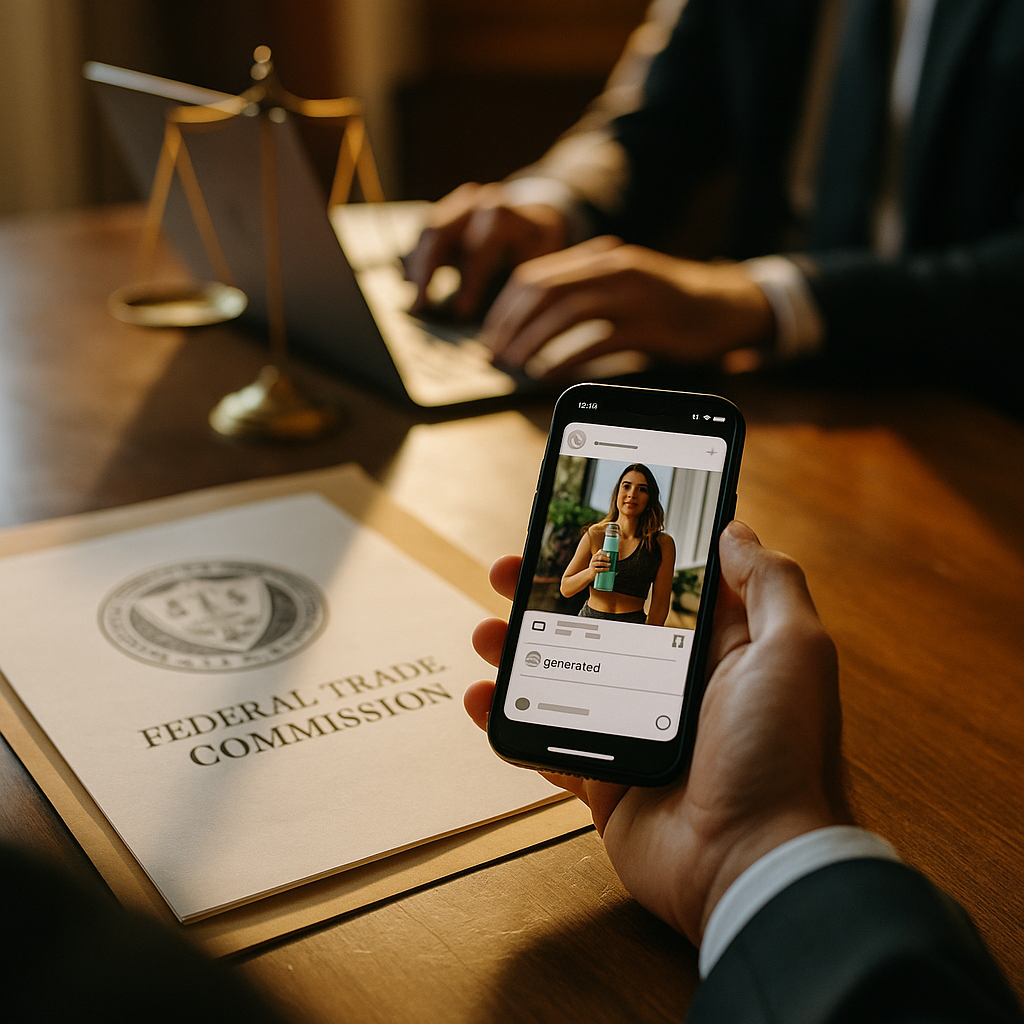
Nine states now have AI-specific disclosure statutes on the books. The FTC still enforces Section 5 the old-fashioned way, case by case, “reasonable consumer” standard intact. Now put a brand’s compliance team in the middle: state AI disclosure laws demand one thing, a platform’s auto-label demands another, and editing the ad to satisfy the platform sometimes creates the exact deception the state law was written to stop. Nobody designed this collision. But it’s here, and legal is asking marketing to explain it.
The Setup Nobody Planned For
Here’s the scenario playing out in ad ops teams right now. A brand generates video ad creative using an AI tool, maybe a synthetic voiceover, maybe a fully generated spokesperson. The platform, say Meta or TikTok, detects AI-generated elements and slaps on its own “AI info” label automatically. Fine so far. But the platform’s label placement, wording, or duration doesn’t satisfy the brand’s home state’s disclosure statute, or the state where the ad is served. So the brand’s compliance team modifies the creative, maybe adding a manual disclosure card, trimming the AI label to fit a template, or overlaying text to make the platform’s badge visible for the required duration.
That modification is the risky part. Once a brand touches AI-generated output to make a platform label “work,” it’s no longer just running a tool’s default disclosure. It’s exercising editorial control over how the disclosure appears to consumers. And editorial control is exactly what triggers direct liability under both state law and Section 5.
Modifying an AI label to satisfy a platform requirement doesn’t just fix a formatting problem. It can shift legal responsibility for the disclosure from the platform to the brand.
What State AI Disclosure Laws Actually Require
California’s AI transparency provisions, Colorado’s AI Act, and similar statutes in states like Illinois and Utah share a common thread: they require clear, conspicuous disclosure when content is materially AI-generated or altered, particularly in contexts involving likeness, voice, or persuasive commercial messaging. Some statutes specify placement (on-screen, not buried in a caption). Others specify duration or font size relative to the rest of the creative. None of them were written with platform-native AI labels in mind, because most predate the current wave of automatic labeling tools rolled out by Meta, TikTok, and YouTube.
That’s the mismatch. State legislators wrote rules assuming brands controlled the disclosure. Platforms built systems assuming they controlled it instead. Brands are stuck reconciling two disclosure regimes that were never designed to talk to each other.
This isn’t hypothetical hair-splitting. If a Colorado-based consumer sees an ad with a platform label that technically satisfies TikTok’s policy but doesn’t meet the state’s “clear and conspicuous” bar, the brand — not the platform — is the party most likely to face a deceptive trade practices claim. Platforms have disclaimed liability in their terms of service for years. Brands rarely read that fine print until it matters.
Where Section 5 Fits, and Why It’s Not the Same Test
The FTC doesn’t care about your state’s specific font-size requirement. Section 5 asks a simpler, broader question: would a reasonable consumer be misled about whether this content is AI-generated or human-created, and does that omission affect a purchasing decision? The FTC has been explicit that disclosure obligations apply regardless of platform-provided labels — a brand can’t outsource its Section 5 duty to a platform’s automated tagging system.
That’s the crux of the reconciliation problem. State law often demands a specific, mechanical disclosure format. Section 5 demands a functional outcome: no material deception, full stop. A brand can satisfy the letter of a state statute — right placement, right duration — and still run afoul of Section 5 if the overall impression created by the ad (label plus modified creative) still misleads a reasonable viewer about human involvement.
Our earlier coverage on TikTok AI labels vs FTC rules found the same pattern: platform compliance and federal compliance are parallel tracks, not the same track. Treating them as interchangeable is the single most common mistake we see in creative review workflows.
The Modification Trap
Let’s get specific about what “modifying AI ad output” actually means in production, because the liability hinges on the type of edit.
- Repositioning a platform label to make it visible in a cropped or resized creative — generally low risk, since you’re not changing the label’s content or meaning.
- Extending label duration to meet a state’s minimum display-time requirement — usually fine, and often necessary since most platform defaults (three to five seconds) fall short of what states like California expect for persuasive commercial content.
- Rewriting or simplifying label language to fit a template or brand voice guideline — high risk. If you change “AI-generated” to something softer like “digitally enhanced,” you’ve arguably created a new, potentially deceptive representation, separate from the platform’s disclosure.
- Removing or shrinking a label to preserve creative real estate — highest risk, full stop. This is the fact pattern that turns a compliance gap into an active misrepresentation claim.
Notice the pattern: the more a brand edits the substance of the disclosure rather than its presentation, the closer it moves toward direct FTC and state liability. Platforms give you formatting flexibility. They don’t give you semantic flexibility. Confusing the two is where legal teams get burned.
Documentation Is the Only Real Defense
Regulators and plaintiffs’ attorneys both look for intent and process. A brand that can show a documented compliance workflow — why a label was modified, what legal standard it was reconciling, who approved the change — is in a dramatically better position than one that can’t reconstruct its own decision-making six months later.
In an FTC investigation, the absence of a documented rationale is often read as evidence of indifference, not innocence.
Practically, that means every AI-label modification needs a paper trail: the original platform-generated label, the specific state statute triggering the change, the modified version, and sign-off from whoever owns disclosure compliance. Treat it like an audit file, because that’s precisely what it becomes if a state AG or the FTC comes asking. Our AI content audit protocol framework is a useful starting template if you don’t already have one built into your creative pipeline.
This is also where the “belt and suspenders” approach earns its keep. Brands running national campaigns across multiple state jurisdictions increasingly default to the strictest applicable state standard for every market, rather than customizing disclosures state by state. It’s less elegant, more conservative, and considerably cheaper than defending fifty different disclosure variants in fifty different regulatory contexts. We’ve seen the same consolidation logic play out in EU AI Act vs FTC disclosure reconciliation, where brands standardize upward rather than fragment their compliance approach by geography.
What This Means for Vendor Contracts
If your AI ad generation tool or media-buying platform is making labeling decisions on your behalf, your contract with that vendor needs to say who’s liable when the label is wrong, late, or removed. Most AI marketing platform agreements are silent on this, or worse, contain broad indemnification language favoring the vendor. That’s backwards. Brands should be pushing for explicit warranties that AI-generated content will be flagged accurately and that any platform-side labeling changes get surfaced to the brand’s compliance team before publication, not after a complaint.
This ties directly into broader data governance clauses for AI marketing platforms, and it deserves the same contractual rigor brands apply to indemnification around AI media-buying agent errors. Labeling failures are, functionally, a subset of the same risk category: a third-party system making a representation on your behalf that you can’t fully control but remain legally accountable for.
A Practical Reconciliation Framework
There’s no single fix, but there is a workable sequence brands can run for every AI-assisted ad before it goes live:
- Identify every state jurisdiction the ad will run in and flag the strictest applicable AI disclosure requirement.
- Compare that requirement against the platform’s default AI label — placement, duration, wording, visibility.
- Where gaps exist, modify presentation only (size, position, duration), never the underlying disclosure language, unless legal explicitly signs off.
- Run the final creative through a “reasonable consumer” gut check: would someone scrolling fast still register that this is AI-generated?
- Document the decision chain and store it alongside the creative asset for as long as your state’s statute of limitations requires.
Step four is the one teams skip under deadline pressure, and it’s the one that actually protects you. A reasonable consumer standard is subjective by design; regulators expect brands to have stress-tested it internally, not just assumed a checkbox label solves the problem. It’s the same discipline we’ve recommended for fast-hook disclosure audits, where speed and compliance constantly compete for the first three seconds of attention.
Industry data on this is still thin, but eMarketer’s ad tech coverage and Statista’s advertising research both point to accelerating AI-ad adoption outpacing platform policy updates, which is exactly the gap regulators are now stepping into. Expect more state activity, not less, over the next several enforcement cycles.
Visible FAQ
FAQs
Do platform AI labels satisfy state disclosure laws automatically?
No. Platform labels are designed to meet the platform’s own policy, not any specific state statute. Brands remain independently responsible for confirming that the label’s placement, duration, and language meet each applicable state’s legal standard.
Can modifying a platform’s AI label create new legal liability?
Yes, particularly if the modification changes the substance or wording of the disclosure rather than just its formatting. Altering the meaning of a label can shift responsibility for the disclosure’s accuracy from the platform to the brand.
How does FTC Section 5 differ from state AI disclosure statutes?
State laws often specify mechanical requirements like placement or duration. Section 5 uses a broader “reasonable consumer” deception standard, meaning a brand can technically satisfy a state law and still violate Section 5 if the overall ad remains misleading.
Should brands use the strictest state standard nationwide?
Many compliance teams default to the strictest applicable state requirement across all markets rather than customizing disclosures state by state, since it reduces legal exposure and simplifies creative production at scale.
What documentation should brands keep for AI-labeled ads?
Keep the original platform-generated label, the specific statute driving any modification, the final modified version, and internal sign-off records. This paper trail is critical if a regulator or plaintiff later questions the brand’s disclosure decisions.
The fix isn’t waiting for state legislatures and platforms to align, they won’t anytime soon. Build a documented, presentation-only modification process now, standardize on the strictest state requirement across markets, and treat every AI label edit as a legal decision, not a creative one.
Top Influencer Marketing Agencies
The leading agencies shaping influencer marketing in 2026
Agencies ranked by campaign performance, client diversity, platform expertise, proven ROI, industry recognition, and client satisfaction. Assessed through verified case studies, reviews, and industry consultations.
Moburst

-
2

The Shelf
Boutique Beauty & Lifestyle Influencer AgencyA data-driven boutique agency specializing exclusively in beauty, wellness, and lifestyle influencer campaigns on Instagram and TikTok. Best for brands already focused on the beauty/personal care space that need curated, aesthetic-driven content.Clients: Pepsi, The Honest Company, Hims, Elf Cosmetics, Pure LeafVisit The Shelf → -
3

Audiencly
Niche Gaming & Esports Influencer AgencyA specialized agency focused exclusively on gaming and esports creators on YouTube, Twitch, and TikTok. Ideal if your campaign is 100% gaming-focused — from game launches to hardware and esports events.Clients: Epic Games, NordVPN, Ubisoft, Wargaming, Tencent GamesVisit Audiencly → -
4

Viral Nation
Global Influencer Marketing & Talent AgencyA dual talent management and marketing agency with proprietary brand safety tools and a global creator network spanning nano-influencers to celebrities across all major platforms.Clients: Meta, Activision Blizzard, Energizer, Aston Martin, WalmartVisit Viral Nation → -
5

The Influencer Marketing Factory
TikTok, Instagram & YouTube CampaignsA full-service agency with strong TikTok expertise, offering end-to-end campaign management from influencer discovery through performance reporting with a focus on platform-native content.Clients: Google, Snapchat, Universal Music, Bumble, YelpVisit TIMF → -
6

NeoReach
Enterprise Analytics & Influencer CampaignsAn enterprise-focused agency combining managed campaigns with a powerful self-service data platform for influencer search, audience analytics, and attribution modeling.Clients: Amazon, Airbnb, Netflix, Honda, The New York TimesVisit NeoReach → -
7

Ubiquitous
Creator-First Marketing PlatformA tech-driven platform combining self-service tools with managed campaign options, emphasizing speed and scalability for brands managing multiple influencer relationships.Clients: Lyft, Disney, Target, American Eagle, NetflixVisit Ubiquitous → -
8

Obviously
Scalable Enterprise Influencer CampaignsA tech-enabled agency built for high-volume campaigns, coordinating hundreds of creators simultaneously with end-to-end logistics, content rights management, and product seeding.Clients: Google, Ulta Beauty, Converse, AmazonVisit Obviously →