


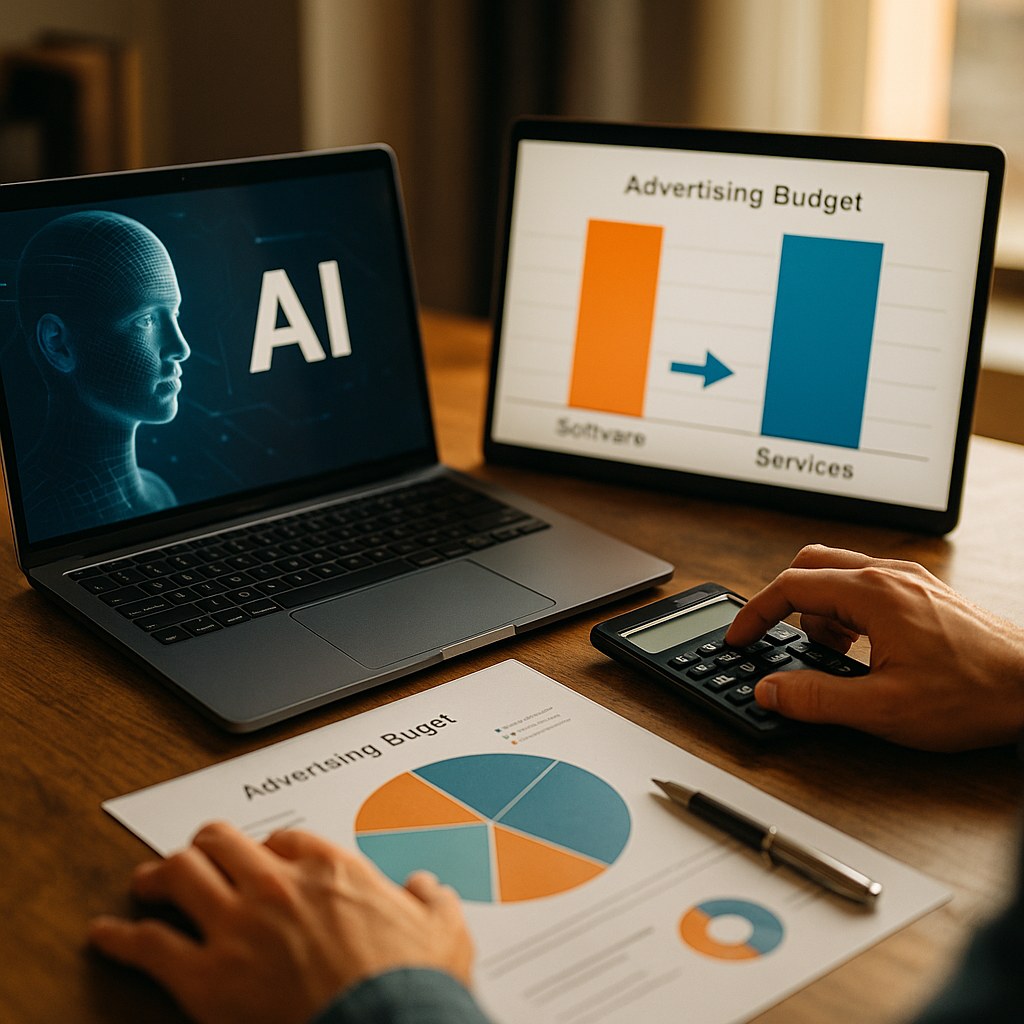
Software used to be the whole pitch. Buy the platform, run the algorithm, watch the CPMs drop. Not anymore. The global AI advertising market is racing toward $422 billion, and most of that growth isn’t coming from tools — it’s coming from services wrapped around them. That reshuffling has massive implications for how you split budget between agencies and in-house teams.
The Software Party Is Over. Services Are the Main Event
For years, the pitch from ad tech vendors was simple: give us your budget, we’ll give you the platform, and the platform does the rest. That story is losing credibility fast. Buyers have realized that access to a model isn’t the same as knowing how to operate it inside a real media plan, with real compliance constraints and real attribution gaps.
What’s replacing it is a services layer: managed campaign optimization, creative generation workflows, agentic media buying, compliance review, and performance modeling delivered as ongoing engagements rather than software licenses. Analysts tracking the AI advertising market consistently point to services outpacing software growth rates by a wide margin, and that’s not a fluke. It’s a structural shift in how AI value gets delivered.
When AI capability becomes table stakes in every platform, the differentiator stops being “do you have AI” and becomes “who’s driving it, and how well.”
That’s the uncomfortable truth for a lot of martech vendors right now. The tools themselves are commoditizing. Anthropic, OpenAI, and Google’s Gemini stack all offer comparable creative and analytical horsepower to anyone with an API key. The moat has moved to execution — and execution requires people, process, and judgment. Services, not seats.
Why This Matters for Your Agency-vs-In-House Math
Here’s the question every CMO and VP of marketing should be asking right now: if the value has shifted from software to services, does that make the case for agencies stronger, or weaker?
The honest answer is: it depends on what kind of service you need, and how fast you need it.
- Agencies win when the service requires cross-client pattern recognition — knowing what’s working across dozens of accounts, not just yours.
- In-house wins when the service requires deep product knowledge, brand voice fluency, or rapid iteration cycles that an external partner can’t match without months of onboarding.
- Hybrid models win almost everywhere else, which is most of the market.
This is a meaningful departure from the software-era logic, where the calculation was mostly about license cost versus headcount cost. Now you’re comparing service quality, speed, and institutional knowledge — softer variables that are harder to benchmark but far more consequential.
The Budget Split Nobody Wants to Admit Is Happening
Talk to enough marketing leaders and a pattern emerges: budgets aren’t moving cleanly from “agency” to “in-house” or vice versa. They’re fragmenting into three buckets — platform spend, managed service fees, and internal operations headcount. The old two-column budget sheet (agency retainer vs. internal team) doesn’t capture reality anymore.
Some brands are quietly shrinking agency retainers while increasing spend on specialized AI service vendors that sit somewhere between a tool and a traditional agency — think AI-driven media optimization shops or agentic buying platforms that come with a dedicated strategist. It’s not disintermediation. It’s re-intermediation with a different vendor category. Our coverage of AI stack consolidation found a similar pattern: brands aren’t cutting AI spend, they’re routing it through fewer, more integrated partners.
That consolidation instinct applies to services too. Fewer vendors, deeper relationships, more accountability per contract.
Where the $422 Billion Is Actually Going
Break down the AI advertising forecasts from firms like eMarketer and Statista, and a consistent story emerges across categories: programmatic optimization services, AI-generated creative production, and predictive audience modeling are pulling ahead of straight platform licensing. Advertisers aren’t just buying smarter targeting anymore — they’re buying entire managed workflows that used to require a dozen internal specialists.
This tracks with what we’ve seen in adjacent coverage. The shift toward attribution-focused AI budgets shows buyers prioritizing measurement services over generative content tools, because measurement is where the ROI argument gets made or lost. Nobody gets fired for buying a content generator. People absolutely get fired for not being able to prove what worked.
Identity and data infrastructure are part of this services wave too. As cookies fade and clean rooms multiply, brands are outsourcing identity resolution rather than building it internally, a trend detailed in our piece on identity resolution in AI marketing. That’s a services line item, not a software SKU, and it’s growing fast because getting it wrong torches your entire measurement stack.
The Risk Nobody’s Pricing In Yet
Services-heavy AI advertising comes with a compliance wrinkle that pure software never had: accountability gets blurry. When a vendor’s AI system makes a targeting decision, generates ad copy, or auto-optimizes a bid in ways that touch protected categories or misrepresent a product, who’s on the hook? The brand. Always the brand.
Regulators are watching closely. The Federal Trade Commission has been explicit that AI-driven advertising decisions don’t get a liability pass just because a human didn’t make the call directly. The UK’s ICO has taken a similar stance on automated decision-making and data use. If your AI ad vendor is making autonomous decisions inside your media plan, you need contractual clarity on audit rights, data handling, and override authority — not just a service-level agreement about uptime.
Outsourcing the execution of AI advertising does not outsource the liability. Brands remain accountable for what their vendors’ models do in market.
This is exactly why performance-based and outcome-tied contract structures are gaining traction — they force clearer accountability lines than legacy retainers ever did. We’ve tracked this shift in creator payment models too, where performance-based contracts are rewiring influencer pay, and the same logic is bleeding into broader AI ad services procurement. Pay for verified outcomes, not activity.
What This Means for Agency Contracts Specifically
Agencies that built their pitch around “we have AI tools” are getting squeezed. Clients can get the tools themselves now, often cheaper. What agencies need to sell instead is judgment: the ability to interpret AI outputs, catch errors before they go live, and translate model recommendations into brand-safe execution.
That’s driving contract restructuring across the industry. Retainers built around headcount and hours are giving way to structures tied to output volume, usable asset counts, and performance thresholds — a shift covered in depth in our analysis of how content volume cuts are forcing agency contracts to change. If you’re renegotiating an agency deal this cycle, benchmark against cost-per-usable-output metrics rather than flat hourly rates. It’s a more honest reflection of what AI-augmented services actually deliver, and it mirrors the shift we’ve seen in cost-per-usable-asset payment models on the creator side.
Building the In-House Case (Without Overbuilding)
None of this means every brand should rush to build a 40-person internal AI ad ops team. That’s the overcorrection trap. In-house teams are excellent at speed and brand fidelity, and terrible at staying current on rapidly shifting AI ad tooling unless you’re constantly retraining. The talent gap is real and well documented — our piece on closing the agentic AI talent gap found most marketing orgs are at least one full skills cycle behind what agentic AI tools now require.
A more sustainable model for most mid-size and enterprise brands: keep strategy, brand governance, and first-party data ownership in-house. Outsource the compute-heavy, rapidly-evolving execution layer to specialized service vendors who live and breathe model updates daily. Revisit that split every two quarters, because the AI ad tooling landscape moves faster than most procurement cycles.
- Own internally: brand voice guidelines, first-party data strategy, measurement framework, compliance sign-off.
- Outsource: model-driven creative variant generation, real-time bid optimization, cross-channel identity stitching.
- Negotiate hard on: exit clauses, data portability, and audit rights over automated decisions.
One more thing worth flagging: this budget conversation doesn’t happen in isolation from the creator economy. As creator investment forecasts show budget shifting away from traditional paid media, the AI services question increasingly overlaps with influencer and UGC spend decisions. The lines between “ad tech services” and “creator services” are blurring, and your budget structure should reflect that instead of pretending they’re separate line items.
Next Step
Audit your current AI ad spend by category — platform license, managed service fee, internal headcount — before your next budget cycle. If more than 60% is still sitting in flat software licenses rather than outcome-tied services, you’re likely overpaying for commoditized capability while underinvesting in the execution talent that actually moves performance.
Frequently Asked Questions
What is driving the shift from AI advertising software to services?
AI capabilities have become commoditized across major platforms, so buyers no longer pay a premium just for access to a model. Value has moved to execution — strategy, optimization, compliance oversight, and creative judgment — which is delivered as a service rather than licensed as software.
Should brands move budget from agencies to in-house AI teams?
Not wholesale. Most brands benefit from keeping brand governance, data strategy, and compliance in-house while outsourcing fast-evolving, compute-intensive execution to specialized service vendors. Revisit the split every couple of quarters as tooling and internal skills evolve.
Who is liable when an AI advertising vendor’s model makes a compliance mistake?
The brand typically remains accountable. Regulators including the FTC have made clear that using automated or AI-driven decision-making doesn’t shift advertising compliance liability away from the brand running the campaign.
How should agency contracts change in response to this services shift?
Move away from flat hourly or headcount-based retainers toward performance-based or output-based structures, such as cost-per-usable-asset pricing, that reflect what AI-augmented services actually deliver rather than time spent.
Is the $422 billion AI advertising market figure mostly software or services?
Industry forecasts consistently show services — managed optimization, creative production workflows, identity resolution, and measurement — growing faster than standalone software licensing, making services the larger driver of near-term market expansion.
FAQs
What is driving the shift from AI advertising software to services?
AI capabilities have become commoditized across major platforms, so buyers no longer pay a premium just for access to a model. Value has moved to execution — strategy, optimization, compliance oversight, and creative judgment — which is delivered as a service rather than licensed as software.
Should brands move budget from agencies to in-house AI teams?
Not wholesale. Most brands benefit from keeping brand governance, data strategy, and compliance in-house while outsourcing fast-evolving, compute-intensive execution to specialized service vendors. Revisit the split every couple of quarters as tooling and internal skills evolve.
Who is liable when an AI advertising vendor’s model makes a compliance mistake?
The brand typically remains accountable. Regulators including the FTC have made clear that using automated or AI-driven decision-making doesn’t shift advertising compliance liability away from the brand running the campaign.
How should agency contracts change in response to this services shift?
Move away from flat hourly or headcount-based retainers toward performance-based or output-based structures, such as cost-per-usable-asset pricing, that reflect what AI-augmented services actually deliver rather than time spent.
Is the $422 billion AI advertising market figure mostly software or services?
Industry forecasts consistently show services — managed optimization, creative production workflows, identity resolution, and measurement — growing faster than standalone software licensing, making services the larger driver of near-term market expansion.
Top Influencer Marketing Agencies
The leading agencies shaping influencer marketing in 2026
Agencies ranked by campaign performance, client diversity, platform expertise, proven ROI, industry recognition, and client satisfaction. Assessed through verified case studies, reviews, and industry consultations.
Moburst

-
2

The Shelf
Boutique Beauty & Lifestyle Influencer AgencyA data-driven boutique agency specializing exclusively in beauty, wellness, and lifestyle influencer campaigns on Instagram and TikTok. Best for brands already focused on the beauty/personal care space that need curated, aesthetic-driven content.Clients: Pepsi, The Honest Company, Hims, Elf Cosmetics, Pure LeafVisit The Shelf → -
3

Audiencly
Niche Gaming & Esports Influencer AgencyA specialized agency focused exclusively on gaming and esports creators on YouTube, Twitch, and TikTok. Ideal if your campaign is 100% gaming-focused — from game launches to hardware and esports events.Clients: Epic Games, NordVPN, Ubisoft, Wargaming, Tencent GamesVisit Audiencly → -
4

Viral Nation
Global Influencer Marketing & Talent AgencyA dual talent management and marketing agency with proprietary brand safety tools and a global creator network spanning nano-influencers to celebrities across all major platforms.Clients: Meta, Activision Blizzard, Energizer, Aston Martin, WalmartVisit Viral Nation → -
5

The Influencer Marketing Factory
TikTok, Instagram & YouTube CampaignsA full-service agency with strong TikTok expertise, offering end-to-end campaign management from influencer discovery through performance reporting with a focus on platform-native content.Clients: Google, Snapchat, Universal Music, Bumble, YelpVisit TIMF → -
6

NeoReach
Enterprise Analytics & Influencer CampaignsAn enterprise-focused agency combining managed campaigns with a powerful self-service data platform for influencer search, audience analytics, and attribution modeling.Clients: Amazon, Airbnb, Netflix, Honda, The New York TimesVisit NeoReach → -
7

Ubiquitous
Creator-First Marketing PlatformA tech-driven platform combining self-service tools with managed campaign options, emphasizing speed and scalability for brands managing multiple influencer relationships.Clients: Lyft, Disney, Target, American Eagle, NetflixVisit Ubiquitous → -
8

Obviously
Scalable Enterprise Influencer CampaignsA tech-enabled agency built for high-volume campaigns, coordinating hundreds of creators simultaneously with end-to-end logistics, content rights management, and product seeding.Clients: Google, Ulta Beauty, Converse, AmazonVisit Obviously →