


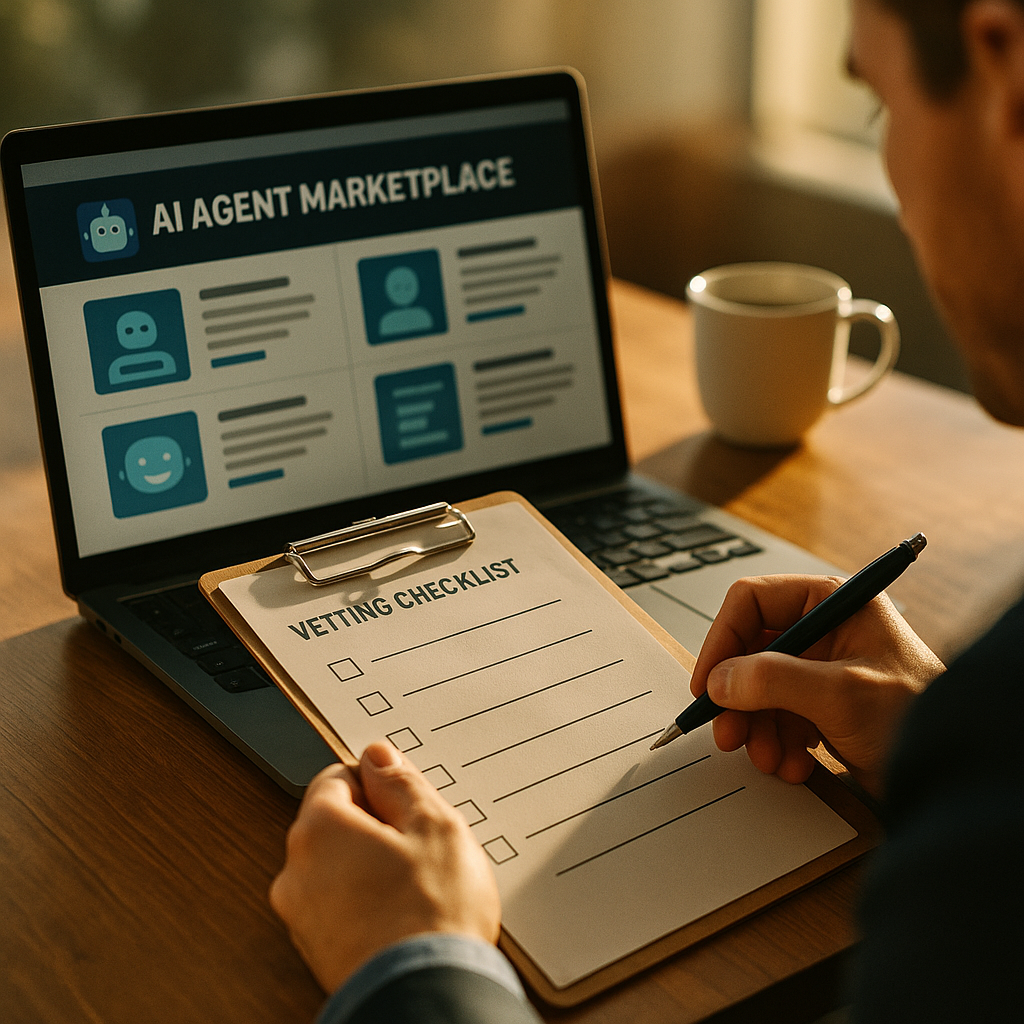
By the time most brands notice a rogue agentic plugin overspent a campaign or auto-signed a creator deal outside contract terms, the money’s already gone. Gartner predicts that over 40% of agentic AI projects will be scrapped by 2027 due to cost and risk failures. AI agent marketplace governance isn’t a compliance nicety anymore. It’s the difference between scaling autonomous marketing and cleaning up after it.
The Marketplace Problem Nobody Priced In
Every major ad platform now ships an agent store. Google, Meta, Amazon, and a swarm of independent vendors are racing to plug third-party “skills” into your media stack: bidding agents, creative generators, influencer-matching bots, contract-negotiation assistants. Install one, grant it API access, and it starts acting — buying impressions, DMing creators, adjusting budgets — often without a human confirming each step.
That’s the pitch. It’s also the risk. A plugin marketplace is only as safe as its weakest submission, and most of these marketplaces are curated more like app stores than financial systems. Nobody’s running a SOC 2 audit before your intern clicks “authorize.”
Granting an agentic plugin access to your media budget is functionally the same as handing a new vendor your corporate card and your creator contract templates — except the vendor is code you didn’t write and can’t fully inspect.
Brands that treated their first wave of agentic tools as “just another SaaS integration” are now discovering the gap. Traditional vendor vetting checks for data security and uptime SLAs. It doesn’t check whether an autonomous agent will renegotiate a creator’s usage rights mid-flight or blow through a spend cap because it interpreted “maximize reach” too literally. We’ve already covered how spend caps and circuit breakers function as a last line of defense — but governance has to start well before that circuit breaker ever trips.
What “Vetting” Actually Means for an Agentic Plugin
Vetting a plugin isn’t a one-time checkbox. It’s an ongoing relationship with four distinct layers: identity, permissions, financial exposure, and legal liability. Skip any one, and you’ve got a governance hole.
1. Verify the agent’s actual decision logic — not just its marketing claims
Ask the vendor directly: what model or model chain powers this agent? Is it a fine-tuned LLM making judgment calls, or a rules-based system with an AI wrapper for the demo? Vendors love to blur this line. Push for documentation on how the agent handles edge cases — a sudden CPM spike, a creator who violates FTC disclosure rules mid-campaign, a budget nearing its ceiling. If the vendor can’t produce a decision tree or audit log sample, that’s your answer.
This matters because ROAS claims from AI ad vendors are notoriously slippery. Our AI ad vendor due diligence checklist is a useful companion here — the same skepticism applies whether you’re vetting a media-buying algorithm or a creator-matching agent.
2. Map every permission scope before you grant it
Agentic plugins typically request broad OAuth-style scopes: read/write access to ad accounts, CRM fields, contract databases, sometimes even bank-linked payment rails. Most marketing teams accept the default scope because narrowing it feels like extra friction. Don’t.
- Read-only where possible. If the agent only needs to analyze performance data, it doesn’t need write access to your DSP.
- Time-boxed tokens. Access should expire and require re-authorization, not persist indefinitely.
- Scoped to campaign, not account. A plugin testing creator outreach for one brand shouldn’t see budget data for every brand in your portfolio.
This is the same discipline behind spend guardrails and approval thresholds for agentic ads generally — permission scoping is just the access-control layer of that broader framework.
3. Financial exposure: what happens when it’s wrong?
Here’s the uncomfortable question most procurement teams skip: if the agent overspends by six figures in an hour, who’s liable? Read the vendor’s terms of service closely. Many explicitly disclaim responsibility for “autonomous decisions made within granted parameters” — meaning if you gave it a $50K daily cap and it spent all of it on bot traffic, that’s on you, not them.
Build financial exposure limits into the contract itself, not just the platform settings. Ask for:
- A documented maximum daily/weekly spend ceiling enforced at the API level, not just the UI
- Rollback or clawback provisions if the agent executes an erroneous transaction
- Real-time alerting thresholds (50%, 75%, 90% of budget) routed to a human, not just logged
Our spend caps governance template lays out exactly how to structure these thresholds contractually rather than leaving them to platform defaults, which vendors can — and do — change without much notice.
Creator Contracts Add a Layer Most Brands Haven’t Thought Through
Media budget overspend is bad. An agent that autonomously negotiates or modifies a creator contract is a different category of risk entirely — it touches usage rights, exclusivity clauses, disclosure obligations, and payment terms, all of which carry legal weight beyond marketing performance.
Picture this: a creator-matching plugin identifies a “high-fit” influencer, auto-generates a contract from a template, and sends it for e-signature — all before your legal team sees it. If that contract’s usage rights language is wrong, or it fails to include FTC-required disclosure clauses, you’re the one holding liability, not the vendor. The FTC’s endorsement guidelines don’t care whether a human or an algorithm sourced the deal.
Before letting any plugin touch creator contracts, confirm:
- It uses your legal team’s approved contract templates, not its own generic ones
- Any auto-generated terms route through a human approval gate before signature
- It flags — rather than resolves — ambiguous clauses like usage duration or platform exclusivity
- It logs every version of a contract it touches, with timestamps, for audit purposes
If you’re building briefs for agentic tools involved in influencer sourcing, our guide on writing agentic AI campaign briefs for influencers covers how to bake these constraints into the initial instructions, rather than trying to police them after the fact.
A Practical Vetting Checklist Before Go-Live
Skip the vendor deck. Run this instead before any plugin gets production access:
- Security review. Has the vendor completed a SOC 2 Type II or ISO 27001 audit? Ask for the report, not a summary slide.
- Data residency and retention. Where does creator and budget data live, and for how long? This matters for GDPR compliance if you operate in the UK or EU — check current guidance from the ICO if creator data crosses borders.
- Kill switch access. Can your team disable the agent instantly, without vendor involvement, at any hour?
- Explainability logs. Does every autonomous action produce a human-readable reason code?
- Incident history. Ask directly: has this agent caused a budget overrun or contract error for another client? Most vendors won’t volunteer this. Ask anyway.
- Sandbox period. Run the plugin in a shadow mode — recommending actions without executing them — for at least two full campaign cycles before granting live write access.
If a vendor can’t answer “what’s the worst thing this agent has ever done” with a specific, documented example, you’re the beta test.
This checklist approach mirrors what we’ve recommended for evaluating platform-native agentic suites — see our governance checklist for Google’s agentic media buying tools, which applies the same logic to first-party platform agents, not just third-party marketplace plugins.
Who Owns This Inside Your Org?
Governance fails when it’s nobody’s job. Marketing wants speed, procurement wants standard contracts, legal wants liability caps, and IT security wants access control — none of them alone can vet an agentic plugin properly. This is part of a broader shift: as we’ve noted in coverage of the CMO role splitting under the AI skills gap, marketing leaders increasingly need a dedicated AI governance function that sits between these teams, not underneath one of them.
Practically, that means a standing review board — marketing ops, legal, and security, minimum — that signs off on any plugin before it touches live budget or contract systems. Not a Slack thread. A documented approval process with a paper trail, because when (not if) an agent does something unexpected, you’ll want to show regulators and your own board that due diligence happened before deployment, not after.
Some brands are also finding that fully autonomous marketing pilots reveal governance gaps faster than gradual rollouts do — worth reading alongside the LSE and Into-it autonomous marketing team pilot for a sense of what happens when governance keeps pace with autonomy versus when it doesn’t.
The Bottom Line on Marketplace Trust
Plugin marketplaces will keep growing. The convenience is real — a well-vetted agent can genuinely outperform manual media buying and creator sourcing on speed and pattern recognition. But convenience without governance is just risk with better UX. According to eMarketer, brands are accelerating agentic ad spend faster than their internal risk frameworks can keep up — which is precisely the gap this vetting process is meant to close.
Treat every plugin as a vendor with financial signing authority, because functionally, that’s what it is. Vet accordingly.
Frequently Asked Questions
What is AI agent marketplace governance?
It’s the set of policies, permissions, and review processes a brand uses to evaluate, approve, and monitor third-party AI plugins before those plugins can access media budgets, ad accounts, or creator contract systems. It covers security review, financial exposure limits, and legal liability, not just technical integration.
How much access should a new agentic plugin get initially?
Start with read-only access and shadow mode, where the agent recommends actions but a human executes them. Expand to limited write access with hard spend caps only after at least one full campaign cycle of monitored performance with no incidents.
Who is liable if an agentic plugin overspends a media budget?
It depends on the vendor contract, but most marketplace terms shift liability to the brand for actions taken within granted permissions. This is why contractual spend ceilings and clawback provisions, not just platform-level settings, are essential before granting access.
Can an AI agent legally sign or modify a creator contract?
Technically, yes, if given e-signature and contract-system access — but this creates significant legal exposure. Brands should require human approval gates for any auto-generated contract terms, and ensure agents use pre-approved legal templates rather than generating their own language.
What questions should we ask a plugin vendor before onboarding?
Ask about their security certifications (SOC 2, ISO 27001), data residency, incident history with other clients, whether a kill switch exists, and whether every autonomous action generates an explainable, human-readable log entry.
Visible FAQ (HTML)
Frequently Asked Questions
What is AI agent marketplace governance?
It’s the set of policies, permissions, and review processes a brand uses to evaluate, approve, and monitor third-party AI plugins before those plugins can access media budgets, ad accounts, or creator contract systems. It covers security review, financial exposure limits, and legal liability, not just technical integration.
How much access should a new agentic plugin get initially?
Start with read-only access and shadow mode, where the agent recommends actions but a human executes them. Expand to limited write access with hard spend caps only after at least one full campaign cycle of monitored performance with no incidents.
Who is liable if an agentic plugin overspends a media budget?
It depends on the vendor contract, but most marketplace terms shift liability to the brand for actions taken within granted permissions. This is why contractual spend ceilings and clawback provisions, not just platform-level settings, are essential before granting access.
Can an AI agent legally sign or modify a creator contract?
Technically, yes, if given e-signature and contract-system access — but this creates significant legal exposure. Brands should require human approval gates for any auto-generated contract terms, and ensure agents use pre-approved legal templates rather than generating their own language.
What questions should we ask a plugin vendor before onboarding?
Ask about their security certifications (SOC 2, ISO 27001), data residency, incident history with other clients, whether a kill switch exists, and whether every autonomous action generates an explainable, human-readable log entry.
Top Influencer Marketing Agencies
The leading agencies shaping influencer marketing in 2026
Agencies ranked by campaign performance, client diversity, platform expertise, proven ROI, industry recognition, and client satisfaction. Assessed through verified case studies, reviews, and industry consultations.
Moburst

-
2

The Shelf
Boutique Beauty & Lifestyle Influencer AgencyA data-driven boutique agency specializing exclusively in beauty, wellness, and lifestyle influencer campaigns on Instagram and TikTok. Best for brands already focused on the beauty/personal care space that need curated, aesthetic-driven content.Clients: Pepsi, The Honest Company, Hims, Elf Cosmetics, Pure LeafVisit The Shelf → -
3

Audiencly
Niche Gaming & Esports Influencer AgencyA specialized agency focused exclusively on gaming and esports creators on YouTube, Twitch, and TikTok. Ideal if your campaign is 100% gaming-focused — from game launches to hardware and esports events.Clients: Epic Games, NordVPN, Ubisoft, Wargaming, Tencent GamesVisit Audiencly → -
4

Viral Nation
Global Influencer Marketing & Talent AgencyA dual talent management and marketing agency with proprietary brand safety tools and a global creator network spanning nano-influencers to celebrities across all major platforms.Clients: Meta, Activision Blizzard, Energizer, Aston Martin, WalmartVisit Viral Nation → -
5

The Influencer Marketing Factory
TikTok, Instagram & YouTube CampaignsA full-service agency with strong TikTok expertise, offering end-to-end campaign management from influencer discovery through performance reporting with a focus on platform-native content.Clients: Google, Snapchat, Universal Music, Bumble, YelpVisit TIMF → -
6

NeoReach
Enterprise Analytics & Influencer CampaignsAn enterprise-focused agency combining managed campaigns with a powerful self-service data platform for influencer search, audience analytics, and attribution modeling.Clients: Amazon, Airbnb, Netflix, Honda, The New York TimesVisit NeoReach → -
7

Ubiquitous
Creator-First Marketing PlatformA tech-driven platform combining self-service tools with managed campaign options, emphasizing speed and scalability for brands managing multiple influencer relationships.Clients: Lyft, Disney, Target, American Eagle, NetflixVisit Ubiquitous → -
8

Obviously
Scalable Enterprise Influencer CampaignsA tech-enabled agency built for high-volume campaigns, coordinating hundreds of creators simultaneously with end-to-end logistics, content rights management, and product seeding.Clients: Google, Ulta Beauty, Converse, AmazonVisit Obviously →