


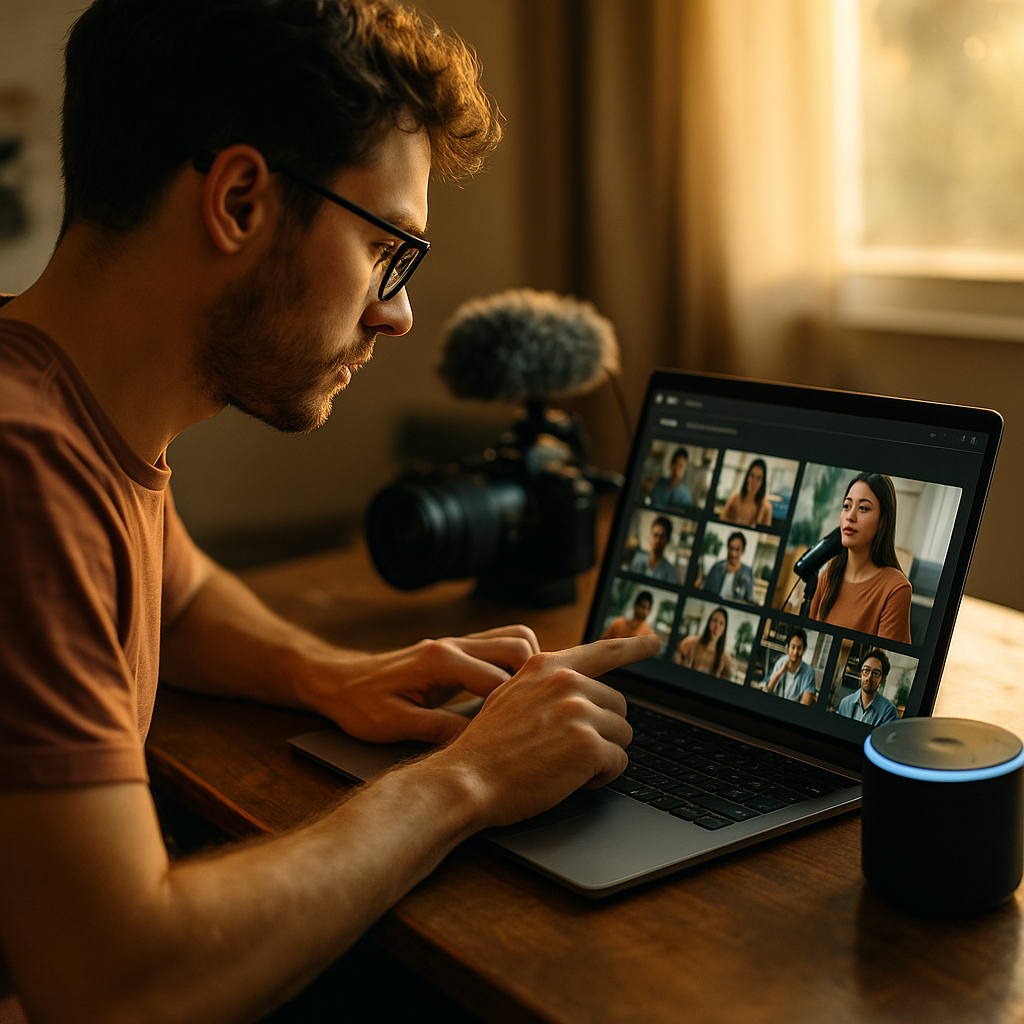
Most Creator Content Is Invisible to AI Shopping Agents
Over 60% of product research queries are now handled or assisted by agentic AI systems — and the creator content your brand paid for isn’t showing up. Not because it’s bad content. Because it wasn’t built to be retrieved. AI context engineering changes that, and brands that act now will own the citation layer before their competitors figure out the game.
Why Retrieval Is the New Distribution
The old distribution model was simple: get the content in front of eyeballs. Algorithm, paid amplification, influencer reach — all of it optimized for human attention. That model still matters. But a parallel layer has emerged that most marketing teams are ignoring: agentic AI retrieval.
When a consumer uses a tool like Perplexity, ChatGPT Shopping, or Google’s AI Overviews to research a skincare product, a B2B software platform, or a kitchen appliance, the AI isn’t scrolling Instagram. It’s querying indexed content through hybrid search systems — combining dense vector embeddings (semantic meaning) with sparse keyword retrieval (BM25-style term matching). The content that wins citations is the content that scores well on both axes simultaneously.
Creator content, by its nature, is semantically rich but structurally thin. A TikTok script or an Instagram caption rarely carries the metadata, schema markup, or contextual framing that retrieval systems need to surface it confidently. That’s the gap context engineering closes.
Hybrid search doesn’t reward the most popular content — it rewards the most retrievable content. Dense embeddings find semantic neighbors; sparse retrieval finds exact-match signals. Creator content needs to win on both vectors to earn AI citations.
What Context Engineering Actually Means for Creator Programs
Context engineering, borrowed from the AI systems world, refers to the deliberate design of the information environment that an AI model operates within. In a retrieval-augmented generation (RAG) pipeline, this means structuring the input documents — the “context window” — so the model can extract, rank, and cite them accurately.
Applied to creator content, it means treating every piece of influencer-produced content as a structured document, not just a social post. Practically, this involves three operational layers:
- Semantic anchoring: Ensuring creator content explicitly names product attributes, use cases, and comparison categories that match how consumers phrase research queries. “This SPF 50 sunscreen doesn’t leave a white cast on deeper skin tones” retrieves differently — and better — than “obsessed with this SPF.”
- Structural metadata: When creator content is republished on owned or earned web properties (brand landing pages, press pages, review aggregators), it must carry appropriate schema markup. Product, Review, and HowTo schema are the minimum. For deeper retrieval, creator metadata and schema practices need to be part of your content operations workflow from the brief stage.
- Contextual framing: The page or post surrounding the creator content signals to the retrieval system what the content is about. A creator video embedded on a bare landing page with no surrounding text gives the AI almost nothing to work with. Wrap that video with a structured product description, entity-linked brand mentions, and FAQ content, and retrieval probability increases substantially.
Hybrid Search: The Dual Engine Your Content Must Satisfy
Most marketing teams have heard of semantic search. Fewer have operationalized what hybrid retrieval actually requires from their content.
Sparse retrieval (think: traditional keyword matching) still rewards exact-phrase precision. If a consumer’s AI agent queries “best noise-canceling headphones under $200 for commuters,” your creator content needs those specific terms — or close variants — somewhere in the retrievable text. Not stuffed. Present. Naturally embedded in authentic creator language, but present.
Dense retrieval operates on meaning. The embedding model converts your content into a vector and finds documents nearby in semantic space. This is where creator content often performs well organically — because authentic storytelling creates rich semantic density. The problem is that platform-native content (vertical video, ephemeral stories) rarely gets indexed by the systems powering AI agents. It lives in walled gardens.
The fix is content syndication architecture. Creator content — especially long-form YouTube reviews, podcast mentions, and blog-style creator articles — needs to be systematically published or mirrored on indexable web properties. For brands running high-volume UGC programs, an AI UGC routing engine can automate the triage of which creator assets get syndicated, transcribed, and structured for web indexing versus which stay native to social platforms.
Brief Design Is Where This Actually Gets Built
Here’s the uncomfortable truth: you can’t retrofit context engineering onto creator content after it’s published. The structural signals have to be planned at the brief stage.
That means your creator briefs need a new section — call it “retrieval requirements” or “AI discoverability guidelines.” This section should specify:
- The exact product attributes and comparison terms the creator must reference verbally or in text (for transcription indexing)
- The long-tail query phrases the content should semantically match — derived from AI search query analysis, not just traditional keyword research
- The call-to-action structure that links to an indexable landing page with proper schema
- Any required entity mentions (brand name, product line, ingredient names) that help retrieval systems identify the content’s subject with confidence
This doesn’t constrain creator voice. It gives creators precision targets while leaving execution flexible. The best creators will work with these requirements naturally — they’re essentially story prompts with SEO discipline baked in. For more on engineering briefs at scale, the approach to AI brief personalization offers a scalable framework.
The Agentic Retrieval Stack: What’s Actually Happening Under the Hood
Understanding the technical pipeline removes the mystery and sharpens your targeting.
When a consumer’s AI shopping agent receives a product research query, it typically runs a hybrid search across a vector database of indexed web content. The query is converted to an embedding, sparse keyword signals are extracted, and both are used to rank candidate documents. The top candidates are passed into the model’s context window, where they’re synthesized into a response — and often cited by URL.
For your creator content to appear in that context window, it must clear four gates: it must be crawlable, indexable, semantically relevant, and structurally credible. AI discoverability and schema markup practices address the last two gates directly. The first two — crawlability and indexability — require your web infrastructure team to ensure creator content landing pages aren’t blocked by robots.txt, paywalls, or JavaScript-only rendering that crawlers can’t parse.
Structured data is disproportionately valuable here. Google’s Search documentation on structured data is the baseline, but AI retrieval systems from Perplexity and others weight entity clarity heavily. If your creator content page can be parsed by an AI as “Review of [Product Name] by [Creator], rating [X/5], mentioning [attributes],” you’ve dramatically improved your citation odds.
The brands that will dominate AI-assisted product research aren’t the ones with the biggest creator rosters. They’re the ones whose creator content is structurally legible to retrieval systems.
Measurement: Are You Actually Getting Retrieved?
Audit your AI citation presence now, before you invest further in context engineering. Run your top 20 product research queries through Perplexity, ChatGPT Shopping, and Google AI Overviews. Note which URLs get cited. Are any of them your creator content? Your competitors’ creator content?
Most brands will find the citations going to third-party review sites, Reddit threads, and editorial publications — not to influencer content. That’s the market share available to capture.
Track this monthly as a standalone KPI: “AI citation share by product category.” This pairs naturally with broader attribution frameworks for creator revenue — because a citation in an AI shopping response is a measurable touchpoint in the purchase path, not just a vanity signal.
Tools like Semrush and BrightEdge are building AI visibility tracking into their platforms. These aren’t perfect yet, but they give you a directional signal. And directional signal beats flying blind.
The opportunity for brands right now is asymmetric. AI citation infrastructure for creator content is genuinely nascent — most competitors haven’t built it. Start by auditing your top three product pages for schema completeness, transcribe your best-performing creator video reviews onto indexed landing pages, and add retrieval requirements to every new creator brief before it goes out.
Frequently Asked Questions
What is AI context engineering for creator content?
AI context engineering for creator content refers to the deliberate structuring of influencer-produced content — including its metadata, surrounding page context, schema markup, and semantic language — so that agentic AI retrieval systems can find, rank, and cite it when answering product research queries. It treats creator content as a structured document optimized for machine retrieval, not just human engagement.
How does hybrid search affect creator content discoverability?
Hybrid search systems combine sparse keyword retrieval (exact-phrase term matching) with dense vector retrieval (semantic meaning via embeddings). Creator content must perform well on both. Semantically rich storytelling helps with dense retrieval, but creator content often lacks the precise terminology and structural metadata needed for sparse retrieval. Closing that gap requires intentional brief design and content syndication strategy.
Which AI systems are retrieving and citing creator content?
Agentic AI systems including Perplexity, ChatGPT with browsing or shopping capabilities, Google AI Overviews, and emerging shopping agents from platforms like Amazon and Shopify are the primary retrieval environments to optimize for. Each uses some form of hybrid search over indexed web content, making web-published, schema-marked creator content far more citable than platform-native social posts.
Does this require changing how creators write or shoot content?
Not fundamentally. Context engineering changes what happens to creator content after it’s produced — how it’s transcribed, published, wrapped with structured metadata, and syndicated to indexable web properties. At the brief stage, brands can add “retrieval requirements” specifying key product attributes and query-matched terminology. This shapes content with precision targets while leaving creative execution to the creator.
How do I measure whether my creator content is being retrieved by AI?
Run your priority product research queries through Perplexity, ChatGPT Shopping, and Google AI Overviews manually each month, and track which URLs get cited. Tools like Semrush and BrightEdge are developing AI visibility reporting features. Track “AI citation share by product category” as a standalone KPI and compare it against competitor-cited URLs to identify gaps and opportunities.
Top Influencer Marketing Agencies
The leading agencies shaping influencer marketing in 2026
Agencies ranked by campaign performance, client diversity, platform expertise, proven ROI, industry recognition, and client satisfaction. Assessed through verified case studies, reviews, and industry consultations.
Moburst

-
2

The Shelf
Boutique Beauty & Lifestyle Influencer AgencyA data-driven boutique agency specializing exclusively in beauty, wellness, and lifestyle influencer campaigns on Instagram and TikTok. Best for brands already focused on the beauty/personal care space that need curated, aesthetic-driven content.Clients: Pepsi, The Honest Company, Hims, Elf Cosmetics, Pure LeafVisit The Shelf → -
3

Audiencly
Niche Gaming & Esports Influencer AgencyA specialized agency focused exclusively on gaming and esports creators on YouTube, Twitch, and TikTok. Ideal if your campaign is 100% gaming-focused — from game launches to hardware and esports events.Clients: Epic Games, NordVPN, Ubisoft, Wargaming, Tencent GamesVisit Audiencly → -
4

Viral Nation
Global Influencer Marketing & Talent AgencyA dual talent management and marketing agency with proprietary brand safety tools and a global creator network spanning nano-influencers to celebrities across all major platforms.Clients: Meta, Activision Blizzard, Energizer, Aston Martin, WalmartVisit Viral Nation → -
5

The Influencer Marketing Factory
TikTok, Instagram & YouTube CampaignsA full-service agency with strong TikTok expertise, offering end-to-end campaign management from influencer discovery through performance reporting with a focus on platform-native content.Clients: Google, Snapchat, Universal Music, Bumble, YelpVisit TIMF → -
6

NeoReach
Enterprise Analytics & Influencer CampaignsAn enterprise-focused agency combining managed campaigns with a powerful self-service data platform for influencer search, audience analytics, and attribution modeling.Clients: Amazon, Airbnb, Netflix, Honda, The New York TimesVisit NeoReach → -
7

Ubiquitous
Creator-First Marketing PlatformA tech-driven platform combining self-service tools with managed campaign options, emphasizing speed and scalability for brands managing multiple influencer relationships.Clients: Lyft, Disney, Target, American Eagle, NetflixVisit Ubiquitous → -
8

Obviously
Scalable Enterprise Influencer CampaignsA tech-enabled agency built for high-volume campaigns, coordinating hundreds of creators simultaneously with end-to-end logistics, content rights management, and product seeding.Clients: Google, Ulta Beauty, Converse, AmazonVisit Obviously →