


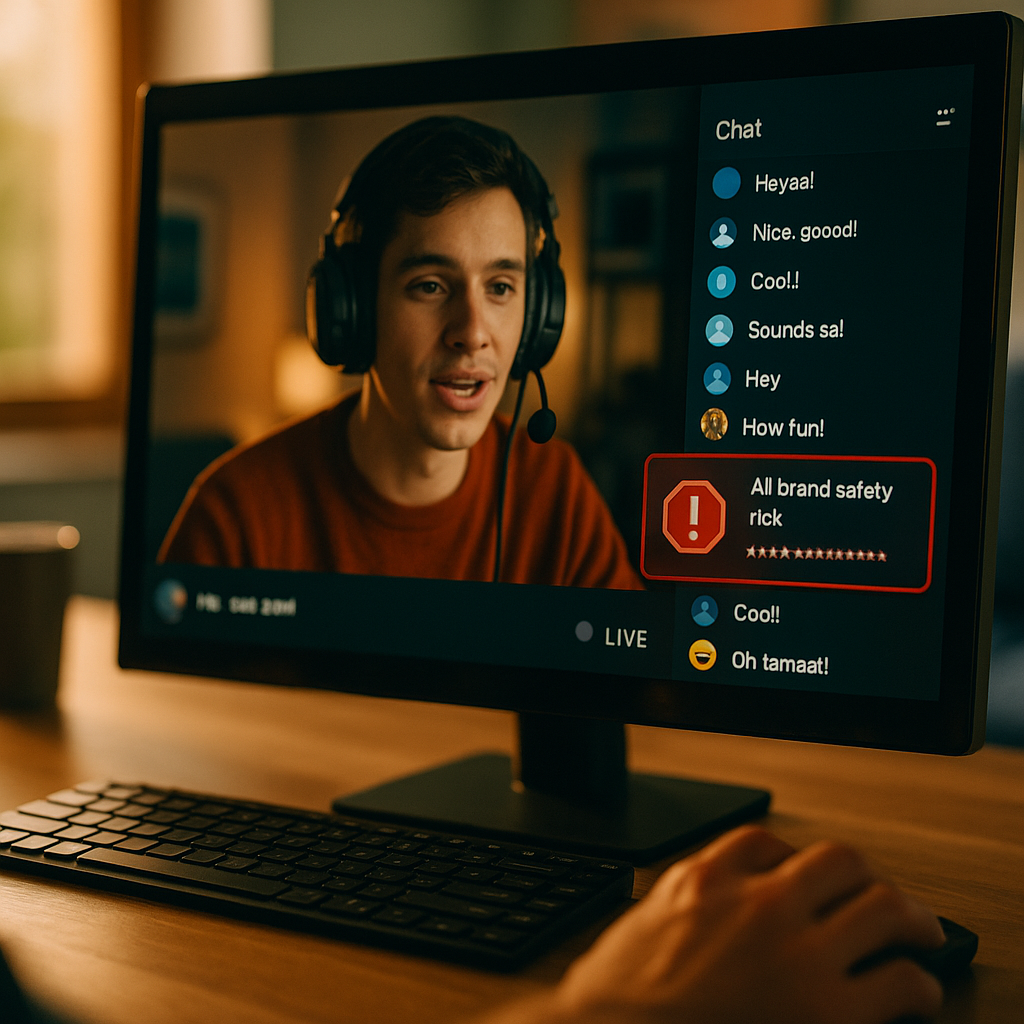
In 2025, livestreams shape how audiences discover brands, but the comment feed can turn risky in seconds. Using AI To Detect Brand Safety Risks In Real-Time Livestream Comments helps teams spot hate speech, harassment, scams, and sensitive topics before they damage trust. This guide explains how it works, what “good” looks like, and how to deploy it responsibly—because your next viral moment could cut both ways.
Why real-time brand safety matters for livestreams
Livestream comments are uniquely high-risk because they are fast, public, and socially contagious. A few harmful messages can trigger pile-ons, derail the creator’s narrative, and force the brand into reactive crisis mode. Unlike pre-moderated posts, livestreams create a “now or never” window: if a risky thread is visible for even a minute, screenshots and reposts can travel far beyond the stream.
Brand safety risks in comments typically fall into predictable categories:
- Hate speech and extremist content: slurs, dehumanizing language, coded hate terms, and recruitment attempts.
- Harassment and bullying: targeted abuse, doxxing attempts, threats, sexual harassment, and brigading.
- Adult or violent content: explicit sexual content, self-harm encouragement, graphic violence, and coercion.
- Misinformation and medical claims: false health advice, dangerous “cures,” impersonation of professionals.
- Scams and fraud: fake giveaways, phishing links, “support” impersonators, crypto scams, donation fraud.
- Brand adjacency issues: sensitive news events, tragedies, political incitement, or illegal activity discussions adjacent to your sponsored segment.
In 2025, most platforms provide baseline moderation tools, but they are rarely sufficient for brand-specific tolerance thresholds, multilingual slang, creator communities, or emerging coded language. AI is most valuable when it compresses detection time from minutes to seconds and routes the right action to the right person.
AI comment moderation: how detection works in real time
Modern AI moderation systems combine multiple techniques to reduce risk while maintaining chat authenticity. A practical real-time pipeline usually includes:
- Streaming ingestion: comments are captured via platform APIs or approved integrations and processed as events in near real time.
- Normalization: the system expands emojis, removes obfuscation (e.g., “h@te” variants), detects leetspeak, and handles repeated characters.
- Language identification and translation assist: the model identifies language, code-switching, and regional variants; some systems run multilingual models rather than translating to avoid losing nuance.
- Multi-label classification: a comment can be simultaneously flagged for hate, harassment, sexual content, scams, and more, each with a probability score.
- Entity and intent extraction: detects targeted individuals, brand names, protected groups, calls to action, or “go to this link” scam intent.
- Contextual scoring: evaluates nearby messages, user history in-session, and reply chains to distinguish “reclaiming” language or quoting from actual abuse.
- Policy + brand rules engine: converts scores into actions based on your tolerance levels, legal constraints, and campaign objectives.
For livestreams, latency is a key metric. The goal is to detect and act quickly enough that harmful comments never become the “top of chat.” Many teams define internal service-level targets such as sub-second scoring, plus immediate enforcement for severe categories (e.g., doxxing threats) while routing borderline cases to human review.
Because comment meaning can be ambiguous, the best systems use ensembles: large language models for nuance, smaller classifiers for speed, and specialized detectors for URLs, phone numbers, and personal data patterns. This layered approach improves accuracy without slowing the stream.
Brand safety risks in livestream comments: what to detect and why
To build a useful program, define what “risk” means for your brand and your regulators. A cosmetics brand sponsoring a beauty stream may prioritize sexual content and counterfeit links; a financial services brand may prioritize scams, impersonation, and deceptive claims. Start with a clear taxonomy and then map it to actions.
High-impact categories and detection notes:
- Doxxing and personal data: detect addresses, phone numbers, emails, workplace details, and “find them at” language. These require near-instant removal and evidence capture.
- Scam patterns: “DM me for prize,” “support agent” impersonation, wallet addresses, shortened links, urgent language, and “limited time” pressure cues. Pair NLP intent detection with URL reputation checks.
- Harassment escalation: repeated targeting of a single user, coordinated harassment, and threats. Use session-based signals like frequency, mentions, and reply chains.
- Hate and coded language: maintain a living lexicon of coded terms and community slang. Rely on contextual models so you don’t over-block benign uses.
- Self-harm and crisis language: detect both encouragement and credible ideation. Your workflow should include crisis escalation options consistent with platform rules and local guidance.
- Regulated claims: “guaranteed returns,” “cures,” or illegal product mentions. Combine keyword detection with claim classification to reduce false positives.
Answering the common follow-up: Should you block everything risky automatically? Not always. For severe categories (doxxing, explicit threats), automatic removal is appropriate. For borderline items (sarcasm, reclaimed slurs, political discussion), hiding pending review often protects the brand without punishing legitimate speech.
Real-time sentiment analysis for brand safety: benefits and limits
Sentiment analysis is often marketed as a brand safety solution, but in livestreams it works best as a supporting signal, not the main detector. Negative sentiment can spike during a controversy, but negativity is not the same as harm. Viewers may express frustration (“this product is overpriced”) without any policy violation.
Where sentiment and emotion models help:
- Early warning for pile-ons: detect rapid increases in hostility, anger, or disgust in a short time window.
- Creator protection: identify sustained toxic tone even when messages avoid explicit slurs.
- Campaign health insights: separate criticism from coordinated abuse and guide moderator staffing decisions.
Key limitations you should plan for:
- Sarcasm and in-group humor: sentiment models can misread jokes, memes, and playful insults common in creator communities.
- Multilingual nuance: sentiment can flip meaning across dialects and slang.
- Over-enforcement risk: using sentiment alone can suppress valid consumer feedback, which harms trust and can look like censorship.
Best practice in 2025 is to combine sentiment with policy-aligned classifiers (harassment, hate, scam intent, sexual content) and trend detectors (rate of violations, user coordination signals). Use sentiment for situational awareness and moderator prioritization, not as a single trigger for bans.
Human-in-the-loop moderation workflows for livestreams
EEAT-aligned moderation is not “set it and forget it.” The most defensible programs keep humans accountable for rules, review edge cases, and continuously improve the model. A practical workflow for livestreams includes:
- Tiered actions: auto-remove only high-severity violations; shadow-hide borderline content; queue uncertain cases for human decision.
- Real-time moderator console: show the flagged comment, model category scores, user context (session history), and the rule that triggered the flag.
- One-click actions: hide, delete, time-out, ban, restrict links, or slow-mode the chat.
- Escalation paths: route threats, doxxing, and self-harm language to trained staff with clear playbooks.
- Audit trails: store decisions, timestamps, and rationale for compliance, appeals, and post-incident reviews.
Answering another common follow-up: How many moderators do you need? It depends on audience size, language mix, and risk tolerance. A reliable approach is dynamic staffing: AI handles triage, while human moderators scale based on spike alerts (e.g., sudden influx of new accounts, rapid violation rate increases, or suspicious link volume).
To strengthen trust with creators and viewers, publish clear chat rules and apply them consistently. Consistency is a key component of perceived fairness, and it reduces “why was I muted?” churn that can dominate chat during enforcement.
Privacy, compliance, and model governance in 2025
Real-time moderation touches user-generated content, which can include personal data. A responsible program protects viewers while protecting the brand from regulatory and reputational blowback. Focus on governance as much as detection accuracy.
Operational safeguards to implement:
- Data minimization: process only what you need (comment text, timestamp, and limited metadata). Avoid storing raw data longer than necessary.
- Retention controls: keep full comment logs for incident investigation only when required, with strict access controls.
- PII redaction: automatically redact phone numbers, addresses, and emails in internal tools unless needed for enforcement evidence.
- Model evaluation: test precision/recall by category, across languages and dialects relevant to your audience. Monitor false positives that silence legitimate speech.
- Bias and fairness checks: examine whether certain groups or dialects are disproportionately flagged. Adjust thresholds, training data, and rules accordingly.
- Explainability for operators: show why content was flagged (category and rule). This speeds decisions and improves accountability.
Vendor and platform due diligence also matters for EEAT. Ask for documented evaluation methods, red-team testing against adversarial obfuscation, and clear policies for model updates. In livestream environments, silent model changes can shift enforcement overnight; insist on change logs and staged rollouts.
Finally, align moderation with platform terms and local legal requirements. Your brand may want stricter enforcement than the platform baseline, but you should still respect user rights, appeals processes where applicable, and creator agreements.
FAQs
What counts as a brand safety risk in livestream comments?
Brand safety risks include hate speech, harassment, threats, doxxing, sexual or violent content, scams and phishing, misinformation (especially health and finance), and sensitive-topic adjacency that can harm brand perception during a sponsored moment.
Can AI moderate livestream comments fast enough to prevent harm?
Yes, with a real-time pipeline that scores comments as they arrive and triggers automated actions for high-severity categories. Performance depends on integration quality, model choice, and whether you use layered detection (NLP + URL/PII detectors) to reduce latency.
Should AI automatically delete comments or just flag them?
Use a tiered approach: auto-delete or instantly hide clear, severe violations (doxxing, threats, explicit hate); queue ambiguous cases for human review; and use “hide pending review” for borderline content to reduce public visibility without over-punishing users.
How do you handle slang, coded language, and multilingual chats?
Combine multilingual models with continuous updates to lexicons for emerging slang and coded terms. Add context-aware scoring that considers nearby messages and reply chains, and routinely evaluate performance across the languages and dialects your audience uses.
Is sentiment analysis enough for brand safety?
No. Sentiment helps detect rising hostility and potential pile-ons, but it cannot reliably distinguish criticism from policy violations. Pair sentiment with classifiers for harassment, hate, scams, adult content, and PII to make defensible moderation decisions.
What metrics should teams track to prove the system works?
Track time-to-detect, time-to-action, precision and recall by category, false-positive rate on benign content, violation rate trends during streams, repeat-offender reduction, and moderator workload changes. Post-stream audits are essential for continuous improvement.
How do you protect viewer privacy while moderating in real time?
Minimize stored data, redact PII in internal tools, enforce strict retention limits and access controls, and maintain audit trails for enforcement decisions. Ensure vendors provide clear governance practices, evaluation documentation, and controlled model updates.
Livestream comments can shift from excitement to reputational risk in moments, so brands need protection that moves at chat speed. AI-driven detection works best when it combines fast classifiers, contextual understanding, and clear policy rules, backed by human oversight. In 2025, the winning approach is accountable, privacy-aware moderation that removes truly harmful content while keeping real audience conversation intact.