


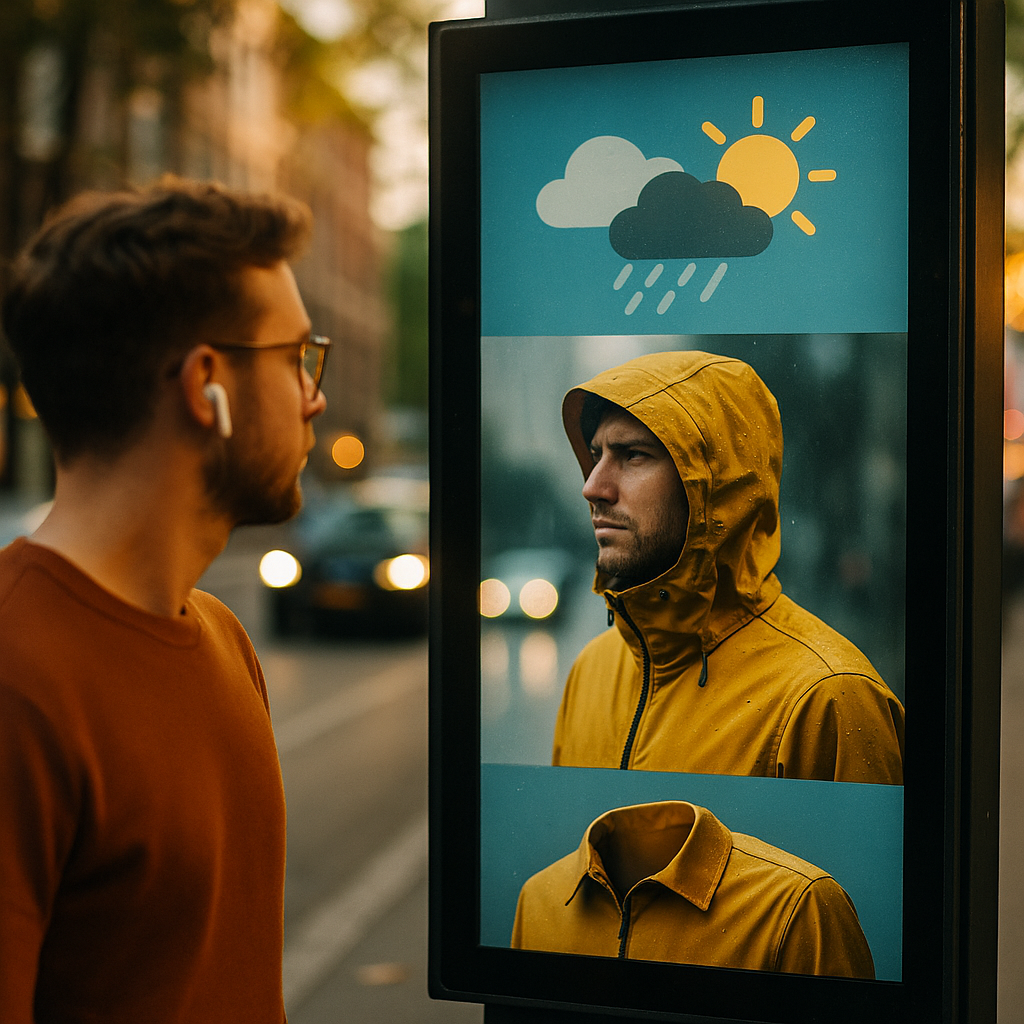
Using AI to personalize dynamic creative based on live weather data is no longer a novelty in 2026. It is a practical way to make ads, emails, app messages, and landing pages feel timely, useful, and more likely to convert. When rain, heat, wind, or pollen levels influence demand, creative should adapt instantly. The real opportunity is knowing how to do it well.
Why live weather marketing matters for dynamic creative optimization
Weather affects attention, intent, timing, and product relevance. A sunny afternoon can increase interest in travel, beverages, outdoor dining, and sports gear. Sudden rain can shift demand toward rideshare apps, food delivery, waterproof apparel, and indoor entertainment. Cold snaps can raise engagement for heating services, skincare, hot drinks, and home essentials. These changes happen fast, often within hours, which is exactly why static campaigns underperform in weather-sensitive categories.
Dynamic creative optimization allows brands to assemble ad components in real time. AI adds a critical layer: prediction, decisioning, and continuous learning. Instead of showing one generic message to every user in a region, AI can evaluate live weather signals, audience data, time of day, inventory, and previous performance to select the best creative variant at that moment.
For marketers, this matters because relevance improves efficiency. Better relevance can lift click-through rate, reduce wasted impressions, and improve conversion quality. For users, it makes marketing feel more useful and less interruptive. A commuter in heavy rain does not need a summer picnic message. They may respond far better to “Stay dry tonight—same-day delivery available.”
From an EEAT perspective, usefulness and accuracy matter more than novelty. Live weather marketing works best when the experience truly matches customer needs and operational reality. If the ad promises same-day delivery during a storm but logistics cannot support it, performance and trust both decline. Effective personalization must connect creative intelligence with business capability.
How AI ad personalization uses weather-triggered campaigns in real time
At its core, AI ad personalization requires three inputs: a live signal, a decision model, and modular creative assets. Weather-triggered campaigns start with data feeds from trusted weather APIs. These feeds can include temperature, precipitation, humidity, UV index, air quality, wind speed, snowfall, and severe weather alerts. AI systems then interpret those signals against campaign rules and historical outcomes.
For example, an apparel retailer may set conditions such as:
- Promote lightweight outerwear when temperature falls below a local threshold
- Prioritize rain jackets when precipitation probability exceeds a defined percentage
- Feature sunglasses and hydration products during high UV and heat conditions
- Suppress outdoor lifestyle imagery during severe weather warnings
Modern AI systems move beyond simple if-then rules. They can score hundreds of combinations and determine which image, headline, call to action, offer, and product set are most likely to perform for a specific audience segment. A user who previously bought running gear may see a weather-adapted creative focused on waterproof trainers, while a first-time visitor sees a broader message around comfort and convenience.
Channels can include:
- Programmatic display ads
- Paid social campaigns
- Search ad customizers
- Email subject lines and content blocks
- Push notifications and in-app messages
- Website hero banners and product recommendations
- Digital out-of-home screens
Real-time decisioning also solves a common problem: lag. Traditional campaign reporting tells you what worked yesterday. Weather-responsive AI adjusts while conditions are changing. That allows marketers to respond during demand shifts, not after them.
To make this practical, teams should define a hierarchy of triggers. Severe weather alerts may override normal promotional logic. Temperature shifts may influence imagery and copy, while precipitation may affect offers, delivery messaging, or store pickup prompts. This layered setup helps avoid conflicts and keeps the creative coherent.
Best practices for weather-based advertising with first-party data
Not every business needs weather-based advertising, but many can benefit from it if they connect weather signals to actual customer behavior. The strongest use cases usually share one trait: weather changes either customer need, buying urgency, or product suitability.
Industries with clear relevance include retail, grocery, travel, food delivery, automotive, insurance, utilities, health and wellness, home services, and entertainment. However, success depends on grounding the strategy in first-party data rather than assumptions.
Start by asking:
- Which products or services rise or fall with specific weather conditions?
- Do weather effects differ by city, season, or audience segment?
- How quickly does demand change after a weather event begins?
- Can operations, inventory, and fulfillment support the promoted message?
Then map weather conditions to business outcomes. If your data shows that same-day grocery orders increase during rain after 4 p.m., the creative should reflect that exact moment with relevant messaging, not a broad “bad weather sale.” If skincare conversions rise during cold, dry conditions, the ad should focus on protection and replenishment, supported by product availability and pricing.
Best practices include:
- Use localized thresholds. “Cold” in one market may be normal in another. AI performs better when thresholds reflect regional behavior.
- Build modular assets. Create interchangeable headlines, visuals, product tiles, and calls to action so AI can assemble relevant combinations without producing off-brand outputs.
- Protect brand safety. Avoid cheerful promotional language during dangerous conditions. Severe weather requires sensitivity.
- Prioritize consent and privacy. Weather signals should complement privacy-safe first-party data, not replace responsible data practices.
- Connect to inventory and serviceability. Personalized creative only works when the offer can be fulfilled.
These practices support EEAT because they reduce overclaiming and improve trustworthiness. The most effective campaigns are not just intelligent; they are operationally honest and genuinely helpful.
Building predictive marketing automation with weather data and creative testing
Many teams begin with reactive weather triggers, but the bigger advantage comes from predictive marketing automation. AI can learn how weather patterns affect engagement, conversion rates, average order value, and churn risk. With enough data, it can anticipate demand and prepare the most effective creative combinations before weather conditions peak.
A robust workflow usually includes:
- Data ingestion: Pull weather data, audience signals, product feeds, location data, and channel metrics into a centralized decisioning layer.
- Feature engineering: Translate raw weather variables into useful inputs such as “rain starting within 2 hours” or “heat above local seasonal norm.”
- Creative tagging: Label assets by weather fit, audience appeal, product category, tone, and intent stage.
- Model training: Use historical performance to predict which combinations are likely to drive the target outcome.
- Experimentation: Run controlled tests to validate uplift against non-weather-personalized control groups.
- Governance: Review outputs for accuracy, compliance, and brand consistency.
Creative testing matters because assumptions often fail. A brand may believe that showing storm imagery during rain improves relevance, but data may show that users respond better to comfort-focused indoor scenes and delivery reassurance. AI helps surface these patterns, but only if tests are designed carefully.
Useful metrics include:
- Incremental lift versus control
- Conversion rate by weather condition and audience segment
- Creative fatigue over repeated weather events
- Revenue per impression or session
- Store visit or pickup intent where relevant
- Opt-out or negative feedback rates for push and email
One important follow-up question is whether weather should dominate the message. Usually, no. Weather is a context signal, not the entire strategy. The best creative blends weather relevance with user intent, lifecycle stage, and product logic. A loyal customer may need a reminder and a useful offer. A new prospect may need clearer product education first.
Common challenges in real-time personalization and how to avoid them
Real-time personalization sounds simple until data latency, fragmented systems, and unclear ownership slow execution. The most common mistakes are not technical alone; they often come from weak planning.
Challenge one: poor data quality. If location data is inaccurate or weather feeds update too slowly, the wrong message reaches the wrong person. Use reliable providers and set fallback logic for uncertain data conditions.
Challenge two: over-automation. AI should optimize within guardrails. Without strong controls, systems can generate odd pairings, insensitive timing, or conflicting offers. Human review remains essential for high-risk scenarios and seasonal launches.
Challenge three: too many variants. Marketers sometimes create dozens of weather-specific assets without enough traffic to learn what works. Start with a focused variant set tied to clear hypotheses, then expand based on results.
Challenge four: disconnected teams. Creative, media, CRM, analytics, and product teams must align on triggers, KPIs, and approval workflows. Weather-responsive campaigns fail when one team changes an offer that another team cannot support.
Challenge five: weak measurement. If you measure only clicks, you may mistake curiosity for value. Tie personalization to downstream outcomes such as qualified conversions, repeat purchase, basket size, or retention.
Challenge six: ethical missteps. Some weather events create vulnerability. Messaging should never appear exploitative during emergencies. Helpful content, transparent offers, and restraint build more long-term trust than aggressive urgency tactics.
A practical way to avoid these issues is to build a playbook. Define approved triggers, asset rules, escalation paths, and measurement standards. This turns weather-based personalization from a clever idea into a repeatable operating model.
Future trends in contextual advertising and AI creative decisioning
In 2026, contextual advertising is growing more intelligent because AI can combine weather data with broader environmental signals. Pollen, air quality, sunrise and sunset timing, severe weather probability, and even local event patterns can improve message relevance when used responsibly. The future is not about flooding campaigns with data. It is about choosing the few signals that clearly improve usefulness.
Three trends stand out.
First, multimodal creative decisioning. AI can now evaluate image style, copy tone, product fit, and audience response together. That means systems can recommend not just what to say, but how the creative should look and feel under certain weather conditions.
Second, cross-channel orchestration. Weather-triggered logic is moving beyond single ads. A user may see a weather-adapted social ad, land on a matching website experience, receive a follow-up push notification if they abandon cart, and then get an email with location-specific inventory. Consistency improves performance.
Third, stronger governance. As AI becomes more autonomous, brands are investing in review layers, policy controls, and transparent measurement. That is good for both performance and trust. Helpful personalization is easier to scale when stakeholders understand how decisions are made.
For marketers deciding whether to invest now, the answer depends on category fit and execution readiness. If weather affects demand and your team can connect data, creative, and measurement, the opportunity is real. You do not need a massive transformation to begin. A pilot in one region, one channel, and a small set of weather triggers can prove value quickly.
FAQs about AI ad personalization and live weather data
What is dynamic creative based on live weather data?
It is a marketing approach where ads, emails, app messages, or website content automatically change based on current local weather conditions. AI helps decide which creative version is most relevant for each audience and moment.
Which businesses benefit most from weather-triggered campaigns?
Brands in retail, grocery, food delivery, travel, skincare, home services, insurance, utilities, and entertainment often benefit most because weather clearly affects customer need or buying intent.
Do you need AI to run weather-based advertising?
No, simple rule-based systems can work. AI becomes valuable when you want to optimize many variables at once, predict performance, personalize across segments, and scale across channels with less manual effort.
What data is needed to personalize creative with weather?
You need reliable weather data, location signals, creative assets, performance history, and ideally first-party audience or customer data. Inventory, pricing, and serviceability data also improve accuracy and usefulness.
How do you measure success?
Measure incremental lift against a control group, not just top-line clicks. Focus on conversion rate, revenue, average order value, store visits, retention, and message relevance by weather condition and audience segment.
Are there privacy concerns?
Yes. Brands should use privacy-safe data practices, honor consent requirements, and avoid unnecessary personal data collection. Weather itself is contextual, but combining it with audience data still requires responsible governance.
What is the biggest mistake brands make?
The biggest mistake is treating weather as a gimmick rather than a meaningful demand signal. If the message is not useful, timely, and operationally supported, personalization will not improve results.
How should a brand get started?
Begin with one clear use case, such as rain-triggered delivery messaging or heat-based product swaps. Build a small set of modular assets, define thresholds, test against a control, and expand only after measuring real incremental impact.
AI and live weather data give marketers a powerful way to make dynamic creative more relevant, but success depends on discipline. Use trustworthy data, connect personalization to real customer needs, and measure incremental results rather than vanity metrics. In 2026, the winning strategy is clear: combine automation with human judgment to deliver useful, timely experiences that customers actually value.