


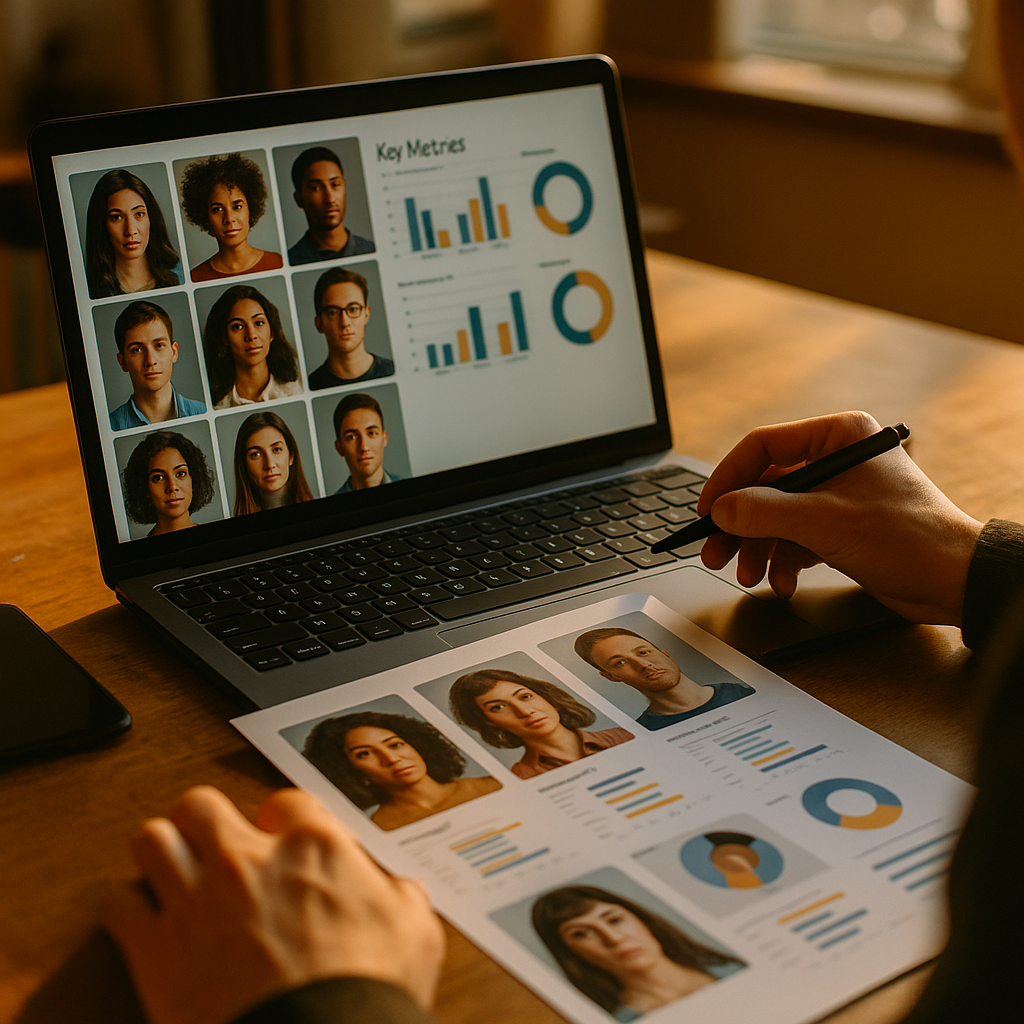
Using AI to generate synthetic personas is changing how teams validate ideas when time, budget, or access to real users is limited. In 2025, product, marketing, and research teams can simulate audience perspectives, pressure-test messaging, and identify risks early—without waiting weeks for recruitment. When you build them responsibly, synthetic personas become a fast, practical layer of insight. Ready to test concepts at speed?
AI-generated synthetic personas for rapid concept testing: what they are and when to use them
Synthetic personas are AI-created representations of customer segments that mirror likely goals, constraints, behaviors, and preferences. They are generated from structured inputs (your existing research, analytics, support logs, CRM notes, market reports) and then used to run fast “what would this person think?” evaluations of concepts, prototypes, messaging, pricing, and onboarding flows.
What they are not: a replacement for real user research. They are a rapid, low-friction way to explore hypotheses, spot gaps, and prioritize what to validate with real people.
Use synthetic personas when you need speed and directional clarity, especially for:
- Early-stage concept testing before you have designs or budget for studies.
- Message and positioning checks across multiple segments, quickly.
- Pre-mortems to identify adoption barriers, trust issues, or compliance concerns.
- Internal alignment when stakeholders disagree on “who we serve” or “what matters.”
- Localization planning to stress-test tone and objections by region or culture (with care and domain review).
When not to use them: high-stakes decisions that require verified behavioral evidence (e.g., medical, financial suitability, safety-critical UX). In those cases, synthetic personas can help generate a research plan—but should not be the evidence base.
Likely follow-up: “Are they accurate?” They can be useful, but accuracy depends on your inputs, constraints, and validation. Treat outputs as hypotheses to be confirmed, not facts.
Concept testing with synthetic users: the fastest workflow that still stays credible
Speed comes from repeatability. The most reliable approach is a lightweight pipeline that starts with your best available evidence, generates personas with explicit constraints, then tests concepts in a structured way.
A practical workflow teams can run in days:
- Define the decision: What must be true for this concept to succeed? (e.g., “Users understand the value in 10 seconds,” “Pricing feels fair,” “Trust concerns are addressed.”)
- Collect inputs: 3–10 artifacts that reflect real-world signals—recent interview notes, win/loss summaries, churn reasons, top support tickets, call transcripts, on-site search queries, usage analytics, competitor reviews.
- Create a persona spec template: Keep it consistent across segments (role, context, goals, triggers, barriers, decision criteria, trust requirements, accessibility needs, channel habits).
- Generate 4–8 personas: Cover primary, secondary, and “edge” segments (skeptical buyer, budget-constrained user, compliance-heavy org, low-tech comfort level).
- Run structured evaluations: Ask each persona the same questions about your concept: comprehension, appeal, perceived risk, reasons to adopt, reasons to reject, needed proof, and what would change their mind.
- Triangulate: Compare patterns across personas, your existing metrics, and stakeholder intuition. Mark items as “confirmed by evidence,” “plausible,” or “needs real-user validation.”
- Decide and plan validation: Turn high-impact unknowns into a short real-user study: who to recruit, what to show, what to measure.
How to keep it credible: require the AI to cite which input artifacts informed each persona trait (even if only as internal traceability), and force explicit uncertainty (“confidence: low/medium/high”). This avoids the common failure mode: polished narratives that feel true but are ungrounded.
Persona prompts and data inputs: how to build realistic segments without stereotyping
The quality of synthetic personas depends more on your inputs and constraints than the model itself. The goal is to reflect behaviors and contexts, not demographics as shortcuts.
Use evidence-led inputs:
- Behavioral: feature adoption paths, time-to-value, drop-off steps, cohort retention patterns.
- Voice-of-customer: support tickets, reviews, open-text surveys, call summaries, community posts.
- Commercial: sales objections, procurement steps, security questionnaires, pricing sensitivity notes.
- Market: category norms, switching costs, regulatory constraints, competitor positioning.
Write prompts that constrain speculation: Ask the model to generate personas only from provided artifacts, to label assumptions, and to avoid sensitive attribute inference. For example, instead of “create a persona for a 35-year-old,” specify “create a persona for a time-poor operator who needs low training overhead and cares about audit trails.”
Include guardrails:
- No protected-attribute guessing (race, religion, health status, etc.) unless you have explicit, ethical, and necessary reasons—then handle with expert review.
- Context over identity: focus on environment, constraints, job-to-be-done, and decision process.
- Counterfactual variants: generate two personas with similar goals but different constraints (budget vs compliance; novice vs expert) to avoid a single “default user.”
Likely follow-up: “Should we include demographics at all?” Only if they are directly relevant to the concept and backed by data. In many B2B cases, role, incentives, and process matter more than age or lifestyle. If you do include demographics, treat them as descriptive, not causal.
Persona validation and EEAT: reducing hallucinations, bias, and false confidence
In 2025, the biggest risk isn’t that synthetic personas are “wrong.” It’s that they can be persuasive even when they’re unverified. EEAT-aligned practice means making provenance, limitations, and review explicit so the output is helpful and accountable.
Concrete validation techniques:
- Provenance notes: attach a short “based on” list (e.g., top 20 support themes, last 6 discovery calls, churn survey summary). Internally, keep links.
- Assumption tagging: require every key claim to be labeled as “observed,” “inferred,” or “speculative.”
- Red-team prompts: ask the model to challenge each persona: “What would make this persona unrealistic? What evidence would disconfirm it?”
- Bias checks: scan for stereotypes, overgeneralizations, or unjustified causal links. If the persona reads like a trope, rewrite it around behaviors and constraints.
- SME review: have a product leader, researcher, or frontline team member (support/sales) do a 15-minute sanity check.
How to measure whether personas are “good enough”:
- Decision utility: did they reveal a risk, gap, or testable hypothesis you would have missed?
- Consistency: do multiple personas react differently for clear reasons, or do they converge into generic feedback?
- Predictive alignment: when you later run real-user sessions, do the major objections and motivations show up?
Answering the real question: “Can we trust this?” You can trust it as a structured way to generate hypotheses and prioritize validation. You should not trust it as evidence of customer truth unless it matches verified data.
Synthetic focus groups and message testing: practical use cases for product and marketing teams
Synthetic personas become most valuable when you operationalize them into repeatable “simulations” that support daily work. The aim is not to ask, “Do they like it?” but “What blocks adoption, and what proof is required?”
High-impact use cases:
- Landing page and positioning critique: test headline clarity, value proposition relevance, and credibility signals. Ask each persona what feels vague, risky, or hype-driven.
- Feature packaging: simulate reactions to bundles and add-ons. Identify where choice overload appears and which benefits map to willingness to pay.
- Onboarding and activation: have personas walk through steps and call out confusion, missing context, and trust moments (permissions, data access, integrations).
- Pricing and procurement objections: model the decision chain—user, manager, finance, security—and the evidence each needs (ROI model, compliance docs, trial outcomes).
- Competitive differentiation: ask what would make them switch, what “good enough” looks like, and which comparisons feel unfair or irrelevant.
How to run a synthetic focus group that produces actionable output:
- Share the stimulus: one-page concept, mock, or script. Keep it consistent for all personas.
- Ask structured questions: comprehension, perceived value, top concern, deal-breaker, required proof, next step.
- Force trade-offs: “If you could change only one thing, what is it?” and “What would you remove?”
- Quantify directionally: have each persona rate clarity and trust on a simple 1–5 scale, then justify the rating in one paragraph.
- Summarize patterns: aggregate the top 5 objections, top 5 motivators, and the top 3 tests to run with real users.
Likely follow-up: “Will stakeholders accept this?” They will if you position it correctly: a fast hypothesis engine that complements real-user research, and a way to make assumptions explicit rather than implicit.
Governance, privacy, and compliance: using synthetic personas responsibly in 2025
Responsible use is a competitive advantage. Mishandling data or presenting synthetic outputs as real can damage trust and create legal risk.
Operational governance checklist:
- Data minimization: use only what you need; avoid raw PII in prompts. Prefer aggregated insights and anonymized excerpts.
- Clear labeling: mark personas as “synthetic” in documents and workshops. Never present quotes as real customer statements.
- Access control: limit who can generate personas from internal data; keep an audit trail of inputs and versions.
- Security review: if you use third-party tools, confirm data handling, retention, and training policies align with your requirements.
- Human accountability: name an owner (often Research, Product Ops, or Insights) responsible for quality standards and updates.
Ethical guardrails that prevent common failures:
- No “fabricated validation”: synthetic personas can’t “prove” market demand. They can only indicate what to test.
- Avoid vulnerable-targeting patterns: do not design manipulative flows based on inferred sensitivities.
- Refresh cadence: update personas when the market shifts, your product changes, or new evidence emerges (support themes, conversion changes, new segments).
Answering the next question: “How do we explain this to leadership?” Use a simple statement: “These are AI-synthesized segment hypotheses grounded in our existing evidence, used to prioritize real-user validation and reduce waste.”
FAQs about AI to generate synthetic personas for rapid concept testing
Do synthetic personas replace customer interviews?
No. They accelerate early exploration and help you design better interviews. Use them to identify assumptions and risks, then validate the most important points with real users.
What data should we use to create synthetic personas?
Use recent, relevant, non-PII sources: support themes, survey summaries, anonymized interview notes, product analytics patterns, sales objections, and competitive reviews. The more your inputs reflect real behavior, the more useful the personas become.
How many synthetic personas do we need for concept testing?
Typically 4–8. Cover your primary segment, at least one secondary segment, and 1–2 edge cases (skeptical buyer, low-tech user, compliance-heavy customer). More than that often creates noise without better decisions.
How do we validate synthetic personas quickly?
Run a short “reality check” with internal frontline teams (sales/support), compare outputs against analytics and VOC trends, and then confirm the top uncertainties with a small set of real-user calls or usability sessions.
Can synthetic personas help with pricing and packaging?
Yes, for generating likely objections, perceived fairness issues, and required proof. They are best for shaping hypotheses and test plans, not for setting final price points without real market validation.
What are the biggest risks of using AI-generated personas?
False confidence, bias, and untraceable claims. Reduce risk by enforcing provenance, assumption labeling, red-teaming, SME review, and strict rules against using PII or presenting synthetic outputs as real customer evidence.
AI-driven synthetic personas can make concept testing faster and more structured, especially when teams need quick direction before investing in recruitment and studies. In 2025, the best results come from grounding personas in real inputs, labeling assumptions, and using outputs to prioritize what to validate with actual users. Treat synthetic feedback as hypothesis generation, not proof—and you’ll move faster with fewer blind spots.
Top Influencer Marketing Agencies
The leading agencies shaping influencer marketing in 2026
Agencies ranked by campaign performance, client diversity, platform expertise, proven ROI, industry recognition, and client satisfaction. Assessed through verified case studies, reviews, and industry consultations.
Moburst

-
2

The Shelf
Boutique Beauty & Lifestyle Influencer AgencyA data-driven boutique agency specializing exclusively in beauty, wellness, and lifestyle influencer campaigns on Instagram and TikTok. Best for brands already focused on the beauty/personal care space that need curated, aesthetic-driven content.Clients: Pepsi, The Honest Company, Hims, Elf Cosmetics, Pure LeafVisit The Shelf → -
3

Audiencly
Niche Gaming & Esports Influencer AgencyA specialized agency focused exclusively on gaming and esports creators on YouTube, Twitch, and TikTok. Ideal if your campaign is 100% gaming-focused — from game launches to hardware and esports events.Clients: Epic Games, NordVPN, Ubisoft, Wargaming, Tencent GamesVisit Audiencly → -
4

Viral Nation
Global Influencer Marketing & Talent AgencyA dual talent management and marketing agency with proprietary brand safety tools and a global creator network spanning nano-influencers to celebrities across all major platforms.Clients: Meta, Activision Blizzard, Energizer, Aston Martin, WalmartVisit Viral Nation → -
5

The Influencer Marketing Factory
TikTok, Instagram & YouTube CampaignsA full-service agency with strong TikTok expertise, offering end-to-end campaign management from influencer discovery through performance reporting with a focus on platform-native content.Clients: Google, Snapchat, Universal Music, Bumble, YelpVisit TIMF → -
6

NeoReach
Enterprise Analytics & Influencer CampaignsAn enterprise-focused agency combining managed campaigns with a powerful self-service data platform for influencer search, audience analytics, and attribution modeling.Clients: Amazon, Airbnb, Netflix, Honda, The New York TimesVisit NeoReach → -
7

Ubiquitous
Creator-First Marketing PlatformA tech-driven platform combining self-service tools with managed campaign options, emphasizing speed and scalability for brands managing multiple influencer relationships.Clients: Lyft, Disney, Target, American Eagle, NetflixVisit Ubiquitous → -
8

Obviously
Scalable Enterprise Influencer CampaignsA tech-enabled agency built for high-volume campaigns, coordinating hundreds of creators simultaneously with end-to-end logistics, content rights management, and product seeding.Clients: Google, Ulta Beauty, Converse, AmazonVisit Obviously →