


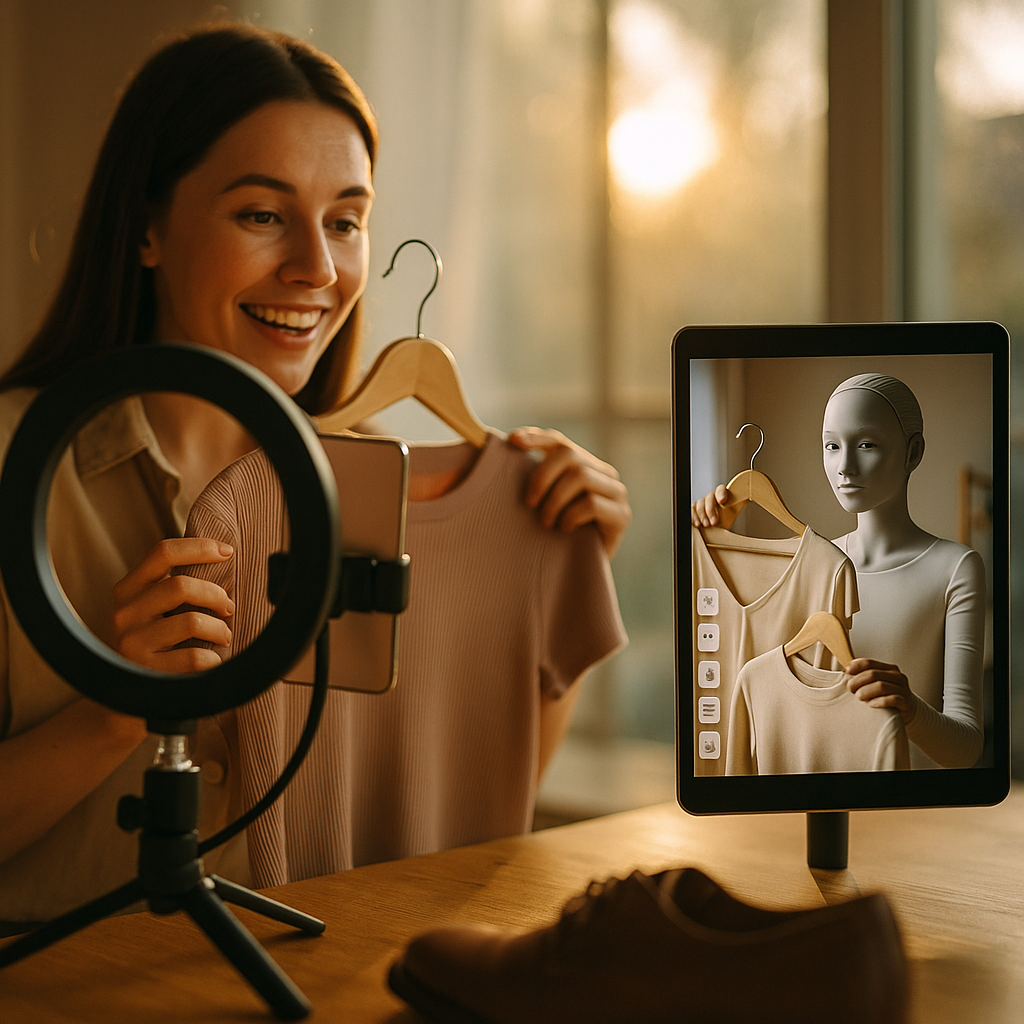
An AI avatar can host a live shopping stream 24 hours a day, never ask for a rate card, and never have a bad day on camera. So why are brands still seeing conversion rates lag behind their human-led streams by double digits? As AI-hosted live shopping moves from novelty to line item in the marketing budget, the gap between what virtual presenters promise and what they deliver is becoming the most important number in the room.
Live commerce isn’t new. What’s new is the pitch that a synthetic host can replicate, or even beat, a human creator’s ability to close a sale. Platforms like Taobao, TikTok Shop, and a growing list of Western entrants have rolled out AI avatar hosting tools over the past two years. The promise is seductive: infinite uptime, zero talent fees, perfect script adherence. But for brands running real budgets against real revenue targets, the question isn’t whether AI hosts are cheaper. It’s whether they convert.
The Pitch Versus the P&L
Vendors selling AI live shopping tools lean hard on efficiency math. A human creator might stream for two or three hours before fatigue sets in. An AI presenter can run a loop indefinitely, covering time zones a human team simply can’t staff. For a DTC brand trying to capture late-night browsing in one region while its US team sleeps, that’s a genuinely compelling operational argument.
The efficiency case is real. The conversion case is still shaky.
Early data from brands testing AI hosts on platforms like TikTok Shop and Amazon Live shows a consistent pattern: AI-hosted streams generate comparable or even higher view counts thanks to algorithmic favorability toward novel formats, but conversion rates per viewer trail human-hosted streams by anywhere from 15% to 40%, depending on category. Beauty and skincare, where trust and demonstrated authenticity matter most, show the widest gap. Commoditized categories like phone accessories or kitchen gadgets show a much narrower one.
That category split matters more than the headline number. It tells you where AI hosting is a reasonable substitute and where it’s a false economy.
In categories where purchase decisions hinge on perceived trust and lived experience, human creators are still converting at rates AI presenters haven’t matched, even as AI hosts close the gap on engagement and watch time.
Why Humans Still Win the Trust Test
Live shopping works because it compresses the consideration phase. A viewer watches someone try a product, ask a question in real time, get an honest answer, and buy on impulse. That loop depends on the audience believing the host has actual skin in the game. Even the most polished AI avatar struggles to replicate the micro-signals, an unscripted laugh, a genuine “oh wait, that’s actually better than I expected”, that make a viewer trust the recommendation enough to tap buy.
This is the same authenticity problem brands have wrestled with in scripted content generally. AI script factories have already forced marketing teams to confront how much polish costs them in perceived credibility. Live shopping just raises the stakes because the transaction happens in the same sixty seconds as the pitch.
There’s also the Q&A problem. Human hosts field unpredictable questions and adjust their pitch on the fly. Most current AI presenters run on scripted flows or retrieval-based responses that handle common questions well but stumble on anything outside the training set. That’s improving fast, particularly as brands pair avatars with retrieval augmented generation systems that ground responses in actual product data rather than generic scripts. But “improving” isn’t “solved,” and a live shopping stream is a bad place to discover the gap.
Where AI Hosts Genuinely Compete
None of this means AI-hosted live shopping is a dead end. It means brands need to be honest about where it fits.
- Overnight and long-tail time slots. A human team can’t staff a 3am stream for a market on the other side of the globe. An AI host can, and something is almost always better than a dark storefront.
- Evergreen product demos. For SKUs that don’t change often and don’t require nuanced trust-building, a well-produced AI host running a consistent, high-quality pitch on loop outperforms an inconsistent junior creator.
- High-volume catalog walkthroughs. Marketplaces with thousands of SKUs benefit from AI hosts that can pivot between products instantly without a script rewrite every time inventory shifts.
- Testing ground for new formats. Brands use AI streams to trial new hooks and offers cheaply before committing a human creator’s time to the winning format, a logic similar to how AI hook generation tools now simulate virality before a single frame is shot.
The pattern across all four is the same: AI hosts win on scale and consistency, not on persuasion. That’s a meaningfully different value proposition than “replaces your creator program,” and brands that buy the tech expecting the latter are the ones posting disappointed case studies.
What the Conversion Data Actually Says
Solid third-party benchmarking on AI versus human live shopping conversion is still thin, largely because the format is young and most data lives inside platform dashboards brands don’t share publicly. But directionally, industry data on livestream commerce growth and creator-led purchase behavior points to a consistent theme: the presence of a recognizable, trusted human still correlates with higher average order value and lower return rates, not just higher raw conversion.
That return rate detail gets overlooked. A stream that converts well but generates elevated returns hasn’t actually improved unit economics, it’s just moved the cost downstream.
Brands running side-by-side tests (same product, same offer, same time slot, human host versus AI host across different days) report the AI variant frequently wins on cost per acquisition when talent fees are removed from the equation entirely. But when brands weight for lifetime value, repeat purchase rate, and return rate, the human-hosted stream usually wins on a fully loaded basis. The efficiency story is real at the top of the funnel. It gets murkier once you follow the customer past the first purchase.
This is exactly the kind of nuance that gets lost when marketing teams report campaign performance using broken attribution schemas that treat every conversion as equal regardless of downstream retention. If your reporting stack can’t separate a one-time impulse buyer from a repeat customer, you’re going to systematically overrate the channel that’s best at generating quick, low-commitment purchases, which right now is usually the AI-hosted stream.
The Hybrid Model Brands Are Actually Adopting
The smartest operators aren’t choosing sides. They’re building tiered systems where AI hosts handle volume and coverage, and human creators handle the moments that actually move revenue: launches, high-consideration categories, and anything where the brand needs a face the audience already trusts.
This mirrors the broader shift toward tiered automation that’s showing up across the influencer stack, where brands set clear boundaries on what AI can handle autonomously and what requires human judgment and sign-off.
Some brands run a “human anchor, AI backup” model: a creator hosts the flagship weekly stream, and an AI avatar trained on that creator’s likeness and speech patterns (with contractual consent, ideally) runs supplementary streams during off-hours using the same brand voice. Early results suggest this preserves more of the conversion lift than a fully generic AI host, likely because some of the trust transfers from the recognizable persona even in synthetic form. It’s an unproven strategy at scale, and it raises its own thorny questions about likeness rights and disclosure that brands are still working through with legal teams.
Compliance Is the Part Nobody’s Pricing In
Regulators haven’t caught up to AI-hosted commerce yet, but they’re paying attention. The Federal Trade Commission has been explicit that AI-generated endorsements and synthetic spokespeople fall under existing disclosure rules, and the UK’s Information Commissioner’s Office has flagged synthetic media as a growing area of consumer protection scrutiny. If your AI host looks or sounds like a real person, licensed or not, you’re in territory that demands clear, conspicuous disclosure that the presenter isn’t human.
Brands that skip this step aren’t just risking a fine. They’re risking the exact trust deficit that’s already suppressing AI host conversion rates. Nothing tanks a livestream faster than viewers feeling deceived mid-purchase.
This is also where the broader governance conversation happening across agentic AI creator selection tools applies directly to live shopping. Any AI system making real-time decisions, what to say, what offer to surface, how to respond to a comment, needs a human-reviewed guardrail layer before it goes live to an audience that’s about to enter payment information.
Building a Test Before You Commit Budget
If you’re evaluating AI-hosted live shopping for the coming quarter, resist the urge to run a single pilot and extrapolate. Structure the test properly.
Run matched pairs: same product, same offer, same promotional push, alternating human and AI hosts across comparable time slots over several weeks. Track conversion rate, average order value, and 30-day return rate, not just clicks and watch time. And segment by category, because a strong result in a low-consideration category won’t tell you anything useful about whether AI hosting works for your flagship, high-trust product line.
Watch platform-level signals too. TikTok Shop’s advertising resources and Meta’s business tools are both expanding live commerce features, and the algorithmic treatment of AI-hosted content is likely to keep shifting as platforms respond to creator and consumer feedback. What performs today may not perform the same way in six months.
Finally, price the total cost honestly. AI hosting tools carry licensing fees, avatar customization costs, and integration overhead that vendors don’t always foreground in the pitch deck. Compare that fully loaded cost against a human creator’s rate, not just the headline “no talent fee” line.
Frequently Asked Questions
Do AI-hosted live shopping streams actually convert worse than human creators?
In categories where trust and lived experience drive purchase decisions, such as beauty and wellness, current data shows AI-hosted streams converting 15% to 40% lower than comparable human-hosted streams. In lower-consideration categories, the gap narrows significantly and sometimes disappears.
Where does AI-hosted live shopping make the most business sense?
AI hosts perform best for overnight or long-tail time slots a human team can’t staff, evergreen product demos, high-volume catalog walkthroughs, and low-cost format testing before committing a human creator’s time.
Are there legal requirements for disclosing an AI host?
Regulators including the FTC and the UK’s ICO treat synthetic spokespeople under existing endorsement and consumer protection rules. Brands should disclose clearly and conspicuously when a presenter is AI-generated, especially if the avatar resembles a real person.
What metrics should brands track beyond conversion rate?
Average order value, 30-day return rate, and repeat purchase behavior matter as much as raw conversion, since AI-hosted streams can win on initial conversion while losing on lifetime value once returns and retention are factored in.
Can brands combine AI and human hosts in one strategy?
Yes. A growing number of brands use a tiered model where human creators anchor high-stakes or high-consideration streams and AI hosts cover volume, overnight slots, and catalog breadth, preserving budget without abandoning conversion quality where it matters most.
Frequently Asked Questions
Do AI-hosted live shopping streams actually convert worse than human creators?
In categories where trust and lived experience drive purchase decisions, such as beauty and wellness, current data shows AI-hosted streams converting 15% to 40% lower than comparable human-hosted streams. In lower-consideration categories, the gap narrows significantly and sometimes disappears.
Where does AI-hosted live shopping make the most business sense?
AI hosts perform best for overnight or long-tail time slots a human team can’t staff, evergreen product demos, high-volume catalog walkthroughs, and low-cost format testing before committing a human creator’s time.
Are there legal requirements for disclosing an AI host?
Regulators including the FTC and the UK’s ICO treat synthetic spokespeople under existing endorsement and consumer protection rules. Brands should disclose clearly and conspicuously when a presenter is AI-generated, especially if the avatar resembles a real person.
What metrics should brands track beyond conversion rate?
Average order value, 30-day return rate, and repeat purchase behavior matter as much as raw conversion, since AI-hosted streams can win on initial conversion while losing on lifetime value once returns and retention are factored in.
Can brands combine AI and human hosts in one strategy?
Yes. A growing number of brands use a tiered model where human creators anchor high-stakes or high-consideration streams and AI hosts cover volume, overnight slots, and catalog breadth, preserving budget without abandoning conversion quality where it matters most.
The bottom line for budget owners: treat AI-hosted live shopping as a coverage tool, not a creator replacement, until the trust gap in the conversion data closes. Run the matched-pair test before your next planning cycle, and let the return-rate numbers, not the CPA, decide where AI hosting earns a permanent slot in your mix.
Top Influencer Marketing Agencies
The leading agencies shaping influencer marketing in 2026
Agencies ranked by campaign performance, client diversity, platform expertise, proven ROI, industry recognition, and client satisfaction. Assessed through verified case studies, reviews, and industry consultations.
Moburst

-
2

The Shelf
Boutique Beauty & Lifestyle Influencer AgencyA data-driven boutique agency specializing exclusively in beauty, wellness, and lifestyle influencer campaigns on Instagram and TikTok. Best for brands already focused on the beauty/personal care space that need curated, aesthetic-driven content.Clients: Pepsi, The Honest Company, Hims, Elf Cosmetics, Pure LeafVisit The Shelf → -
3

Audiencly
Niche Gaming & Esports Influencer AgencyA specialized agency focused exclusively on gaming and esports creators on YouTube, Twitch, and TikTok. Ideal if your campaign is 100% gaming-focused — from game launches to hardware and esports events.Clients: Epic Games, NordVPN, Ubisoft, Wargaming, Tencent GamesVisit Audiencly → -
4

Viral Nation
Global Influencer Marketing & Talent AgencyA dual talent management and marketing agency with proprietary brand safety tools and a global creator network spanning nano-influencers to celebrities across all major platforms.Clients: Meta, Activision Blizzard, Energizer, Aston Martin, WalmartVisit Viral Nation → -
5

The Influencer Marketing Factory
TikTok, Instagram & YouTube CampaignsA full-service agency with strong TikTok expertise, offering end-to-end campaign management from influencer discovery through performance reporting with a focus on platform-native content.Clients: Google, Snapchat, Universal Music, Bumble, YelpVisit TIMF → -
6

NeoReach
Enterprise Analytics & Influencer CampaignsAn enterprise-focused agency combining managed campaigns with a powerful self-service data platform for influencer search, audience analytics, and attribution modeling.Clients: Amazon, Airbnb, Netflix, Honda, The New York TimesVisit NeoReach → -
7

Ubiquitous
Creator-First Marketing PlatformA tech-driven platform combining self-service tools with managed campaign options, emphasizing speed and scalability for brands managing multiple influencer relationships.Clients: Lyft, Disney, Target, American Eagle, NetflixVisit Ubiquitous → -
8

Obviously
Scalable Enterprise Influencer CampaignsA tech-enabled agency built for high-volume campaigns, coordinating hundreds of creators simultaneously with end-to-end logistics, content rights management, and product seeding.Clients: Google, Ulta Beauty, Converse, AmazonVisit Obviously →