


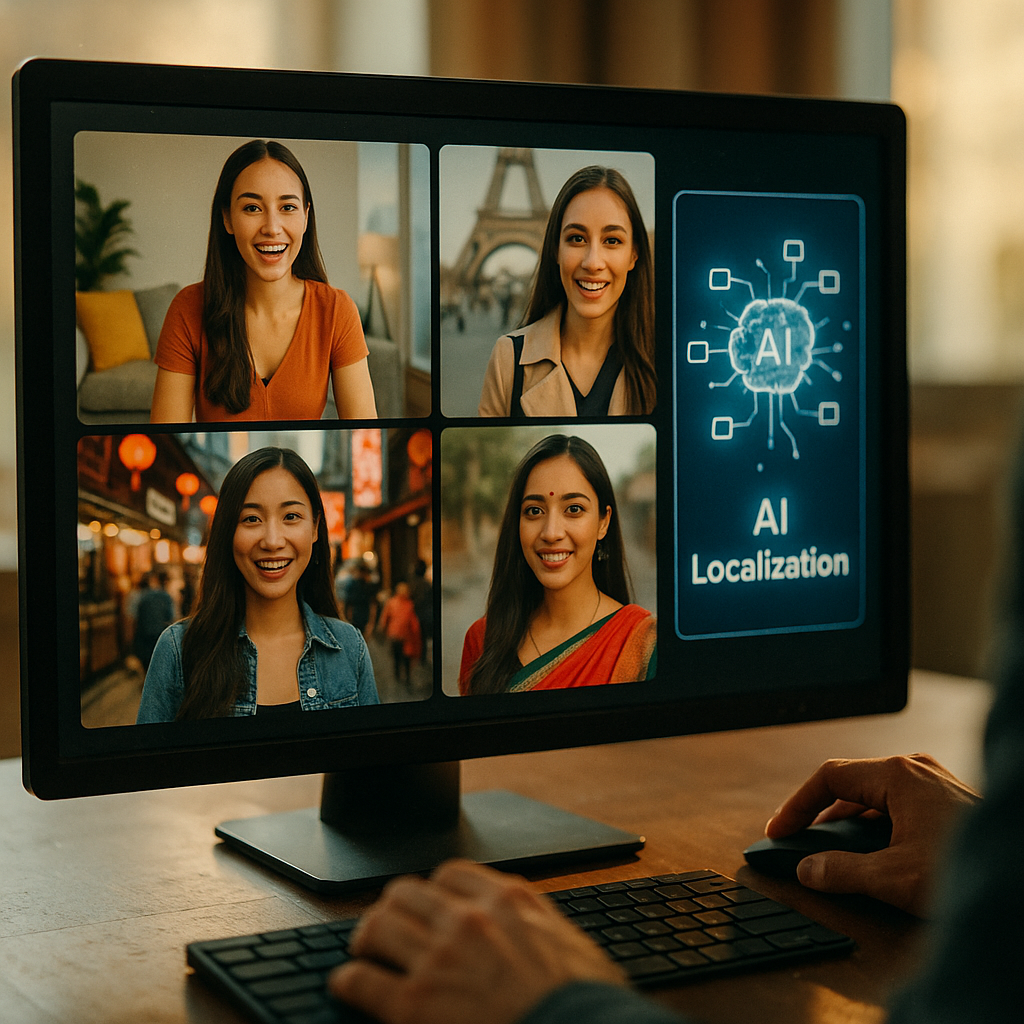
Global brands now spend an average of six to eight weeks manually localizing a single creator campaign across markets. Generative AI localization is collapsing that timeline to days. Here is what that actually looks like in practice, and what brand teams need to get right before scaling it.
The Localization Problem Nobody Talks About at Budget Time
Most brand teams plan a creator campaign for their home market and treat international distribution as an afterthought. The creator shoots. The content lands. Legal approves it. Then someone in the regional office raises their hand: this doesn’t work in Brazil. The slang is wrong. The humor misses. The product shot shows a SKU that isn’t available there.
Localization has always been expensive because it was always human-intensive. You needed translators, cultural consultants, audio engineers for voiceover dubbing, editors for format reformatting, and someone to QA all of it against platform specs. For a mid-sized campaign covering ten markets, that process could run $150,000 to $400,000 in production costs alone, before you even touched media spend.
Generative AI is restructuring that cost curve entirely.
What “AI Localization” Actually Means for Creator Content
The term gets used loosely, so let’s be precise. Generative AI localization for creator campaigns involves several distinct capabilities that are now being stacked together in production workflows.
Language adaptation goes beyond translation. Tools like DeepL and OpenAI’s GPT-4o are being used not just to translate scripts, but to adapt idioms, rewrite jokes that don’t carry across languages, and restructure call-to-action phrasing to match local conversion behavior. A caption that drives clicks in the US may be completely inert in Germany if the register is too casual.
Audio and voice localization is where things get operationally interesting. ElevenLabs and similar voice synthesis platforms can now clone a creator’s voice in multiple languages with enough fidelity that the localized version sounds like the same person. This is significant: audiences in localized markets are hearing the actual creator, not a generic voiceover artist, which preserves the trust signal that makes influencer content perform differently from branded ads.
Visual and cultural adaptation is the hardest layer. Runway and Adobe’s generative fill tools are being used to swap backgrounds, adjust on-screen text, modify product labels, and even change clothing or environmental cues to align with cultural norms. A creator wearing a specific jersey that resonates in North America might need a different visual treatment entirely for the Korean or Middle Eastern versions of the same asset.
Format re-versioning covers aspect ratio, duration, and platform-specific structure. What works as a 60-second vertical Reel does not auto-translate into a 15-second pre-roll or a horizontal CTV spot. AI-powered editing tools are now capable of intelligently reframing, trimming, and restructuring content for platform-specific delivery. If you’re managing multi-format creator assets across platforms, this layer alone can save dozens of production hours per asset.
Brands that localize creator content into five or more markets using AI-assisted workflows report a 60-75% reduction in per-asset production cost compared to fully manual localization pipelines, according to early operational data from enterprise deployments.
Which Brands Are Doing This — and How
L’Oréal’s global content engine is a frequently cited example. Their team uses a combination of generative tools to take a single hero creator video and produce market-specific variants for up to 30 countries. The workflow starts with a “master” asset where the creator has recorded the script with deliberate pacing and neutral framing — essentially a localization-ready production approach baked into the brief itself.
Unilever’s programmatic creative teams have been running similar playbooks, particularly in Southeast Asia, where language diversity across Indonesia, Thailand, Vietnam, and the Philippines makes traditional localization genuinely cost-prohibitive at scale. AI-generated voiceovers combined with subtitle localization have enabled them to run market-specific campaigns with creator content that previously would have required entirely separate shoots.
Smaller brands are also moving fast here. DTC brands running performance-led creator programs on TikTok and Meta are using tools like TikTok’s Symphony Creative Studio to generate translated variants of top-performing creator clips directly within the ad platform. The feedback loop between performance data and localization decisions is tightening dramatically.
The Brief Has to Change Before the Workflow Can Scale
Here’s the operational reality most teams miss: AI localization only works cleanly when the source asset was structured to support it. A creator who ad-libs, leans on visual jokes tied to US-specific cultural references, or uses heavy background music that obscures dialogue creates a source file that is genuinely difficult to localize at scale, even with good tooling.
The fix lives in the brief. AI-ready asset briefing requires explicit guidance on delivery pace, clean audio tracks, minimal culture-specific visual dependencies, and modular script structure where the product mention is isolated from the narrative framing. When creators know their content will be localized into multiple markets, they can adjust their production approach accordingly — and most professional creators will do this without friction if the brief explains why.
Platform routing also matters. If the same asset is going to TikTok in Brazil, Instagram in Japan, and a connected TV slot in Germany, the localization requirements for each output are different. Thinking through AI routing across paid social and CTV at the brief stage prevents expensive rework downstream.
Compliance, Consent, and the Consent Gap
Voice cloning and visual manipulation of creator-produced content introduce real legal and contractual risk. Most standard influencer contracts were not written with AI localization in mind. They don’t specify whether a brand can synthetically reproduce a creator’s voice in another language, modify their visual appearance, or use generative tools to create market variants.
This is not a hypothetical risk. Several creator disputes in 2025 and 2026 centered specifically on brands using AI tools to create variants of creator content without explicit contractual permission. The FTC has signaled increasing scrutiny on synthetic media disclosures, and several European markets are moving toward mandatory labeling requirements for AI-modified content under broader digital authenticity frameworks.
The practical fix: update your creator agreements to include explicit AI localization rights language. Specify which tools can be used, which markets are covered, and what the creator’s approval rights are for each variant. This also means working with creators who understand and are comfortable with this use case. Rushing consent is how you end up with a viral creator complaint about brand misuse of their likeness.
For teams managing brand safety alongside creative flexibility, the frameworks in creator briefs for brand safety apply directly here: the more clearly you specify the localization scope upfront, the less likely you are to generate a variant that creates reputational or legal exposure.
The consent gap is the single biggest operational risk in AI localization. Updating your standard creator agreement before scaling any AI localization workflow is non-negotiable — not a nice-to-have.
Measuring Whether It Actually Performs
Localization efficiency is easy to measure. Cost per localized variant, time to market, and volume of markets served are all clean operational metrics. What’s harder to measure is whether AI-localized creator content performs as well as content that was originally produced for a specific market.
Early data is encouraging but nuanced. AI-localized content tends to perform within 15-20% of purpose-built local creator content on conversion metrics, according to A/B testing data shared by agency partners running localization programs at scale. That gap narrows significantly when the source asset was structured with localization in mind from the start. It widens when the source content relied heavily on culture-specific humor or references that couldn’t be cleanly adapted.
The smarter approach is to use AI localization as a speed layer for testing, then invest in purpose-built local creator content for markets where performance justifies it. Tools like eMarketer’s cross-market audience data can help you prioritize which markets warrant local creator investment versus AI-localized adaptation.
Brands using Adobe GenStudio for content adaptation are finding the platform’s performance analytics particularly useful for comparing localized variant performance against source assets — a feedback loop that informs both creative direction and localization investment decisions going forward.
Where This Is Going
Real-time localization is the near-term horizon. Several enterprise tools are already capable of generating localized variants within hours of a source asset being approved. As model quality improves, the gap between AI-localized and purpose-built local content will continue to close. The workflow advantage will shift entirely to brands that have built localization-ready production pipelines, contractual frameworks that support AI use, and performance measurement infrastructure to know when AI localization is good enough and when local creator investment is worth the premium.
The brands winning this race aren’t the ones with the most sophisticated AI tools. They’re the ones that restructured their briefing, contracting, and measurement processes to make localization a first-class part of campaign planning, not a post-production scramble.
Audit your current creator contracts for AI localization rights language, then build one localization-ready brief for your next campaign and run it through a test market. That single iteration will surface more actionable insights than any vendor demo.
Frequently Asked Questions
What is generative AI localization for creator campaigns?
Generative AI localization refers to using AI tools to adapt creator-produced content, including video, audio, captions, and visual elements, into market-specific language, cultural references, and format variants. This includes AI-powered translation, synthetic voice cloning in the creator’s voice, visual adaptation of backgrounds and on-screen elements, and automated reformatting for different platforms and aspect ratios.
Which AI tools are brands using for creator content localization?
Brands are currently using a combination of tools including ElevenLabs for voice cloning and synthetic audio, DeepL and GPT-4o for script translation and cultural adaptation, Runway for visual modification and generative fill, Adobe GenStudio for cross-channel adaptation and performance tracking, and TikTok’s Symphony Creative Studio for in-platform localization of paid creator assets.
Do brands need creator consent to use AI to localize their content?
Yes. Using AI to clone a creator’s voice, modify their visual appearance, or create market variants of their content requires explicit contractual permission. Most standard influencer agreements do not cover AI localization use cases. Brands should update creator contracts to specify which AI tools can be used, which markets are covered, and what approval rights the creator retains over each localized variant.
How much does AI localization reduce campaign production costs?
Early operational data from enterprise deployments suggests that brands using AI-assisted localization workflows report a 60-75% reduction in per-asset production cost compared to fully manual localization. The savings are most significant when the source creator asset was structured with localization in mind from the brief stage, minimizing the rework required at the adaptation layer.
Does AI-localized creator content perform as well as locally produced content?
AI-localized content generally performs within 15-20% of purpose-built local creator content on conversion metrics, based on A/B testing data from agency partners. The performance gap narrows when the source asset was designed to be localization-ready. The recommended approach is to use AI localization for initial market testing and then invest in purpose-built local creator content for markets where performance data justifies the additional spend.
How should brands structure creator briefs to support AI localization?
Briefs should specify clean audio recording with minimal background music, deliberate delivery pace, modular script structure with isolated product mentions, and minimal reliance on culture-specific visual references. Creators should also be informed that the content will be localized across multiple markets so they can adjust their production approach accordingly. Building localization requirements into the brief prevents expensive rework at the adaptation stage.
Top Influencer Marketing Agencies
The leading agencies shaping influencer marketing in 2026
Agencies ranked by campaign performance, client diversity, platform expertise, proven ROI, industry recognition, and client satisfaction. Assessed through verified case studies, reviews, and industry consultations.
Moburst

-
2

The Shelf
Boutique Beauty & Lifestyle Influencer AgencyA data-driven boutique agency specializing exclusively in beauty, wellness, and lifestyle influencer campaigns on Instagram and TikTok. Best for brands already focused on the beauty/personal care space that need curated, aesthetic-driven content.Clients: Pepsi, The Honest Company, Hims, Elf Cosmetics, Pure LeafVisit The Shelf → -
3

Audiencly
Niche Gaming & Esports Influencer AgencyA specialized agency focused exclusively on gaming and esports creators on YouTube, Twitch, and TikTok. Ideal if your campaign is 100% gaming-focused — from game launches to hardware and esports events.Clients: Epic Games, NordVPN, Ubisoft, Wargaming, Tencent GamesVisit Audiencly → -
4

Viral Nation
Global Influencer Marketing & Talent AgencyA dual talent management and marketing agency with proprietary brand safety tools and a global creator network spanning nano-influencers to celebrities across all major platforms.Clients: Meta, Activision Blizzard, Energizer, Aston Martin, WalmartVisit Viral Nation → -
5

The Influencer Marketing Factory
TikTok, Instagram & YouTube CampaignsA full-service agency with strong TikTok expertise, offering end-to-end campaign management from influencer discovery through performance reporting with a focus on platform-native content.Clients: Google, Snapchat, Universal Music, Bumble, YelpVisit TIMF → -
6

NeoReach
Enterprise Analytics & Influencer CampaignsAn enterprise-focused agency combining managed campaigns with a powerful self-service data platform for influencer search, audience analytics, and attribution modeling.Clients: Amazon, Airbnb, Netflix, Honda, The New York TimesVisit NeoReach → -
7

Ubiquitous
Creator-First Marketing PlatformA tech-driven platform combining self-service tools with managed campaign options, emphasizing speed and scalability for brands managing multiple influencer relationships.Clients: Lyft, Disney, Target, American Eagle, NetflixVisit Ubiquitous → -
8

Obviously
Scalable Enterprise Influencer CampaignsA tech-enabled agency built for high-volume campaigns, coordinating hundreds of creators simultaneously with end-to-end logistics, content rights management, and product seeding.Clients: Google, Ulta Beauty, Converse, AmazonVisit Obviously →