


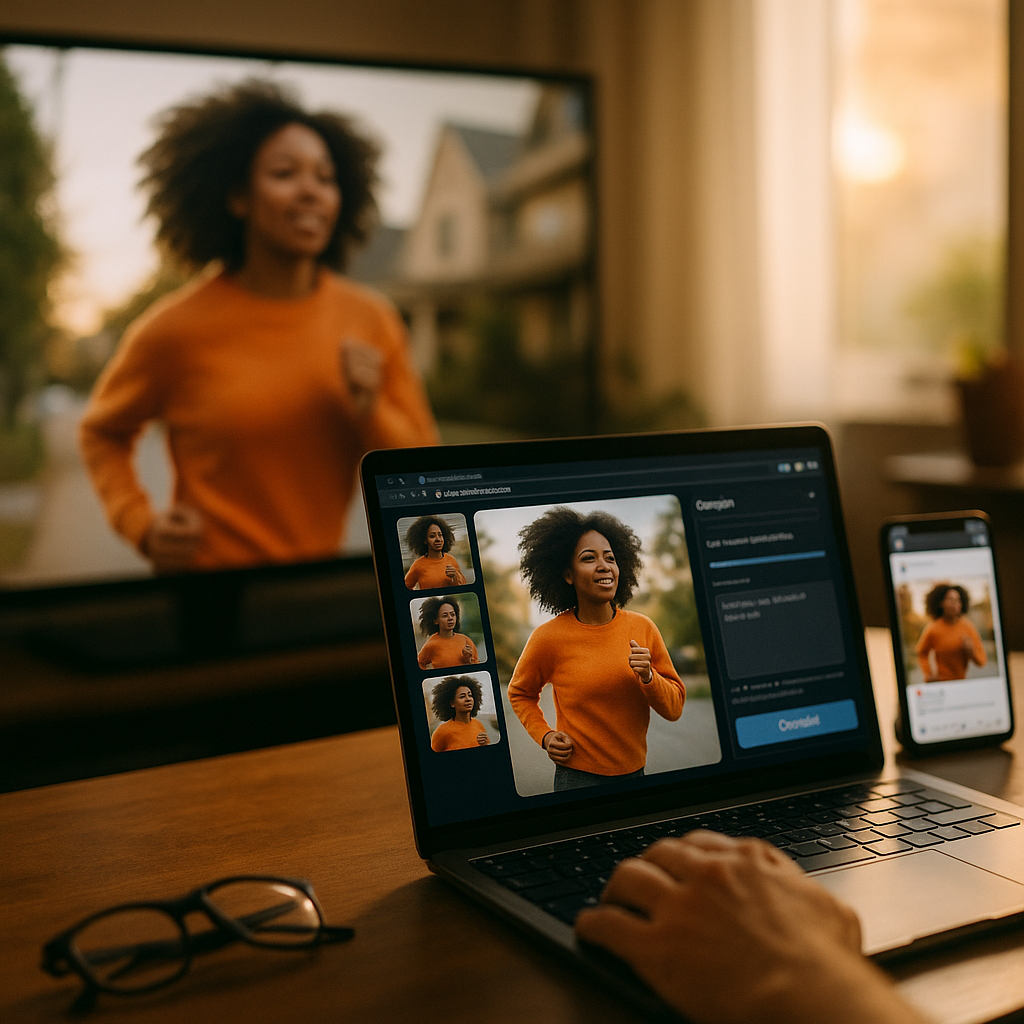
One Brief. Thirty Formats. Zero Production Delays.
Connected TV ad spend is projected to surpass $42 billion in the U.S. alone, yet most brands still treat CTV and social creative as separate production workstreams. Generative AI is collapsing that divide fast. The brands gaining ground right now are running single creative briefs through AI-orchestrated distribution engines that output CTV-ready spots, TikTok cuts, YouTube pre-rolls, and Instagram Stories simultaneously.
Why CTV and Social Creative Have Always Been Siloed
The historical reason is straightforward: CTV demanded broadcast-grade production values. Fifteen-second and thirty-second spots required studio shoots, color grading, union voiceover talent, and legal review cycles that took weeks. Social assets needed the opposite — raw, fast, native-feeling content that aged quickly and was rebuilt constantly.
Those constraints created two separate agency structures, two separate budget lines, and two separate approval chains. For a mid-market brand running a seasonal campaign, that meant producing the same messaging twice, at double the cost, with inevitable creative inconsistency between screens.
Generative AI breaks this structural deadlock.
How AI-Orchestrated Distribution Engines Actually Work
The term “AI-orchestrated distribution engine” sounds like vendor jargon, but the mechanics are concrete. Platforms like Adobe GenStudio and Runway ML allow brand teams to input a core creative brief — messaging hierarchy, visual identity, approved talent footage, brand voice guidelines — and output version sets across multiple aspect ratios, durations, and platform specs in a single rendering pass.
The orchestration layer handles more than format conversion. It applies platform-specific creative logic: CTV spots retain longer narrative arcs and higher production polish, while the same source material gets remixed into vertical, punchy social cuts with captions, motion graphics, and platform-native pacing. Compliance metadata, brand safety tags, and legal supers are embedded at the asset level, not retrofitted afterward.
Brands running AI-orchestrated creative pipelines report cutting time-to-activation by 60-70% compared to traditional parallel production workflows — with measurable consistency gains across brand audits.
For teams already using AI asset refresh and governance workflows, this isn’t a stretch. The same signal-based refresh logic that triggers social ad rotation can now trigger CTV variant generation when frequency caps are hit or performance signals drop.
The Production Reality: What Generative AI Can (and Can’t) Replace
Let’s be precise. Generative AI is not replacing the creative director or the strategic brief. What it replaces is the repetitive downstream execution: transcoding, resizing, subtitle generation, music bed adaptation, and the forty-seventh round of “can you make the logo bigger on mobile.”
Where it genuinely earns its budget is in variant generation at scale. A national retailer running a holiday campaign across Hulu, Peacock, YouTube CTV, Amazon Fire TV, TikTok, and Instagram used to need six to eight production days just for format adaptation. With tools like Runway Gen-3 or Pika Labs combined with a structured asset management layer, that same adaptation workstream runs overnight. Human creative review still happens — but on final outputs, not on individual export settings.
The gap remains in original ideation and in talent-dependent creative. If your CTV spot requires a celebrity appearance or a specific on-location shoot, generative AI doesn’t solve that upstream production cost. It maximizes the downstream value of every hour you did spend on set.
Consider how this connects to AI video editing efficiency gains already being documented across creator workflows. The same principles apply at the brand campaign level.
Platform Specs Are a Moving Target — AI Handles the Drift
Anyone who has managed a multi-platform media buy knows the pain: TikTok changes its safe zone specs, YouTube updates its skippable ad format requirements, Roku introduces a new interactive overlay unit, and suddenly half your asset library is non-compliant. Rebuilding manually is expensive and slow.
AI-orchestrated systems maintain living spec libraries that update with platform changes and auto-flag assets that fall outside current requirements. This is operational risk mitigation, not just efficiency. A brand that misses a spec update and runs non-compliant CTV ads faces not only wasted media spend but potential brand safety exposure on premium inventory.
For teams managing governance at scale, this connects directly to how AI campaign automation and brand safety frameworks are being structured across enterprise marketing operations.
The Attribution Problem Across Screens
Producing CTV and social assets from a unified AI pipeline creates an unexpected attribution advantage. When creative variants share a common source brief and asset DNA, cross-screen attribution models can more reliably isolate the incremental effect of CTV exposure on social engagement and conversion. Mixed-media modeling becomes cleaner when the creative variable is controlled.
This matters for budget allocation decisions. If your CTV spot and your TikTok cut are genuinely the same message in different formats rather than loosely related campaigns, you can attribute lift with more confidence. Brands using real-time performance signals for channel mix rebalancing are already using this unified creative logic to make faster media mix decisions.
The IAB has published frameworks for cross-screen measurement that increasingly assume unified creative taxonomies. Brands that produce CTV and social assets in silos are structurally disadvantaged in applying these models.
When CTV and social creative share a unified source brief, cross-screen attribution models can isolate incremental lift with significantly higher confidence — a direct input into smarter media mix decisions.
Compliance, Rights Management, and the Legal Layer
Here is where many brand teams underestimate the complexity. Generative AI can produce a CTV-ready spot using AI-synthesized voiceover, stock footage, and brand-provided visual assets. But the rights landscape for AI-generated content in broadcast contexts is still evolving. SAG-AFTRA agreements now include provisions governing AI voice and likeness use. Some CTV networks have their own content authenticity requirements that may flag AI-generated video.
The practical answer is a human-in-the-loop compliance review at the final output stage, not an assumption that the AI pipeline handles legal clearances automatically. Platforms like Adobe‘s Content Credentials initiative are building provenance tracking directly into asset metadata, which helps — but doesn’t replace a legal sign-off workflow.
For teams building out these review processes, the same audit discipline outlined for AI contract automation in influencer agreements applies here: automate the routine, review the consequential.
What a Mature AI Creative Stack Looks Like in Practice
The brands doing this well have three things in common. First, they have a structured creative brief format that the AI pipeline can parse — clear messaging hierarchy, locked visual identity tokens, pre-approved music and talent assets. Second, they have a defined human review checkpoint before CTV assets go to network delivery. Third, they have connected their creative production system to their media activation layer so that performance data flows back and triggers new variant requests automatically.
This is not a tool purchase. It’s a workflow redesign. The CMOs seeing the most meaningful efficiency gains from generative AI in creative production are the ones who rebuilt their internal processes first and then layered in the tooling. Upskilling the team on AI creative orchestration is a prerequisite, not an afterthought — a challenge covered in depth when examining AI fluency gaps for marketing leaders.
For brands evaluating where to start, Think with Google has documented several case studies where unified AI creative production delivered measurable lifts in brand recall across CTV and social simultaneously.
Start with one campaign, one unified brief, and one AI-orchestrated output set. Measure creative consistency and production cycle time against your current baseline, then build the governance layer before you scale.
Frequently Asked Questions
What is an AI-orchestrated distribution engine in CTV advertising?
An AI-orchestrated distribution engine is a system that takes a single creative brief and automatically generates multiple ad format variants for different platforms — including CTV spots, social video cuts, and display assets — while applying platform-specific specs, compliance metadata, and brand guidelines at the asset level. Tools like Adobe GenStudio and Runway ML are among the leading platforms enabling this workflow for brand advertisers.
Can generative AI produce broadcast-quality CTV spots without a production shoot?
Generative AI can produce high-quality CTV-ready spots using AI-synthesized visuals, voiceover, and motion graphics, but it cannot replicate a live talent shoot or location-specific footage. Most enterprise brand campaigns use generative AI to maximize the downstream value of shoot-based footage — generating dozens of format variants from a core asset set rather than replacing the original production entirely.
How does unified AI creative production improve cross-screen attribution?
When CTV and social assets originate from the same creative brief and source material, the creative variable is controlled across channels. This makes it significantly easier for mixed-media models to isolate the incremental contribution of each screen. Brands using real-time performance signals can then rebalance channel budgets with higher confidence in the data rather than making gut-feel media mix decisions.
What are the compliance risks of using AI-generated content in CTV campaigns?
The primary risks involve AI voice and likeness rights under SAG-AFTRA agreements, platform-specific content authenticity requirements from CTV networks, and evolving FTC guidelines on AI-generated advertising disclosures. Best practice is to implement a human-in-the-loop legal review at the final output stage and use content provenance tools like Adobe’s Content Credentials to maintain clear asset metadata trails.
How long does it take to implement an AI-orchestrated creative pipeline for CTV and social?
Implementation timelines vary significantly based on existing martech infrastructure and internal process maturity. Brands with structured asset management systems and defined brand style guides can typically run a pilot workflow within four to eight weeks. Full integration with media activation layers and performance feedback loops generally requires three to six months and a deliberate workflow redesign effort alongside the technology deployment.
Top Influencer Marketing Agencies
The leading agencies shaping influencer marketing in 2026
Agencies ranked by campaign performance, client diversity, platform expertise, proven ROI, industry recognition, and client satisfaction. Assessed through verified case studies, reviews, and industry consultations.
Moburst

-
2

The Shelf
Boutique Beauty & Lifestyle Influencer AgencyA data-driven boutique agency specializing exclusively in beauty, wellness, and lifestyle influencer campaigns on Instagram and TikTok. Best for brands already focused on the beauty/personal care space that need curated, aesthetic-driven content.Clients: Pepsi, The Honest Company, Hims, Elf Cosmetics, Pure LeafVisit The Shelf → -
3

Audiencly
Niche Gaming & Esports Influencer AgencyA specialized agency focused exclusively on gaming and esports creators on YouTube, Twitch, and TikTok. Ideal if your campaign is 100% gaming-focused — from game launches to hardware and esports events.Clients: Epic Games, NordVPN, Ubisoft, Wargaming, Tencent GamesVisit Audiencly → -
4

Viral Nation
Global Influencer Marketing & Talent AgencyA dual talent management and marketing agency with proprietary brand safety tools and a global creator network spanning nano-influencers to celebrities across all major platforms.Clients: Meta, Activision Blizzard, Energizer, Aston Martin, WalmartVisit Viral Nation → -
5

The Influencer Marketing Factory
TikTok, Instagram & YouTube CampaignsA full-service agency with strong TikTok expertise, offering end-to-end campaign management from influencer discovery through performance reporting with a focus on platform-native content.Clients: Google, Snapchat, Universal Music, Bumble, YelpVisit TIMF → -
6

NeoReach
Enterprise Analytics & Influencer CampaignsAn enterprise-focused agency combining managed campaigns with a powerful self-service data platform for influencer search, audience analytics, and attribution modeling.Clients: Amazon, Airbnb, Netflix, Honda, The New York TimesVisit NeoReach → -
7

Ubiquitous
Creator-First Marketing PlatformA tech-driven platform combining self-service tools with managed campaign options, emphasizing speed and scalability for brands managing multiple influencer relationships.Clients: Lyft, Disney, Target, American Eagle, NetflixVisit Ubiquitous → -
8

Obviously
Scalable Enterprise Influencer CampaignsA tech-enabled agency built for high-volume campaigns, coordinating hundreds of creators simultaneously with end-to-end logistics, content rights management, and product seeding.Clients: Google, Ulta Beauty, Converse, AmazonVisit Obviously →