


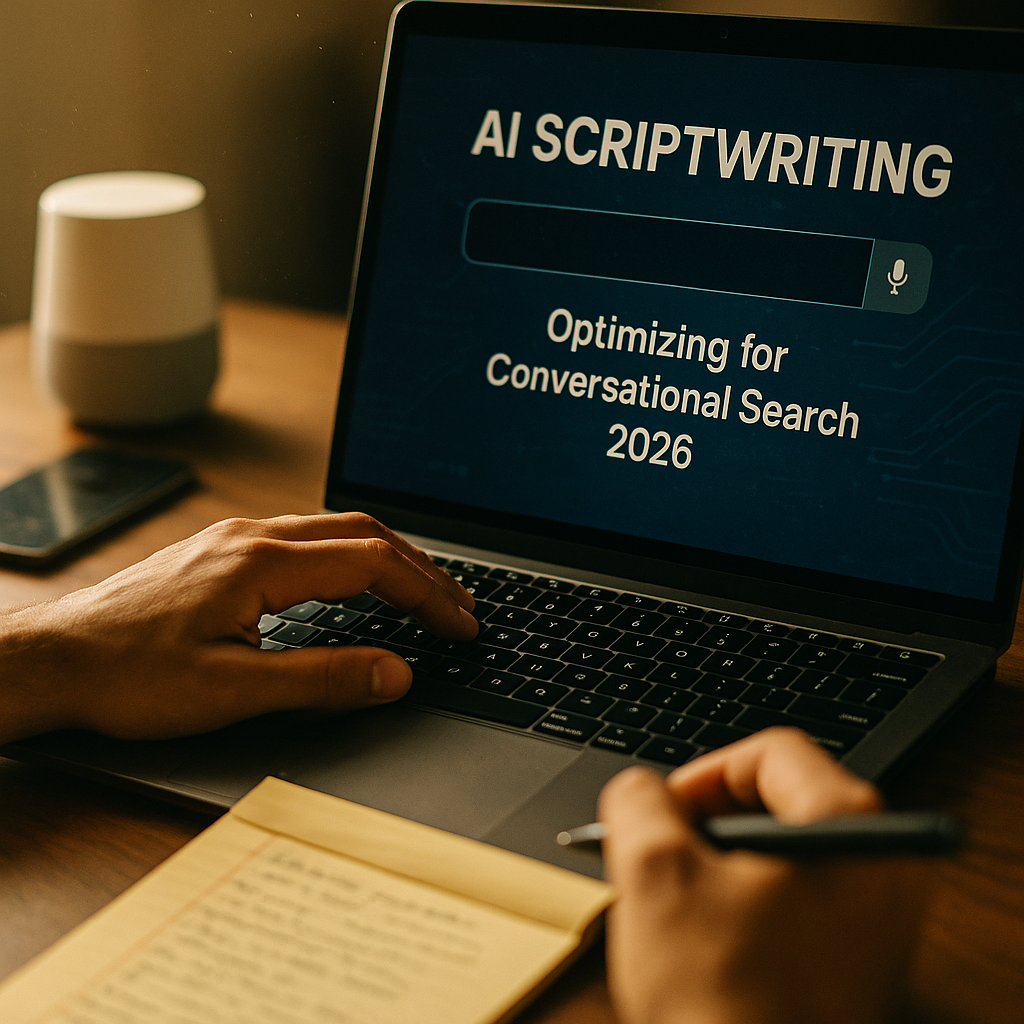
Search behavior in 2026 is no longer limited to typed keywords and blue links. Brands now compete inside chat interfaces, AI summaries, voice assistants, and answer engines, making AI Powered Scriptwriting for Conversational and Generative Search a practical growth strategy. The right scripts help content sound natural, earn trust, and surface in machine-mediated journeys. So what actually works today?
Why conversational search optimization matters in 2026
Conversational search optimization has moved from an experimental tactic to a core content discipline. People now ask full questions, refine them in follow-up prompts, and expect direct, contextual answers. Search engines and AI assistants respond by assembling information from multiple sources, then presenting concise explanations, recommendations, and next-step options.
That shift changes how scripts should be written. Traditional SEO copy often targeted a single query with rigid keyword placement. Conversational environments reward language that mirrors real human dialogue: clear answers, natural transitions, helpful examples, and explicit context. If a user asks, What is the safest way to use AI for content scripts?, content must answer the question directly before expanding on nuance.
Effective scriptwriting for this environment should do three things:
- Answer intent quickly: Lead with the core response, then provide detail.
- Support follow-up questions: Anticipate what the user will ask next and address it naturally.
- Signal trustworthiness: Show expertise, explain methods, and avoid unsupported claims.
This is where EEAT matters. Helpful content in 2026 must demonstrate experience, expertise, authoritativeness, and trust. For scriptwriting, that means using accurate terminology, reflecting real workflows, acknowledging limitations, and writing with enough specificity that a reader can act on the advice. AI can accelerate drafting, but trust still depends on human oversight and editorial judgment.
How AI scriptwriting tools improve generative search content
AI scriptwriting tools can dramatically speed up production for generative search content, but the biggest advantage is not raw volume. It is structural intelligence. Good tools help writers organize answers around intent clusters, build semantic coverage, and generate variants for different conversational contexts such as voice, chat, featured summaries, and FAQ responses.
For example, a marketer can prompt an AI system to create:
- A 40-word direct answer for AI overviews
- A longer explanatory paragraph for landing pages
- Voice-friendly phrasing for spoken assistants
- Customer support style responses for branded chat experiences
- FAQ entries that align with common follow-up queries
That said, strong outputs depend on strong inputs. Generic prompts usually produce generic scripts. The highest-performing teams use detailed prompt frameworks that include audience type, search context, brand voice, user intent, funnel stage, compliance boundaries, and preferred evidence style. This process improves consistency and reduces editing time.
Another benefit is scenario testing. Writers can compare multiple script versions for the same topic: one optimized for comparison searches, another for problem-solving searches, and another for high-intent purchase questions. This makes AI useful not just for creation, but also for message refinement.
Still, automation should not be confused with authority. AI often writes plausible but shallow content. To meet EEAT expectations, every script should be reviewed by someone who understands the subject matter, verifies accuracy, and checks whether the answer is genuinely useful. In sensitive industries such as healthcare, finance, and legal services, this step is essential.
Best practices for AI content strategy and script structure
An effective AI content strategy starts with understanding how users phrase needs in conversational environments. They do not just search CRM tools. They ask, Which CRM is easiest for a small remote sales team? or What CRM integrates with my email and does not require much training? Script structure must reflect that specificity.
A practical script framework for conversational and generative search looks like this:
- Intent-led opening: Begin with a direct answer in one or two sentences.
- Context expansion: Explain why the answer fits the user’s situation.
- Evidence layer: Add relevant facts, examples, process details, or expert insight.
- Decision guidance: Help the reader compare options or choose next steps.
- Follow-up coverage: Address common objections or adjacent questions.
This structure works because generative systems prefer content that is easy to extract, summarize, and reframe. Clear writing with well-defined sections and concise supporting details gives AI systems better material to interpret.
Brands should also build topic depth rather than isolated pages. A single script rarely performs well across every query type. Instead, create connected content around a topic: explainer pages, use-case pages, implementation guides, troubleshooting content, and FAQs. This expands semantic relevance and increases the chance that your brand appears in answer synthesis.
To strengthen EEAT within this strategy, include details that generic AI copy tends to miss:
- First-hand observations: What teams actually learn during implementation or testing
- Operational specificity: Steps, workflows, constraints, and decision criteria
- Clear authorship signals: Subject-matter review, editorial standards, and accuracy checks
- Balanced guidance: Benefits, limitations, and realistic expectations
These elements make content more useful to people and more credible to search systems designed to evaluate quality signals.
Using natural language processing for search intent mapping
Natural language processing helps scriptwriters move beyond exact-match keywords into intent mapping. Instead of asking only which terms have volume, teams can analyze how people describe problems, compare solutions, and signal urgency. This produces scripts that better match conversational search behavior.
Intent mapping usually falls into several categories:
- Informational intent: The user wants to understand a concept.
- Comparative intent: The user is weighing options.
- Transactional intent: The user is close to taking action.
- Navigational or branded intent: The user wants a specific company, product, or source.
- Problem-resolution intent: The user needs a fix, explanation, or troubleshooting step.
AI-powered scriptwriting becomes more effective when each script is designed around one primary intent and several likely follow-ups. If the core query is How do I optimize content for AI search?, likely follow-ups include Do keywords still matter?, How do AI overviews choose sources?, and What metrics should I track? Strong scripts answer these naturally instead of forcing the user to start over.
NLP tools can also reveal entities, recurring phrases, sentiment patterns, and contextual relationships across search behavior. This helps writers include the concepts that matter most in a topic area. For example, an article on AI scriptwriting should logically reference prompts, user intent, voice search, structured answers, editorial review, hallucination risk, and trust signals. Leaving these out makes content less complete.
However, completeness should not create bloat. The best scripts remain disciplined. They cover what users need to know, in the order they need to know it, without padding. That balance is especially important for generative search, where clarity often determines whether information is surfaced or ignored.
Voice search content and multi-turn dialogue scripts
Voice search content requires a different writing rhythm than traditional web copy. Spoken queries are longer, more conversational, and often local or action-oriented. Users ask things like What is the fastest way to create AI-friendly content scripts? or Which tools help with generative search optimization? The ideal response sounds human when spoken aloud.
That means scriptwriters should prioritize:
- Short, direct sentences
- Natural phrasing over keyword repetition
- Clear definitions for technical ideas
- Logical sequencing for multi-step answers
- A conversational tone that still feels authoritative
Multi-turn dialogue is equally important. Generative search often behaves like a conversation, not a one-time query. A user may ask a broad question, then narrow it: How does AI scriptwriting help SEO? followed by Can it help with product pages too? and then What are the risks? Content that anticipates this journey performs better because it offers layered answers instead of isolated statements.
One effective method is to write scripts in modular blocks. Start with a direct summary, then create expandable answer units for benefits, use cases, risks, workflows, and examples. This modular approach supports websites, chatbots, help centers, sales enablement, and answer engines at the same time.
Accessibility also matters. Voice-friendly content should avoid jargon unless it is immediately explained. Acronyms should be used carefully. Numbers, steps, and product claims should be easy to hear and understand. These choices improve user experience and reduce misinterpretation by both people and machines.
Content automation workflows, quality control, and EEAT safeguards
Content automation workflows can save time, but they need guardrails. The fastest teams in 2026 combine AI generation with strong editorial systems. Without that balance, brands risk publishing inaccurate, repetitive, or thin content that fails users and weakens visibility.
A reliable workflow often includes these stages:
- Research and intent analysis: Gather real user questions, SERP patterns, support tickets, and product insights.
- Prompt design: Define audience, purpose, tone, facts to include, and claims to avoid.
- Draft generation: Produce multiple script options for different search contexts.
- Expert review: Check technical accuracy, completeness, and usefulness.
- Editorial refinement: Improve clarity, flow, brand voice, and compliance.
- Performance monitoring: Track engagement, citations, conversions, and query coverage.
The review stage is where EEAT becomes visible. Editors should ask:
- Does this script answer the user’s real question quickly?
- Is every factual claim verified?
- Does the content show practical experience, not just abstraction?
- Are limitations or tradeoffs clearly stated?
- Would a reader trust this enough to act on it?
Measurement should also evolve. Rankings still matter, but generative search visibility requires broader signals. Teams should monitor assisted conversions, branded search lift, citation frequency in AI answers, user engagement from chat-driven discovery, and the performance of FAQ and support content. These indicators reveal whether scripts are actually contributing to discoverability and trust.
Finally, avoid over-automation. If every page sounds machine-generated, audiences notice. Distinctive expertise, original examples, and grounded recommendations are now competitive advantages. AI should help scale quality, not imitate it.
FAQs about AI powered scriptwriting for conversational and generative search
What is AI powered scriptwriting for conversational and generative search?
It is the use of AI tools to create, refine, and optimize content scripts that perform well in chat-based search, AI summaries, voice assistants, and answer engines. The goal is to produce natural, intent-led answers that are easy for both users and AI systems to understand.
Does traditional SEO still matter if generative search is growing?
Yes. Technical SEO, crawlability, topical authority, internal linking, and search intent alignment still matter. Generative search builds on many traditional SEO signals, but it rewards clearer answers, stronger trust signals, and more conversational language.
How do I make AI-written scripts meet Google’s EEAT standards?
Use human subject-matter review, verify claims, include practical insights, explain methods, and be transparent about limitations. AI can draft content, but expertise and trust must be added through editorial oversight and first-hand knowledge.
What types of content benefit most from AI scriptwriting?
FAQ pages, product explainers, support content, comparison pages, landing pages, chatbot responses, voice search answers, and knowledge base articles all benefit. Any format that requires concise, structured, user-focused responses is a strong fit.
Can AI scriptwriting help with voice search optimization?
Yes. AI can generate shorter, more natural answers that align with spoken queries. It can also produce multiple phrasing variations, helping brands match how real people ask questions verbally.
What are the main risks of using AI for search content?
The biggest risks are factual errors, vague language, repeated ideas, and weak differentiation. These issues are preventable with high-quality prompts, strong editing, and expert review before publication.
How should success be measured in 2026?
Track more than rankings. Measure engagement, conversion impact, AI answer citations, branded query growth, FAQ visibility, and how well content supports multi-turn user journeys across search and chat interfaces.
AI-powered scriptwriting works best when it serves real user needs with precision, depth, and editorial discipline. Brands that win in conversational and generative search do not rely on automation alone; they combine smart tools, intent mapping, and verified expertise. Build scripts that answer clearly, anticipate follow-up questions, and earn trust, and your content becomes far more discoverable where search is heading.