


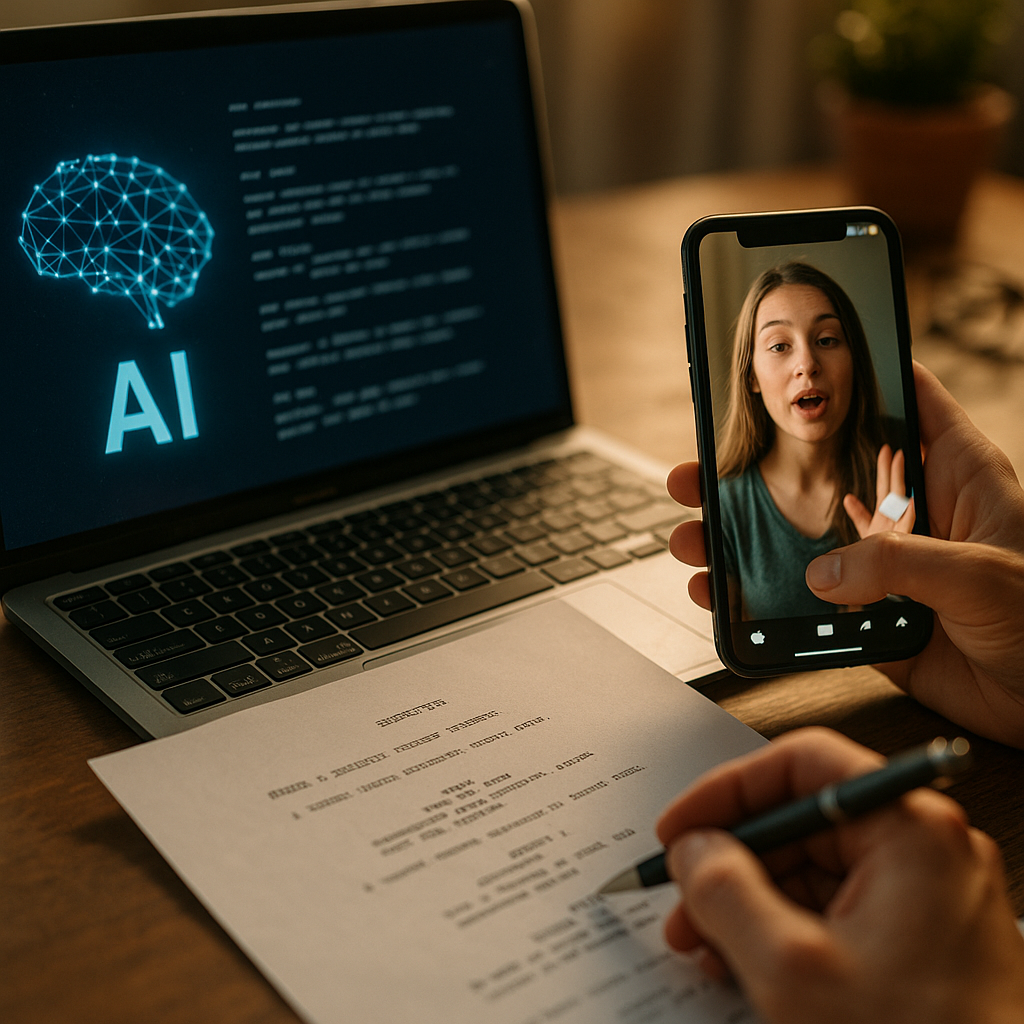
AI for automated scriptwriting based on top-performing viral hooks is changing how creators, brands, and agencies turn audience attention into repeatable results. Instead of guessing what will land, you can model proven openings, map them to your offer, and generate scripts built for retention and conversion. The real advantage is speed with discipline—so your next script doesn’t just get made, it gets watched. Ready to steal attention the ethical way?
Viral hook analysis for automated scriptwriting
A “viral hook” is the first 1–3 seconds (short-form) or first 10–30 seconds (long-form) that earns continued viewing. In 2025, the platforms reward early retention, repeat watches, and strong session time—so your hook must create a clear reason to stay. AI helps by analyzing patterns across top-performing content and translating those patterns into repeatable hook structures you can adapt to your niche.
Automated scriptwriting works best when you treat hooks as formats rather than lines. Formats are stable patterns that travel across topics. Examples include:
- Contrarian truth: “Everyone says X. Here’s what actually works…”
- Immediate payoff: “In 20 seconds you’ll know exactly how to…”
- Specific curiosity: “The mistake hidden in your [tool/process] is…”
- Proof-first: “Here’s the result, then I’ll show the steps.”
- High-stakes problem: “If you do this wrong, you’ll waste…”
The AI workflow starts with a dataset of top-performing videos/posts in your niche, tagged with performance indicators (views, average watch time, saves, shares, click-through, comments). You then extract hook attributes: length, pacing, claim type, specificity level, emotional trigger, proof element, and audience addressed. The output isn’t “copy this sentence,” but “use this hook recipe with your unique product, proof, and angle.”
If you’re wondering whether this becomes generic, it doesn’t have to. The difference comes from your inputs: your audience pains, your product constraints, your real examples, and your on-camera voice. AI can scale structure; only you can supply credibility.
AI scriptwriting tools for viral content creation
In 2025, most modern AI writing systems can draft scripts, but the strongest results come from combining three capabilities: research, pattern extraction, and brand-safe generation. Look for tools (or stacks) that support:
- Trend and competitor capture: ingest links or transcripts, cluster by topic and hook pattern, and surface what’s rising.
- Transcript parsing: identify hook, setup, payoff, CTA, and “retention bumps” (pattern breaks, cuts, visuals cues).
- Guardrails: style guide, banned claims, compliance notes (health/finance), and fact-check prompts.
- A/B script variants: generate 5–10 openings with different hook formats while keeping the same core message.
- Repurposing: adapt one script into short clips, captions, emails, and landing-page intros without losing the promise.
Common mistake: using AI as a “script vending machine.” That approach produces volume but not performance. Instead, use AI like a writers’ room: you provide the strategy, positioning, and proof; AI provides options and iteration speed.
To answer the question most teams ask next—how many variants should we generate? Start with 5 hooks per idea. Keep the body consistent so you can attribute performance differences to the opening. Once you find a hook format that consistently beats the others for your audience, build a library of that format with different claims and proofs.
Hook templates and storytelling frameworks for short-form video
Hooks win attention, but structure keeps it. For short-form videos (15–60 seconds), your script must deliver the promise quickly, then keep tension alive through micro-payoffs. AI can automate this by generating scripts that follow reliable frameworks:
1) Hook → Proof → Steps → CTA
- Hook (0–2s): clear claim or curiosity gap
- Proof (2–6s): show result, credential, demo, or before/after
- Steps (6–45s): 2–4 tight steps with visual cues
- CTA (last 3–8s): one action aligned to viewer intent
2) Problem → Agitation → Minimal solution
- Problem: “If your videos stall at 2 seconds…”
- Agitation: cost of staying stuck, common wrong fix
- Minimal solution: one principle + one example
3) Myth → Mechanism → Method
- Myth: “You need longer scripts to explain.”
- Mechanism: why the myth fails (retention physics)
- Method: repeatable step-by-step template
To make AI output sound human and not templated, provide a hook brief with: audience persona, desired emotion (relief, surprise, urgency), claim boundaries (no exaggerated results), and one real example. Then ask for three versions: one bold, one calm, one comedic. You can also instruct the AI to write for spoken cadence—short sentences, contractions, and deliberate pauses.
Follow-up question: How do we keep curiosity without clickbait? Make the hook specific and deliver on it. Replace vague teases (“You won’t believe…”) with concrete stakes (“This 10-second change stopped my intros from dropping 40% of viewers”). If you can’t support a number, don’t use it—use a verifiable observation instead.
Data-driven content strategy using viral hook metrics
Automated scriptwriting improves when you measure the right metrics and feed them back into your hook library. The goal isn’t “more views,” it’s more qualified attention. Track:
- 3-second hold rate: did the hook earn the next moment?
- Average view duration and completion rate: did the script keep its promise?
- Rewatches/saves: did it provide utility worth returning to?
- Shares: did it create identity or social value?
- Click-through and conversion: did it move the right audience to the next step?
Build a simple “hook scorecard” that pairs each script with its hook format and a few variables: claim type (result, risk, shortcut), specificity (numbers, time, audience), proof type (demo, social proof, credential), and tone (direct, playful, skeptical). After 20–30 posts, you’ll see patterns that AI can exploit responsibly.
Practical loop for teams:
- Collect: export top-performing content transcripts weekly.
- Label: tag hooks by format, claim type, and proof type.
- Generate: use AI to draft 5 hook variants per new topic using your best formats.
- Test: publish with consistent visuals and similar posting windows.
- Learn: update your hook library with “winning constraints” (what must be present to work).
Most readers then ask: How do I avoid chasing trends that don’t fit my offer? Add one more filter: only approve hooks that naturally lead to your product’s unique mechanism. If the hook can’t transition into your offer without a hard pivot, it’s a distraction—even if it gets views.
Ethical AI content creation and EEAT for scriptwriting
When scripts scale, credibility becomes your main asset. Google’s EEAT principles—Experience, Expertise, Authoritativeness, and Trust—apply even when you publish primarily on social platforms because audiences cross-check, compare, and search. Automated scriptwriting should make your content more reliable, not less.
Use these EEAT guardrails:
- Experience: include one real detail per script (a test you ran, a before/after you can show, a mistake you made). AI can’t invent this ethically; you must supply it.
- Expertise: define what you know and what you don’t. If a topic is outside your domain, frame it as “what I’ve observed” rather than “what you must do.”
- Authoritativeness: reference credible sources when making factual claims, and keep citations accessible in descriptions or companion posts when appropriate.
- Trust: avoid fabricated testimonials, unrealistic promises, and medical/financial claims without proper context and compliance.
Also protect originality. “Based on top-performing hooks” should mean “inspired by patterns,” not “rewriting someone’s script.” In your AI prompts, explicitly prohibit copying phrases longer than a short snippet and require a fresh example or angle.
Finally, implement a human review checklist before publishing:
- Does the hook match what the video actually delivers?
- Are claims verifiable or clearly framed as opinion/experience?
- Is there a respectful, non-manipulative CTA?
- Would I stand behind this script publicly if challenged?
Workflow for automated script generation from top-performing hooks
Here is a repeatable process you can run weekly, solo or with a team, to produce scripts quickly without losing quality.
Step 1: Build your hook bank. Gather 50–200 examples from your niche (your own posts plus competitors). Save transcripts and performance signals. Tag each with hook format and proof type.
Step 2: Define your content “pillars.” Choose 3–5 pillars that connect directly to your offer (education, myth-busting, case studies, behind-the-scenes, tool demos). This prevents trend drift.
Step 3: Create a prompt blueprint. Include:
- Audience: who this is for and what they care about today
- Promise: one sentence outcome
- Unique mechanism: what makes your approach different
- Proof: one real example you can show
- Constraints: length, tone, banned claims, and no copying
Step 4: Generate structured outputs. Ask for:
- 10 hook options across 3–4 winning formats
- 3 full scripts using the best hooks
- On-screen text suggestions and cut cues
- Caption and title variants optimized for clarity (not keyword stuffing)
Step 5: Human edit for voice and truth. Tighten wording, remove fluff, and ensure every sentence serves retention or clarity. Add your lived detail (what you tried, what changed, what you’d do differently).
Step 6: Publish and iterate with intention. Compare hook performance against your scorecard, then update your hook bank with what actually worked for your audience.
Follow-up question: How fast can this work? Most creators see measurable improvement once they’ve tested at least 20 scripts with consistent measurement. The AI speeds up iteration; the learning comes from your feedback loop.
FAQs: AI for automated scriptwriting based on viral hooks
Can AI really write viral scripts, or does it just remix common phrases?
AI is best at generating strong structure and multiple hook variants quickly. Virality still depends on your niche, distribution, credibility, and creative execution. If you feed AI your real proof, clear positioning, and performance data, it can produce scripts that outperform “generic” content reliably.
How do I find top-performing hooks to train my approach?
Start with your platform’s search and analytics, competitor channels, and curated trend feeds. Save transcripts of posts that consistently perform (not just one-off spikes). Tag them by hook format and proof type so you learn patterns instead of copying lines.
What’s the safest way to avoid plagiarism when using viral-hook inspiration?
Use pattern-based prompts: request new phrasing, new examples, and a different angle while keeping the hook format. Avoid reusing distinctive sentences, story beats, or unique metaphors from a single creator. Add your own experience detail so the script is unmistakably yours.
Should I optimize scripts for SEO if they’re mainly for social video?
Yes, but prioritize clarity over keyword density. Use consistent topic language in titles, captions, and spoken phrases so the content is searchable. Then support your best videos with companion pages or newsletters that expand the idea for search audiences.
How many hook variants should I test per idea?
Test 3–5 hook variants for the same core script, then keep the winner and iterate. This isolates the hook’s impact and builds a reliable library of formats that work for your audience.
What proof works best in the first few seconds?
Fast, visual proof: a before/after, a screen recording, a quick demo result, or a concise credential tied to the claim. If you can’t show proof immediately, use a concrete example and promise the demonstration within the next few seconds.
In 2025, automated scriptwriting succeeds when you combine proven viral hook patterns with real expertise, measurable feedback, and ethical guardrails. AI gives you speed, variation, and structure; your job is to supply truth, proof, and a clear point of view. Build a hook library, test methodically, and refine what wins. The takeaway: don’t chase virality—engineer consistent attention you can earn and keep.
Top Influencer Marketing Agencies
The leading agencies shaping influencer marketing in 2026
Agencies ranked by campaign performance, client diversity, platform expertise, proven ROI, industry recognition, and client satisfaction. Assessed through verified case studies, reviews, and industry consultations.
Moburst

-
2

The Shelf
Boutique Beauty & Lifestyle Influencer AgencyA data-driven boutique agency specializing exclusively in beauty, wellness, and lifestyle influencer campaigns on Instagram and TikTok. Best for brands already focused on the beauty/personal care space that need curated, aesthetic-driven content.Clients: Pepsi, The Honest Company, Hims, Elf Cosmetics, Pure LeafVisit The Shelf → -
3

Audiencly
Niche Gaming & Esports Influencer AgencyA specialized agency focused exclusively on gaming and esports creators on YouTube, Twitch, and TikTok. Ideal if your campaign is 100% gaming-focused — from game launches to hardware and esports events.Clients: Epic Games, NordVPN, Ubisoft, Wargaming, Tencent GamesVisit Audiencly → -
4

Viral Nation
Global Influencer Marketing & Talent AgencyA dual talent management and marketing agency with proprietary brand safety tools and a global creator network spanning nano-influencers to celebrities across all major platforms.Clients: Meta, Activision Blizzard, Energizer, Aston Martin, WalmartVisit Viral Nation → -
5

The Influencer Marketing Factory
TikTok, Instagram & YouTube CampaignsA full-service agency with strong TikTok expertise, offering end-to-end campaign management from influencer discovery through performance reporting with a focus on platform-native content.Clients: Google, Snapchat, Universal Music, Bumble, YelpVisit TIMF → -
6

NeoReach
Enterprise Analytics & Influencer CampaignsAn enterprise-focused agency combining managed campaigns with a powerful self-service data platform for influencer search, audience analytics, and attribution modeling.Clients: Amazon, Airbnb, Netflix, Honda, The New York TimesVisit NeoReach → -
7

Ubiquitous
Creator-First Marketing PlatformA tech-driven platform combining self-service tools with managed campaign options, emphasizing speed and scalability for brands managing multiple influencer relationships.Clients: Lyft, Disney, Target, American Eagle, NetflixVisit Ubiquitous → -
8

Obviously
Scalable Enterprise Influencer CampaignsA tech-enabled agency built for high-volume campaigns, coordinating hundreds of creators simultaneously with end-to-end logistics, content rights management, and product seeding.Clients: Google, Ulta Beauty, Converse, AmazonVisit Obviously →