


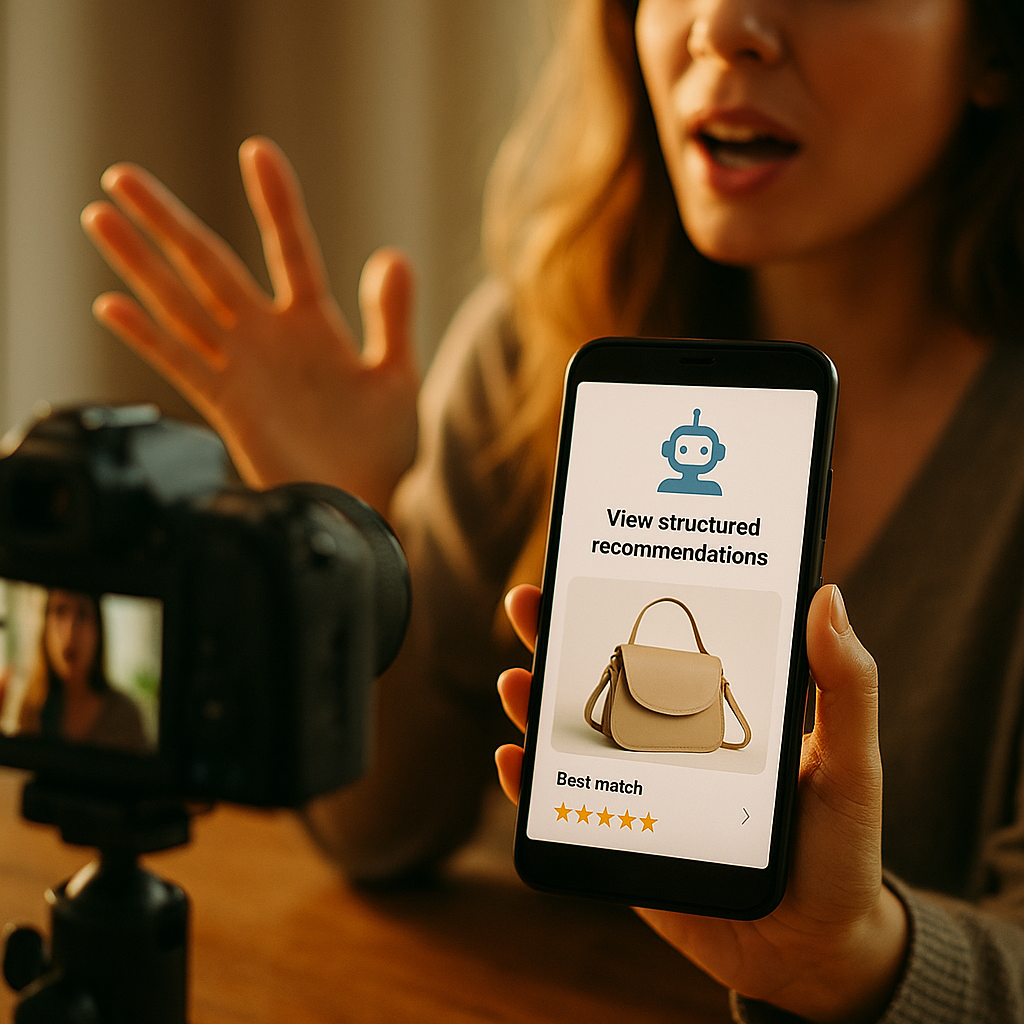
Gartner predicts that by 2027, 40% of enterprise applications will feature task-specific AI agents, and a growing share of consumer purchases will route through agentic assistants that browse, compare, and check out without a human clicking a single link. So here’s the uncomfortable question for every brand running influencer programs: is your creator content even readable by the thing that’s about to do the shopping? Advertising to AI agents isn’t a future problem. It’s a Q1 planning problem.
Most influencer content today is built for human eyeballs: a hook in the first three seconds, a vibe, a link in bio. Machine buyers don’t care about vibes. They care about structured facts, verifiable claims, and metadata they can parse in milliseconds. If your creator assets can’t answer a machine’s questions, you’re invisible to an entire emerging purchase channel.
What Is a “Machine Buyer,” Exactly?
A machine buyer is any AI agent, shopping assistant, or autonomous checkout tool acting on a consumer’s behalf to research, shortlist, or purchase a product. Think of Perplexity’s shopping features, Amazon’s Rufus, OpenAI’s shopping integrations inside ChatGPT, and the wave of agentic browser tools that Google and Microsoft are racing to ship. These systems don’t scroll TikTok for inspiration. They query product feeds, review databases, and increasingly, creator content that’s been indexed and structured well enough to cite.
The mechanics matter here. An agent tasked with “find me the best budget skincare routine under $50” isn’t watching a 45-second Reel. It’s pulling structured claims, comparing them against competitors, and generating a recommendation in text. If a creator’s video mentions ingredients, price, and use case, but that information lives only in spoken audio with no transcript or schema markup, the agent has nothing to work with. It moves on to a brand that made its content legible.
The brands winning agentic visibility today aren’t necessarily the ones with the biggest creator budgets. They’re the ones whose content has structure an AI can actually parse.
Why Creator Content Is Uniquely Unprepared
Influencer marketing was built on authenticity signals: tone, personality, unscripted moments. Those are exactly the things machines struggle to evaluate. A human viewer trusts a creator because of subtle social cues. An AI agent trusts a creator because of extractable, verifiable data points.
This creates a real mismatch. Most creator briefs still optimize for watch time and engagement rate, not machine legibility. Captions are an afterthought. Product claims are buried in speech, not text. There’s rarely a consistent naming convention for products, ingredients, or pricing across a creator’s content library. That’s fine for a human scrolling for entertainment. It’s a dead end for an agent trying to extract facts.
Our earlier coverage on structuring UGC transcripts for AI engines flagged this exact problem: content that isn’t transcribed and tagged with schema is functionally invisible to generative answer engines, and the same logic applies one layer deeper to shopping agents making purchase decisions.
The Transcript Is the New Landing Page
Here’s a mental model shift worth adopting: treat every creator video transcript like a product page. That means clear product names (not “this little guy”), specific claims (“reduces redness in 48 hours” rather than “it just works”), and pricing or availability stated in plain text somewhere in the caption or description.
Brands running large creator programs should be running transcription and tone analysis at scale, not spot-checking a handful of top performers. Tools built for this, covered in our piece on AI transcription and creator tone scoring, can flag when a creator’s phrasing is too vague for machine extraction, giving teams a chance to request a pickup or add clarifying text before the asset goes live.
Structured Data Isn’t Optional Anymore
If you’ve spent any time in technical SEO, this will sound familiar: schema markup, product feeds, and structured metadata are the language machines actually speak. The same infrastructure that helps Google’s shopping graph understand your catalog is what helps an AI agent understand your creator content’s claims.
We’ve written before about how product feeds need structured data before AI agents will recommend a product at all. Extend that thinking to influencer content: every sponsored post, every affiliate link, every creator video should be paired with machine-readable metadata that states the product name, price, availability, and key claims in a format an agent can ingest without guessing.
Practically, that means:
- Adding schema.org markup (Product, Review, VideoObject) to any landing page hosting creator content
- Ensuring UGC video transcripts are indexed and attached to the product page, not just the social platform
- Standardizing product naming across every creator’s content so an agent doesn’t have to reconcile five different nicknames for the same SKU
- Publishing pricing and availability in text near the video, not just verbally in the clip
None of this is glamorous work. It’s the plumbing. But plumbing is exactly what determines whether an agent can find you when a consumer asks it to shop on their behalf.
Verification Becomes the New Trust Signal
Human audiences trust creators because of parasocial relationships. Machines don’t have relationships. They have verification. An AI agent evaluating whether to recommend a product based on creator content will weigh whether the claims made are consistent, sourced, and free of the kind of exaggeration that gets flagged by regulators.
This is where compliance and machine readiness start to overlap in ways most marketing teams haven’t fully mapped. The FTC’s disclosure guidelines already require clear, unambiguous claims in sponsored content. That same clarity happens to be exactly what makes content legible to an AI agent. Vague, hedge-everything copy that skirts disclosure rules is also copy an agent can’t confidently cite. Cleaning up for compliance and cleaning up for machine buyers are, encouragingly, the same job.
Brands running high-volume creator programs are already using AI to catch this at scale before it becomes a legal or a discoverability problem. Our coverage of AI contract redlining shows how automated review is catching risky claims language before publication, and that same review layer can be extended to check for machine-legibility gaps, not just legal ones.
Rethinking Briefs, Not Just Publishing
If agents are going to parse creator content, the fix starts upstream at the brief. A creator brief written purely for vibes and hooks won’t produce content an agent can extract facts from. Add a short section to every brief: “state the product name and one specific claim clearly in spoken audio, not just visually.” That single line changes everything downstream.
AI-assisted brief generation is already catching on for speed reasons. Our analysis of AI creative briefs found that automated brief drafting saves real time, but strategists still need to catch errors and gaps, including, increasingly, gaps in machine legibility.
A brief that optimizes only for hook rate is optimizing for humans. A brief that also demands clear spoken claims is optimizing for both humans and the agents about to shop on their behalf.
What About Dynamic Creative and Testing?
Dynamic creative optimization tools are already reshaping how brands test hooks, and that same testing discipline needs a machine-readability lane. Our piece on AI dynamic creative optimization found that most testing still prioritizes hooks over calls to action. Add a third variable: does the winning version also state the product claim in extractable text or audio? A hook that wins engagement but buries the product fact is a hook that loses the agentic channel entirely.
The ROI Case, Bluntly
Skeptical marketers will ask: is this worth the operational lift right now? Fair question. Adoption of agentic shopping is early, and eMarketer and Statista data both show consumer trust in AI-driven purchase recommendations still building rather than mainstream. But the infrastructure lift here isn’t wasted even if agentic adoption is slower than the hype suggests.
Structured, transcript-rich, schema-tagged creator content also improves traditional search visibility, supports affiliate attribution, and gives legal teams a cleaner audit trail. It’s a rare case where preparing for a future channel pays dividends in the current one. That’s a much easier budget conversation than “invest now for a channel that might matter in three years.”
Governance matters here too. As more of this content prep gets automated, brands need audit trails showing what was checked and when. Platforms building this layer, like the one covered in our piece on governance layers and audit trails, are worth watching as agentic commerce scales and compliance teams start asking harder questions about how creator claims were verified before an AI agent ever cited them.
FAQs
Frequently Asked Questions
What does “advertising to AI agents” actually mean for a brand?
It means preparing creator and product content so that autonomous shopping agents, not just human viewers, can extract accurate facts, prices, and claims to make purchase recommendations on a consumer’s behalf.
Do I need to change my entire creator content strategy right now?
Not entirely. Start by adding structured metadata, clear spoken claims, and transcripts to existing high-performing creator content rather than rebuilding your whole program from scratch.
How is this different from traditional SEO?
Traditional SEO optimizes for search engine crawlers and human readers scanning results. Machine buyer optimization prepares content for autonomous agents that extract and compare specific facts to make a purchase decision without a human reviewing search results at all.
Does FTC disclosure compliance help with AI agent visibility?
Yes. Clear, unambiguous disclosure and claims language, which the FTC already requires, tends to be exactly the kind of structured, verifiable content that AI agents can confidently extract and cite.
What’s the biggest mistake brands make with this right now?
Treating machine readiness as a future problem instead of adding it to current briefs, transcripts, and schema markup, which means starting from a deficit once agentic shopping adoption accelerates.
Next step: Pick your top ten performing creator assets this quarter, add transcripts and schema markup to their landing pages, and rewrite the brief template so every future creator states the product name and one clear claim in spoken audio. That’s the entire head start most competitors haven’t taken yet.
Top Influencer Marketing Agencies
The leading agencies shaping influencer marketing in 2026
Agencies ranked by campaign performance, client diversity, platform expertise, proven ROI, industry recognition, and client satisfaction. Assessed through verified case studies, reviews, and industry consultations.
Moburst

-
2

The Shelf
Boutique Beauty & Lifestyle Influencer AgencyA data-driven boutique agency specializing exclusively in beauty, wellness, and lifestyle influencer campaigns on Instagram and TikTok. Best for brands already focused on the beauty/personal care space that need curated, aesthetic-driven content.Clients: Pepsi, The Honest Company, Hims, Elf Cosmetics, Pure LeafVisit The Shelf → -
3

Audiencly
Niche Gaming & Esports Influencer AgencyA specialized agency focused exclusively on gaming and esports creators on YouTube, Twitch, and TikTok. Ideal if your campaign is 100% gaming-focused — from game launches to hardware and esports events.Clients: Epic Games, NordVPN, Ubisoft, Wargaming, Tencent GamesVisit Audiencly → -
4

Viral Nation
Global Influencer Marketing & Talent AgencyA dual talent management and marketing agency with proprietary brand safety tools and a global creator network spanning nano-influencers to celebrities across all major platforms.Clients: Meta, Activision Blizzard, Energizer, Aston Martin, WalmartVisit Viral Nation → -
5

The Influencer Marketing Factory
TikTok, Instagram & YouTube CampaignsA full-service agency with strong TikTok expertise, offering end-to-end campaign management from influencer discovery through performance reporting with a focus on platform-native content.Clients: Google, Snapchat, Universal Music, Bumble, YelpVisit TIMF → -
6

NeoReach
Enterprise Analytics & Influencer CampaignsAn enterprise-focused agency combining managed campaigns with a powerful self-service data platform for influencer search, audience analytics, and attribution modeling.Clients: Amazon, Airbnb, Netflix, Honda, The New York TimesVisit NeoReach → -
7

Ubiquitous
Creator-First Marketing PlatformA tech-driven platform combining self-service tools with managed campaign options, emphasizing speed and scalability for brands managing multiple influencer relationships.Clients: Lyft, Disney, Target, American Eagle, NetflixVisit Ubiquitous → -
8

Obviously
Scalable Enterprise Influencer CampaignsA tech-enabled agency built for high-volume campaigns, coordinating hundreds of creators simultaneously with end-to-end logistics, content rights management, and product seeding.Clients: Google, Ulta Beauty, Converse, AmazonVisit Obviously →