


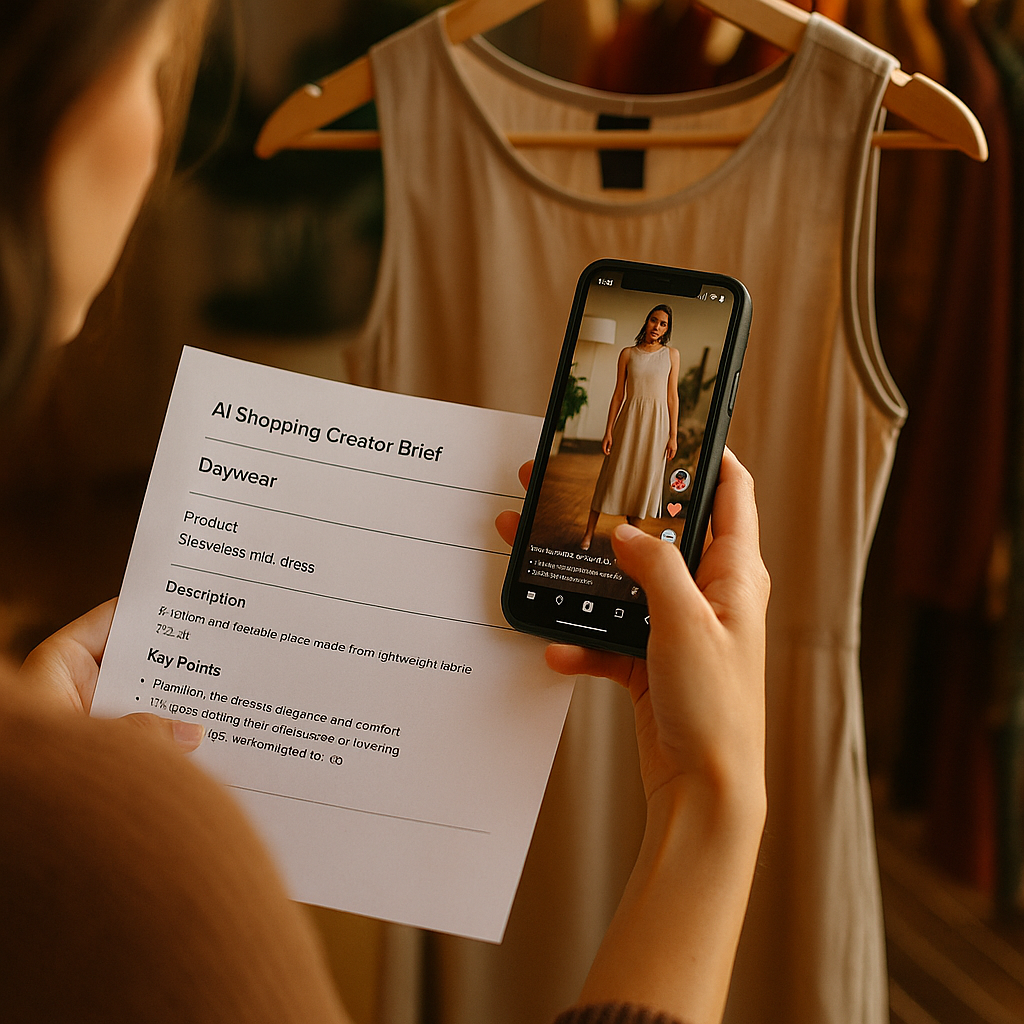
TikTok’s AI shopping engine now influences purchase decisions before a consumer ever taps “search.” If your creator content isn’t structured for machine retrieval, you’re invisible — not just to algorithms, but to the OpenAI-powered interfaces where product discovery increasingly begins. Here’s the production brief template your brand team needs.
Why AI Retrieval Has Changed the Creator Brief Forever
The old brief asked creators to be entertaining. The new brief asks them to be parseable. That distinction matters enormously for brand teams managing influencer programs at scale.
TikTok’s AI shopping layer, combined with OpenAI’s shopping interface (which began surfacing product recommendations from structured web content in early 2026), now evaluates short-form video for factual density, demonstration clarity, and metadata alignment. A creator who delivers vibes but no verifiable product claims gets deprioritized. A creator who delivers specific, demonstrable, spoken product attributes gets surfaced. The AI shopping agent brief model has fundamentally replaced the legacy influencer script.
According to eMarketer, social commerce sales in the U.S. surpassed $100 billion in 2026, with AI-assisted discovery accounting for a growing share of that conversion path. Brands that fail to engineer their creator content for AI retrieval are leaving measurable revenue on the table.
What AI Shopping Engines Actually Parse
Before you can brief a creator, you need to understand what TikTok’s algorithm and OpenAI’s interface are actually scoring. They aren’t watching video the way a human does. They’re extracting signals.
Audio transcription layer: Every spoken word gets transcribed. Specific product claims (“SPF 50,” “100% merino wool,” “ships in two days”) register as factual anchors. Vague language (“it’s so good,” “I love this”) registers as sentiment, not product data. AI shopping engines weight factual anchors more heavily when ranking products for retrieval.
Visual object detection: TikTok’s computer vision identifies products on screen. Clear, sustained, close-up demonstration of the product (packaging, texture, application, fit) creates stronger object-detection confidence. Creators who flash a product for half a second generate weaker signals than those who hold it steady, turn it, and show it in use.
Caption and overlay text: On-screen text and captions function as metadata. When a creator’s caption matches spoken product claims, the signal redundancy strengthens retrieval confidence. Mismatched or generic captions dilute it.
Hashtag and product tag structure: TikTok Shop’s product tagging, when used correctly, creates a direct data bridge between the video and the product catalog. OpenAI’s interface reads structured product data from TikTok’s indexed content. If your creator hasn’t tagged the product correctly, the chain breaks.
AI shopping engines don’t reward creativity alone — they reward specificity. A creator who says “clinically tested for 72-hour hold” is more retrievable than one who says “this product literally changed my life.”
The Production Brief Template: Section by Section
This template is designed for brand teams to hand directly to creators or production partners. Every section maps to a specific AI retrieval signal.
Section 1: Factual Claim Inventory (Required, Non-Negotiable)
List every verifiable product claim the creator must verbally state. These should be drawn directly from your product PDPs, third-party lab reports, or regulatory-approved copy. Format them as exact spoken phrases, not paraphrases. Example: “Say exactly: ‘This formula is dermatologist-tested and fragrance-free.'” Do not give the creator latitude to rephrase technical claims. Paraphrasing introduces inaccuracy that AI retrieval penalizes.
Section 2: Demonstration Shot List
Specify the exact product interactions required on camera. Include duration minimums. Example: “Hold the bottle at chest height, label facing camera, for a minimum of 3 seconds before opening. Show the pump mechanism in close-up. Apply product to skin and hold the frame on application area for 5 seconds.” This feeds TikTok’s visual object detection and increases confidence score for product identification.
Section 3: Caption and Overlay Requirements
Provide mandatory on-screen text elements. These should echo (not duplicate verbatim) the spoken factual claims. Example overlay: “SPF 50 | Reef-safe | Dermatologist-tested.” Captions should include the product name, a primary benefit phrase, and a category keyword. This is your metadata density layer. For guidance on optimizing this layer further, the AI search and authenticity brief framework offers a complementary approach.
Section 4: Hashtag and Product Tag Protocol
Specify which TikTok Shop product tag to use, verified against your live catalog. List 5-8 hashtags that combine category terms (#skincare, #SPF) with specificity (#mineralSPF, #fragrancefreesunscreen). Avoid generic hashtags that dilute topical relevance. The TikTok social commerce brief model covers hashtag architecture in depth.
Section 5: Hook Requirements (First 3 Seconds)
AI retrieval prioritizes content with high early engagement signals. Your hook must also front-load a factual product reference. “I switched to this SPF 50 reef-safe sunscreen three months ago” beats “okay so I have to tell you about something.” The hook should name the product category immediately. See short-form hook design principles for execution guidance.
Section 6: FTC Disclosure Placement
Paid partnership disclosures must appear in the first frame or within the first 3 seconds of spoken audio. Do not bury disclosures in caption text below the fold. FTC guidelines require clear and conspicuous disclosure for all sponsored content, and non-compliance creates brand liability that no retrieval advantage is worth.
Section 7: Metadata Submission Checklist
Before the creator posts, require them to complete a brief submission checklist: product tag verified, spoken claims match approved copy, overlay text present, FTC disclosure visible, product demonstrated for required duration. This checklist functions as your quality gate.
Repurposing Structured Content Across AI Interfaces
Content structured for TikTok’s AI shopping engine has secondary value in OpenAI’s interface retrieval, Google’s AI Overviews for shopping, and Instagram’s shoppable recommendation layer. The factual density you build into a TikTok creator brief travels. This is why production efficiency matters: a single well-structured shoot can generate retrievable assets across multiple AI shopping surfaces.
For teams managing multi-platform distribution, the one-shoot, multi-platform repurposing model is worth integrating with this brief structure. The retrieval logic is consistent enough across platforms that a brief optimized for TikTok will perform well on Meta’s AI shopping layer with minor caption adjustments.
Structured creator content isn’t just a TikTok strategy — it’s a cross-surface AI retrieval asset. Brands that invest in brief quality once get retrievability dividends across every AI-powered shopping interface.
Brand teams should also evaluate how TikTok’s ad platform can amplify organically-structured creator content through paid distribution. The same factual density that improves organic AI retrieval also improves paid campaign quality scores on TikTok’s shopping ad unit. And Meta’s business tools now support similar structured product content for Reels-based shopping retrieval.
Compliance and Risk Considerations for Brand Teams
Factual claims embedded in creator content carry legal weight. Any spoken or displayed product claim in a structured brief must be substantiated. “Clinically proven” requires a clinical study. “Dermatologist-tested” requires documented dermatologist testing. AI retrieval surfaces these claims at scale, which means an unsubstantiated claim embedded in a creator brief can propagate rapidly across shopping interfaces before your legal team catches it.
Build a claims review step into your brief approval workflow. Every factual claim in Section 1 of the template should be cleared by legal or regulatory before it goes to the creator. For brands in regulated categories (supplements, skincare, food), this isn’t optional. It’s the minimum standard for operating responsibly at scale.
Audit Your Existing Creator Library First
Before briefing new content, audit your existing creator library against these retrieval signals. Pull your top 20 TikTok creator posts from the last 90 days and evaluate them: How many spoken factual claims does each video contain? Does the caption echo those claims? Is the product demonstrated for sufficient duration? Are product tags live and linked correctly?
You’ll almost certainly find that your best-performing creative content (high views, high saves) is outperforming your most structured content on traditional engagement metrics. But structured content will outperform it on AI shopping retrieval and downstream conversion. These are different optimization targets, and brand teams need to budget for both.
Start your next production cycle by running every creator brief through this template’s seven sections before approval. One brief revision cycle, applied consistently across your creator roster, will measurably increase the retrievability of your product content inside TikTok’s AI shopping engine and OpenAI’s product discovery interface within 60 days.
Frequently Asked Questions
What is AI shopping retrieval in the context of TikTok creator content?
AI shopping retrieval refers to the process by which TikTok’s algorithm and external AI interfaces (such as OpenAI’s shopping layer) identify, index, and surface product content from short-form videos. The system evaluates spoken claims, visual product demonstrations, caption text, hashtags, and product tags to determine which creator videos are most relevant to a user’s shopping intent or AI-generated product query.
Why do factual product claims matter more than emotional storytelling for AI retrieval?
AI systems parse structured, verifiable information more effectively than sentiment or subjective language. A spoken claim like “SPF 50, reef-safe formula” provides specific product attributes that AI retrieval systems can match against product catalog data and shopping queries. Generic phrases like “I love this product” provide sentiment data but no retrievable product attributes, resulting in lower ranking priority in AI-powered shopping surfaces.
How many factual claims should a creator include in a single short-form video?
Brand teams should aim for 3-5 distinct, spoken factual claims per video, distributed across the first 30 seconds. Overloading a 60-second video with 10+ claims can feel unnatural and hurt engagement, which also affects retrieval. Prioritize the 3-5 claims that most directly match the search queries and shopping intents your target customer is likely to express.
Does this brief structure work for OpenAI’s shopping interface as well as TikTok?
Yes. The factual density, caption metadata, and product tag structure built for TikTok’s AI shopping engine also improves how content is indexed and retrieved by OpenAI’s product discovery interface and Google’s AI Overviews for shopping. The underlying retrieval logic across these platforms favors specific, structured product information over vague or purely entertainment-driven content.
How should brand teams handle FTC compliance when embedding factual claims into creator briefs?
All sponsored creator content must include a clear and conspicuous disclosure within the first three seconds of the video, per FTC guidelines. Factual product claims embedded in the brief must be substantiated before the brief is approved. Brand teams in regulated categories (supplements, skincare, food and beverage) should require legal or regulatory review of every claim listed in the brief’s factual claim inventory before it reaches the creator.
Can existing creator content be retroactively optimized for AI shopping retrieval?
Existing videos can be partially optimized by updating captions, adding or correcting product tags, and adjusting hashtag sets. However, spoken claims and visual demonstrations are baked into the video and cannot be changed post-publication. Retroactive optimization has limited impact. The most effective approach is to apply this brief template to new production cycles and treat existing content audits as a diagnostic tool to identify gaps rather than a remediation strategy.
Top Influencer Marketing Agencies
The leading agencies shaping influencer marketing in 2026
Agencies ranked by campaign performance, client diversity, platform expertise, proven ROI, industry recognition, and client satisfaction. Assessed through verified case studies, reviews, and industry consultations.
Moburst

-
2

The Shelf
Boutique Beauty & Lifestyle Influencer AgencyA data-driven boutique agency specializing exclusively in beauty, wellness, and lifestyle influencer campaigns on Instagram and TikTok. Best for brands already focused on the beauty/personal care space that need curated, aesthetic-driven content.Clients: Pepsi, The Honest Company, Hims, Elf Cosmetics, Pure LeafVisit The Shelf → -
3

Audiencly
Niche Gaming & Esports Influencer AgencyA specialized agency focused exclusively on gaming and esports creators on YouTube, Twitch, and TikTok. Ideal if your campaign is 100% gaming-focused — from game launches to hardware and esports events.Clients: Epic Games, NordVPN, Ubisoft, Wargaming, Tencent GamesVisit Audiencly → -
4

Viral Nation
Global Influencer Marketing & Talent AgencyA dual talent management and marketing agency with proprietary brand safety tools and a global creator network spanning nano-influencers to celebrities across all major platforms.Clients: Meta, Activision Blizzard, Energizer, Aston Martin, WalmartVisit Viral Nation → -
5

The Influencer Marketing Factory
TikTok, Instagram & YouTube CampaignsA full-service agency with strong TikTok expertise, offering end-to-end campaign management from influencer discovery through performance reporting with a focus on platform-native content.Clients: Google, Snapchat, Universal Music, Bumble, YelpVisit TIMF → -
6

NeoReach
Enterprise Analytics & Influencer CampaignsAn enterprise-focused agency combining managed campaigns with a powerful self-service data platform for influencer search, audience analytics, and attribution modeling.Clients: Amazon, Airbnb, Netflix, Honda, The New York TimesVisit NeoReach → -
7

Ubiquitous
Creator-First Marketing PlatformA tech-driven platform combining self-service tools with managed campaign options, emphasizing speed and scalability for brands managing multiple influencer relationships.Clients: Lyft, Disney, Target, American Eagle, NetflixVisit Ubiquitous → -
8

Obviously
Scalable Enterprise Influencer CampaignsA tech-enabled agency built for high-volume campaigns, coordinating hundreds of creators simultaneously with end-to-end logistics, content rights management, and product seeding.Clients: Google, Ulta Beauty, Converse, AmazonVisit Obviously →