


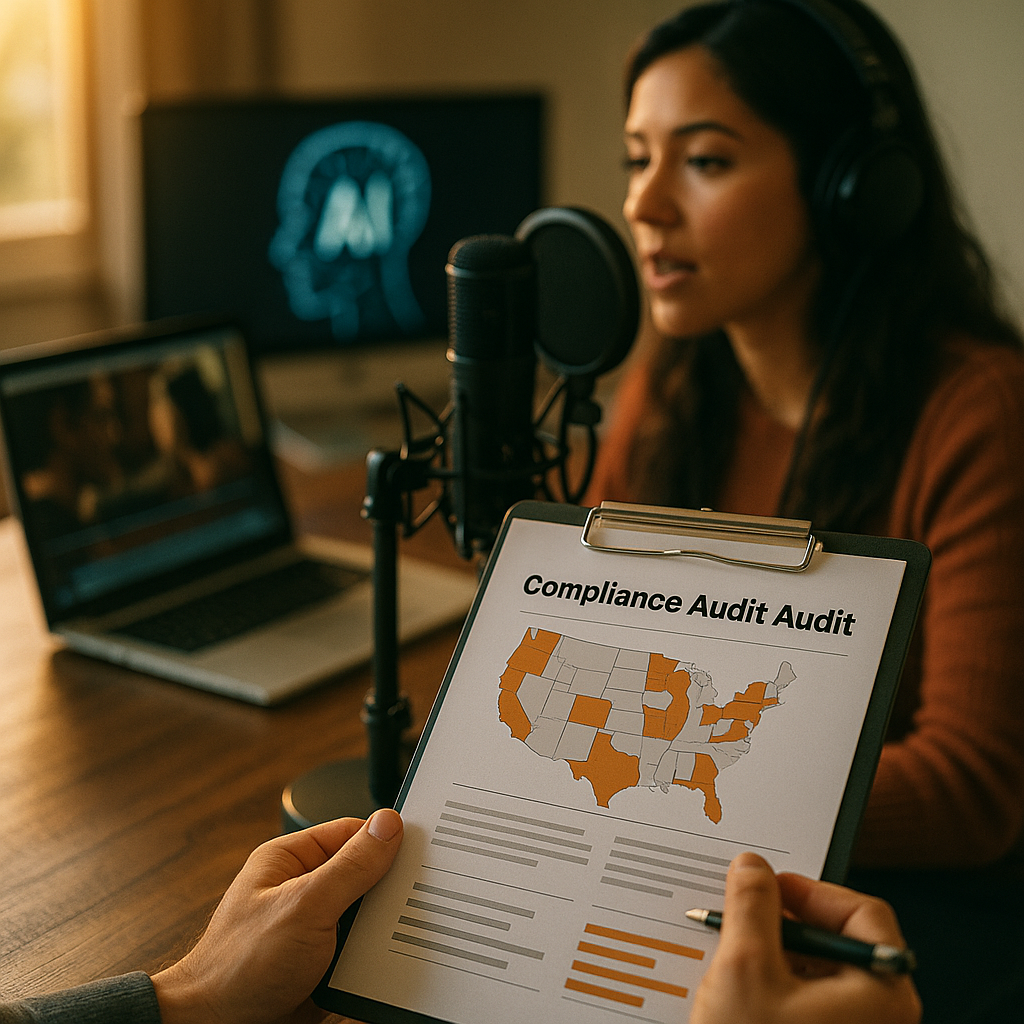
Fourteen states now have statutory right-of-publicity protections, and at least ten have active enforcement patterns targeting synthetic voice replication. If your brand is dubbing creator content into Spanish, Mandarin, or Portuguese using AI voice cloning, and you haven’t run a compliance audit for AI voice cloning against these statutes, you’re one demand letter away from a very expensive lesson.
Multilingual dubbing was supposed to be the easy win of the AI era. Clone a creator’s voice, feed it a translated script, ship the video to twelve markets by Friday. Marketing teams love the math: one shoot, ten languages, a fraction of the dubbing-studio cost. But the legal exposure scales just as fast as the production savings, and most brand compliance checklists still treat voice cloning like a technical workflow issue instead of a publicity-rights minefield.
Why Voice Cloning Isn’t Just a Music Industry Problem Anymore
Right-of-publicity law grew up protecting celebrities from unauthorized endorsements and misappropriated likeness. Tennessee’s ELVIS Act, passed in response to AI voice deepfakes, explicitly added “voice” as a protected attribute, not just name, image, and likeness. Other states followed suit or already had voice-inclusive statutes on the books. The result: a patchwork where a creator’s cloned voice, used in a dubbed ad without proper consent, can trigger statutory damages even if the underlying video content was fully licensed.
This matters because dubbing workflows often separate “video rights” from “voice rights” without anyone noticing. A brand licenses a creator’s video appearance for paid use, translates the script, and runs the audio through an AI voice clone trained on the creator’s original track. Nobody signed off on the *voice* being used to say words the creator never spoke, in a language they may not speak at all.
A signed content license does not automatically cover voice cloning rights. Treat video likeness and vocal likeness as two separate consent categories, because ten state statutes already do.
The Ten-State Snapshot: Where Voice Is Explicitly Protected
Right-of-publicity statutes vary wildly in scope, duration, and remedy structure. For multilingual dubbing programs, the states worth building your audit around include Tennessee, California, New York, Illinois, Washington, Kentucky, Indiana, Ohio, Texas, and Nevada. Each treats voice differently:
- Tennessee — The ELVIS Act names voice explicitly, covers algorithmic and synthetic replication, and applies regardless of whether the person is a public figure.
- California — Civil Code 3344 and common-law claims cover “voice” when it’s distinctive and widely recognized, with case law (the old Midler and Waits precedents) still shaping how courts view synthetic replication.
- New York — Civil Rights Law sections 50-51 were amended to address digital replicas, including post-mortem rights for deceased performers’ voices used in commercial content.
- Illinois — Right of publicity statute covers voice as part of “identity,” with a 50-year postmortem term, among the longest in the country.
- Washington — Broad statutory language treats voice alongside name and likeness, with commercial use triggering liability even for non-celebrities.
- Kentucky, Indiana, Ohio, Texas, Nevada — Each has publicity statutes that either name voice directly or have been interpreted by courts and regulators to include vocal likeness under “persona” or “identity” language.
The common thread: consent has to be specific to the *use*, not just the relationship. A creator agreeing to a brand deal doesn’t automatically agree to their voice being cloned, translated, and redeployed across markets they never discussed.
The Multilingual Wrinkle Nobody’s Contract Covers
Here’s where it gets genuinely tricky. Most influencer agreements were written for single-language, single-market use. When a brand takes a creator’s voice clone and generates dubbed versions in Korean, French, and Hindi, three new questions emerge that most legal teams haven’t priced in:
- Does the original consent cover derivative synthetic speech in languages the creator never recorded?
- Which state’s (or country’s) right-of-publicity law governs when the creator lives in one state, the brand is headquartered in another, and the dubbed content runs in a third market?
- Does the AI-dubbing vendor’s terms of service assign IP ownership of the cloned voice model to the brand, the creator, or the vendor itself?
Most contracts are silent on all three. That silence isn’t neutral, it’s exposure. For a deeper look at how sign-off chains should be structured, see this voice cloning sign-off matrix, which maps who needs to approve what before a cloned voice ever reaches production.
Building the Audit Framework
A real audit isn’t a legal memo nobody reads. It’s a repeatable checklist your production team runs before every dubbing project ships. Here’s the structure we recommend to brand compliance leads:
- Consent scope mapping — Does the creator agreement explicitly authorize voice cloning, synthetic dubbing, and multilingual derivative use? If it only says “likeness,” that’s not enough anymore.
- Jurisdiction stacking — Identify every state where the creator resides, where the brand operates, and where the content will run as paid media. Apply the strictest applicable statute, not the most convenient one.
- Vendor contract review — Confirm the AI dubbing platform’s terms assign no independent ownership or reuse rights over the voice model. Many platforms retain training rights by default unless you negotiate otherwise.
- Duration and post-termination use — Right-of-publicity claims often hinge on whether use continued after a contract ended. Set automatic model deletion or license expiration triggers.
- Disclosure layering — Dubbed content using AI voice cloning likely needs its own disclosure treatment, separate from standard sponsorship disclosure. The FTC’s stance on synthetic media disclosure is evolving fast, and multilingual audiences deserve the same transparency as domestic ones. Review the two-layer disclosure standard for how this stacks with existing endorsement rules.
Run this checklist per market, per language, per creator. Yes, it’s tedious. It’s also cheaper than a statutory damages claim in Illinois, where remedies can include actual damages, profits attributable to the unauthorized use, and attorney’s fees.
If your dubbing vendor can’t tell you where the voice model is stored, who can access it, and when it gets deleted, you don’t have a compliance program — you have a liability generator.
Where This Collides With Existing FTC and Synthetic Media Rules
Right-of-publicity statutes don’t operate in isolation. The FTC has been increasingly vocal about synthetic endorsers and AI-generated testimonials, and its guidance treats undisclosed synthetic voice use as a potential deceptive practice, separate from the publicity-rights question entirely. That means a single dubbed video can trigger two independent compliance failures: a state-law publicity claim from the creator, and a federal deception claim from the FTC if audiences aren’t told the voice is synthetic.
Brands running AI-enhanced creator content in regulated categories, finance, health, beauty, should already be layering these considerations. Our coverage of AI-enhanced disclosure in finance and health and the broader synthetic performer law collision with FTC rules both address how these two regulatory tracks interact. Voice cloning for dubbing sits squarely at that intersection, arguably with higher stakes because the audience hearing the “creator” speak fluent Portuguese has no reason to suspect it’s synthetic at all.
According to eMarketer, spending on AI-driven content localization has grown sharply as brands push into non-English-speaking markets through creator partnerships. That growth curve is exactly why regulators are paying attention now, not later. The FTC has signaled that synthetic media disclosure enforcement will intensify, and state attorneys general have shown willingness to pursue publicity-rights claims tied to AI voice replication even without a filed lawsuit from the creator themselves.
What Beauty and Consumer Brands Are Already Getting Wrong
Beauty and CPG brands lean hardest into multilingual dubbing because their creator content travels well across borders visually. A skincare routine doesn’t need much cultural translation, just language. That’s exactly why so many beauty marketing teams have quietly scaled voice-cloned dubbing without running it past legal.
The risk framework we outlined in synthetic creators in beauty applies directly here: once a brand normalizes synthetic voice replication for efficiency, it becomes organizational habit, not a one-off decision reviewed by counsel each time. Habits don’t get audited. Statutes get enforced.
There’s also a practical operations layer worth mentioning: contract templates matter as much as legal strategy. If your standard influencer agreement doesn’t already include voice-cloning consent language, timing restrictions, and revocation rights, start with the fundamentals covered in the influencer contract checklist before layering in state-specific publicity clauses.
What an Audit Actually Delivers
Done right, a compliance audit doesn’t just flag risk. It gives your team a defensible paper trail: dated consent records, jurisdiction analysis, vendor contract terms, and disclosure copy, all timestamped before content goes live. If a creator or their estate ever challenges a dubbed use, that paper trail is the difference between a quick settlement and a multi-year legal fight. Industry benchmarking from HubSpot and Sprout Social consistently shows that brands with documented compliance workflows resolve creator disputes faster and at lower cost than those improvising case by case.
None of this requires slowing down localization strategy. It requires building the audit into the workflow, the same way legal review became standard for FTC disclosure years ago.
Next step: Pull every dubbing project currently in production, map each creator’s home state against the ten statutes above, and confirm your vendor contracts don’t grant independent reuse rights over the cloned voice model. If you can’t complete that mapping in an afternoon, your audit trail doesn’t exist yet, and that’s the actual risk.
FAQs
Does a standard influencer contract cover AI voice cloning for dubbing?
Usually not. Most agreements license “likeness” or “content” for specific uses, but voice cloning for multilingual dubbing is a distinct derivative use that courts and several state statutes treat separately from video likeness. You need explicit, itemized consent language covering synthetic voice replication and translated speech.
Which states currently have the strongest voice-specific right-of-publicity protections?
Tennessee’s ELVIS Act is the most explicit, naming voice directly and covering algorithmic replication. California, New York, Illinois, and Washington also have strong statutory or case-law protections that extend to distinctive or commercially recognizable voices.
Does disclosure solve the right-of-publicity problem?
No. Disclosure addresses FTC deception concerns around synthetic endorsers, but it does not substitute for consent under right-of-publicity statutes. A brand can disclose that a voice is AI-generated and still face a publicity claim if the creator never authorized the cloning in the first place.
What happens if the AI dubbing vendor retains rights to the voice model?
This creates a serious downstream liability. If the vendor’s terms allow reuse or retraining on the cloned voice, the brand may be indirectly enabling unauthorized use even after the campaign ends. Vendor contracts should explicitly restrict model retention, reuse, and third-party licensing.
How often should brands re-run this compliance audit?
At minimum, before every new dubbing project and any time a creator agreement, vendor platform, or target market changes. State right-of-publicity law is actively evolving, so an audit framework built even a year ago may already be outdated.
FAQs
Does a standard influencer contract cover AI voice cloning for dubbing?
Usually not. Most agreements license “likeness” or “content” for specific uses, but voice cloning for multilingual dubbing is a distinct derivative use that courts and several state statutes treat separately from video likeness. You need explicit, itemized consent language covering synthetic voice replication and translated speech.
Which states currently have the strongest voice-specific right-of-publicity protections?
Tennessee’s ELVIS Act is the most explicit, naming voice directly and covering algorithmic replication. California, New York, Illinois, and Washington also have strong statutory or case-law protections that extend to distinctive or commercially recognizable voices.
Does disclosure solve the right-of-publicity problem?
No. Disclosure addresses FTC deception concerns around synthetic endorsers, but it does not substitute for consent under right-of-publicity statutes. A brand can disclose that a voice is AI-generated and still face a publicity claim if the creator never authorized the cloning in the first place.
What happens if the AI dubbing vendor retains rights to the voice model?
This creates a serious downstream liability. If the vendor’s terms allow reuse or retraining on the cloned voice, the brand may be indirectly enabling unauthorized use even after the campaign ends. Vendor contracts should explicitly restrict model retention, reuse, and third-party licensing.
How often should brands re-run this compliance audit?
At minimum, before every new dubbing project and any time a creator agreement, vendor platform, or target market changes. State right-of-publicity law is actively evolving, so an audit framework built even a year ago may already be outdated.
Top Influencer Marketing Agencies
The leading agencies shaping influencer marketing in 2026
Agencies ranked by campaign performance, client diversity, platform expertise, proven ROI, industry recognition, and client satisfaction. Assessed through verified case studies, reviews, and industry consultations.
Moburst

-
2

The Shelf
Boutique Beauty & Lifestyle Influencer AgencyA data-driven boutique agency specializing exclusively in beauty, wellness, and lifestyle influencer campaigns on Instagram and TikTok. Best for brands already focused on the beauty/personal care space that need curated, aesthetic-driven content.Clients: Pepsi, The Honest Company, Hims, Elf Cosmetics, Pure LeafVisit The Shelf → -
3

Audiencly
Niche Gaming & Esports Influencer AgencyA specialized agency focused exclusively on gaming and esports creators on YouTube, Twitch, and TikTok. Ideal if your campaign is 100% gaming-focused — from game launches to hardware and esports events.Clients: Epic Games, NordVPN, Ubisoft, Wargaming, Tencent GamesVisit Audiencly → -
4

Viral Nation
Global Influencer Marketing & Talent AgencyA dual talent management and marketing agency with proprietary brand safety tools and a global creator network spanning nano-influencers to celebrities across all major platforms.Clients: Meta, Activision Blizzard, Energizer, Aston Martin, WalmartVisit Viral Nation → -
5

The Influencer Marketing Factory
TikTok, Instagram & YouTube CampaignsA full-service agency with strong TikTok expertise, offering end-to-end campaign management from influencer discovery through performance reporting with a focus on platform-native content.Clients: Google, Snapchat, Universal Music, Bumble, YelpVisit TIMF → -
6

NeoReach
Enterprise Analytics & Influencer CampaignsAn enterprise-focused agency combining managed campaigns with a powerful self-service data platform for influencer search, audience analytics, and attribution modeling.Clients: Amazon, Airbnb, Netflix, Honda, The New York TimesVisit NeoReach → -
7

Ubiquitous
Creator-First Marketing PlatformA tech-driven platform combining self-service tools with managed campaign options, emphasizing speed and scalability for brands managing multiple influencer relationships.Clients: Lyft, Disney, Target, American Eagle, NetflixVisit Ubiquitous → -
8

Obviously
Scalable Enterprise Influencer CampaignsA tech-enabled agency built for high-volume campaigns, coordinating hundreds of creators simultaneously with end-to-end logistics, content rights management, and product seeding.Clients: Google, Ulta Beauty, Converse, AmazonVisit Obviously →