


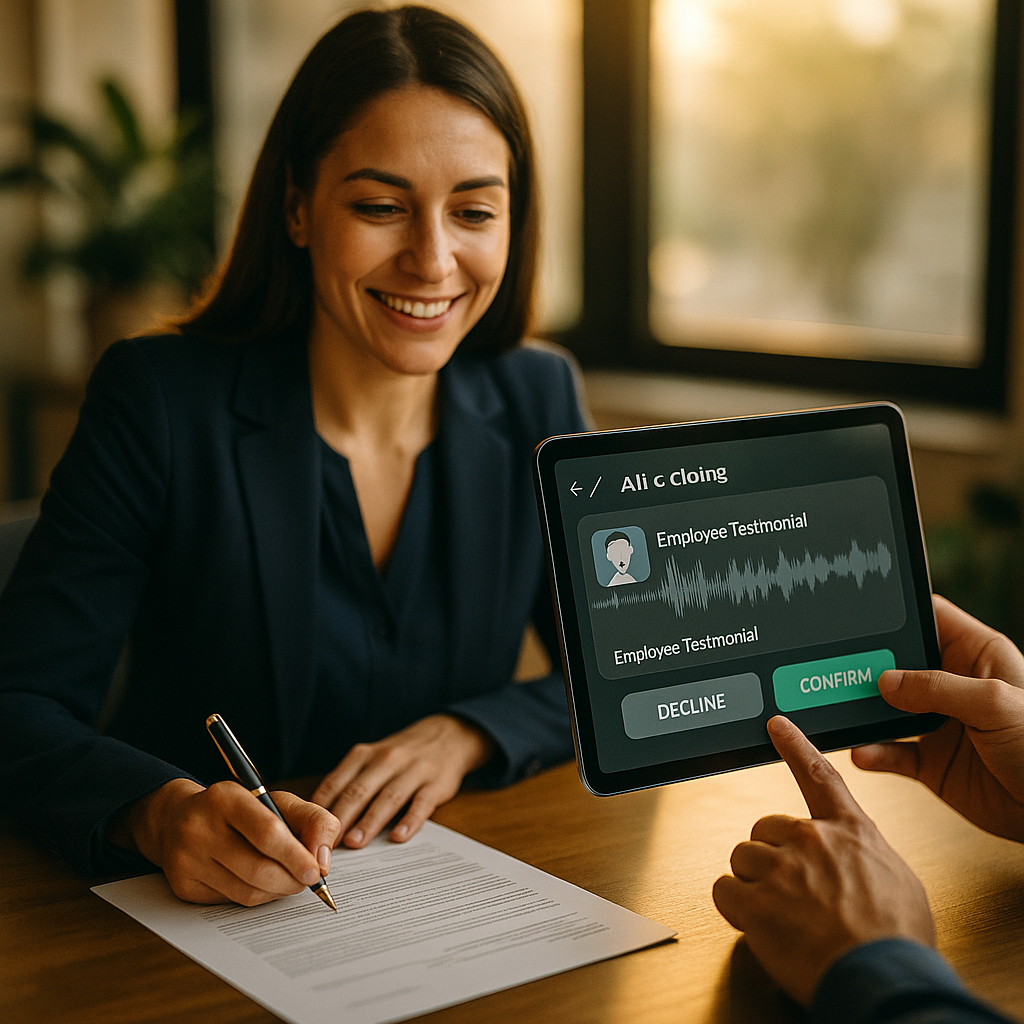
Sixty percent of employees say they’d rather quit than have their voice cloned without a real say in how it’s used, according to recent workplace trust surveys. Yet most internal advocacy programs still bury AI voice cloning consent in a single vague line inside the employer handbook. That’s not consent. That’s a liability waiting for an exit interview to turn into a lawsuit.
Employee advocacy is booming. Brands are turning staff into spokespeople, using AI to scale their voices across training videos, recruiting content, and internal comms. But when a company clones an employee’s voice to generate new lines they never actually said, the legal and reputational stakes look nothing like a standard release form. This is personal biometric data, tied to someone’s livelihood, often used long after they’ve left the company.
Why Employee Voice Cloning Isn’t the Same Risk as Creator Contracts
Brand teams have spent the last two years tightening influencer contracts around AI clauses. Good instinct, wrong template. Employee testimonials operate under a completely different power dynamic than creator partnerships.
A creator negotiates rates, has an agent, and can walk away without touching their paycheck. An employee signing a consent form during onboarding week is, functionally, agreeing under implied pressure. Refusing to sign might not get anyone fired outright, but it can quietly mark someone as “not a team player.” That imbalance means courts and regulators scrutinize employee consent far more closely than they do vendor consent.
Consent obtained under employment pressure is not the same as consent obtained in an arm’s-length commercial negotiation — and regulators are increasingly treating the two differently.
There’s also the biometric privacy angle. States like Illinois (BIPA), Texas, and Washington already regulate voiceprints as biometric identifiers, with statutory damages that make sloppy consent forms expensive fast. Add in New York’s expanding synthetic media rules, and you’ve got a compliance landscape that shifts depending on where your employee lives, not just where your company is headquartered. Brands already tracking this shift should review how synthetic performer law intersects with platform-level AI labeling requirements, because internal content doesn’t stay internal forever. Clips leak. Recruiting reels get reposted on LinkedIn. Once that happens, you’re suddenly dealing with external disclosure obligations too.
The Scope Problem: “Testimonial” Is Doing a Lot of Work
Ask ten legal teams what “testimonial use” means and you’ll get ten different answers. Does it cover a cloned voice reading a script the employee never wrote? Does it cover translating their testimonial into six languages using their voiceprint? What about generating a “composite” voice trained partly on their recordings and partly on others?
Vague scope is the single biggest failure point in employee AI consent language. If the consent form says “may use employee’s voice for internal communications,” that sentence alone won’t survive a dispute. It doesn’t define duration, doesn’t define derivative use, doesn’t address what happens when the employee leaves.
Structure consent around four scope variables, every time:
- Content type: training videos, recruiting content, town halls, external PR, social clips
- Distribution channel: internal LMS only, company intranet, external social, paid media
- Duration: a hard expiration date, tied to employment status or a fixed term
- Derivative rights: whether the cloned voice can generate net-new scripted lines versus reading only pre-approved text
Miss any one of these and you’ve written a consent form that looks thorough but leaves a gap big enough for a plaintiff’s attorney to drive a truck through.
What Happens When the Employee Leaves?
This is the question that trips up almost every internal advocacy program. A voice clone trained on an employee’s testimonial doesn’t expire when they hand in their resignation letter. If your consent language doesn’t explicitly terminate usage rights upon departure, you may retain a legal (if not ethical) claim to keep using their cloned voice indefinitely.
That’s a brand risk nightmare. Picture a former employee discovering, a year after leaving for a competitor, that your recruiting video still uses an AI version of their voice praising the company culture. Best case, it’s an awkward LinkedIn post. Worst case, it’s a lawsuit and a viral news cycle about your company “digitally enslaving” former staff. Neither outcome is hypothetical anymore; voice cloning controversies have already hit entertainment and media companies hard, and HR departments are next.
Build automatic termination triggers into the consent language itself:
- Consent expires automatically on the employee’s last day, unless a separate post-employment agreement is signed with additional compensation.
- Any existing cloned content featuring a departed employee gets pulled from active rotation within a defined window, say 30 days.
- The company retains no right to generate new synthetic content using that employee’s voiceprint after departure, full stop.
Some companies are experimenting with a “sunset and pay” model, similar to buyout clauses in entertainment contracts, where continued use post-departure requires ongoing compensation. It’s more complex to administer, but it removes the ambiguity that turns into litigation.
Revocation Rights Aren’t Optional Anymore
Regulators are converging on one principle: if you can consent to something, you need a real, accessible way to revoke it. Static consent forms signed once during onboarding don’t meet that bar in most emerging frameworks.
Build a revocation mechanism that’s actually usable, not one buried in a policy PDF nobody reads. That means:
- A named contact (not a general HR inbox) for consent revocation requests
- A defined response timeline, ideally under 10 business days
- Written confirmation once content has been pulled or the voiceprint deleted from active AI training sets
- No retaliation clause, stated explicitly, not just implied by company culture
This mirrors the direction the FTC has taken on endorsement and consent enforcement generally: consent that can’t be meaningfully withdrawn isn’t really consent. Brands that have already built revocation workflows for creator content, as covered in our piece on FTC script control risk, have a head start. The employee version just needs a lower bureaucratic barrier, since there’s no agent or manager acting as an intermediary.
Draft Language That Actually Holds Up
Generic legalese isn’t the goal here. Clear, specific language that an employee can actually understand in one read-through is what protects the company. Courts and regulators increasingly favor plain-language consent over dense legal boilerplate, especially in employment contexts where power imbalance is already a factor.
A workable consent clause structure looks something like this:
- Purpose statement: exactly what the voice clone will be used for, named specifically (e.g., “onboarding training modules distributed via internal LMS only”).
- Data handling disclosure: where the voice recording is stored, which vendor processes it, and whether it’s used to train any broader AI model beyond this specific use case.
- Opt-out mechanics: how and when the employee can revoke consent, with a named contact.
- Compensation terms: even a nominal stipend changes the legal character of the agreement and reduces coercion claims.
- Termination trigger: automatic expiration tied to employment status.
- Third-party restriction: explicit prohibition on sublicensing the voiceprint to external vendors, partners, or advertisers without separate written consent.
That last point matters more than most legal teams realize. If your AI voice vendor’s terms of service allow them to use client-submitted audio to improve their own models, you’ve just handed an employee’s biometric data to a third party without them knowing. This is the exact same failure pattern we’ve flagged in AI training-data consent clauses for influencer content: vendors quietly reserve broad training rights unless you negotiate them out explicitly.
Run every AI voice vendor contract through the same lens you’d apply to a data-sharing rider for external creator tools. If the vendor’s default terms don’t name your employee data explicitly as excluded from model training, assume it’s included.
Vendor Contracts Need Their Own Line Item
Don’t rely on your employee-facing consent form to also govern your vendor relationship. Those are two separate documents solving two separate problems. The vendor contract needs its own explicit clause stating that employee voiceprints cannot be used to improve the vendor’s underlying model, cannot be retained beyond the contract term, and must be deletable on request within a specific window.
Companies using platforms like HubSpot-integrated content tools or dedicated AI voice synthesis vendors should treat this the same way they’d treat a data processing agreement. Our breakdown on drafting a DPA for AI agents handling PII covers the same structural principles: name the data type, name the retention limit, name the deletion mechanism.
Where This Intersects With FTC and State Disclosure Rules
Internal advocacy content has a habit of going external. Someone shares the training video on LinkedIn. A recruiting reel gets pulled into a paid campaign. The moment that happens, you’re no longer just managing employment law risk, you’re managing endorsement disclosure risk too.
If an AI-cloned employee voice appears in anything resembling promotional content, disclosure obligations kick in just as they would for a paid creator. The FTC’s endorsement guidance doesn’t carve out an exception for staff. Review how this plays out in our analysis of FTC scripting risk, because the same “who controls the words” test applies to a cloned employee voice reading brand-approved talking points.
State-level synthetic media laws add another layer. If your internal-turned-external content lands in New York, it may trigger synthetic performer disclosure requirements separate from FTC rules entirely. Our piece on the gap between state law and platform AI labels is worth a full read if any employee-generated content has a plausible external distribution path, even an accidental one.
Practical fix: build a distribution firewall into the consent form itself. Explicitly state that content cannot move from internal-only channels to external or paid channels without a separate, additional consent and compensation agreement. This isn’t just a legal safeguard, it’s an operational tripwire that forces marketing and legal to have a conversation before a video goes live somewhere it was never meant to.
Building the Audit Trail
None of this matters if you can’t prove it happened. Every consent form, revocation request, and vendor data-handling confirmation needs to live somewhere retrievable, timestamped, and tied to a specific employee record.
Set up a simple internal register:
- Employee name and role
- Date consent signed, with version number of the consent language used
- Specific content pieces the voice clone appears in
- Compensation, if any
- Revocation status and date, if applicable
This isn’t bureaucratic overkill. It’s the same discipline brands apply to vendor concentration risk registers, just pointed inward instead of outward. When (not if) an employee, a regulator, or a plaintiff’s attorney asks “what exactly did this person agree to, and when,” you want an answer in minutes, not weeks of email archaeology.
Data from Statista shows AI-generated marketing content adoption climbing sharply year over year, and internal comms teams are following the same curve as external marketing. The compliance infrastructure needs to keep pace, or brands will keep finding out about gaps the expensive way: in a demand letter.
Get the consent language right once, and every future use case, recruiting, training, executive comms, inherits a clean foundation instead of a liability.
FAQs
Do employees need to be paid extra for AI voice cloning consent?
Not legally required in most jurisdictions, but nominal compensation strengthens the enforceability of consent and reduces claims of coercion. It also signals good faith, which matters if the arrangement is ever challenged.
Does employee voice cloning consent expire automatically?
Only if you build an expiration trigger into the language. Without one, many consent forms are read as open-ended, which creates risk once an employee leaves the company.
Can a brand reuse an employee’s cloned voice after they quit?
Generally, no, unless the original consent explicitly grants post-employment usage rights, often with additional compensation. Best practice is automatic termination of rights on the employee’s last day.
How is this different from consent required for influencer voice cloning?
Employee consent carries a higher coercion risk because of the employment relationship, so courts and regulators scrutinize it more closely than arm’s-length creator agreements. Employees also need simpler, more accessible revocation mechanisms.
What happens if internal AI content ends up on external platforms?
It triggers the same FTC endorsement disclosure obligations as any paid promotional content. Build a distribution firewall clause requiring separate consent before internal content moves to external or paid channels.
FAQs
Do employees need to be paid extra for AI voice cloning consent?
Not legally required in most jurisdictions, but nominal compensation strengthens the enforceability of consent and reduces claims of coercion. It also signals good faith, which matters if the arrangement is ever challenged.
Does employee voice cloning consent expire automatically?
Only if you build an expiration trigger into the language. Without one, many consent forms are read as open-ended, which creates risk once an employee leaves the company.
Can a brand reuse an employee’s cloned voice after they quit?
Generally, no, unless the original consent explicitly grants post-employment usage rights, often with additional compensation. Best practice is automatic termination of rights on the employee’s last day.
How is this different from consent required for influencer voice cloning?
Employee consent carries a higher coercion risk because of the employment relationship, so courts and regulators scrutinize it more closely than arm’s-length creator agreements. Employees also need simpler, more accessible revocation mechanisms.
What happens if internal AI content ends up on external platforms?
It triggers the same FTC endorsement disclosure obligations as any paid promotional content. Build a distribution firewall clause requiring separate consent before internal content moves to external or paid channels.
Top Influencer Marketing Agencies
The leading agencies shaping influencer marketing in 2026
Agencies ranked by campaign performance, client diversity, platform expertise, proven ROI, industry recognition, and client satisfaction. Assessed through verified case studies, reviews, and industry consultations.
Moburst

-
2

The Shelf
Boutique Beauty & Lifestyle Influencer AgencyA data-driven boutique agency specializing exclusively in beauty, wellness, and lifestyle influencer campaigns on Instagram and TikTok. Best for brands already focused on the beauty/personal care space that need curated, aesthetic-driven content.Clients: Pepsi, The Honest Company, Hims, Elf Cosmetics, Pure LeafVisit The Shelf → -
3

Audiencly
Niche Gaming & Esports Influencer AgencyA specialized agency focused exclusively on gaming and esports creators on YouTube, Twitch, and TikTok. Ideal if your campaign is 100% gaming-focused — from game launches to hardware and esports events.Clients: Epic Games, NordVPN, Ubisoft, Wargaming, Tencent GamesVisit Audiencly → -
4

Viral Nation
Global Influencer Marketing & Talent AgencyA dual talent management and marketing agency with proprietary brand safety tools and a global creator network spanning nano-influencers to celebrities across all major platforms.Clients: Meta, Activision Blizzard, Energizer, Aston Martin, WalmartVisit Viral Nation → -
5

The Influencer Marketing Factory
TikTok, Instagram & YouTube CampaignsA full-service agency with strong TikTok expertise, offering end-to-end campaign management from influencer discovery through performance reporting with a focus on platform-native content.Clients: Google, Snapchat, Universal Music, Bumble, YelpVisit TIMF → -
6

NeoReach
Enterprise Analytics & Influencer CampaignsAn enterprise-focused agency combining managed campaigns with a powerful self-service data platform for influencer search, audience analytics, and attribution modeling.Clients: Amazon, Airbnb, Netflix, Honda, The New York TimesVisit NeoReach → -
7

Ubiquitous
Creator-First Marketing PlatformA tech-driven platform combining self-service tools with managed campaign options, emphasizing speed and scalability for brands managing multiple influencer relationships.Clients: Lyft, Disney, Target, American Eagle, NetflixVisit Ubiquitous → -
8

Obviously
Scalable Enterprise Influencer CampaignsA tech-enabled agency built for high-volume campaigns, coordinating hundreds of creators simultaneously with end-to-end logistics, content rights management, and product seeding.Clients: Google, Ulta Beauty, Converse, AmazonVisit Obviously →