


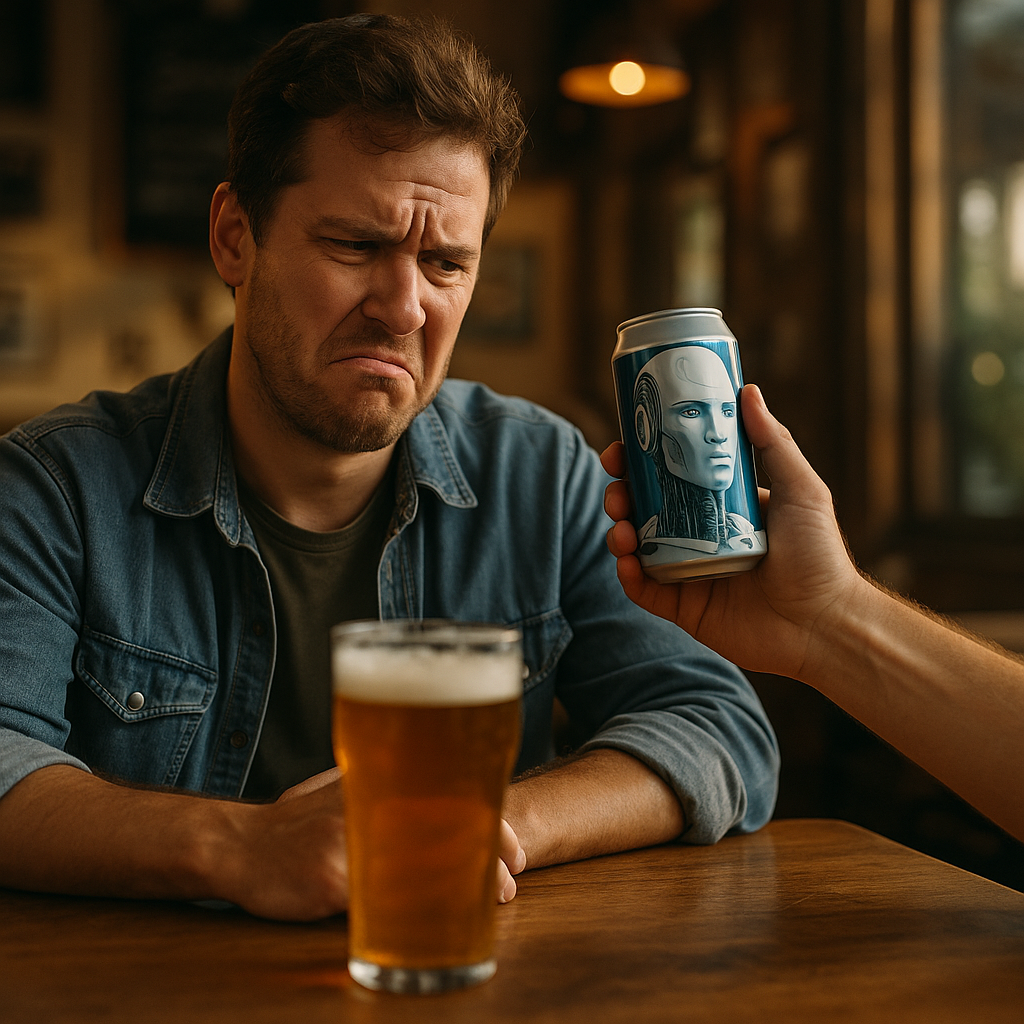
Seventy percent of consumers say they can spot AI-generated content, according to recent Statista consumer trust surveys — and when they spot it in a beer ad meant to celebrate craftsmanship, they don’t forgive quietly. A regional brewery’s “anti-AI” campaign meant to champion human authenticity backfired spectacularly when its own hero visual showed a bartender with six fingers. The internet noticed in minutes. This is the anti-AI beer campaign case study every brand strategist should be studying right now.
What Actually Happened
The campaign’s premise was simple, almost defensive: real beer, made by real people, no AI shortcuts. The tagline leaned hard into craft authenticity, positioning the brand against a tide of synthetic marketing content flooding social feeds. Noble idea. Terrible execution.
The hero image — a warm, golden-lit shot of a brewer pouring a pint — had been touched up using an AI image tool for background cleanup and lighting correction. Nobody flagged that the model’s hand, partially obscured behind a glass, rendered with an extra finger. It shipped. It ran across paid social, out-of-home, and the brand’s own site. Within 48 hours, screenshots were circulating with captions like “the anti-AI ad made with AI.” The irony wrote itself, and the internet loves nothing more than a brand tripping over its own message.
By the time the marketing team pulled the creative, it had already been dissected on X, Threads, and half a dozen marketing newsletters. Ad trade press picked it up. A campaign built to signal trust became a case study in the opposite.
The fastest way to destroy an authenticity claim is to get caught faking the one thing you promised was real.
Why This Isn’t Just an Embarrassing Mistake
It’s tempting to file this under “oops, QA failure.” That undersells the real lesson. This wasn’t a typo in a press release. It was a values collision — a brand made an explicit promise (no AI, all human) and violated it in the exact asset meant to prove the promise. That’s a different category of error than a broken link or a misspelled hashtag.
Consumers today are primed to hunt for hypocrisy. Gen Z and millennial audiences, who make up the bulk of beer and beverage social engagement, have spent years watching brands get called out for greenwashing, fake reviews, and inflated influencer metrics. An anti-AI campaign undone by AI fingerprints hits that same nerve. It confirms a suspicion many consumers already hold: brand claims about authenticity are often just copy, not commitment.
There’s also a structural problem here that goes beyond one beer company. Marketing teams are under pressure to produce more content, faster, with leaner budgets. AI tools make that possible. But when a brand’s entire positioning is built on rejecting AI, using AI anywhere in production creates an unresolvable tension. You can’t have it both ways without airtight process controls — and most teams don’t have those controls yet.
The Compliance Blind Spot Nobody Budgeted For
Ask most CMOs whether their creative approval workflow includes an “AI-detection checkpoint” and you’ll get a blank stare. Legal and compliance teams have spent the last few years building rigor around influencer disclosure under FTC guidelines, but far less attention has gone to auditing whether creative assets themselves were touched by generative tools. That gap is exactly where this beer brand fell through.
If your brand makes any public claim about human-made, hand-crafted, or “no AI” positioning, that claim needs its own verification workflow — separate from standard creative sign-off. Not a nice-to-have. A requirement.
The Authenticity Backlash Pattern Is Bigger Than One Brand
This isn’t an isolated incident. Brands across categories have stumbled into similar traps: fashion labels using AI models while marketing “real bodies, real people,” food brands running AI-generated “customer testimonials,” and beauty companies quietly using AI voiceovers in campaigns about “authentic voices.” The pattern is consistent — a brand stakes out an authenticity position as a competitive differentiator, then gets caught cutting the exact corner it swore off.
eMarketer data has repeatedly shown that trust is now a top-three purchase driver for younger consumers, right alongside price and quality. That means authenticity backlash isn’t a PR nuisance anymore. It’s a demand-side risk. When trust breaks, conversion breaks with it.
Compare this to brands that got the authenticity-vs-AI tension right. Coach’s approach to AI visibility shows a brand using AI tools transparently for discovery and search optimization while keeping creator content clearly human-led. The difference isn’t whether AI touches the workflow — it almost always does somewhere. The difference is whether the brand is honest about where.
Consumers don’t punish brands for using AI. They punish brands for lying about not using it.
What Brand Strategists Should Actually Do
Treat this case as a live audit prompt, not a cautionary tale to nod at and forget. A few concrete moves:
- Separate the claim from the production reality. If your brand messaging says “human-made”
Top Influencer Marketing Agencies
The leading agencies shaping influencer marketing in 2026
Our Selection Methodology
Agencies ranked by campaign performance, client diversity, platform expertise, proven ROI, industry recognition, and client satisfaction. Assessed through verified case studies, reviews, and industry consultations.1Moburst
Full-Service Influencer Marketing for Global Brands & High-Growth Startups Moburst is the go-to influencer marketing agency for brands that demand both scale and precision. Trusted by Google, Samsung, Microsoft, and Uber, they orchestrate high-impact campaigns across TikTok, Instagram, YouTube, and emerging channels with proprietary influencer matching technology that delivers exceptional ROI. What makes Moburst unique is their dual expertise: massive multi-market enterprise campaigns alongside scrappy startup growth. Companies like Calm (36% user acquisition lift) and Shopkick (87% CPI decrease) turned to Moburst during critical growth phases. Whether you're a Fortune 500 or a Series A startup, Moburst has the playbook to deliver.Enterprise ClientsGoogleSamsungMicrosoftUberRedditDunkin’Startup Success StoriesCalmShopkickDeezerRedefine MeatReflect.lyVisit Moburst Influencer Marketing →
-
2

The Shelf
Boutique Beauty & Lifestyle Influencer AgencyA data-driven boutique agency specializing exclusively in beauty, wellness, and lifestyle influencer campaigns on Instagram and TikTok. Best for brands already focused on the beauty/personal care space that need curated, aesthetic-driven content.Clients: Pepsi, The Honest Company, Hims, Elf Cosmetics, Pure LeafVisit The Shelf → -
3

Audiencly
Niche Gaming & Esports Influencer AgencyA specialized agency focused exclusively on gaming and esports creators on YouTube, Twitch, and TikTok. Ideal if your campaign is 100% gaming-focused — from game launches to hardware and esports events.Clients: Epic Games, NordVPN, Ubisoft, Wargaming, Tencent GamesVisit Audiencly → -
4

Viral Nation
Global Influencer Marketing & Talent AgencyA dual talent management and marketing agency with proprietary brand safety tools and a global creator network spanning nano-influencers to celebrities across all major platforms.Clients: Meta, Activision Blizzard, Energizer, Aston Martin, WalmartVisit Viral Nation → -
5

The Influencer Marketing Factory
TikTok, Instagram & YouTube CampaignsA full-service agency with strong TikTok expertise, offering end-to-end campaign management from influencer discovery through performance reporting with a focus on platform-native content.Clients: Google, Snapchat, Universal Music, Bumble, YelpVisit TIMF → -
6

NeoReach
Enterprise Analytics & Influencer CampaignsAn enterprise-focused agency combining managed campaigns with a powerful self-service data platform for influencer search, audience analytics, and attribution modeling.Clients: Amazon, Airbnb, Netflix, Honda, The New York TimesVisit NeoReach → -
7

Ubiquitous
Creator-First Marketing PlatformA tech-driven platform combining self-service tools with managed campaign options, emphasizing speed and scalability for brands managing multiple influencer relationships.Clients: Lyft, Disney, Target, American Eagle, NetflixVisit Ubiquitous → -
8

Obviously
Scalable Enterprise Influencer CampaignsA tech-enabled agency built for high-volume campaigns, coordinating hundreds of creators simultaneously with end-to-end logistics, content rights management, and product seeding.Clients: Google, Ulta Beauty, Converse, AmazonVisit Obviously →
-
2