


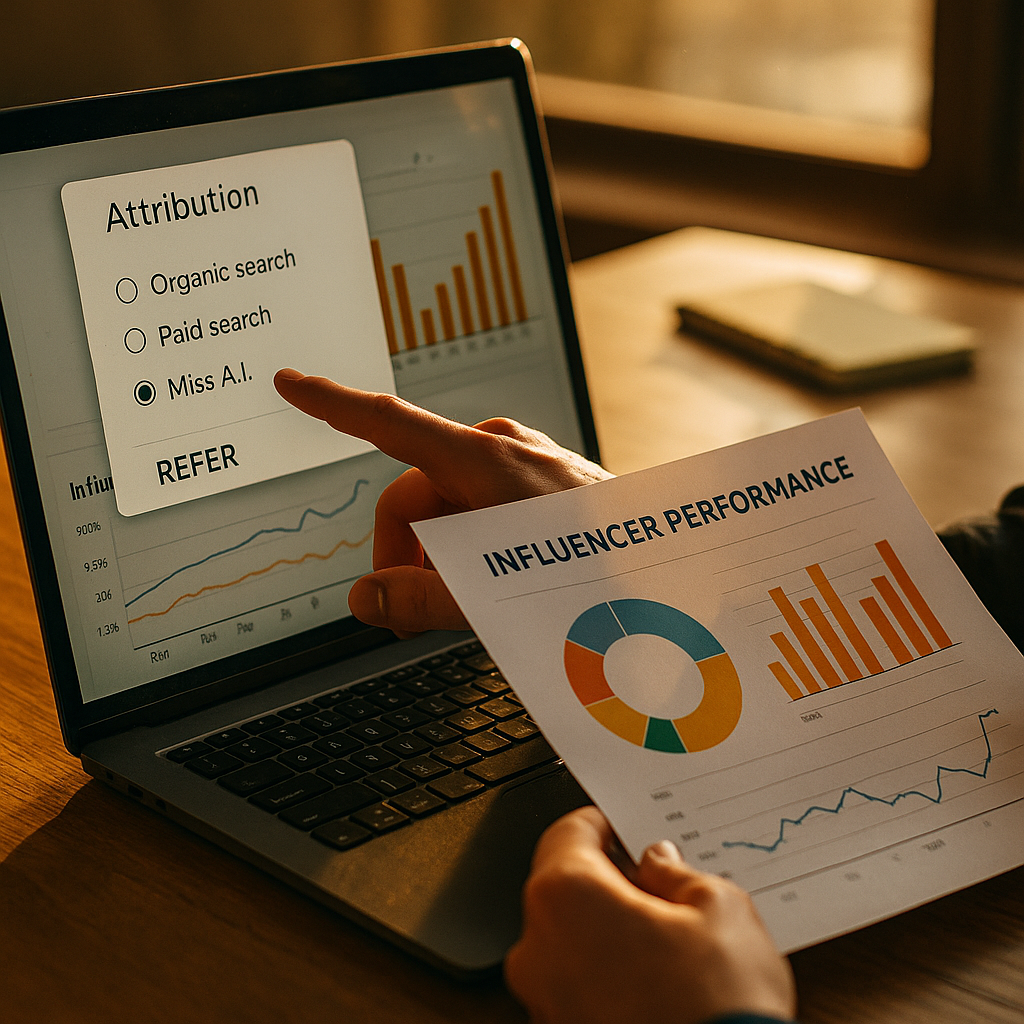
Nearly 60% of consumers now use ChatGPT, Gemini, or Perplexity to research purchases before they ever type a query into Google, according to recent eMarketer survey data. Yet walk through almost any brand’s “how did you hear about us” dropdown and you’ll find the same tired options: Google, Instagram, a friend, maybe TikTok if the form got an update this decade. Attribution forms have not caught up to the answer engine era, and that gap is quietly costing marketing teams the data they need to prove influencer and content ROI.
This isn’t a UX nitpick. It’s a measurement blind spot with budget consequences.
The Dropdown That Time Forgot
Most attribution forms were built for a world with three or four discovery channels. Search, social, referral, direct. That taxonomy made sense in 2018. It makes far less sense now that a meaningful share of purchase research happens inside a conversational AI interface that never shows up in a referrer string or a UTM parameter.
When a customer discovers your product because an AI assistant recommended it based on a creator’s review, that interaction leaves almost no digital fingerprint. No click, no session, no last-touch cookie. If your intake form or checkout survey doesn’t explicitly ask “did an AI assistant recommend this,” you’re forcing that customer into an ill-fitting bucket, usually “Google” or “other,” and your marketing mix modeling inherits the error.
If your attribution form doesn’t include an AI assistant option, every AI-influenced conversion gets misfiled as organic search, direct traffic, or noise, and your influencer program looks less effective than it actually is.
This matters most for brands running creator campaigns designed to seed content that AI models later cite. Teams already investing in AI shopping carousel placement are optimizing for a discovery path their own attribution tooling can’t see. That’s a resourcing problem waiting to happen when budget season arrives and someone asks why the AI content strategy shows no measurable lift.
Why “Other” Is Not an Answer
Some marketers assume a generic “other” field with a text box solves this. It doesn’t, practically speaking. Free-text fields have abysmal completion rates and even worse data quality. People type “idk,” “google I guess,” or leave it blank. You cannot build a reliable attribution model on write-in answers.
Compare that to a structured, mutually exclusive option like “AI assistant (ChatGPT, Gemini, Copilot, etc.)” sitting right next to “search engine” and “social media.” Structured options get selected. They get counted. They feed directly into a pivot table without a human reading through hundreds of free-text responses trying to bucket “chat gpt told me” under the right category.
This is a small form change with outsized downstream value, and it costs almost nothing to implement. Compare that to the multi-week engineering lift required for full server-side identity resolution, discussed in depth in this piece on creator attribution pipelines. The dropdown fix is the low-effort, high-leverage move most teams are skipping.
What Good Looks Like: Building the Question Right
Not every AI assistant option is created equal, and lumping them together loses valuable granularity. If you’re serious about tracking answer engine influence, consider a two-tier question structure.
- Tier one: “How did you first hear about [brand]?” with options including search engine, social media, AI assistant or chatbot, word of mouth, advertisement, and other.
- Tier two (conditional): If “AI assistant” is selected, follow up with “Which one?” listing ChatGPT, Gemini, Perplexity, Copilot, Claude, or other. This single follow-up question turns vague directional data into something your BI team can actually segment by platform.
Why does the second tier matter? Because different AI platforms cite content differently. Perplexity leans heavily on recent, well-sourced articles. ChatGPT’s browsing mode favors structured product pages and Reddit threads. If your form only says “AI assistant” without specifying which one, you lose the ability to correlate a spike in conversions with a specific optimization effort, like a creator brief refresh aimed at improving Gemini citations.
Place this question at checkout, in post-purchase email surveys, and in lead-gen forms for B2B services. Redundancy is fine here. The goal is capturing the signal wherever the customer is willing to give it.
Connecting the Form to the Bigger Attribution Picture
An updated dropdown answers “did AI influence this,” but it doesn’t answer “which piece of content, which creator, which brief.” That’s where the form data needs to feed into a broader system rather than sit in a spreadsheet nobody revisits.
Teams that have made progress here typically pair the self-reported form data with server-side citation tracking, similar to the approach outlined in building attribution models around AI citations instead of clicks. The form data acts as a directional sanity check. If citation tracking shows your product being referenced in AI answers 40% more often after a creator campaign, and your form data shows a parallel jump in “AI assistant” selections at checkout, you’ve got corroborating evidence strong enough to defend budget in a QBR.
Self-reported attribution data will never be perfectly precise, but directionally accurate data beats a complete blind spot every time budget conversations happen.
None of this works, though, if the underlying customer data feeding your matching and modeling tools is a mess. It’s worth remembering that only about 21% of CRM data is currently ready for AI-driven creator matching workflows. An AI assistant field on your attribution form is only as useful as the CRM architecture receiving and cleaning that data downstream. Run a basic CRM data readiness check before you assume the new field will slot in cleanly.
Compliance and Trust: A Quiet Side Benefit
There’s a secondary reason to formalize AI assistant attribution beyond measurement. Regulatory scrutiny of AI-influenced recommendations, especially in creator marketing, is increasing. The FTC has been explicit that disclosure obligations apply regardless of the discovery channel, and having documented attribution data showing how customers found sponsored content strengthens your compliance paper trail. Brands already using tools to flag disclosure risk, like those covered in this piece on AI compliance checkers, benefit from having attribution data that corroborates when and how a disclosure requirement was triggered.
It also builds internal trust with legal and finance teams. When you can say “we know exactly how many conversions this quarter were AI-assisted, and here’s the form data proving it,” you’re not guessing anymore. You’re reporting.
The Practical Rollout: Don’t Overthink It
You don’t need a six-month project plan to fix this. Here’s a realistic rollout sequence most marketing ops teams can execute within a sprint or two.
- Audit every existing attribution touchpoint: checkout surveys, lead forms, post-purchase emails, sales intake questionnaires.
- Add the structured AI assistant option (with the platform-specific follow-up) to each one.
- Update your CRM field mapping so the new response feeds cleanly into existing dashboards rather than sitting in an orphaned column.
- Set a quarterly review cadence to track the percentage of conversions citing AI assistants, and correlate spikes with specific creator or content initiatives.
- Loop findings back into brief creation, since grounded creator briefs perform better in AI citations than generic ones.
Tools like HubSpot and Sprout Social already support custom attribution fields, so this rarely requires new software spend. It’s a configuration change, not a platform migration.
Where This Goes Next
As ads inside AI assistants become more common, the line between “organic AI citation” and “paid AI placement” will blur further, and your attribution form will need to distinguish the two eventually. That’s a future iteration. For now, the immediate fix is simpler: give customers a way to tell you an AI assistant sent them, and actually count the answer.
The brands that update this now will have a full quarter, maybe two, of clean AI-attribution data before this becomes standard practice across the industry. That head start compounds. It shows up as sharper budget defense, more precise creator payouts tied to actual influence, and fewer arguments in the boardroom about whether the AI content strategy is “working.”
Frequently Asked Questions
Why don’t standard attribution forms already include an AI assistant option?
Most forms were built years before generative AI tools became a mainstream research channel, and few marketing ops teams have prioritized updating legacy dropdown fields since. It’s a maintenance gap, not a deliberate omission.
Should the AI assistant option be a single choice or broken down by platform?
A two-tier structure works best. Ask a broad question first (AI assistant versus search engine versus social media), then follow up with a platform-specific question if AI assistant is selected. This gives you both high-level and granular data.
How accurate is self-reported AI attribution data?
It’s directionally useful rather than perfectly precise, since customers may misremember or underreport. Pairing it with citation tracking and other quantitative signals gives a more reliable overall picture than either method alone.
Does adding this field require new martech tools?
Usually not. Most CRM and form platforms, including widely used marketing suites, already support custom fields and conditional logic. This is typically a configuration change rather than a new software purchase.
How does this connect to FTC disclosure compliance?
Documented attribution data showing how customers discovered sponsored content strengthens a brand’s compliance record and helps demonstrate when disclosure obligations were triggered, regardless of whether discovery happened via search, social, or an AI assistant.
Top Influencer Marketing Agencies
The leading agencies shaping influencer marketing in 2026
Agencies ranked by campaign performance, client diversity, platform expertise, proven ROI, industry recognition, and client satisfaction. Assessed through verified case studies, reviews, and industry consultations.
Moburst

-
2

The Shelf
Boutique Beauty & Lifestyle Influencer AgencyA data-driven boutique agency specializing exclusively in beauty, wellness, and lifestyle influencer campaigns on Instagram and TikTok. Best for brands already focused on the beauty/personal care space that need curated, aesthetic-driven content.Clients: Pepsi, The Honest Company, Hims, Elf Cosmetics, Pure LeafVisit The Shelf → -
3

Audiencly
Niche Gaming & Esports Influencer AgencyA specialized agency focused exclusively on gaming and esports creators on YouTube, Twitch, and TikTok. Ideal if your campaign is 100% gaming-focused — from game launches to hardware and esports events.Clients: Epic Games, NordVPN, Ubisoft, Wargaming, Tencent GamesVisit Audiencly → -
4

Viral Nation
Global Influencer Marketing & Talent AgencyA dual talent management and marketing agency with proprietary brand safety tools and a global creator network spanning nano-influencers to celebrities across all major platforms.Clients: Meta, Activision Blizzard, Energizer, Aston Martin, WalmartVisit Viral Nation → -
5

The Influencer Marketing Factory
TikTok, Instagram & YouTube CampaignsA full-service agency with strong TikTok expertise, offering end-to-end campaign management from influencer discovery through performance reporting with a focus on platform-native content.Clients: Google, Snapchat, Universal Music, Bumble, YelpVisit TIMF → -
6

NeoReach
Enterprise Analytics & Influencer CampaignsAn enterprise-focused agency combining managed campaigns with a powerful self-service data platform for influencer search, audience analytics, and attribution modeling.Clients: Amazon, Airbnb, Netflix, Honda, The New York TimesVisit NeoReach → -
7

Ubiquitous
Creator-First Marketing PlatformA tech-driven platform combining self-service tools with managed campaign options, emphasizing speed and scalability for brands managing multiple influencer relationships.Clients: Lyft, Disney, Target, American Eagle, NetflixVisit Ubiquitous → -
8

Obviously
Scalable Enterprise Influencer CampaignsA tech-enabled agency built for high-volume campaigns, coordinating hundreds of creators simultaneously with end-to-end logistics, content rights management, and product seeding.Clients: Google, Ulta Beauty, Converse, AmazonVisit Obviously →