


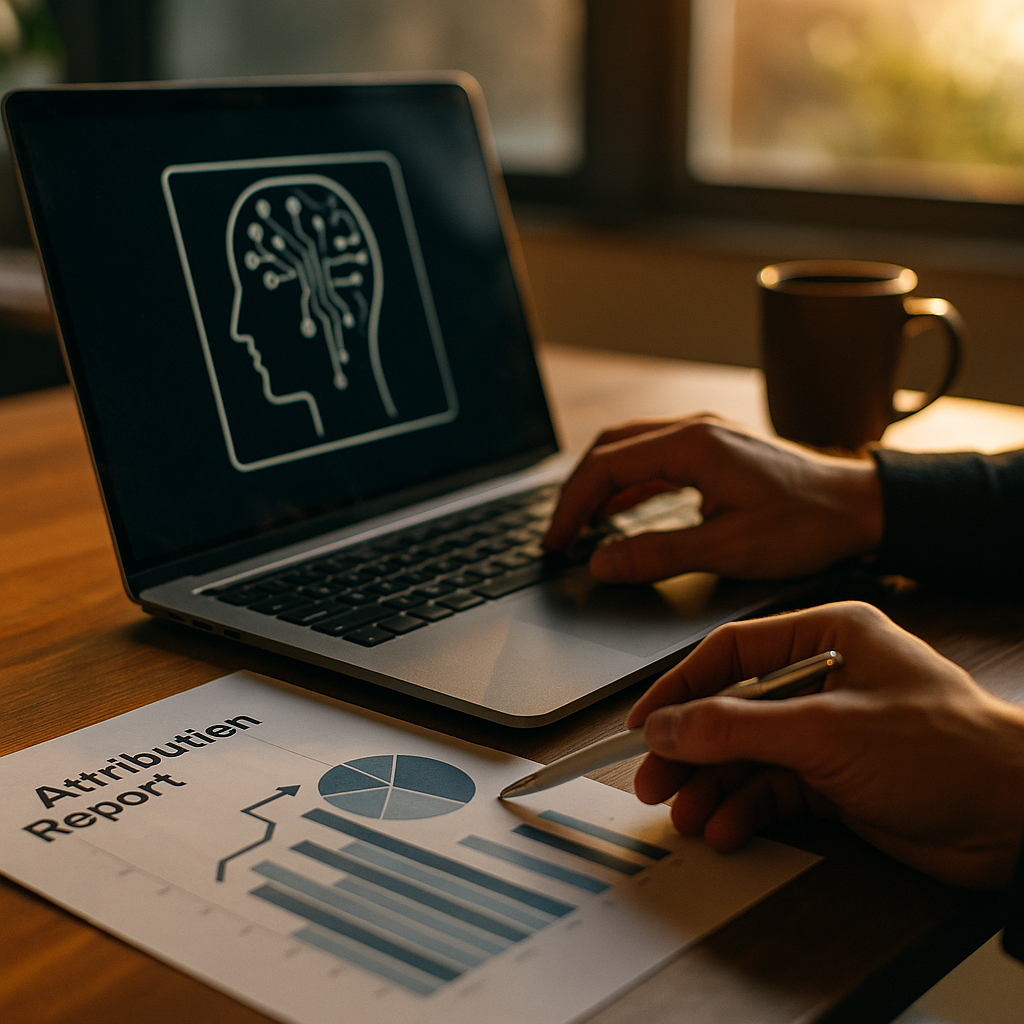
Zero. That’s how many clicks some of your highest-converting influencer campaigns might be generating right now, even as they drive real purchase intent. Consumers are asking ChatGPT, Perplexity, and Google AI Mode “what’s the best retinol serum” and acting on the answer without ever tapping a link. Attribution in influencer marketing was built for a world of trackable clicks. That world is quietly ending, and most measurement stacks haven’t caught up.
The Click Was Never the Whole Story, but Now It’s Barely Part of It
For a decade, influencer attribution meant UTM parameters, affiliate codes, and last-touch conversion windows. Imperfect, sure, but at least there was a trail. AI answer engines break that trail entirely. When a large language model synthesizes a recommendation from a dozen sources, including a creator’s review buried in a YouTube transcript or a Reddit thread quoting an influencer’s TikTok, the brand gets influence without a referral URL to prove it.
This is not a hypothetical edge case. eMarketer has tracked a steady climb in AI-assisted product research, and Google itself has confirmed that AI Overviews and AI Mode are reshaping how discovery happens before a user ever reaches a traditional results page. Consumers still convert. They just don’t click their way there anymore.
If your dashboard only counts what a pixel can see, you’re systematically undercounting the influence that’s actually moving your category conversation.
That undercounting has budget consequences. Finance teams cut what they can’t see. A creator partnership that’s quietly seeding the exact language an AI model repeats to shoppers looks, on paper, like a dud. Marketers who can’t explain that gap are the ones who lose next quarter’s influencer line item.
What Is an “AI Citation” and Why Should Brands Track It?
An AI citation happens when a generative engine, be it ChatGPT, Perplexity, Gemini, or Google’s AI Overviews, references, paraphrases, or links to content in its generated answer. Sometimes that’s a direct source link. More often, it’s an invisible ingestion: the model was trained or retrieval-augmented on content that included your creator’s claim, comparison, or product mention, and it surfaces that framing without attribution the user can see.
Brands should care because these citations function like the new “position zero.” A creator review that gets consistently pulled into AI answers is shaping purchase consideration for thousands of users who never see the original post. That’s influence at scale, happening in a black box.
Our earlier coverage of zero-click shopping strategies laid out why answer engine visibility now rivals SEO rankings in importance. Attribution has to catch up to that reality, not fight it.
Where Traditional Attribution Breaks Down
- No referral header: AI chat interfaces rarely pass referral data the way a browser click does, so server logs show a direct visit with no discernible source.
- Delayed conversion: A user might see an AI-cited recommendation on Monday and purchase in-store or on a different device Thursday, breaking any cookie-based window.
- Synthesized, not sourced, content: The model blends five creator opinions into one answer. Which creator gets credit? None, in a last-click model.
- Platform opacity: Most AI engines don’t publish citation logs or analytics dashboards for brands the way Google Search Console does for organic search.
This isn’t just an influencer marketing problem. It’s the same structural shift discussed in zero-click funnel rebuilding, where entire search strategies now have to plan for a discovery layer that never touches your owned properties.
Building an Attribution Model That Accounts for AI Influence
You can’t fully solve this with a single dashboard fix. But you can build a layered model that triangulates signal instead of chasing a single source of truth.
1. Brand lift and share-of-answer tracking. Tools that monitor how often your brand and specific product claims appear in AI-generated answers are emerging fast, similar to how rank trackers monitor SERP position. Run periodic prompt audits, ask the same category questions across ChatGPT, Perplexity, and Gemini, and log whether your creators’ language shows up in the response.
2. Server-side and modeled attribution. Because client-side tracking misses so much of this journey, server-side data collection paired with statistical modeling fills gaps that pixels can’t. This mirrors the approach outlined in server-side attribution and holdout testing, which builds finance-grade confidence without relying on a perfect click trail.
3. Holdout and geo-lift testing. If you can’t track the individual path, test the aggregate effect. Run a creator campaign in one region and withhold it in a matched control region. Compare organic search volume, direct traffic, and sales lift. This method doesn’t care whether the click happened in a browser or never happened at all.
4. First-party identity resolution. A durable identity graph tied to hashed emails or logged-in behavior lets you connect a delayed, cross-device conversion back to an earlier touchpoint, even when the middle of that journey ran through an AI chat interface. The framework in first-party identity graphs is directly applicable here.
The brands winning this transition aren’t chasing a perfect click. They’re building confidence intervals around influence, the same way finance teams have always modeled marketing mix.
Making Creator Content Machine-Readable Is Now an Attribution Strategy
Here’s the part most CMOs miss: attribution and discoverability are converging. If you want to measure AI citations, you first need your creator content to be structured in a way models can actually parse and re-cite consistently. That means clean product claims, consistent naming conventions, and schema markup on branded landing pages tied to creator campaigns.
This is the same discipline covered in machine-readable content audits, applied to influencer output instead of just owned media. When a creator’s review is structured cleanly, with clear product names, verified claims, and consistent phrasing, it becomes far easier for an AI model to cite it accurately, and far easier for your team to detect when that citation happens.
There’s a compliance layer too. Hallucinated product claims that get absorbed into AI training data and later regurgitated as fact are a growing legal exposure, something explored in RAG for creator briefs. Retrieval-augmented generation systems that ground creator content in verified product data reduce the odds that an AI model cites your creator saying something your legal team never approved.
What Should the Creator Brief Look Like Now?
Briefs need a new section: source-of-truth language. Give creators exact product specifications, approved claims, and preferred phrasing that’s likely to be lifted verbatim into AI-generated summaries. Vague, creative-only language might perform on TikTok but disappear into the noise when a model is synthesizing five competing product reviews into one answer. Specificity survives synthesis. Vagueness doesn’t.
Pair that with the affinity-based creator selection approach in AI affinity scores for creator matching, since creators whose existing content already ranks well in AI answers are more likely to get your new campaign cited too. Past citation performance is becoming a legitimate vetting criterion, right alongside engagement rate and audience quality.
Governance: Who Owns This Data, and Can You Prove It?
New measurement methods invite new risk. If you’re scraping AI outputs to monitor citations, or feeding creator content into third-party retrieval systems, someone needs to own the governance of that pipeline. Marketing teams building agentic workflows around this kind of monitoring should follow the same access control discipline detailed in role-based access controls for marketing AI, so that citation-tracking tools don’t become an ungoverned shadow IT problem.
There’s also a data quality risk. Attribution models built on AI citation signals are only as good as the underlying data feeding them. The finding that 45% of agentic AI marketing projects fail on bad data applies directly here. If your prompt-audit tooling or citation trackers are pulling from inconsistent or stale sources, you’ll draw the wrong conclusions about which creators are actually driving influence.
Finance and legal will ask two questions before signing off on any new attribution methodology: can you defend the number under audit, and does the data collection comply with privacy regulation? Get ahead of both. Document your modeling assumptions the way you would for any statistical attribution method, and review your data collection against guidance from the FTC on disclosure and endorsement, since AI-cited creator claims are still subject to the same truth-in-advertising rules as a standard sponsored post.
Practical Steps for the Next Quarter
- Run a baseline prompt audit across three major AI engines for your top ten category queries, and log which creators or competitors get cited.
- Add source-of-truth language requirements to every creator brief template.
- Pilot a geo-holdout test on one active influencer campaign to measure lift independent of click tracking.
- Loop in legal to review AI-citation monitoring tools for data handling compliance before scaling adoption.
- Report share-of-answer alongside engagement and click metrics in your next quarterly business review, even if the number is rough. Rough beats absent.
Platforms like Sprout Social and enterprise listening tools are beginning to build AI mention tracking into their roadmaps. Watch for it, and push your existing vendors for a timeline if they haven’t announced one yet.
FAQs
Frequently Asked Questions
What exactly counts as an AI citation in influencer marketing?
An AI citation occurs when a generative engine like ChatGPT, Gemini, or Perplexity references, paraphrases, or links to a creator’s content when generating an answer to a user’s query. This can be a visible source link or an invisible influence, where the model’s training or retrieval data included creator content that shaped its response.
Can brands actually measure AI citation attribution today?
Not with full precision. Most brands use a triangulation approach combining periodic prompt audits, server-side attribution modeling, geo-based holdout testing, and first-party identity resolution to estimate influence that traditional click tracking misses.
Why do clicks matter less than they used to for influencer ROI?
Because consumers increasingly get recommendations directly from AI chat interfaces without clicking through to a source, converting later on a different device or channel. Last-click and pixel-based attribution models were never designed to capture that kind of delayed, cross-device journey.
How does creator content need to change to perform well in AI-generated answers?
Creator briefs should include specific, verified product claims and consistent phrasing rather than vague creative language, since AI models are more likely to lift precise, well-structured claims when synthesizing multiple sources into one answer.
What compliance risks come with AI citation tracking?
Two main risks: privacy exposure if monitoring tools scrape or process user data improperly, and legal exposure if hallucinated or unverified creator claims get absorbed and repeated by AI models as fact, triggering endorsement disclosure and truth-in-advertising concerns.
Start small: run one prompt audit this week, pick your three most-cited competitors’ creators, and reverse-engineer why the models keep quoting them. That single exercise will tell you more about your attribution gap than another quarter of click-based reporting.
Top Influencer Marketing Agencies
The leading agencies shaping influencer marketing in 2026
Agencies ranked by campaign performance, client diversity, platform expertise, proven ROI, industry recognition, and client satisfaction. Assessed through verified case studies, reviews, and industry consultations.
Moburst

-
2

The Shelf
Boutique Beauty & Lifestyle Influencer AgencyA data-driven boutique agency specializing exclusively in beauty, wellness, and lifestyle influencer campaigns on Instagram and TikTok. Best for brands already focused on the beauty/personal care space that need curated, aesthetic-driven content.Clients: Pepsi, The Honest Company, Hims, Elf Cosmetics, Pure LeafVisit The Shelf → -
3

Audiencly
Niche Gaming & Esports Influencer AgencyA specialized agency focused exclusively on gaming and esports creators on YouTube, Twitch, and TikTok. Ideal if your campaign is 100% gaming-focused — from game launches to hardware and esports events.Clients: Epic Games, NordVPN, Ubisoft, Wargaming, Tencent GamesVisit Audiencly → -
4

Viral Nation
Global Influencer Marketing & Talent AgencyA dual talent management and marketing agency with proprietary brand safety tools and a global creator network spanning nano-influencers to celebrities across all major platforms.Clients: Meta, Activision Blizzard, Energizer, Aston Martin, WalmartVisit Viral Nation → -
5

The Influencer Marketing Factory
TikTok, Instagram & YouTube CampaignsA full-service agency with strong TikTok expertise, offering end-to-end campaign management from influencer discovery through performance reporting with a focus on platform-native content.Clients: Google, Snapchat, Universal Music, Bumble, YelpVisit TIMF → -
6

NeoReach
Enterprise Analytics & Influencer CampaignsAn enterprise-focused agency combining managed campaigns with a powerful self-service data platform for influencer search, audience analytics, and attribution modeling.Clients: Amazon, Airbnb, Netflix, Honda, The New York TimesVisit NeoReach → -
7

Ubiquitous
Creator-First Marketing PlatformA tech-driven platform combining self-service tools with managed campaign options, emphasizing speed and scalability for brands managing multiple influencer relationships.Clients: Lyft, Disney, Target, American Eagle, NetflixVisit Ubiquitous → -
8

Obviously
Scalable Enterprise Influencer CampaignsA tech-enabled agency built for high-volume campaigns, coordinating hundreds of creators simultaneously with end-to-end logistics, content rights management, and product seeding.Clients: Google, Ulta Beauty, Converse, AmazonVisit Obviously →