


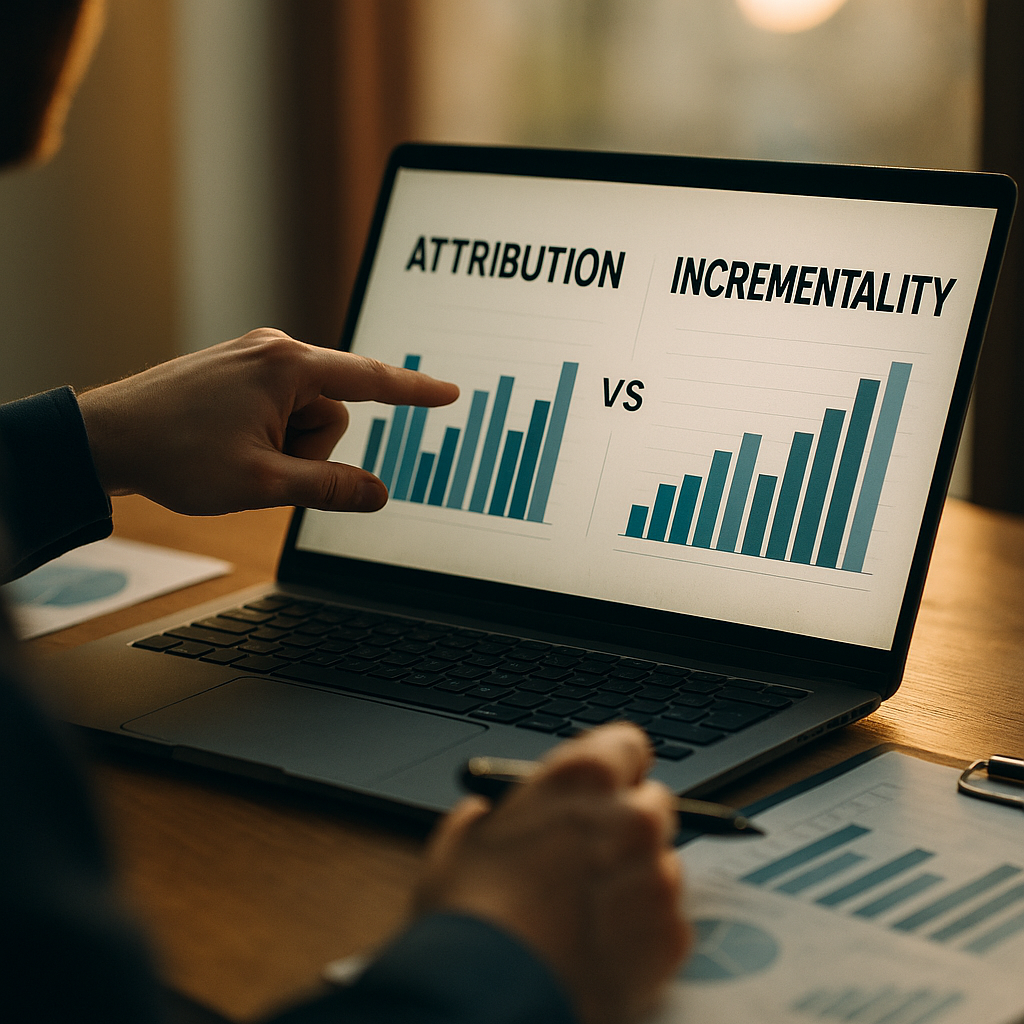
73% of marketers still can’t confidently tell their CFO which channel actually drove incremental revenue — they can only say which one touched it last. That gap is why attribution vs incrementality has become the defining measurement debate for teams running creator and paid media budgets simultaneously. Pick the wrong lens, and you’ll either overfund vanity-metric channels or kill programs that were quietly working.
Two Questions, Not One Answer
Attribution answers: who gets credit? Incrementality answers: what would have happened anyway? These are fundamentally different questions, and conflating them is how brands end up cutting a creator program that was driving 30% of net-new revenue because it “wasn’t converting” in the last-click dashboard.
Attribution models — first-touch, last-touch, linear, data-driven — assign credit across observed touchpoints. They’re descriptive. Incrementality testing, by contrast, is causal. It asks what happens in a world where the campaign didn’t run, usually via holdout groups, geo-lift tests, or matched-market experiments. One tells you a story about the customer journey. The other tells you what actually moved the needle.
The problem in 2026 isn’t that marketers don’t know this distinction exists. It’s that most measurement stacks still treat attribution as the primary decision-making tool, with incrementality bolted on as an occasional audit. That’s backwards for high-velocity creator spend, where platform-reported conversions and multi-touch models routinely overstate impact.
Attribution tells you what touched the sale. Incrementality tells you what caused it. Confusing the two is the single most expensive measurement mistake brands make with creator budgets.
Why Creator Media Breaks Traditional Attribution
Multi-touch attribution was built for a world of trackable clicks and consistent UTM hygiene. Creator content doesn’t play by those rules. A viewer sees a TikTok, doesn’t click, searches the brand three days later, then buys in-store. Attribution sees nothing. The sale gets credited to “direct” or organic search, and the creator who actually started the journey gets zero credit.
This is the well-documented “dark social” problem, and it’s gotten worse, not better, as platforms tighten data-sharing and users increasingly screenshot or share content off-platform entirely. Identity resolution helps close some of this gap — our identity resolution comparison shows how match rates vary wildly between end-to-end and DIY stacks — but no identity graph fully solves the influence-without-click problem inherent to creator content.
Platform-side attribution tools compound this. TikTok’s Symphony Agent and Meta’s ad platforms will happily report the conversions they can see, but they have obvious incentive to attribute generously to their own inventory. We’ve reviewed Symphony Agent’s claims directly and found the same pattern that shows up across walled gardens: self-reported attribution flatters the platform doing the reporting.
Where Incrementality Testing Actually Earns Its Keep
Incrementality testing solves the credit-assignment problem by sidestepping it entirely. Instead of tracing touchpoints, you hold out a matched audience or geography, run the campaign everywhere else, and measure the delta. No creator, no campaign — did sales still happen at roughly the same rate? If yes, your “winning” channel might be riding on demand that existed anyway.
Geo-lift tests are the most practical version for mid-market brands: pick comparable DMAs, run creator campaigns in half, hold the other half dark, and compare lift. It’s not perfect — seasonality, local competitor activity, and market size mismatches all introduce noise — but it’s far more honest than a last-click dashboard.
The catch? Incrementality testing is slow and resource-intensive. You can’t run a geo-lift test on every micro-influencer flight. Most brands run 4-6 incrementality studies a year on their largest spend categories, then use those findings to calibrate the attribution model they use day-to-day. That calibration step is the whole game.
Most brands don’t need to choose attribution or incrementality. They need incrementality testing on a quarterly cadence to keep their always-on attribution model honest.
Building the Hybrid Stack
A durable measurement stack in 2026 layers three components, each doing a job the others can’t:
- Always-on attribution for operational decisions — which creator gets rebooked next week, which ad set gets more budget tomorrow. Speed matters more than perfect causality here.
- Periodic incrementality tests to validate whether attributed results reflect real lift or just correlation. Run these on your top three to five spend categories, not everything.
- A reconciliation layer that adjusts attribution weightings based on incrementality findings. If geo-lift tests show your branded search spend is 80% incremental cannibalization of organic, discount that channel’s attributed credit going forward.
This is essentially what agentic attribution platforms are now trying to automate. We stress-tested one such platform in our review of LayerFive’s 90% accuracy claims, and the honest takeaway was that AI-driven reconciliation is promising but still requires human judgment on the incrementality side. No model, however sophisticated, replaces an actual holdout experiment.
For teams building this stack from scratch, the data infrastructure matters as much as the modeling. You need clean, real-time creator performance feeds to make attribution useful operationally — see our buyers guide on real-time data feeds for what “clean” actually requires. And if your CDP or warehouse can’t support running both attribution models and holdout-based experiments off the same underlying data, you’re building on sand. The CustomerLake vs. CDP comparison is a useful reference point for evaluating whether your current warehouse can actually support this.
What This Looks Like in Practice
Take a mid-size DTC skincare brand running both TikTok Shop affiliate content and Meta paid social. Attribution says TikTok drove 40% of last-touch conversions in Q3. A geo-lift test across matched DMAs, however, shows only about half of that TikTok-attributed revenue was genuinely incremental — the rest was demand that would have converted through search or direct anyway, just with TikTok in the touchpoint history because the creator posted right before a planned product restock.
That doesn’t mean kill the TikTok program. It means recalibrate the budget model: TikTok’s true incremental value is closer to 20% of conversions, not 40%, but it’s still a strong performer relative to spend. Without the lift test, that brand would have kept scaling TikTok budget based on inflated attribution numbers, and wondered a year later why the ROAS from paid social kept softening as they poured more dollars into a channel with diminishing incremental returns.
This is also where creator vetting quality matters more than people assume. Audience intelligence tools that verify real engagement, not follower inflation, reduce the noise you’re testing against in the first place — our piece on audience intelligence replacing follower vetting covers why this upstream quality check makes downstream measurement cleaner.
The Compliance Angle Nobody Talks About
There’s a risk-mitigation dimension here too. As privacy regulation tightens and platforms restrict third-party tracking, attribution models leaning on device-level tracking face growing legal exposure. The FTC and the ICO have both signaled increased scrutiny of ad tech data practices. Incrementality testing, built on aggregate geo or audience-level comparisons rather than individual tracking, is inherently more privacy-resilient. That’s not just a nice side benefit — it’s becoming a structural argument for weighting your measurement stack toward experimentation as identity-based tracking gets legally riskier.
Industry data backs the shift in priorities: eMarketer has tracked rising marketer investment in incrementality and media mix modeling as third-party cookie deprecation and platform data restrictions squeeze traditional attribution. This isn’t a fringe methodology anymore — it’s becoming table stakes for any brand serious about defending its media spend to finance.
How to Start This Quarter
You don’t need a data science team to begin. Start with one incrementality test on your largest creator spend category this quarter. Use it to sanity-check whatever attribution model you already run. If the numbers diverge wildly, that’s your signal for where to invest measurement resources next — not everywhere, just where the gap is biggest.
Frequently Asked Questions
What’s the main difference between attribution and incrementality?
Attribution assigns credit across observed touchpoints in a customer journey. Incrementality measures causal lift by comparing results with and without a campaign, typically through holdout or geo-lift tests. Attribution describes correlation; incrementality proves causation.
Can a brand rely on attribution alone for creator campaigns?
Not reliably. Creator content frequently drives influence without a trackable click, so attribution models undercount its impact or misattribute it to other channels. Incrementality testing catches what attribution misses, particularly for dark social and delayed-conversion behavior.
How often should brands run incrementality tests?
Most mid-market brands run four to six structured incrementality studies annually, focused on their highest-spend channels. Testing everything constantly isn’t practical; testing nothing leaves attribution numbers unchecked.
Are platform-reported attribution numbers trustworthy?
Treat them skeptically. Platforms have a built-in incentive to attribute conversions generously to their own inventory. Independent incrementality testing is the best check against inflated platform-reported performance.
Does incrementality testing work for small creator budgets?
It’s harder at small scale because geo-lift and holdout tests need sufficient volume to detect statistically meaningful lift. Smaller brands often pool incrementality testing across quarters or focus it only on their single largest spend category.
What data infrastructure is required to run both models?
You need clean, real-time performance feeds and a warehouse or CDP capable of supporting both attribution modeling and experiment-based holdout analysis on the same underlying dataset, without duplicative data pipelines.
The takeaway: stop treating attribution vs incrementality as a choice. Run attribution for daily decisions, run incrementality quarterly to calibrate it, and let the gap between the two tell you where your budget is actually working — not just where it looks like it is.
Frequently Asked Questions
What’s the main difference between attribution and incrementality?
Attribution assigns credit across observed touchpoints in a customer journey. Incrementality measures causal lift by comparing results with and without a campaign, typically through holdout or geo-lift tests. Attribution describes correlation; incrementality proves causation.
Can a brand rely on attribution alone for creator campaigns?
Not reliably. Creator content frequently drives influence without a trackable click, so attribution models undercount its impact or misattribute it to other channels. Incrementality testing catches what attribution misses, particularly for dark social and delayed-conversion behavior.
How often should brands run incrementality tests?
Most mid-market brands run four to six structured incrementality studies annually, focused on their highest-spend channels. Testing everything constantly isn’t practical; testing nothing leaves attribution numbers unchecked.
Are platform-reported attribution numbers trustworthy?
Treat them skeptically. Platforms have a built-in incentive to attribute conversions generously to their own inventory. Independent incrementality testing is the best check against inflated platform-reported performance.
Does incrementality testing work for small creator budgets?
It’s harder at small scale because geo-lift and holdout tests need sufficient volume to detect statistically meaningful lift. Smaller brands often pool incrementality testing across quarters or focus it only on their single largest spend category.
What data infrastructure is required to run both models?
You need clean, real-time performance feeds and a warehouse or CDP capable of supporting both attribution modeling and experiment-based holdout analysis on the same underlying dataset, without duplicative data pipelines.
Top Influencer Marketing Agencies
The leading agencies shaping influencer marketing in 2026
Agencies ranked by campaign performance, client diversity, platform expertise, proven ROI, industry recognition, and client satisfaction. Assessed through verified case studies, reviews, and industry consultations.
Moburst

-
2

The Shelf
Boutique Beauty & Lifestyle Influencer AgencyA data-driven boutique agency specializing exclusively in beauty, wellness, and lifestyle influencer campaigns on Instagram and TikTok. Best for brands already focused on the beauty/personal care space that need curated, aesthetic-driven content.Clients: Pepsi, The Honest Company, Hims, Elf Cosmetics, Pure LeafVisit The Shelf → -
3

Audiencly
Niche Gaming & Esports Influencer AgencyA specialized agency focused exclusively on gaming and esports creators on YouTube, Twitch, and TikTok. Ideal if your campaign is 100% gaming-focused — from game launches to hardware and esports events.Clients: Epic Games, NordVPN, Ubisoft, Wargaming, Tencent GamesVisit Audiencly → -
4

Viral Nation
Global Influencer Marketing & Talent AgencyA dual talent management and marketing agency with proprietary brand safety tools and a global creator network spanning nano-influencers to celebrities across all major platforms.Clients: Meta, Activision Blizzard, Energizer, Aston Martin, WalmartVisit Viral Nation → -
5

The Influencer Marketing Factory
TikTok, Instagram & YouTube CampaignsA full-service agency with strong TikTok expertise, offering end-to-end campaign management from influencer discovery through performance reporting with a focus on platform-native content.Clients: Google, Snapchat, Universal Music, Bumble, YelpVisit TIMF → -
6

NeoReach
Enterprise Analytics & Influencer CampaignsAn enterprise-focused agency combining managed campaigns with a powerful self-service data platform for influencer search, audience analytics, and attribution modeling.Clients: Amazon, Airbnb, Netflix, Honda, The New York TimesVisit NeoReach → -
7

Ubiquitous
Creator-First Marketing PlatformA tech-driven platform combining self-service tools with managed campaign options, emphasizing speed and scalability for brands managing multiple influencer relationships.Clients: Lyft, Disney, Target, American Eagle, NetflixVisit Ubiquitous → -
8

Obviously
Scalable Enterprise Influencer CampaignsA tech-enabled agency built for high-volume campaigns, coordinating hundreds of creators simultaneously with end-to-end logistics, content rights management, and product seeding.Clients: Google, Ulta Beauty, Converse, AmazonVisit Obviously →