


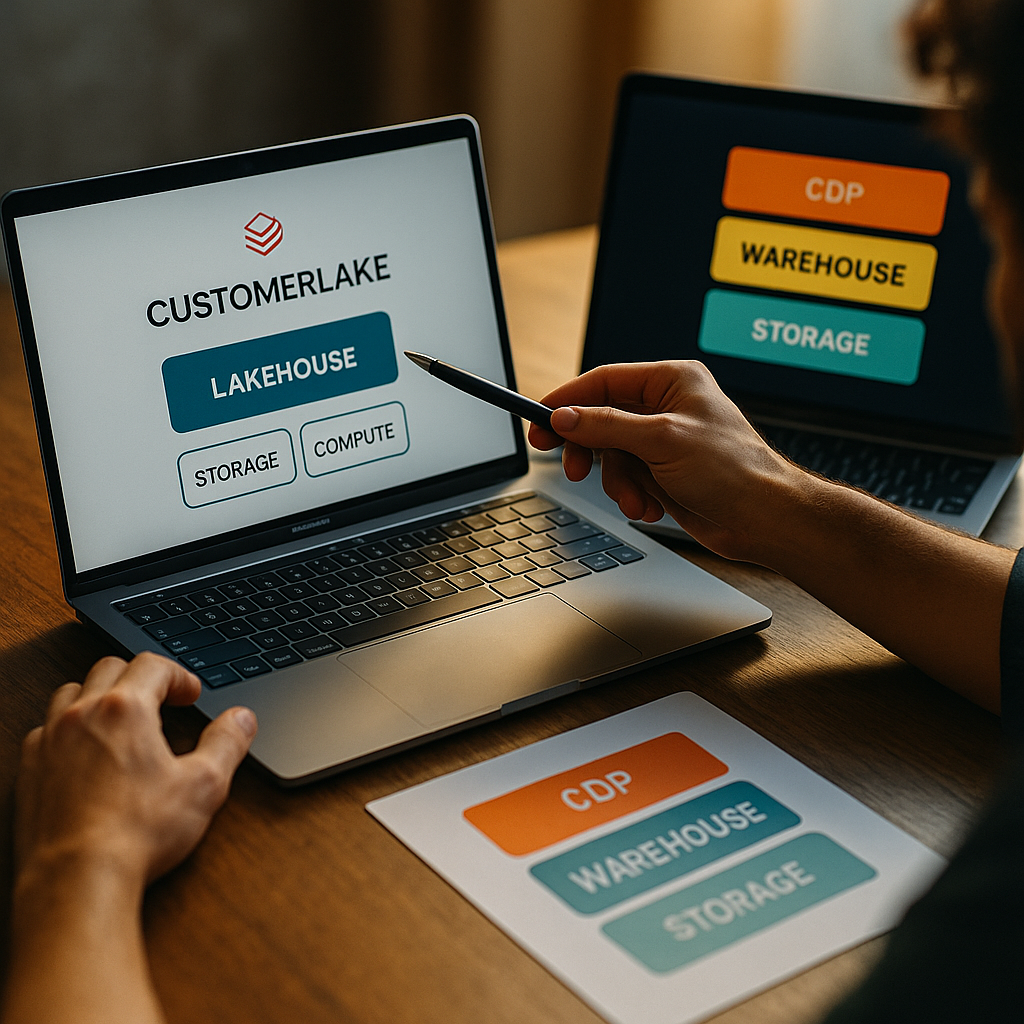
Gartner predicts that by 2027, most CDP vendors will have bolted “agentic” onto their pitch decks whether or not the architecture supports it. Databricks CustomerLake is the rare entrant making a technical case, not just a marketing one. But does building a CDP on top of a data lakehouse actually beat the traditional warehouse-plus-CDP stack marketers have relied on for a decade? The answer is more nuanced than either camp wants to admit.
What Databricks CustomerLake Actually Is
CustomerLake isn’t a standalone product bolted onto Databricks. It’s a set of governed data assets, identity resolution logic, and activation APIs built directly on the Databricks Lakehouse Platform, using Delta Lake as the storage layer and Unity Catalog for governance. In plain terms: your customer data never leaves the warehouse to live in a separate CDP silo. It stays in the lakehouse, and CustomerLake layers customer profiles, segments, and agentic workflows on top.
That’s the pitch, anyway. For brand marketers used to Segment, Tealium, or a traditional CDP sitting between the warehouse and the activation channels, this is a structural shift. No more shipping data out to a CDP, transforming it, then shipping segments back out to Meta or TikTok. Everything happens where the data already lives.
Why does this matter for agentic AI specifically? Agents need low-latency access to fresh, unified data to make decisions autonomously, whether that’s adjusting bid strategy or triggering a personalized offer. Round-tripping data between systems introduces lag and reconciliation risk. Keep it in one place, and agents theoretically get a cleaner, faster read.
The Traditional Warehouse-Plus-CDP Stack, Honestly Assessed
The composable approach, warehouse for storage, CDP for identity and activation, has dominated MarTech stacks for good reason. It lets teams pick best-in-breed tools. Snowflake or BigQuery for the data layer, Segment or mParticle for customer data unification, then activation tools downstream. This is the model most of our readers evaluated in our agentic CDP readiness comparison of Segment, Tealium, and mParticle.
The problem isn’t that this stack doesn’t work. It’s that it was designed for batch-oriented, human-in-the-loop marketing. Someone builds a segment, QAs it, pushes it to an ad platform, waits for results. Agentic workflows compress that cycle into seconds or minutes, and every hop between systems becomes a latency tax and a failure point.
Every data hop between warehouse, CDP, and activation channel adds latency and reconciliation risk. Agentic AI doesn’t tolerate the lag that human-reviewed campaigns absorbed for years.
There’s also the identity resolution problem. In our analysis of identity resolution match rates for end-to-end vs. DIY stacks, DIY compositions consistently lagged unified platforms by wide margins, sometimes over 20 points, as we detailed in a companion piece on why DIY stacks lag on identity match rates. If CustomerLake’s single-system approach genuinely reduces the number of joins and transformations needed to resolve identity, that’s not a minor efficiency gain. It’s a materially better foundation for any AI agent making targeting decisions.
Where the Lakehouse Model Wins on Paper
- Fewer data movement points. Eliminating ETL hops between warehouse and CDP reduces both latency and the surface area for data drift or PII leakage.
- Unified governance. Unity Catalog applies the same access controls and lineage tracking to customer profiles as it does to raw transaction data, simplifying compliance audits.
- Native ML/AI tooling. Because Databricks already hosts MLflow and its own model serving infrastructure, agentic workflows can query models and customer data without leaving the platform.
- Cost consolidation. One platform bill instead of warehouse fees plus CDP licensing plus reverse-ETL tooling (think Fivetran, Census, or Hightouch).
That last point deserves emphasis for anyone running procurement conversations this year. Composable stacks have real hidden costs: reverse-ETL subscriptions, engineering time to maintain pipelines, and the inevitable data quality tickets when a schema change upstream breaks a downstream segment. Consolidation isn’t just architecturally cleaner, it’s a real line-item reduction.
Where It Falls Short, or at Least Isn’t Proven Yet
Here’s the part vendor briefings tend to skip. CustomerLake is young relative to Segment or Tealium, both of which have years of production hardening across thousands of brands. Databricks is strong at data engineering and ML; it has historically been weaker at the marketer-facing UX layer, journey builders, and pre-built activation connectors that CDPs perfected.
If your team needs a marketer to build an audience segment without writing SQL or waiting on a data engineer, check whether CustomerLake’s interface actually delivers that self-service experience, or whether it still requires technical intervention for anything beyond basic filters. Ask vendors directly: how many clicks, and how much SQL knowledge, does a non-technical campaign manager need to launch a new segment?
Activation connector breadth is another open question. Traditional CDPs maintain hundreds of pre-built integrations to ad platforms, email tools, and CRMs. Databricks’ partner ecosystem is growing but is not yet at parity. Before switching, get a written list of native connectors to your specific stack, TikTok Ads, Meta, Klaviyo, Salesforce, whatever you run, and test them, don’t take the pitch deck’s word for it.
Latency and Real-Time Activation: The Numbers That Actually Matter
Agentic marketing lives or dies on how fast the system can act on a signal. According to eMarketer, real-time personalization initiatives increasingly hinge on sub-second data freshness rather than the hourly or daily batch updates that satisfied marketers a few years ago. That’s the bar CustomerLake and its competitors are being measured against.
Databricks’ architecture benefits from Delta Lake’s support for streaming ingestion, meaning customer events can, in theory, be available for query almost immediately rather than waiting for a nightly batch job. Traditional warehouses paired with CDPs can achieve similar streaming performance, Snowflake’s Snowpipe Streaming and BigQuery’s streaming inserts both exist for this reason, but it typically requires more custom engineering to stitch together than CustomerLake’s out-of-box claims.
Still, “can theoretically stream data” and “reliably powers autonomous agent decisions at scale in production” are different claims. If you’re evaluating CustomerLake for a real-time creator campaign use case, look at how it performs under our framework in real-time data feeds for creator campaigns. The buyer questions there, latency SLAs, failure recovery, data freshness guarantees, apply directly here too.
Governance and Compliance: The Underrated Battleground
Brand marketers underestimate how much governance complexity agentic systems introduce. When a human marketer builds a segment, there’s a review step. When an agent autonomously creates and activates a segment based on inferred signals, who’s accountable if it uses data it shouldn’t, say, health-adjacent inferences or protected-class proxies?
Unity Catalog’s fine-grained access controls give CustomerLake an edge here on paper: row-level and column-level security policies apply uniformly whether a human or an agent is querying. Traditional CDP-plus-warehouse stacks often have governance policies enforced inconsistently across systems, one policy in the warehouse, a different, looser one in the CDP’s activation layer.
This matters more than it sounds. The FTC has been explicit that automated decision-making doesn’t exempt companies from existing consumer protection and data privacy obligations. If your agentic CDP can’t produce a clean audit trail of what data an agent accessed and why, you have a compliance liability wearing an efficiency costume. Any procurement checklist for CustomerLake, or any competitor, should require a live demo of lineage tracking for an agent-initiated action, not a slide about it.
For teams weighing this decision alongside broader identity infrastructure, our comparison of CTV identity resolution vendors is a useful parallel exercise. Same governance questions, different channel.
Should You Migrate, Bolt On, or Wait?
Three honest paths exist right now, and the right one depends on where your stack already sits.
- Already on Databricks for data engineering? CustomerLake is a low-friction add-on worth piloting. You’re not introducing a new vendor relationship, just extending an existing one. Run a 90-day pilot against one campaign vertical before committing budget-wide.
- Running a composable stack that works? Don’t rip it out for architectural purity. Instead, benchmark CustomerLake against your current CDP on the specific metrics that matter: identity match rate, segment activation latency, and cost per managed customer record. If it doesn’t beat your incumbent by a meaningful margin, the migration cost isn’t justified.
- Evaluating your first real CDP investment? This is where CustomerLake’s pitch is most compelling, since you’re not fighting sunk cost. But weigh it against the broader debate in our composable stack vs. all-in-one suite guide, because lock-in risk cuts both ways.
One more consideration that gets glossed over: vector search capability. If your agentic use cases involve matching creator content, audience embeddings, or semantic search across unstructured data, Databricks has real advantages documented in our look at Pinecone vs. Databricks vector search for creator content. That’s a meaningful differentiator competitors haven’t matched yet, and it’s worth factoring into any CDP decision that touches creator matching or content intelligence.
According to Statista, enterprise spending on unified customer data infrastructure continues climbing year over year, which means the cost of getting this decision wrong compounds. Don’t let a slick demo substitute for a structured pilot with your actual data and your actual campaign use cases.
FAQs
Is Databricks CustomerLake a replacement for a traditional CDP?
It’s positioned as one, but functional parity varies by use case. CustomerLake handles identity resolution and governance well within the Databricks ecosystem, but marketer-facing tools like drag-and-drop journey builders and activation connector breadth are still maturing compared to established CDPs like Segment or Tealium.
Does CustomerLake require a full Databricks migration?
Yes, practically speaking. CustomerLake’s value comes from keeping customer data inside the Databricks Lakehouse rather than moving it to a separate system. If your data infrastructure isn’t already on Databricks, adopting CustomerLake means migrating your data layer first, which is a significant lift, not a quick add-on.
How does latency compare between CustomerLake and a warehouse-plus-CDP stack?
CustomerLake’s single-system architecture removes ETL hops that add latency in composable stacks. In theory this means faster segment activation for agentic use cases. In practice, well-engineered streaming pipelines on Snowflake or BigQuery paired with a modern CDP can achieve comparable freshness, though usually with more custom engineering.
What governance advantages does CustomerLake offer for compliance teams?
Unity Catalog applies consistent, fine-grained access controls and lineage tracking across all data, whether queried by a human marketer or an autonomous agent. This gives compliance teams a single audit trail rather than reconciling policies across separate warehouse and CDP systems.
Should brands with an existing CDP switch to CustomerLake?
Not without benchmarking it first. Run a direct comparison on identity match rate, activation latency, and cost per managed record against your incumbent CDP before committing to a migration. Architectural elegance isn’t a business case on its own.
FAQs
Is Databricks CustomerLake a replacement for a traditional CDP?
It’s positioned as one, but functional parity varies by use case. CustomerLake handles identity resolution and governance well within the Databricks ecosystem, but marketer-facing tools like drag-and-drop journey builders and activation connector breadth are still maturing compared to established CDPs like Segment or Tealium.
Does CustomerLake require a full Databricks migration?
Yes, practically speaking. CustomerLake’s value comes from keeping customer data inside the Databricks Lakehouse rather than moving it to a separate system. If your data infrastructure isn’t already on Databricks, adopting CustomerLake means migrating your data layer first, which is a significant lift, not a quick add-on.
How does latency compare between CustomerLake and a warehouse-plus-CDP stack?
CustomerLake’s single-system architecture removes ETL hops that add latency in composable stacks. In theory this means faster segment activation for agentic use cases. In practice, well-engineered streaming pipelines on Snowflake or BigQuery paired with a modern CDP can achieve comparable freshness, though usually with more custom engineering.
What governance advantages does CustomerLake offer for compliance teams?
Unity Catalog applies consistent, fine-grained access controls and lineage tracking across all data, whether queried by a human marketer or an autonomous agent. This gives compliance teams a single audit trail rather than reconciling policies across separate warehouse and CDP systems.
Should brands with an existing CDP switch to CustomerLake?
Not without benchmarking it first. Run a direct comparison on identity match rate, activation latency, and cost per managed record against your incumbent CDP before committing to a migration. Architectural elegance isn’t a business case on its own.
The technical case for CustomerLake is real, but it’s not a substitute for due diligence: pilot it against your incumbent stack on identity match rate and activation latency before you sign anything, and demand a live governance demo, not a slide.
Top Influencer Marketing Agencies
The leading agencies shaping influencer marketing in 2026
Agencies ranked by campaign performance, client diversity, platform expertise, proven ROI, industry recognition, and client satisfaction. Assessed through verified case studies, reviews, and industry consultations.
Moburst

-
2

The Shelf
Boutique Beauty & Lifestyle Influencer AgencyA data-driven boutique agency specializing exclusively in beauty, wellness, and lifestyle influencer campaigns on Instagram and TikTok. Best for brands already focused on the beauty/personal care space that need curated, aesthetic-driven content.Clients: Pepsi, The Honest Company, Hims, Elf Cosmetics, Pure LeafVisit The Shelf → -
3

Audiencly
Niche Gaming & Esports Influencer AgencyA specialized agency focused exclusively on gaming and esports creators on YouTube, Twitch, and TikTok. Ideal if your campaign is 100% gaming-focused — from game launches to hardware and esports events.Clients: Epic Games, NordVPN, Ubisoft, Wargaming, Tencent GamesVisit Audiencly → -
4

Viral Nation
Global Influencer Marketing & Talent AgencyA dual talent management and marketing agency with proprietary brand safety tools and a global creator network spanning nano-influencers to celebrities across all major platforms.Clients: Meta, Activision Blizzard, Energizer, Aston Martin, WalmartVisit Viral Nation → -
5

The Influencer Marketing Factory
TikTok, Instagram & YouTube CampaignsA full-service agency with strong TikTok expertise, offering end-to-end campaign management from influencer discovery through performance reporting with a focus on platform-native content.Clients: Google, Snapchat, Universal Music, Bumble, YelpVisit TIMF → -
6

NeoReach
Enterprise Analytics & Influencer CampaignsAn enterprise-focused agency combining managed campaigns with a powerful self-service data platform for influencer search, audience analytics, and attribution modeling.Clients: Amazon, Airbnb, Netflix, Honda, The New York TimesVisit NeoReach → -
7

Ubiquitous
Creator-First Marketing PlatformA tech-driven platform combining self-service tools with managed campaign options, emphasizing speed and scalability for brands managing multiple influencer relationships.Clients: Lyft, Disney, Target, American Eagle, NetflixVisit Ubiquitous → -
8

Obviously
Scalable Enterprise Influencer CampaignsA tech-enabled agency built for high-volume campaigns, coordinating hundreds of creators simultaneously with end-to-end logistics, content rights management, and product seeding.Clients: Google, Ulta Beauty, Converse, AmazonVisit Obviously →