


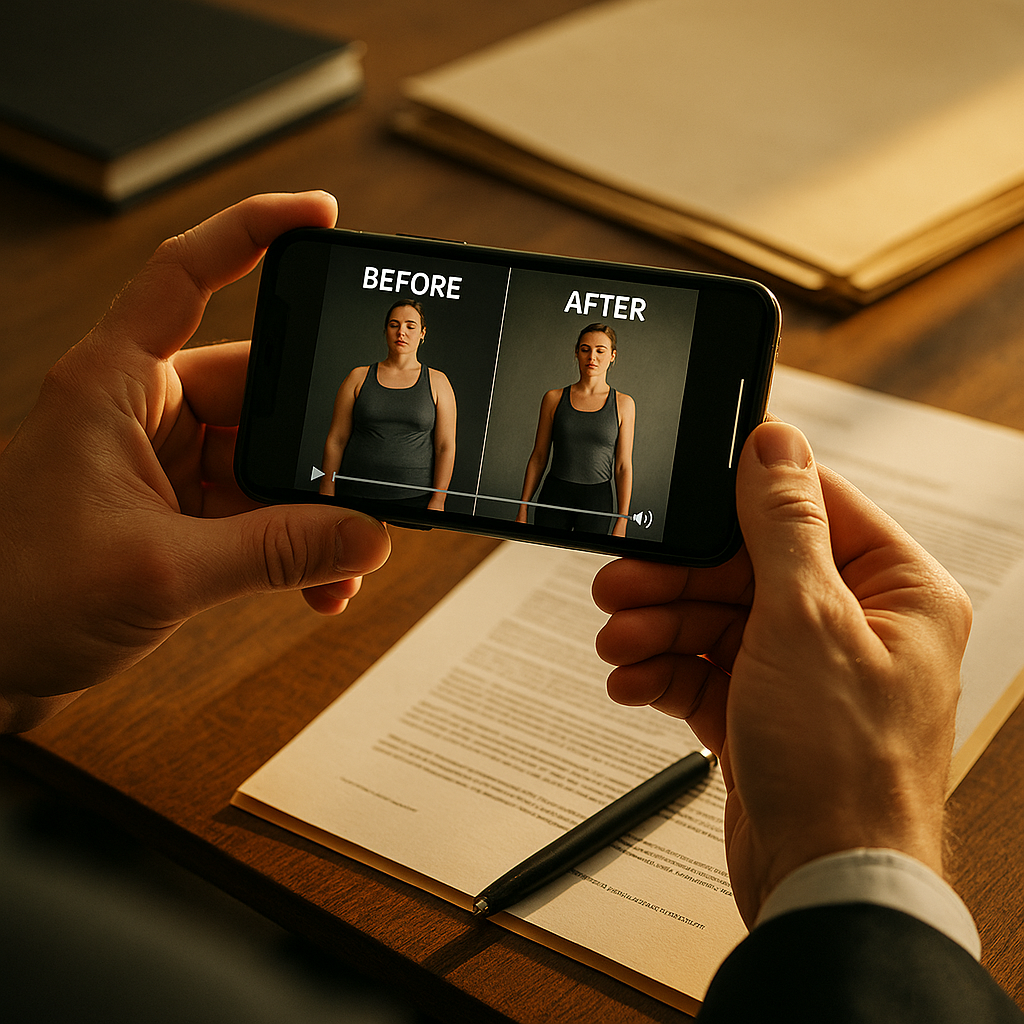
Nearly 700 enforcement letters went out from the FTC’s endorsement guidance sweep in recent years, and a disproportionate share targeted before and after content. Why? Because transformation reels are the single easiest format to make misleading, and the easiest to get caught doing it. If your brand runs before and after transformation reels without a compliance safe creative brief, you’re not building a content engine. You’re building a liability queue.
Why This Format Draws More Legal Heat Than Any Other
Skincare, fitness, supplements, teeth whitening, hair growth. These categories love the before and after arc because it’s the most persuasive structure in advertising: problem, product, proof. But that same persuasive power is exactly what regulators scrutinize hardest. A dramatic jawline transformation or a “30 day skin reset” isn’t just a creative choice, it’s a claim. And claims need substantiation.
The FTC has been explicit that testimonials showing atypical results without clear disclosure of what’s typical can constitute deceptive advertising, even if the creator genuinely experienced that outcome. That’s the trap most brands fall into. The content is technically honest, but the framing implies a guarantee nobody can back up.
A before and after reel that doesn’t disclose typicality isn’t a marketing asset, it’s a documented exposure to a false advertising claim waiting for a regulator or a class action attorney to notice.
What the Brief Has to Cover Before Anyone Films Anything
Most transformation content problems don’t start on set. They start with a brief that only covers vibe and timeline, not compliance. A legally sound brief for this format needs to spell out, in writing, before a single frame is shot:
- The exact claim being implied by the transformation (and whether you have data to support it)
- Required disclosure language and where it must appear in the video, not just the caption
- Whether the results shown are typical, exceptional, or paid-to-achieve, with that status stated on screen
- A prohibition on editing techniques (filters, lighting changes, angle tricks) that exaggerate the visual delta
- Approved and banned claim language, including words like “cure,” “guaranteed,” or “instant”
This isn’t legal theater. Brands running affiliate and creator programs at scale, especially in beauty and wellness, are increasingly asking their legal teams to sign off on briefs before creators are even booked. That single step catches most problems before they cost anything. For a deeper breakdown of the disclosure framework itself, our piece on before and after UGC walks through the specific FTC language brands need baked into contracts.
Script Structure That Passes Legal Review Without Killing the Hook
Compliance and creativity aren’t opposites, they just need to be sequenced correctly. The best-performing compliant scripts follow a pattern that still hits hard in the first three seconds:
- Hook with context, not just visual. “This took me 12 weeks and I still use retinol every night” beats a silent jump cut with no framing.
- State the disclosure verbally or in a persistent caption. Not a flash-frame disclaimer buried at second four. On-screen text that stays up for the full clip is the safer standard.
- Show the process, not just the bookend. A quick middle segment (even five seconds) showing consistent product use reduces the “instant miracle” implication that regulators flag hardest.
- Close with a grounded claim. “Results vary, this was my experience” is not a weak line, it’s the line that keeps the asset usable for the next two years.
Brands that have built entire libraries around this arc, including the teams behind our transformation reveal scripts guide, have found that disclosure baked into the hook actually performs better on watch time, because it reads as more credible, not less.
Disclosure Placement: Where Brands Keep Getting It Wrong
Caption-only disclosure is the most common failure point, and it’s an easy one to fix. Platforms like TikTok and Instagram truncate captions, bury them below the fold, or simply get scrolled past before the reader reaches the disclaimer at the bottom. The FTC’s endorsement guidance is clear that disclosures need to be “clear and conspicuous,” which in practice means on video, not just in text that requires a tap to expand.
Practical placement rules that hold up:
- On-screen text disclosure visible for the full duration of the before and after segment, not just the intro
- Verbal disclosure in the audio track if the creator is speaking, redundancy protects you
- Platform-native disclosure tools (TikTok’s Branded Content Toggle, Meta’s Paid Partnership label) used in addition to, not instead of, in-content disclosure
Regulators outside the US are tightening similarly. The ICO in the UK and equivalent bodies across the EU have signaled increased attention on influencer disclosure, so global brands can’t treat US-only compliance as sufficient if the content runs internationally.
Approval Workflow: Making Compliance Scale Without Slowing Everything Down
Here’s the operational reality nobody likes to admit: legal review is the bottleneck that kills creator program velocity. If every before and after reel needs a three-day legal turnaround, you’ll never keep pace with trend cycles. The fix isn’t skipping review, it’s front-loading it.
Build a pre-approved claim library once. Have legal sign off on a set of allowable language, disclosure formats, and visual guardrails as a template, not a per-post exercise. Creators and editors work inside that approved framework, and only genuinely novel claims escalate for individual review. This is the same principle brands use for fast-turnaround content that still needs legal sign-off without losing timeliness.
Pairing this with a locked hook framework helps too. Teams using a brand approved hooks system report far fewer revision cycles because creators are drawing from language that’s already cleared, rather than improvising claims on camera.
What This Actually Costs You If You Skip It
Compliance failures aren’t abstract. Removed content means wasted production spend, paused ad accounts mean lost pipeline, and FTC inquiries mean legal fees that dwarf whatever the campaign would have earned. Per HubSpot’s marketing benchmarks and industry reporting from Sprout Social, influencer and UGC spend continues climbing year over year, which means the exposure scales right alongside the budget. A brand running fifty transformation reels a month without a compliant brief isn’t running fifty pieces of content, it’s running fifty individual points of risk.
Platform enforcement compounds this. Meta’s advertising policies already restrict misleading before and after claims in regulated categories like health and beauty, meaning noncompliant creative can get an ad account flagged before a regulator ever sees it. That’s often the faster, more painful consequence brands overlook.
There’s a format proof point worth noting here too. Split screen and duet-style formats that let a second party validate the transformation in real time tend to read as more trustworthy to both audiences and reviewers, because the “proof” isn’t solely creator-controlled. Our breakdown of split screen reactions covers how that structure builds credibility without extra disclosure gymnastics.
Building the Checklist Into Your Creator Contract
Verbal agreements about disclosure don’t hold up when something goes wrong. Every before and after brief should have contract language attached that makes the creator contractually responsible for including required disclosures, using only approved claim language, and submitting drafts for review before publishing. Statista’s advertising data continues to show creator marketing as one of the fastest-growing line items in brand budgets, per Statista’s influencer marketing tracking, which means the contracts governing this content need to mature at the same pace as the spend.
None of this needs to slow your content calendar down once it’s built. The upfront work is a one-time cost. After that, it’s a repeatable system.
Next Step
Pull your last ten before and after posts and check disclosure placement against the on-screen, full-duration standard, not just the caption. If more than two fail, your brief needs a rewrite before your next shoot, not after your next regulatory letter.
Frequently Asked Questions
What makes a before and after reel noncompliant with FTC guidelines?
A reel becomes noncompliant when it implies typical or guaranteed results without disclosing that the outcome shown is atypical, when disclosure is buried in a caption instead of shown clearly in the video, or when editing exaggerates the visual difference beyond what the product actually delivered.
Where should disclosure appear in a transformation reel?
Disclosure should appear as persistent on-screen text visible for the duration of the before and after segment, ideally reinforced with verbal disclosure if the creator speaks, in addition to platform-native tools like Instagram’s Paid Partnership label or TikTok’s Branded Content Toggle.
Do brands or creators carry liability for noncompliant before and after content?
Both can be held liable. The FTC has pursued action against brands for creator content they sponsored, which is why contracts need explicit disclosure and claim language requirements rather than relying on informal creator judgment.
Can a compliant before and after reel still perform well?
Yes. Grounded language like “results vary” and visible process footage often increase perceived credibility and watch time rather than reducing it, because audiences are increasingly skeptical of unrealistic instant transformation claims.
How often should a brand update its transformation content brief?
Review the brief whenever platform disclosure policies change, whenever entering a new regulated category like health or finance, and at minimum once a year alongside a legal audit of existing live content.
Top Influencer Marketing Agencies
The leading agencies shaping influencer marketing in 2026
Agencies ranked by campaign performance, client diversity, platform expertise, proven ROI, industry recognition, and client satisfaction. Assessed through verified case studies, reviews, and industry consultations.
Moburst

-
2

The Shelf
Boutique Beauty & Lifestyle Influencer AgencyA data-driven boutique agency specializing exclusively in beauty, wellness, and lifestyle influencer campaigns on Instagram and TikTok. Best for brands already focused on the beauty/personal care space that need curated, aesthetic-driven content.Clients: Pepsi, The Honest Company, Hims, Elf Cosmetics, Pure LeafVisit The Shelf → -
3

Audiencly
Niche Gaming & Esports Influencer AgencyA specialized agency focused exclusively on gaming and esports creators on YouTube, Twitch, and TikTok. Ideal if your campaign is 100% gaming-focused — from game launches to hardware and esports events.Clients: Epic Games, NordVPN, Ubisoft, Wargaming, Tencent GamesVisit Audiencly → -
4

Viral Nation
Global Influencer Marketing & Talent AgencyA dual talent management and marketing agency with proprietary brand safety tools and a global creator network spanning nano-influencers to celebrities across all major platforms.Clients: Meta, Activision Blizzard, Energizer, Aston Martin, WalmartVisit Viral Nation → -
5

The Influencer Marketing Factory
TikTok, Instagram & YouTube CampaignsA full-service agency with strong TikTok expertise, offering end-to-end campaign management from influencer discovery through performance reporting with a focus on platform-native content.Clients: Google, Snapchat, Universal Music, Bumble, YelpVisit TIMF → -
6

NeoReach
Enterprise Analytics & Influencer CampaignsAn enterprise-focused agency combining managed campaigns with a powerful self-service data platform for influencer search, audience analytics, and attribution modeling.Clients: Amazon, Airbnb, Netflix, Honda, The New York TimesVisit NeoReach → -
7

Ubiquitous
Creator-First Marketing PlatformA tech-driven platform combining self-service tools with managed campaign options, emphasizing speed and scalability for brands managing multiple influencer relationships.Clients: Lyft, Disney, Target, American Eagle, NetflixVisit Ubiquitous → -
8

Obviously
Scalable Enterprise Influencer CampaignsA tech-enabled agency built for high-volume campaigns, coordinating hundreds of creators simultaneously with end-to-end logistics, content rights management, and product seeding.Clients: Google, Ulta Beauty, Converse, AmazonVisit Obviously →