


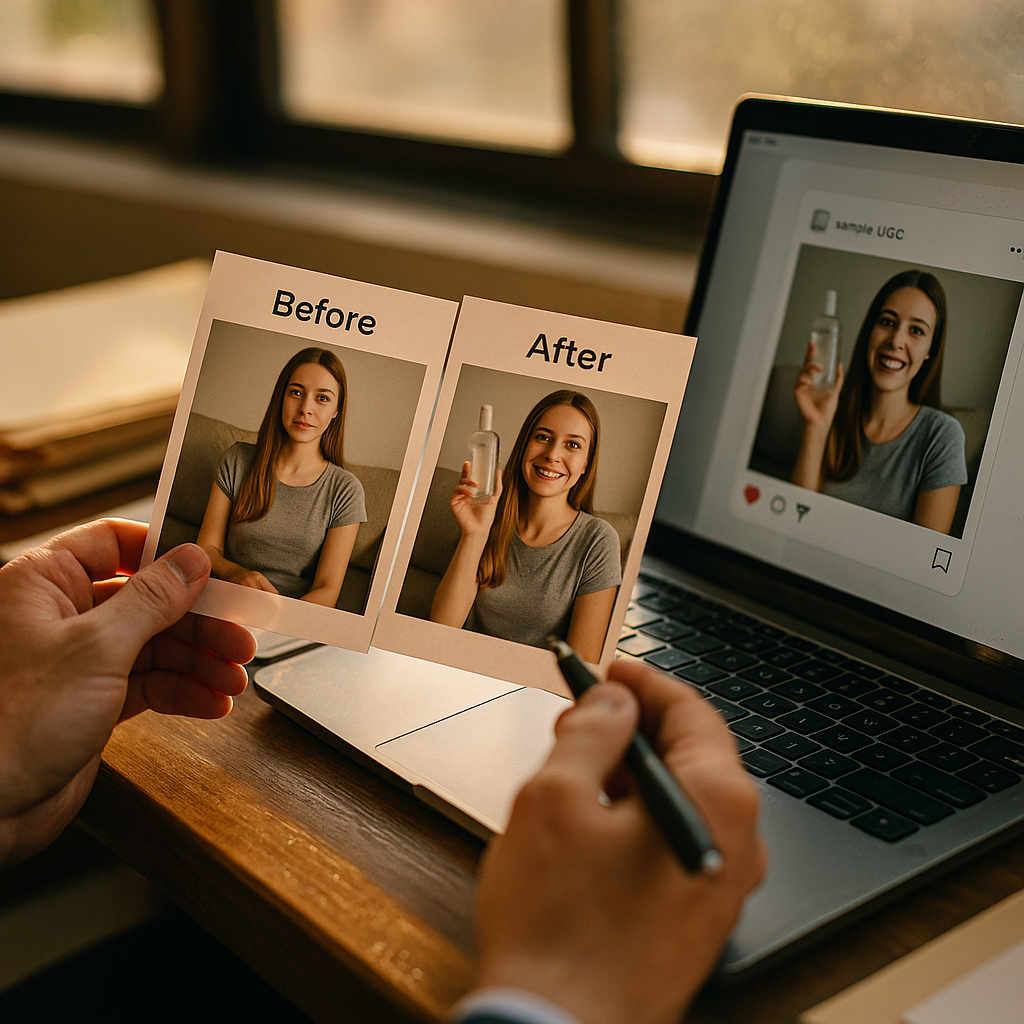
Transformation content converts at rates most brands can only dream of, yet the before and after transformation format sits closer to regulatory scrutiny than almost any other creative style in the influencer playbook. Weight loss supplements, skincare, teeth whitening, fitness programs: the categories that benefit most from visual proof are also the categories the FTC watches hardest. So how do you keep the format that sells without inviting a subpoena?
The answer isn’t avoiding transformation content. It’s building a framework around it.
Why This Format Keeps Winning
Marketers keep coming back to before and after content because it does something static product shots can’t: it shows change happening. A dull skin to glowing skin cut, a cluttered garage to an organized one, a cracked screen to a repaired phone. The brain processes contrast fast, and contrast sells outcomes rather than features.
Performance data backs this up. Creative teams running paid social consistently report that transformation-style hooks outperform standard product demos on hook rate and thumb-stop percentage. Sprout Social’s research on social content performance has repeatedly shown that visual proof formats drive higher engagement than talking-head reviews, largely because viewers don’t have to trust a claim, they can see it.
But that same visual power is exactly what regulators flag. A transformation implies causation. And causation is where the FTC’s substantiation requirements kick in.
The moment a creator shows “before” next to “after,” they’ve made an implicit efficacy claim, whether the brand intended it or not.
Where Brands Actually Get Burned
Most compliance failures in this format aren’t malicious. They’re operational gaps. A few patterns show up again and again in enforcement actions and platform takedowns:
- No disclosed timeframe. “After” without a stated duration implies instant or typical results, which regulators treat as a deceptive claim by omission.
- Cherry-picked outliers. Using a single best-case creator result as if it represents typical outcomes.
- Missing #ad or #sponsored tags on the specific post, not just the creator’s bio.
- Lighting, filters, or angle changes between before and after shots that exaggerate the visual difference beyond the actual product effect.
- No retained consent or model release covering the specific use case (paid amplification, whitelisting, or repurposing into display ads).
Any one of these can trigger a platform flag. Combine two or three, and you’ve got a case study for the next FTC guidance update.
The Compliance-Safe Framework, Step by Step
Building a repeatable, defensible transformation format means treating it as a production pipeline with checkpoints, not a one-off creative brief. Here’s the structure that holds up under legal review.
1. Lock the claim before you shoot
Legal and brand teams should agree on the exact substantiated claim before a single frame is captured. If the product is clinically tested to show results in eight weeks, the creative brief states eight weeks. Not “results may vary,” not “in as little as.” Specificity is your friend here, vagueness is what gets flagged.
2. Standardize the capture conditions
Same lighting setup, same camera distance, same angle, same time of day if possible. This isn’t just about compliance, it’s about credibility. Viewers are savvier than brands give them credit for, and inconsistent conditions read as manipulation even when the product genuinely works. Teams already running structured hook testing processes can extend the same rigor to visual consistency checks before footage gets approved.
3. Disclose inline, not just in captions
The disclosure needs to live inside the video itself, ideally as an on-screen text overlay during the first three seconds, not buried in a caption below the fold. The FTC’s endorsement guidelines are explicit that disclosures must be “clear and conspicuous,” meaning a viewer shouldn’t have to tap “see more” to find out they’re watching an ad.
4. Get consent for every downstream use case
A creator agreeing to post organically is not the same as agreeing to appear in a paid display ad six months later. Brands that skip this step end up scrambling when a legal or performance team wants to whitelist a top-performing post. Building this into your workflow from day one, following a process similar to what’s outlined in a rights registry workflow, saves weeks of reshoot delays later.
5. Archive everything, including the raw footage
If a claim is ever challenged, the brand needs to produce the original unedited footage, the creator’s consent form, and the substantiation data used to support the claim. Retention policy isn’t optional here. Set a minimum three-year archive window and stick to it.
What “Typical Results” Actually Requires
Here’s where a lot of brand teams get tripped up. The FTC doesn’t just want you to avoid lying, it wants you to represent what’s typical. If your best customer lost 15 pounds but your average customer lost three, showing only the 15-pound transformation without a “results not typical” disclosure, paired with data on what’s actually average, is a deceptive practice regardless of how the creator phrased it.
This means your legal team needs access to real performance data, not just marketing anecdotes, before approving any transformation brief. If you don’t have that data, you don’t have a defensible campaign. Full stop.
A transformation ad without substantiation data behind it isn’t a growth lever, it’s a liability sitting in your ad account waiting to get flagged.
Building the Brief Creators Can Actually Follow
Creators aren’t lawyers, and they shouldn’t have to be. The compliance burden lives with the brand, which means your creative brief has to do the heavy lifting. A good transformation brief specifies the exact disclosure language, the required on-screen text timing, the claim boundaries (what the creator can and can’t say), and the capture conditions.
This is where structured briefing frameworks earn their keep. Brands already using hook-first UGC briefs to standardize creator output can adapt the same discipline to transformation content, treating the disclosure line as non-negotiable as the hook itself. Similarly, teams that have built legal-approved hook libraries for other formats should extend that same pre-approval process to before and after scripts specifically, since these carry higher regulatory weight than a standard testimonial.
One tactic worth stealing: build a short “compliance card” that goes out with every transformation brief, listing the three or four things the creator must include (timeframe disclosure, #ad tag placement, no beauty filter, no claim beyond X). Keep it to one page. Creators will actually read one page. They won’t read a twelve-page legal document, and honestly, why would they.
Platform-Specific Wrinkles
Meta, TikTok, and Amazon each treat transformation content slightly differently, and brands running cross-platform campaigns need to account for it.
- Meta ads require disclosure both in the creative and via the platform’s branded content tool, per Meta’s branded content policies. Skipping the tagging feature, even with an on-screen disclosure, can still trigger ad rejection.
- TikTok increasingly flags before and after content in restricted categories (weight loss, supplements) for manual review, so build extra approval time into your TikTok Ads Manager workflow.
- Amazon storefronts and Posts have their own review process for transformation claims tied to product listings, and formatting matters as much as compliance. Brands adapting UGC for retail placements should look at how Amazon-ready UGC ad formatting handles claim language differently from social-first creative.
Is the Effort Worth It?
Short answer: yes, if the category supports genuine results. Transformation content isn’t going anywhere, and eMarketer’s creator economy forecasts continue to show visual proof formats as a growing share of influencer ad spend, particularly in beauty, wellness, and home categories. The brands winning here aren’t the ones avoiding the format out of fear. They’re the ones who’ve built the compliance scaffolding so tightly that legal review takes hours instead of weeks, letting creative teams move at the speed the trend cycle demands.
That operational speed matters more than people admit. A transformation trend that’s compliant but three weeks late to market has lost most of its value. Pairing this framework with faster internal approval processes, similar to the turnaround discussed in legal UGC replication workflows, is what separates brands who use this format profitably from brands who use it once and then get scared off after a takedown notice.
FAQs
What makes before and after content risky from a compliance standpoint?
It implies a causal, measurable outcome, which triggers FTC substantiation requirements. Brands need data proving the shown result is typical, not just achievable by one standout customer.
Do disclosures need to appear inside the video itself?
Yes. Caption-only disclosures don’t meet the “clear and conspicuous” standard regulators expect. On-screen text during the opening seconds is the safer standard.
How long should timeframes be disclosed for transformation results?
Always state the actual duration used to achieve the shown result, and avoid vague phrasing like “in just weeks” unless that exact timeframe is substantiated by data.
Can a creator’s organic consent cover paid amplification later?
No. Whitelisting, boosting, or repurposing content into paid ads requires separate consent covering that specific use, which should be secured at the time of the original agreement.
Which product categories face the most scrutiny for this format?
Weight loss, supplements, skincare, and teeth whitening see the highest regulatory attention, since results vary widely across individuals and outcomes are easy to exaggerate visually.
Start by auditing your last five transformation campaigns against the five failure points above, then build the one-page compliance card into every future brief before your next shoot goes into production.
Top Influencer Marketing Agencies
The leading agencies shaping influencer marketing in 2026
Agencies ranked by campaign performance, client diversity, platform expertise, proven ROI, industry recognition, and client satisfaction. Assessed through verified case studies, reviews, and industry consultations.
Moburst

-
2

The Shelf
Boutique Beauty & Lifestyle Influencer AgencyA data-driven boutique agency specializing exclusively in beauty, wellness, and lifestyle influencer campaigns on Instagram and TikTok. Best for brands already focused on the beauty/personal care space that need curated, aesthetic-driven content.Clients: Pepsi, The Honest Company, Hims, Elf Cosmetics, Pure LeafVisit The Shelf → -
3

Audiencly
Niche Gaming & Esports Influencer AgencyA specialized agency focused exclusively on gaming and esports creators on YouTube, Twitch, and TikTok. Ideal if your campaign is 100% gaming-focused — from game launches to hardware and esports events.Clients: Epic Games, NordVPN, Ubisoft, Wargaming, Tencent GamesVisit Audiencly → -
4

Viral Nation
Global Influencer Marketing & Talent AgencyA dual talent management and marketing agency with proprietary brand safety tools and a global creator network spanning nano-influencers to celebrities across all major platforms.Clients: Meta, Activision Blizzard, Energizer, Aston Martin, WalmartVisit Viral Nation → -
5

The Influencer Marketing Factory
TikTok, Instagram & YouTube CampaignsA full-service agency with strong TikTok expertise, offering end-to-end campaign management from influencer discovery through performance reporting with a focus on platform-native content.Clients: Google, Snapchat, Universal Music, Bumble, YelpVisit TIMF → -
6

NeoReach
Enterprise Analytics & Influencer CampaignsAn enterprise-focused agency combining managed campaigns with a powerful self-service data platform for influencer search, audience analytics, and attribution modeling.Clients: Amazon, Airbnb, Netflix, Honda, The New York TimesVisit NeoReach → -
7

Ubiquitous
Creator-First Marketing PlatformA tech-driven platform combining self-service tools with managed campaign options, emphasizing speed and scalability for brands managing multiple influencer relationships.Clients: Lyft, Disney, Target, American Eagle, NetflixVisit Ubiquitous → -
8

Obviously
Scalable Enterprise Influencer CampaignsA tech-enabled agency built for high-volume campaigns, coordinating hundreds of creators simultaneously with end-to-end logistics, content rights management, and product seeding.Clients: Google, Ulta Beauty, Converse, AmazonVisit Obviously →