


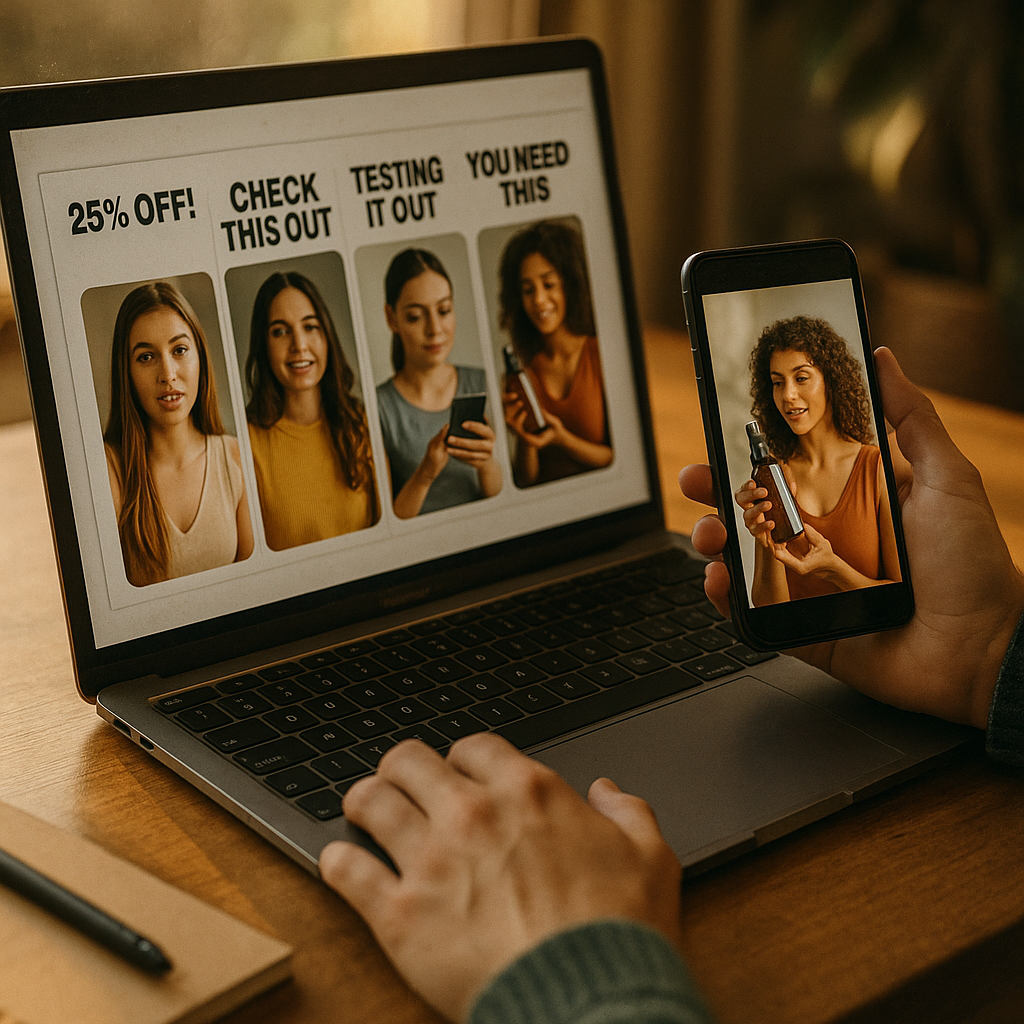
Ninety percent of a video’s fate gets decided in the first three seconds. Yet most brands still test one hook per creative brief and hope. Canvas style hook testing flips that math by letting teams generate, screen, and rank dozens of faceless UGC hook variants before a single dollar goes into paid distribution. If your influencer program still treats the hook as an afterthought, you’re leaving performance on the table.
What Canvas Style Hook Testing Actually Means
Borrowed from Meta’s Advantage+ Canvas and TikTok’s dynamic creative tooling, “canvas style” testing refers to a structured grid approach: multiple hook variations laid out side by side, each swapped against a consistent body and CTA, so you isolate the one variable that matters most for scroll stopping performance. It’s less a platform feature and more a production discipline.
Faceless UGC makes this scalable in a way traditional talent shoots never could. No face, no wardrobe continuity, no scheduling around a creator’s calendar. Just a script, a product, a voice (often AI generated or licensed), and B roll you can remix endlessly. That’s why faceless formats have become the default testing ground for hook experimentation at brands running always on paid social.
Brands running structured hook tests report identifying a winning variant using roughly a third of the spend it takes to find one through sequential, single-creative testing.
Why Faceless UGC Is the Right Testing Vehicle
Faceless content strips out the variable of “is this person likable” and replaces it with “is this message compelling.” That’s a cleaner signal for hook testing specifically. When you’re trying to isolate whether a pattern interrupt, a bold claim, or a question format performs better, you don’t want an influencer’s charisma muddying the data.
There’s also a practical production angle. A faceless UGC batch, built from stock or licensed footage, voiceover, text overlays, and product shots, can produce fifteen to twenty hook variants in the time it takes to schedule one creator shoot. For brands managing tight quarterly budgets, that speed matters as much as the insight itself.
- Faster iteration cycles: swap a hook line without reshooting anything.
- Lower legal exposure: no likeness rights, no creator contract renegotiation for every variant.
- Easier localization: voice clone and caption swaps travel across markets without new shoots.
If you’re building out a rights framework for this kind of reusable footage, it’s worth pairing hook testing with a proper UGC rights registry so legal never becomes the bottleneck when a winning hook needs to scale into paid.
Building the Canvas: Structure Before Creative
The mistake most teams make is starting with ideas instead of structure. A real canvas test needs a fixed matrix: hook type on one axis, product angle or pain point on the other. Common hook archetypes to stock your canvas with include:
- The provocation hook: a bold, slightly contrarian claim that challenges assumed knowledge.
- The stat hook: a jarring number delivered in the first two seconds.
- The relatable problem hook: “if you’ve ever struggled with X” framing.
- The visual interrupt hook: a jump cut, zoom, or unexpected object that stops the scroll before words even register.
- The direct address hook: speaking straight to camera (or straight to lens, faceless equivalent being a hand or product close up) with a question.
Run each archetype against two or three product angles and you get a twelve to fifteen cell canvas. That’s your test grid. Anything smaller and you’re not really testing, you’re guessing with extra steps.
Scripting for Volume Without Losing Quality
Volume production lives or dies on script templates. Build a modular script skeleton: hook line, problem statement, product reveal, proof point, CTA. Only the hook line changes between variants; everything else stays locked. This is the same logic behind bite size video series production, where consistency in structure lets you scale output without reshooting the whole asset every time.
For teams leaning on AI voice tools to cut recording time, pairing a locked script skeleton with voice clone dubbing means you can produce the same canvas in four or five languages without re-briefing a single creator.
Where Canvas Testing Actually Runs
Meta’s Advantage+ creative tools and TikTok’s Smart Creative both support dynamic hook rotation natively, serving different opening frames to different audience segments and reporting back on hold rate and three second view rate. That’s your primary read. Don’t wait for conversion data to make a call, hook performance shows up in retention metrics within the first 48 to 72 hours of spend.
YouTube Shorts and LinkedIn are catching up but still reward manual A/B upload testing more than automated variant serving. If your program spans CTV reformats too, the hook discipline still applies, just check the platform specs first; the Peacock and Sky CTV specs guide covers how hook timing shifts when you’re not fighting an infinite scroll feed.
Reading the Data Without Fooling Yourself
Three second view rate is a start, not a finish line. A hook can stop the scroll and still fail to drive intent if the payoff doesn’t match the promise. Track hold rate through at least the six second mark, and if budget allows, run a lightweight brand lift or click through comparison across your top three hooks before declaring a winner.
Statista and eMarketer both track rising ad fatigue rates on short form video, and the pattern is consistent: creative refresh cycles that used to run six to eight weeks now need refreshing every two to three weeks on aggressive spend accounts. Reference Statista’s social media advertising data if you need to make the case internally for sustained testing budget rather than a one time creative sprint.
A hook that wins in week one can decay 30 to 40 percent in hold rate by week four simply from audience fatigue, not because the message stopped being true.
Operationalizing the Workflow
None of this works as a one off project. Canvas hook testing needs to be a standing operational lane, not a quarterly experiment. That means:
- A brief template that separates hook variables from body content, so creative ops doesn’t rebuild the wheel every cycle.
- A tagging system in your asset library that labels each variant by hook archetype, so you can spot patterns across campaigns, not just within one.
- A clear handoff from creative testing to media buying, so winning hooks get scaled into paid within days, not weeks.
If your team is already running a structured creator pipeline, this slots naturally alongside broader TikTok creator ops workflows, just add a hook tagging field to whatever brief and payment system you’re already using. And once you find winners, don’t let them live in one format. A strong hook deserves a multi platform master edit treatment so it reaches Reels, Shorts, and TikTok without a full reshoot.
What Compliance and Legal Need to Know
Faceless doesn’t mean risk free. Disclosure rules still apply if the content is sponsored, and AI voice or synthetic elements carry their own disclosure expectations in several markets. The FTC’s endorsement guidance applies regardless of whether a human face appears on screen, and UK advertisers should check current ICO guidance on data use if voice cloning involves any real person’s likeness or vocal identity. Build a compliance checkpoint into the canvas workflow itself rather than treating it as a final gate; it’s cheaper to catch an issue at script stage than after a hundred variants are already in market.
Common Mistakes That Waste the Testing Budget
Teams new to this format tend to make the same handful of errors. Testing hooks against inconsistent bodies (so you can’t isolate what actually moved the metric). Declaring a winner after 48 hours of spend on a small audience, before the algorithm has fully calibrated delivery. And treating the winning hook as permanent instead of expecting decay and building refresh cycles into the media plan from day one.
Another quiet killer: outsourcing hook writing to whoever’s available that week instead of building a small, repeatable bench of writers who understand the archetype framework. Consistency in how hooks get written matters as much as the testing structure around them. If you’re also running employee generated content as a lower cost complement to paid UGC, the same modular hook discipline applies there; see how employee advocacy video series use a similar bench model to control costs while still generating enough raw material to test against.
FAQs
Frequently Asked Questions
What is canvas style hook testing?
It’s a structured method of testing multiple video hook variations against a fixed body and CTA, usually laid out in a grid (or “canvas”) that crosses hook archetypes against product angles, so marketers can isolate exactly which opening line or visual drives the strongest scroll stopping performance.
Why use faceless UGC for hook testing instead of creator led content?
Faceless UGC removes the variable of an individual creator’s likability or charisma, giving cleaner data on whether the hook itself, not the person delivering it, is driving retention. It’s also faster and cheaper to produce at the volume required for real testing.
How many hook variants should a canvas test include?
Most effective tests run twelve to twenty variants, crossing three to five hook archetypes against two to four product angles or pain points. Fewer than ten variants rarely produces a statistically meaningful pattern.
How long does a hook typically perform before it needs refreshing?
Depending on spend level and audience size, winning hooks often show measurable fatigue within two to four weeks, with hold rate declining 30 percent or more. High spend accounts should plan refresh cycles accordingly rather than treating a winning hook as permanent.
Does synthetic or AI generated voice in faceless UGC require disclosure?
In most markets, sponsored content disclosure rules apply regardless of whether a real person appears on screen. Brands using AI voice or synthetic elements should also review current endorsement and data use guidance, since expectations are evolving quickly.
Start small: build a twelve cell hook canvas for your next paid social push, tag every variant by archetype, and let the retention data pick the winner before your media budget does. That single habit shift is usually worth more than any new creative concept you’ll brief this quarter.
Top Influencer Marketing Agencies
The leading agencies shaping influencer marketing in 2026
Agencies ranked by campaign performance, client diversity, platform expertise, proven ROI, industry recognition, and client satisfaction. Assessed through verified case studies, reviews, and industry consultations.
Moburst

-
2

The Shelf
Boutique Beauty & Lifestyle Influencer AgencyA data-driven boutique agency specializing exclusively in beauty, wellness, and lifestyle influencer campaigns on Instagram and TikTok. Best for brands already focused on the beauty/personal care space that need curated, aesthetic-driven content.Clients: Pepsi, The Honest Company, Hims, Elf Cosmetics, Pure LeafVisit The Shelf → -
3

Audiencly
Niche Gaming & Esports Influencer AgencyA specialized agency focused exclusively on gaming and esports creators on YouTube, Twitch, and TikTok. Ideal if your campaign is 100% gaming-focused — from game launches to hardware and esports events.Clients: Epic Games, NordVPN, Ubisoft, Wargaming, Tencent GamesVisit Audiencly → -
4

Viral Nation
Global Influencer Marketing & Talent AgencyA dual talent management and marketing agency with proprietary brand safety tools and a global creator network spanning nano-influencers to celebrities across all major platforms.Clients: Meta, Activision Blizzard, Energizer, Aston Martin, WalmartVisit Viral Nation → -
5

The Influencer Marketing Factory
TikTok, Instagram & YouTube CampaignsA full-service agency with strong TikTok expertise, offering end-to-end campaign management from influencer discovery through performance reporting with a focus on platform-native content.Clients: Google, Snapchat, Universal Music, Bumble, YelpVisit TIMF → -
6

NeoReach
Enterprise Analytics & Influencer CampaignsAn enterprise-focused agency combining managed campaigns with a powerful self-service data platform for influencer search, audience analytics, and attribution modeling.Clients: Amazon, Airbnb, Netflix, Honda, The New York TimesVisit NeoReach → -
7

Ubiquitous
Creator-First Marketing PlatformA tech-driven platform combining self-service tools with managed campaign options, emphasizing speed and scalability for brands managing multiple influencer relationships.Clients: Lyft, Disney, Target, American Eagle, NetflixVisit Ubiquitous → -
8

Obviously
Scalable Enterprise Influencer CampaignsA tech-enabled agency built for high-volume campaigns, coordinating hundreds of creators simultaneously with end-to-end logistics, content rights management, and product seeding.Clients: Google, Ulta Beauty, Converse, AmazonVisit Obviously →