


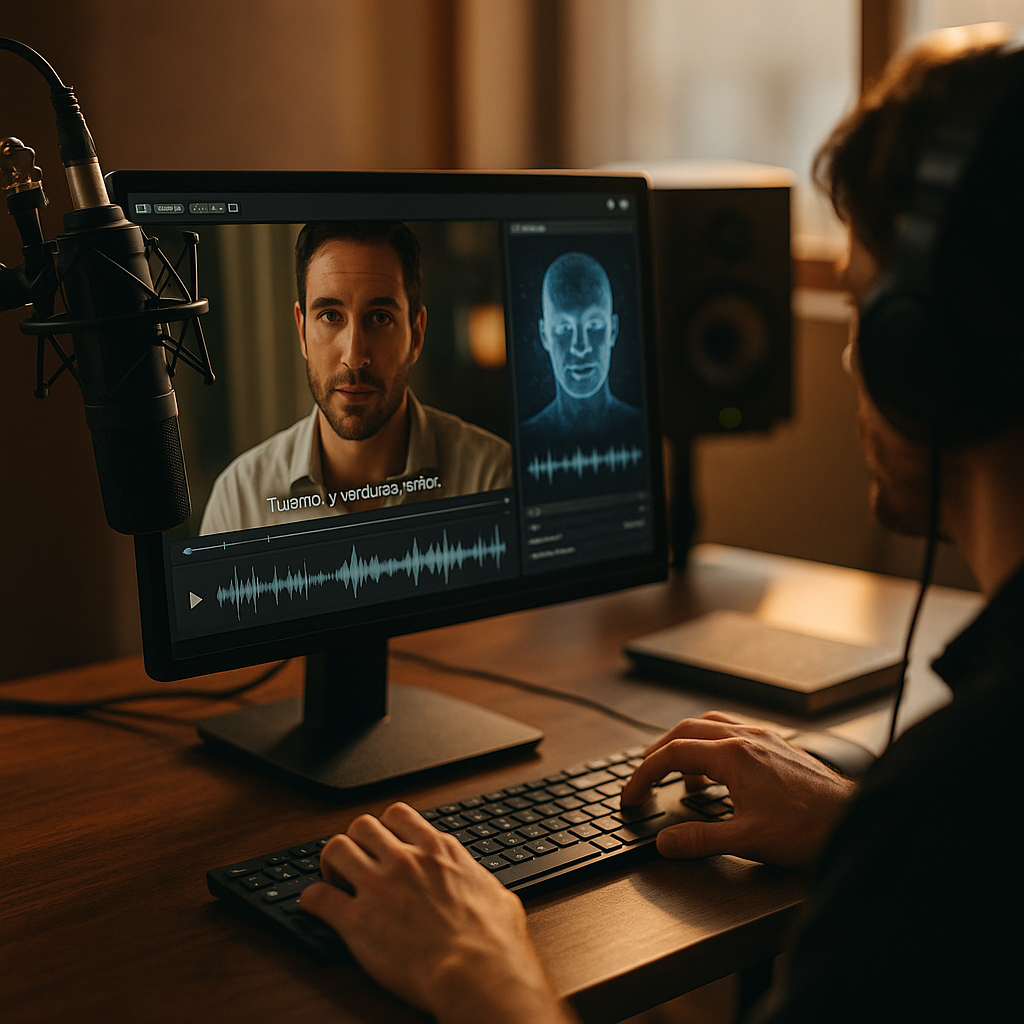
One creator video. Fourteen languages. Zero reshoots. AI voice clone dubbing is quietly becoming the fastest way for brands to turn a single piece of creator content into a global media plan, and the market data backs up the shift: the global market for AI-powered dubbing and localization tools is projected to grow well into the billions by the end of the decade, according to industry trackers at Statista. If your influencer program still stops at English, you’re leaving reach on the table.
What AI Voice Clone Dubbing Actually Is
Strip away the buzzwords and it’s simple. AI voice clone dubbing uses a creator’s own vocal fingerprint, tone, pacing, breath patterns, even their laugh, to generate spoken audio in a language they never actually recorded. The lip movements can be synced to match too, using generative video tools, so the creator appears to be fluently speaking Spanish, Hindi, or Japanese on screen.
This isn’t the robotic dubbing of old dubbed anime or poorly synced infomercials. Tools like ElevenLabs, HeyGen, and Deepdub have pushed voice cloning to a point where casual viewers often can’t tell the audio was synthetic. That’s the whole point: the format only works if it feels native, not translated.
A single creator video localized into six languages via AI dubbing costs a fraction of commissioning six regional creators, and it ships in days instead of months.
Why Brands Are Paying Attention Now
Three forces are converging. First, creator budgets are under more scrutiny than ever, and finance teams want proof that content spend scales efficiently. Second, platforms like TikTok and YouTube Shorts have made cross-border discovery the default, meaning a video posted in Austin can land in front of viewers in Jakarta within hours. Third, the AI dubbing tech finally cleared the quality bar that made marketers wince a few years ago.
Put those together and you get a genuinely new creative format, not just a localization hack bolted onto old workflows. A single sponsored video shot once can now anchor campaigns in a dozen markets without hiring a dozen local creators or booking a dozen studio sessions.
For teams already experimenting with AI voiceover overlays to swap scripts without reshoots, voice clone dubbing is the natural next step: same core idea, applied across languages instead of just message variants.
The ROI Case: Fewer Shoots, More Markets
Let’s talk numbers, because that’s what gets this format approved past the CMO. A typical mid-tier creator collaboration in the US or UK runs anywhere from a few thousand dollars to tens of thousands, depending on reach and usage rights. Replicating that same production quality with local creators in Brazil, Germany, South Korea, and Mexico multiplies cost fourfold, minimum, before you even account for coordination overhead across agencies and time zones.
AI dubbing collapses that math. One shoot, one usage negotiation, one set of legal terms with the original creator, then a licensing layer for the voice clone itself. Agencies report localization costs dropping by 60 to 80 percent when they shift from market-by-market creator sourcing to a single-source-plus-dubbing model, though exact savings depend heavily on how many languages and how much lip-sync polish you need.
There’s a speed benefit too. Regional creator sourcing, briefing, and approval cycles can eat four to six weeks per market. AI dubbing turns that into a matter of days once the source asset is locked, which matters enormously for time-sensitive drops or reactive campaigns. If you’re running drop shop reveal videos with a hard countdown, waiting six weeks for a Portuguese-language version simply isn’t an option.
Where the Format Actually Works Best
Not every piece of creator content is a good candidate. Voice clone dubbing shines when the value lives in what’s being said, not in hyperlocal cultural nuance. Product explainers, tutorials, review formats, and founder-led storytelling translate cleanly because the core message (features, benefits, proof points) holds up across markets.
- Product demos and reviews: the demonstration is visual and universal, so dubbed narration carries the weight.
- Founder or expert commentary: credibility transfers well when the same recognizable face and voice pattern appear across markets.
- Educational or how-to content: instructional clarity matters more than idiomatic slang.
- Long-form documentary style pieces: similar to what we covered in long form product documentaries, where narrative structure survives translation better than punchy meme-driven content.
Where it struggles: comedy built on wordplay, culturally specific slang, or content that leans heavily on regional trends. A joke about a US sitcom reference doesn’t land in Manila no matter how good the voice clone sounds. Know the difference before you greenlight a market-wide dubbing rollout.
The Disclosure and Consent Problem Nobody Can Skip
Here’s where brand safety teams need to lean in hard. Voice cloning sits in a regulatory gray zone that’s tightening fast. The FTC has already signaled that synthetic media used in advertising without clear disclosure can trigger deceptive practices scrutiny, and the UK’s ICO has published guidance touching on biometric data, which voice prints arguably qualify as.
Practically, that means two things for your program. One, get explicit, written consent from creators for voice cloning specifically, not just a blanket usage rights clause buried in a standard influencer contract. Two, disclose that dubbed content is AI-generated audio, ideally with an on-screen label, especially in markets like the EU where AI transparency rules are moving from guidance to enforcement.
Skipping disclosure on AI-dubbed content isn’t just a compliance risk, it’s a trust risk. Audiences who discover after the fact that a “local” creator video was synthetically voiced tend to remember the deception more than the product.
Build this into your creator contracts now rather than retrofitting later. Legal teams should treat voice clone licensing the way they treat music licensing: a distinct right that needs its own line item, term length, and revocation clause.
Building the Workflow: What Good Looks Like
A functional AI dubbing pipeline has four stages, and skipping any of them shows up in the final quality.
- Source capture: shoot with clean audio and minimal background noise. Voice models clone more accurately from crisp source files.
- Script localization, not literal translation: a direct word-for-word translation almost always sounds stiff. Bring in native-language copywriters to adapt phrasing, humor, and pacing before feeding scripts into the voice model.
- Voice generation and review: generate the dubbed audio, then have a native speaker (ideally someone unconnected to the project) review for tone and cultural fit before publishing.
- Lip sync and visual polish: tools like HeyGen or Sync Labs can adjust mouth movements to match new audio, though this step adds cost and isn’t always necessary for voiceover-style content where the creator isn’t the sole visual focus.
This workflow pairs well with existing subtitle strategies. If you’ve already built a subtitle first design approach for muted autoplay, layering dubbed audio on top gives you a belt-and-suspenders localization stack: viewers get both the native audio and the on-screen text, which research from Sprout Social suggests improves comprehension and completion rates on social video.
Measuring Whether It’s Actually Working
Don’t just track views by market. Watch completion rate and engagement rate for dubbed versions against the original language cut. If a dubbed video underperforms significantly, that’s usually a signal the localization missed cultural nuance, not that the format itself failed. A/B test two or three dubbed variants (literal translation versus adapted script) before scaling a market-wide rollout.
Comment sentiment is your other early warning system. Native speakers will call out awkward phrasing or unnatural voice patterns in the comments faster than any internal QA process will catch it. Build a lightweight monitoring cadence, even a weekly spot check, into the first month of any new market launch.
FAQs
Frequently Asked Questions
Is AI voice clone dubbing legal for advertising?
Yes, but it requires explicit creator consent for the voice clone specifically and, in most jurisdictions, clear disclosure that the audio is AI-generated. Regulatory guidance from the FTC and similar bodies is tightening around synthetic media in ads, so brands should treat consent and disclosure as non-negotiable steps, not optional extras.
How much does AI dubbing cost compared to hiring local creators?
Costs vary by tool and language count, but agencies typically report savings of 60 to 80 percent compared to sourcing individual creators in each target market. The bigger saving is often time, since dubbing a locked asset takes days versus the weeks needed to source, brief, and approve local creator content.
Does AI voice cloning work for every type of content?
No. It performs best on product demos, tutorials, and expert or founder commentary where the message carries the value. It performs worse on comedy, slang-heavy content, or anything relying on cultural references that don’t translate directly.
Can viewers tell the audio is AI-generated?
With current leading tools, casual viewers often cannot distinguish cloned voice audio from an original recording, especially with a well-adapted script. That’s precisely why disclosure matters: the technology is convincing enough that transparency has to be a deliberate choice, not something audiences can figure out on their own.
Do creators need to approve every dubbed language version?
Best practice is yes, or at minimum grant approval rights within the original contract. Creators have a personal stake in how their voice and likeness are represented abroad, and giving them review rights protects both the brand and the creator relationship long term.
Start small: pick one high-performing creator video, dub it into two or three priority markets, and measure completion rate against the original before committing budget to a full rollout. The format rewards brands that treat consent and disclosure as part of the creative process, not an afterthought.
Top Influencer Marketing Agencies
The leading agencies shaping influencer marketing in 2026
Agencies ranked by campaign performance, client diversity, platform expertise, proven ROI, industry recognition, and client satisfaction. Assessed through verified case studies, reviews, and industry consultations.
Moburst

-
2

The Shelf
Boutique Beauty & Lifestyle Influencer AgencyA data-driven boutique agency specializing exclusively in beauty, wellness, and lifestyle influencer campaigns on Instagram and TikTok. Best for brands already focused on the beauty/personal care space that need curated, aesthetic-driven content.Clients: Pepsi, The Honest Company, Hims, Elf Cosmetics, Pure LeafVisit The Shelf → -
3

Audiencly
Niche Gaming & Esports Influencer AgencyA specialized agency focused exclusively on gaming and esports creators on YouTube, Twitch, and TikTok. Ideal if your campaign is 100% gaming-focused — from game launches to hardware and esports events.Clients: Epic Games, NordVPN, Ubisoft, Wargaming, Tencent GamesVisit Audiencly → -
4

Viral Nation
Global Influencer Marketing & Talent AgencyA dual talent management and marketing agency with proprietary brand safety tools and a global creator network spanning nano-influencers to celebrities across all major platforms.Clients: Meta, Activision Blizzard, Energizer, Aston Martin, WalmartVisit Viral Nation → -
5

The Influencer Marketing Factory
TikTok, Instagram & YouTube CampaignsA full-service agency with strong TikTok expertise, offering end-to-end campaign management from influencer discovery through performance reporting with a focus on platform-native content.Clients: Google, Snapchat, Universal Music, Bumble, YelpVisit TIMF → -
6

NeoReach
Enterprise Analytics & Influencer CampaignsAn enterprise-focused agency combining managed campaigns with a powerful self-service data platform for influencer search, audience analytics, and attribution modeling.Clients: Amazon, Airbnb, Netflix, Honda, The New York TimesVisit NeoReach → -
7

Ubiquitous
Creator-First Marketing PlatformA tech-driven platform combining self-service tools with managed campaign options, emphasizing speed and scalability for brands managing multiple influencer relationships.Clients: Lyft, Disney, Target, American Eagle, NetflixVisit Ubiquitous → -
8

Obviously
Scalable Enterprise Influencer CampaignsA tech-enabled agency built for high-volume campaigns, coordinating hundreds of creators simultaneously with end-to-end logistics, content rights management, and product seeding.Clients: Google, Ulta Beauty, Converse, AmazonVisit Obviously →