


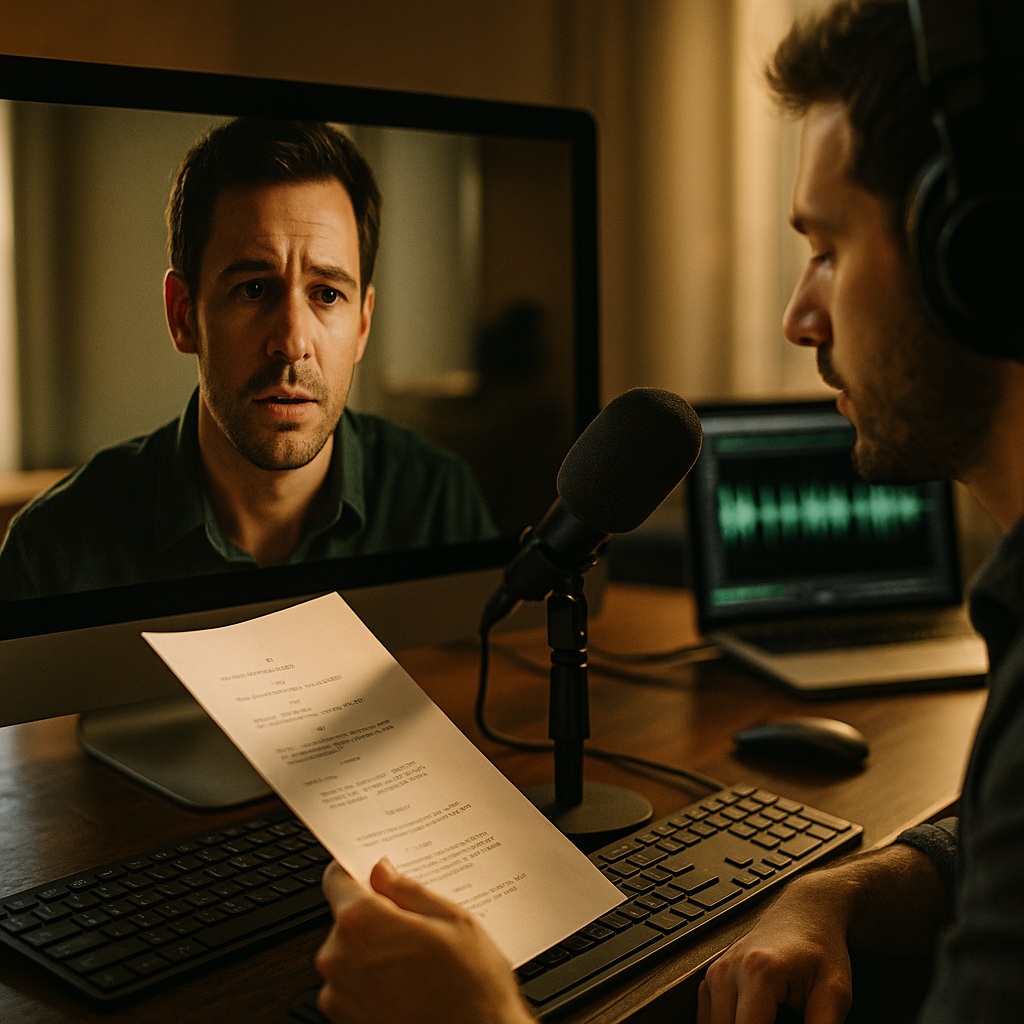
Seventy-two hours. That is how long it now takes some agencies to turn a single creator brief into twelve localized video ads, and none of it involves a camera crew reshooting scripts. The secret is AI voiceover overlays, and they are quietly replacing the on-camera talking head as the default format for fast, scalable creator content.
If your team is still booking reshoots every time a script needs a tweak, you are burning budget on a problem that got solved sometime in the last eighteen months.
What Are AI Voiceover Overlays, Exactly?
An AI voiceover overlay is a video built around synthetic or AI-cloned narration laid over B-roll, screen capture, product footage, or creator-shot visuals, instead of a creator speaking on camera in sync with a script. The creator still shoots the raw footage, often unscripted or loosely directed, but the final voice track is generated or refined using tools like ElevenLabs, Descript, or Adobe’s Podcast AI suite. Some brands clone the creator’s own voice with permission so the narration still sounds native to the account. Others use a branded AI voice across an entire campaign for consistency.
The format sits adjacent to trends we have covered before, like silent caption scripts and subtitle first design, both of which emerged from the same pressure: feeds are muted by default, and audio can no longer be the only carrier of message.
Brands running AI voiceover pipelines report cutting script-to-publish time by more than half, largely by eliminating reshoots tied to compliance edits or messaging changes.
Why On-Camera Scripts Are Losing Ground
On-camera scripted talking heads have a structural problem: every change requires the creator. Legal flags a claim, marketing wants a different CTA, or the offer expires and needs updating. That means another shoot day, another round of creator scheduling, another approval cycle. For brands running always-on influencer programs across five or six platforms, that friction adds up fast.
AI voiceover overlays decouple the script from the shoot. Once the visual footage exists, you can regenerate narration in minutes. Need a version without a specific product claim? Regenerate the script, keep the footage, done. Need the same ad in Spanish, German, and Portuguese for a EU rollout? Feed the script through translation and TTS, no creator flight required.
This is the same efficiency logic behind format agnostic distribution briefs: shoot once, adapt endlessly. Voiceover overlays just push that principle one step further by making the audio layer as modular as the crop and caption layer already is.
The Compliance Angle Nobody Talks About Enough
Here is the part that should matter most to anyone sitting in brand safety or legal review. On-camera scripted claims are hard to edit after the fact. If a creator says something that later triggers an FTC concern, or if regulatory guidance shifts (as it periodically does per the FTC’s endorsement guidelines), you are stuck re-shooting or pulling the asset entirely.
With voiceover overlays, the narration track is a text file before it is audio. Legal can review, redline, and approve a script the same way they would a press release, and the AI generates the final audio only after sign-off. That is a meaningfully lower-risk workflow than trusting a creator to nail a legally reviewed line verbatim on the fourth take.
It also solves a headache we have written about before with creative approval bottlenecks: when the bottleneck is a script, not a shoot, approval cycles get dramatically shorter.
Where This Format Actually Wins
AI voiceover overlays are not a fit for every creative brief. They shine in specific use cases:
- Product explainer content where visuals do the heavy lifting and narration is functional, not personality-driven.
- Localization at scale, turning one hero asset into a dozen market-specific versions without re-booking talent.
- Performance ad variants for paid social, where marketers need rapid A/B testing of hooks, CTAs, and claims.
- Evergreen educational series where the same creator’s “voice” narrates updated information over time (think software tutorials or financial explainers).
- Compliance-heavy categories like pharma, finance, and supplements, where every word needs sign-off before it goes live.
Where it does not work as well: anything relying on a creator’s personal charisma, comedic timing, or spontaneous reaction. If the format’s entire value is the human being on screen reacting in real time, an AI voice sitting on top of it can feel hollow. That is part of why formats like blooper reel marketing and unscripted B-roll diaries still outperform on trust metrics. Authenticity and speed are not always the same axis, and brands need to know which one a given piece of content is optimizing for.
The Production Math That’s Winning Budget Approval
Let’s talk numbers, because that is what gets this format greenlit in budget meetings. A traditional on-camera influencer video with scripted VO typically runs through several cost centers: creator fee, shoot day, script revisions, re-shoot contingency, and post-production sync. Swap the on-camera narration for an AI overlay, and you eliminate the re-shoot contingency almost entirely, plus you compress post-production because there is no lip-sync matching to worry about.
Agencies running high-volume creator programs, the kind pushing fifty or more assets a month across TikTok, Instagram, and YouTube Shorts, are the ones adopting this fastest. According to data trends tracked by eMarketer, short-form video ad spend continues to climb year over year, and turnaround speed is becoming as important as creative quality in winning platform algorithm favor. Slower production cycles mean fewer iterations, and fewer iterations mean weaker performance data to optimize against.
Speed is not just a cost saver anymore. It is a competitive input, because platforms reward accounts that can test and refresh creative faster than their category peers.
Does This Hurt Authenticity? A Fair Question
Skeptics will ask, rightly, whether swapping a creator’s real voice for a synthetic one erodes the trust that made influencer marketing work in the first place. It is a fair concern, and the honest answer is: it depends on disclosure and execution.
When brands are transparent that a voiceover is AI-assisted, particularly in explainer or ad contexts where audiences already expect a degree of production polish, backlash is minimal. Where it gets risky is when a brand clones a creator’s voice without clear consent framing or uses it in a way that implies the creator personally endorsed something they never actually said. That is a fast track to a trust problem, and platforms are increasingly building disclosure requirements around synthetic media, similar to guidance already published by Meta for Business on AI-generated content labeling.
The safest operational rule: use AI voiceover overlays for information-first content, and reserve the creator’s real, live voice for anything positioned as personal opinion or lived experience. That distinction alone prevents most of the reputational risk.
How to Brief This Format Without Wasting a Shoot Day
Because voiceover overlays separate audio from footage, the brief itself needs restructuring. A few practical rules that agencies running this at scale have landed on:
- Shoot broad, flexible B-roll rather than footage timed tightly to a specific script, since the script may change after the shoot.
- Draft two or three script variants before recording so legal can approve one without triggering a reshoot.
- Keep visual pacing loose enough that new narration lengths (shorter or longer) still cut cleanly, borrowing the same logic covered in editing style testing.
- Pair the voiceover with strong on-screen text, since muted autoplay still applies and the overlay audio won’t help viewers who never turn sound on.
- Get explicit, written creator consent if cloning their voice, and store that consent alongside the usage rights documentation.
Teams already running vertical video style guides will find this format slots in cleanly, since the visual system is already decoupled from any single script.
What This Means for Creator Relationships
Some creators will resist this shift, and understandably so; their voice is part of their brand equity, not just an audio track to be swapped out. The brands handling this well are treating voice licensing as its own negotiated line item, separate from the on-camera appearance fee. That keeps the relationship transparent and gives creators fair compensation for a use case that extends well beyond the original shoot.
It also opens a new kind of creator partnership: creators who license their cloned voice for ongoing brand narration without needing to appear on camera at all. That is a meaningfully different (and in some cases more scalable) commercial relationship than the traditional per-post deal, and it is worth tracking as this format matures.
The takeaway for brand teams: build voiceover overlays into your production pipeline now, starting with your highest-volume, lowest-personality content (explainers, product demos, localization runs), and keep creator-led authentic footage where the human voice is doing the persuasive work. Get the consent and compliance documentation right from the first project, not after the first complaint.
Frequently Asked Questions
What is an AI voiceover overlay in influencer marketing?
It is a video format where AI-generated or AI-cloned narration is layered over creator-shot or brand-shot footage instead of relying on the creator delivering a scripted line on camera, allowing faster edits, localization, and compliance approvals.
Does using an AI voice hurt authenticity or audience trust?
Not necessarily, as long as brands disclose synthetic narration where appropriate and reserve the creator’s real voice for personal opinion or testimonial content. Problems mostly arise from undisclosed voice cloning, not the technology itself.
Which platforms and tools are commonly used for AI voiceover overlays?
ElevenLabs, Descript, and Adobe’s Podcast AI tools are among the most widely used for generating or cloning voice tracks, often paired with standard video editing software for the overlay and pacing work.
Is this format cheaper than traditional on-camera influencer video?
In most cases, yes, primarily because it removes reshoot costs tied to script revisions and shortens legal and compliance review cycles, since the script can be approved as text before any audio is generated.
Do creators need to consent to having their voice cloned?
Yes, and brands should treat voice licensing as a distinct, compensated line item separate from the standard on-camera appearance fee, with written consent documented alongside usage rights.
Visible FAQ (HTML)
See above section for the visible FAQ content.
Top Influencer Marketing Agencies
The leading agencies shaping influencer marketing in 2026
Agencies ranked by campaign performance, client diversity, platform expertise, proven ROI, industry recognition, and client satisfaction. Assessed through verified case studies, reviews, and industry consultations.
Moburst

-
2

The Shelf
Boutique Beauty & Lifestyle Influencer AgencyA data-driven boutique agency specializing exclusively in beauty, wellness, and lifestyle influencer campaigns on Instagram and TikTok. Best for brands already focused on the beauty/personal care space that need curated, aesthetic-driven content.Clients: Pepsi, The Honest Company, Hims, Elf Cosmetics, Pure LeafVisit The Shelf → -
3

Audiencly
Niche Gaming & Esports Influencer AgencyA specialized agency focused exclusively on gaming and esports creators on YouTube, Twitch, and TikTok. Ideal if your campaign is 100% gaming-focused — from game launches to hardware and esports events.Clients: Epic Games, NordVPN, Ubisoft, Wargaming, Tencent GamesVisit Audiencly → -
4

Viral Nation
Global Influencer Marketing & Talent AgencyA dual talent management and marketing agency with proprietary brand safety tools and a global creator network spanning nano-influencers to celebrities across all major platforms.Clients: Meta, Activision Blizzard, Energizer, Aston Martin, WalmartVisit Viral Nation → -
5

The Influencer Marketing Factory
TikTok, Instagram & YouTube CampaignsA full-service agency with strong TikTok expertise, offering end-to-end campaign management from influencer discovery through performance reporting with a focus on platform-native content.Clients: Google, Snapchat, Universal Music, Bumble, YelpVisit TIMF → -
6

NeoReach
Enterprise Analytics & Influencer CampaignsAn enterprise-focused agency combining managed campaigns with a powerful self-service data platform for influencer search, audience analytics, and attribution modeling.Clients: Amazon, Airbnb, Netflix, Honda, The New York TimesVisit NeoReach → -
7

Ubiquitous
Creator-First Marketing PlatformA tech-driven platform combining self-service tools with managed campaign options, emphasizing speed and scalability for brands managing multiple influencer relationships.Clients: Lyft, Disney, Target, American Eagle, NetflixVisit Ubiquitous → -
8

Obviously
Scalable Enterprise Influencer CampaignsA tech-enabled agency built for high-volume campaigns, coordinating hundreds of creators simultaneously with end-to-end logistics, content rights management, and product seeding.Clients: Google, Ulta Beauty, Converse, AmazonVisit Obviously →