


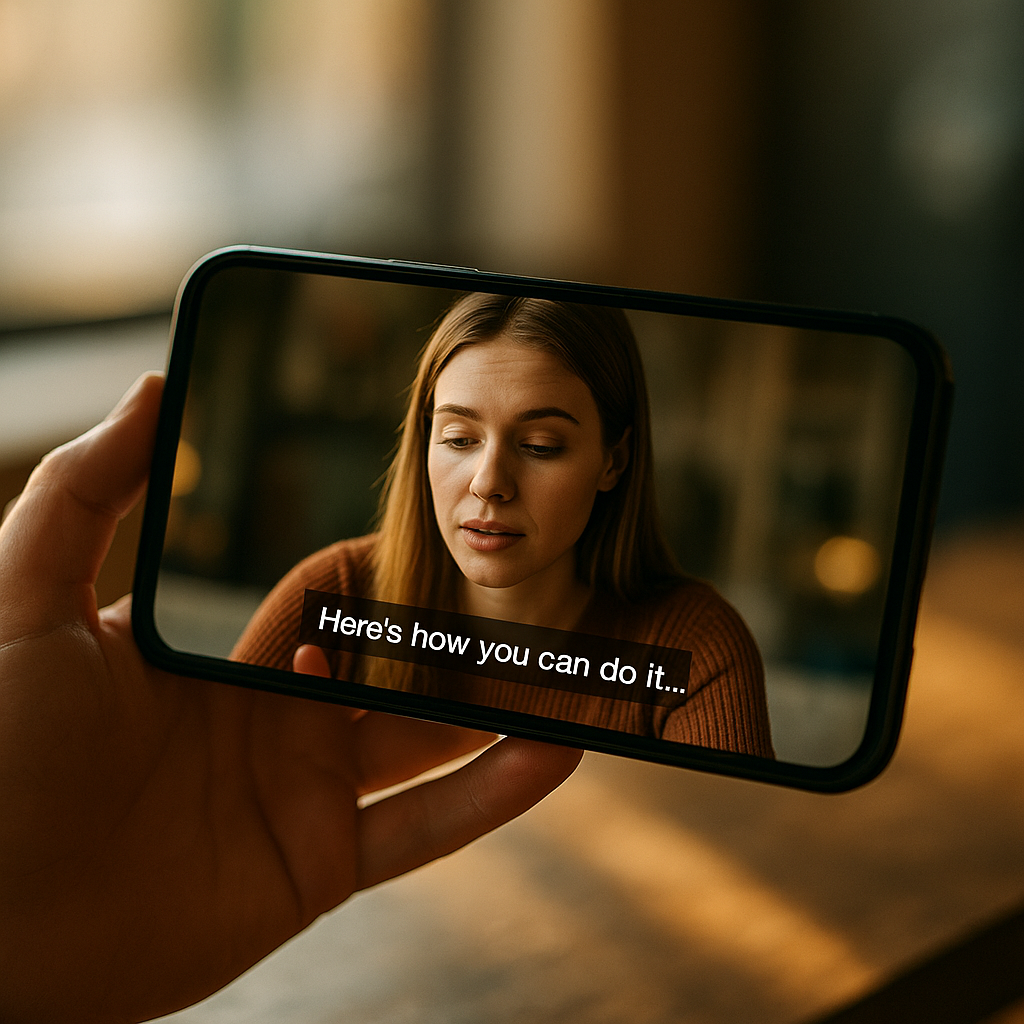
85% of social video is watched with the sound off, yet most brands still brief creators like they’re producing a radio ad with pictures. That gap is where impressions quietly die. A silent subtitled video format isn’t a nice-to-have anymore. It’s the baseline requirement for any creator content entering a feed where autoplay is muted by default and captions do the heavy lifting.
If your influencer program still measures success on “does the audio sell it,” you’re optimizing for the wrong environment. Let’s fix that.
Why Sound Off Is the Default, Not the Exception
Meta, TikTok, and LinkedIn all autoplay video muted. Users have to opt in to sound, and most never do, especially in office settings, commutes, or shared spaces where audio is socially inconvenient. Sprout Social’s platform research has repeatedly flagged silent viewing as the majority behavior, not a niche edge case. If your creator brief doesn’t account for that, you’re producing content that fails in the first two seconds, which is exactly when the algorithm decides whether to keep showing it.
This isn’t a new problem. Publishers cracked it years ago with captioned news clips. What’s new is applying that discipline to influencer and UGC content, where the creative process is faster, more decentralized, and often skips the polish a broadcast team would insist on.
A video that only works with sound on is a video that only works for a fraction of your actual audience. Silent subtitled video design closes that gap by treating captions as the primary storytelling layer, not an accessibility afterthought.
What “Silent Subtitled” Actually Means as a Format
This is more than slapping auto-generated captions on a finished cut. A true silent subtitled video format is built from the script stage with the assumption that sound may never play. That changes several production decisions:
- Visual hooks replace audio hooks. The first frame has to carry the pattern interrupt, not a voiceover line delivered over black screen.
- Text pacing matches speech rhythm. Captions that dump full sentences at once read as sluggish. Word-by-word or phrase-by-phrase reveal keeps pace with natural speech and holds attention.
- On-screen text does narrative work. Product names, price points, and CTAs need to appear as burned-in text, not just spoken. If the value prop only exists in audio, sound-off viewers never get it.
- Emphasis is visual, not tonal. Bold, color, or size changes on key words substitute for vocal emphasis a muted viewer will never hear.
Compare this to standard editing practices covered in silent autoplay editing techniques, where the focus is on cut timing for muted feeds. The subtitled format takes that a step further by making text the primary information channel, with visuals and sound as reinforcement rather than the other way around.
Auto Captions Are Not a Strategy
Every platform now offers native auto captioning. TikTok, Instagram, and YouTube Shorts all generate captions automatically, and it’s tempting to lean on that as “done.” Don’t. Auto captions are frequently wrong on brand names, product terms, and industry jargon, which is a compliance and clarity risk you don’t want riding on an algorithm’s guess. They also default to a generic style that does nothing for brand recognition or retention.
Brands running creator programs at scale should treat caption styling as part of brand guidelines, the same way they’d treat a logo lockup or color palette. Consistent caption fonts, colors, and placement across a creator roster build recognition in-feed even before the viewer knows which brand they’re watching.
The ROI Case: What Changes When You Design for Silence
Marketing teams often ask why this deserves a dedicated production step rather than a post-production afterthought. The answer is retention and completion rate, both of which directly affect CPM efficiency on paid amplification.
When captions are baked into the script and pacing rather than bolted on afterward, viewers process the message faster. Faster comprehension means less drop-off in the first three seconds, which is the window most platforms use to decide algorithmic distribution. Meta’s ad guidance has long recommended designing “for sound off, delight with sound on,” and that principle scales directly to organic and paid creator content alike.
There’s also a compounding effect on paid spend. If your creative already performs on mute, you don’t need to pay a premium for sound-on placements or worry about performance cratering when a video runs in a feed environment where audio defaults are stricter, such as LinkedIn. Brands repurposing UGC into paid placements should review the specific framework in paid amplification rights checklist before assuming a creator asset is ready for spend, since usage rights and format readiness are separate risk categories entirely.
Where This Matters Most: B2B and Considered Purchases
Sound-off consumption is especially acute on LinkedIn, where users are frequently scrolling in professional settings without headphones handy. A demo video that relies on narrated feature explanations will lose most of its B2B audience before the value prop lands. The sound-off brief approach detailed in LinkedIn product showcase reels is a useful reference point for brands running creator or founder-led content on that platform, since the buyer psychology there rewards clarity over charisma.
Briefing Creators for Silent Subtitled Format
Most creators are used to talking-head content with captions added in CapCut as a final pass. Getting them to design for silence from the start requires a brief that spells out expectations clearly, not just “add captions.”
Here’s what an effective brief should specify:
- Hook must be legible, not just audible. If the opening line is a joke or a stat, it needs to appear as text on screen within the first second.
- Caption style guide. Font, color, background contrast, and placement should be locked so the creator isn’t guessing or defaulting to platform templates that don’t match brand identity.
- CTA redundancy. Every spoken CTA needs a visual twin, whether that’s on-screen text, a graphic overlay, or a end-card.
- Pacing benchmarks. Give creators a reference clip showing ideal caption reveal speed. Too slow feels dated, too fast becomes unreadable.
This is where hook-first scripting pays off. If you’re already using structured approaches like those in hook-first UGC briefs, adapting for silent subtitled format is a smaller lift, since the hook is already isolated and scriptable independent of delivery style. Brands scaling this across many creators can also look at how AI concept to script pipelines generate hook variations, then layer caption-first formatting on top as a standard production step rather than a one-off request.
Compliance and Accessibility Aren’t Separate Conversations
There’s a legal dimension here too, and it’s worth taking seriously rather than treating captions as purely a growth tactic. Accessibility guidelines increasingly expect captioned video as a baseline for any brand communicating publicly, and regulators in some markets have begun treating video accessibility as part of broader digital compliance expectations. The ICO’s guidance on accessible digital communication is a useful benchmark even for teams operating primarily in North America, since global brands often need a single standard across markets.
On the disclosure side, captions also matter for FTC compliance. If a sponsored video’s disclosure (“#ad” or “Paid partnership”) only appears in a voiceover, sound-off viewers never see it, which creates a disclosure gap regulators have flagged in enforcement guidance. Brands should cross-reference their caption strategy against the standards laid out in the FTC framework for UGC to make sure disclosure text is burned in, not just spoken. The FTC’s endorsement guidance is unambiguous that disclosures need to be “clear and conspicuous” regardless of playback conditions, and a muted autoplay clip with a spoken-only disclaimer doesn’t meet that bar.
Measuring What Actually Matters
Standard video metrics like view count don’t tell you whether silent subtitled format is working. The metrics that matter here:
- 3-second and 15-second retention rates, compared across muted versus sound-on cohorts where platform data allows segmentation.
- Completion rate relative to caption pacing changes. A/B test two caption speeds on the same script and watch what happens to drop-off.
- CTA click-through by placement, isolating whether visual CTAs outperform spoken-only ones.
Platforms like TikTok and TikTok Ads Manager expose enough granularity to test this without needing third-party tools, and HubSpot’s video marketing benchmarks are a reasonable external reference point for what “good” retention looks like by industry vertical.
Take the Next Step
Audit your last ten creator videos: how many communicate the hook and CTA on mute, with zero audio? If the answer is fewer than seven, your brief needs a rewrite before your next production cycle, not your next quarterly review.
FAQs
What is silent subtitled video format?
It’s a video production approach where captions and on-screen text carry the primary narrative, designed from the script stage so the content communicates fully even when audio is muted, which is the default state for most feed viewing.
Why does sound-off viewing matter for creator content specifically?
Creator content is often consumed casually, in feeds that autoplay muted. If the value prop, hook, or CTA only exists in spoken audio, a large share of the audience never receives the message, wasting production spend and hurting retention metrics that influence algorithmic distribution.
Are auto-generated platform captions good enough?
Auto captions are a starting point, not a finished product. They frequently misread brand names and product terms, and they don’t reflect brand styling. Treat captions as a designed brand element, not a default setting.
Does silent subtitled format affect FTC disclosure compliance?
Yes. If sponsorship disclosures only appear as spoken audio, viewers watching on mute never see them, which risks falling short of “clear and conspicuous” disclosure standards. Disclosures should always be burned into on-screen text as well.
How do I brief creators to produce sound-off ready content?
Specify caption style, pacing, and placement in the brief, require visual redundancy for every spoken CTA, and provide a reference clip showing the caption reveal speed you expect. Treat it as a scripting requirement, not a post-production task.
FAQs
What is silent subtitled video format?
It’s a video production approach where captions and on-screen text carry the primary narrative, designed from the script stage so the content communicates fully even when audio is muted, which is the default state for most feed viewing.
Why does sound-off viewing matter for creator content specifically?
Creator content is often consumed casually, in feeds that autoplay muted. If the value prop, hook, or CTA only exists in spoken audio, a large share of the audience never receives the message, wasting production spend and hurting retention metrics that influence algorithmic distribution.
Are auto-generated platform captions good enough?
Auto captions are a starting point, not a finished product. They frequently misread brand names and product terms, and they don’t reflect brand styling. Treat captions as a designed brand element, not a default setting.
Does silent subtitled format affect FTC disclosure compliance?
Yes. If sponsorship disclosures only appear as spoken audio, viewers watching on mute never see them, which risks falling short of “clear and conspicuous” disclosure standards. Disclosures should always be burned into on-screen text as well.
How do I brief creators to produce sound-off ready content?
Specify caption style, pacing, and placement in the brief, require visual redundancy for every spoken CTA, and provide a reference clip showing the caption reveal speed you expect. Treat it as a scripting requirement, not a post-production task.
Top Influencer Marketing Agencies
The leading agencies shaping influencer marketing in 2026
Agencies ranked by campaign performance, client diversity, platform expertise, proven ROI, industry recognition, and client satisfaction. Assessed through verified case studies, reviews, and industry consultations.
Moburst

-
2

The Shelf
Boutique Beauty & Lifestyle Influencer AgencyA data-driven boutique agency specializing exclusively in beauty, wellness, and lifestyle influencer campaigns on Instagram and TikTok. Best for brands already focused on the beauty/personal care space that need curated, aesthetic-driven content.Clients: Pepsi, The Honest Company, Hims, Elf Cosmetics, Pure LeafVisit The Shelf → -
3

Audiencly
Niche Gaming & Esports Influencer AgencyA specialized agency focused exclusively on gaming and esports creators on YouTube, Twitch, and TikTok. Ideal if your campaign is 100% gaming-focused — from game launches to hardware and esports events.Clients: Epic Games, NordVPN, Ubisoft, Wargaming, Tencent GamesVisit Audiencly → -
4

Viral Nation
Global Influencer Marketing & Talent AgencyA dual talent management and marketing agency with proprietary brand safety tools and a global creator network spanning nano-influencers to celebrities across all major platforms.Clients: Meta, Activision Blizzard, Energizer, Aston Martin, WalmartVisit Viral Nation → -
5

The Influencer Marketing Factory
TikTok, Instagram & YouTube CampaignsA full-service agency with strong TikTok expertise, offering end-to-end campaign management from influencer discovery through performance reporting with a focus on platform-native content.Clients: Google, Snapchat, Universal Music, Bumble, YelpVisit TIMF → -
6

NeoReach
Enterprise Analytics & Influencer CampaignsAn enterprise-focused agency combining managed campaigns with a powerful self-service data platform for influencer search, audience analytics, and attribution modeling.Clients: Amazon, Airbnb, Netflix, Honda, The New York TimesVisit NeoReach → -
7

Ubiquitous
Creator-First Marketing PlatformA tech-driven platform combining self-service tools with managed campaign options, emphasizing speed and scalability for brands managing multiple influencer relationships.Clients: Lyft, Disney, Target, American Eagle, NetflixVisit Ubiquitous → -
8

Obviously
Scalable Enterprise Influencer CampaignsA tech-enabled agency built for high-volume campaigns, coordinating hundreds of creators simultaneously with end-to-end logistics, content rights management, and product seeding.Clients: Google, Ulta Beauty, Converse, AmazonVisit Obviously →